HomeNext Gen IT-InfraMonitoring & ManagementCyber SecurityBCP / DRAutomationDecoded
Next Gen IT-Infra
Cato’s SASE Supports Cybersecurity Skills Development

How Cato’s SASE Supports Cybersecurity Skills Development

🕓 April 8, 2025

How SASE Supports the Security Needs of SMBs

How SASE Supports the Security Needs of SMBs

🕓 February 9, 2025

Attack Surface Reduction with Cato’s SASE

Attack Surface Reduction with Cato’s SASE

🕓 February 10, 2025

SASE for Digital Transformation in UAE

SASE for Digital Transformation in UAE

🕓 February 8, 2025

Monitoring & Management
Understanding Atera’s SLA Management

Understanding Atera’s SLA Management

🕓 February 7, 2025

Cost-Performance Ratio: Finding the Right Balance in IT Management Networks

Cost-Performance Ratio: Finding the Right Balance in IT Management Networks

🕓 June 16, 2025

Customizing Atera with APIs

Customizing Atera with APIs

🕓 March 3, 2025

Power Up Your IT Team’s Strategy with Atera’s Communication Tools

Power Up Your IT Team’s Strategy with Atera’s Communication Tools

🕓 February 8, 2025

Cyber Security
Visual guide showing Cato CMA interface for configuring Internet and WAN firewall rules, enabling threat protection, and monitoring security events in real time for UAE IT teams.

Enforcing Firewall and Threat Protection Policies in Cato

🕓 July 25, 2025

Isometric illustration of professionals managing network performance, bandwidth analytics, and cloud-based optimization around the Cato Networks platform, symbolizing bandwidth control and QoS visibility.

Mastering Bandwidth Control and QoS in Cato Networks

🕓 July 26, 2025

Illustration of the Cato Cloud architecture showing its role in delivering SASE for secure, optimized global connectivity.

Understanding the Cato Cloud and Its Role in SASE

🕓 January 29, 2025

Global network backbone powering Cato SASE solution for secure, high-performance connectivity across regions.

Global Backbone: The Engine Powering Cato’s SASE Solution

🕓 January 30, 2025

BCP / DR
Illustration showing diverse business and IT professionals collaborating with cloud, backup, and security icons, representing Vembu use cases for SMBs, MSPs, and IT teams.

Who Uses Vembu? Real-World Use Cases for SMBs, MSPs & IT Teams

🕓 July 12, 2025

Graphic showcasing Vembu’s all-in-one backup and disaster recovery platform with icons for cloud, data protection, and business continuity for IT teams and SMBs.

What Is Vembu? A Deep Dive Into the All in One Backup & Disaster Recovery Platform

🕓 July 6, 2025

Illustration showing Vembu backup and disaster recovery system with cloud storage, server racks, analytics dashboard, and IT professionals managing data.

The Rising Cost of Data Loss: Why Backup Is No Longer Optional?

🕓 August 14, 2025

3D isometric illustration of cloud backup and data recovery infrastructure with laptop, data center stack, and digital business icons — FSD Tech

RPO & RTO: The Heart of Business Continuity

🕓 August 15, 2025

Automation
Cross-Functional Collaboration with ClickUp

Fostering Cross-Functional Collaboration with ClickUp for Multi-Departmental Projects

🕓 February 11, 2025

ClickUp Project Reporting

Revolutionizing Enterprise Reporting with ClickUp’s Advanced Analytics and Dashboards

🕓 June 16, 2025

ClickUp’s Design Collaboration and Asset Management Tools

Empowering Creative Teams with ClickUp’s Design Collaboration and Asset Management Tools

🕓 February 26, 2025

ClickUp Communication and Collaboration Tools

ClickUp Communication and Collaboration Tools: Empowering Remote Teams

🕓 March 12, 2025

Decoded
Multi-Factor Authentication (MFA)

Multi-Factor Authentication (MFA): All You Need to Know

🕓 December 7, 2025

L3 Switch

What Is an L3 Switch? L2 vs L3 & Why You Need Layer 3?

🕓 December 8, 2025

IPSec

IPSec Explained: Protocols, Modes, IKE & VPN Security

🕓 December 3, 2025

 Datagram Transport Layer Security (DTLS)

What is Datagram Transport Layer Security (DTLS)? How it works?

🕓 December 4, 2025

    Subscribe to our newsletter!

    About Us

    Follow Us

    Copyright © 2024 | Powered by 

    Cato SASE Architecture

    Inside Cato’s SASE Architecture: A Blueprint for Modern Security

    🕓 January 26, 2025

    Enterprise Data Security and Privacy with ClickUp

    Ensuring Enterprise Data Security and Privacy with ClickUp

    🕓 February 9, 2025

    DDoS protection SASE

    DDoS Protection and Cato’s Defence Mechanisms

    🕓 February 11, 2025

    Table of Contents

    What is Cloud Virtual Private Network (VPN)?

    Surbhi Suhane
    January 9, 2026
    Comments
    Cloud Virtual Private Network (VPN)

    Cloud VPN provides a secure way to connect your networks to a cloud provider's network. This technology is vital for businesses that want the flexibility of the cloud while keeping their connections private and protected.


    You likely use a Virtual Private Network (VPN) in your daily life to protect your personal information. Cloud VPN works on a similar principle but on a much larger, corporate scale. It creates a secure tunnel for your data as it travels between your on-premises data center and your Virtual Private Cloud (VPC) network.


    To understand this better, think of it this way: your Cloud VPN acts as a private, armored car on the public internet highway. It ensures no one can read your sensitive documents while they move from one secure location to another. Cloud VPN is essential for maintaining privacy and data security in today’s hybrid cloud environments.


    Hybrid Security Contact


    Cloud VPN vs. Traditional On-Premises VPN

    When we compare different types of VPNs, the first question that arises is, "What makes Cloud VPN different?" The key distinction lies in the management and location of the VPN endpoint.

    A traditional VPN requires you to purchase, set up, and maintain physical hardware—the VPN servers—in your own data center. You bear the entire burden of managing these devices, including updates, patches, and scaling.
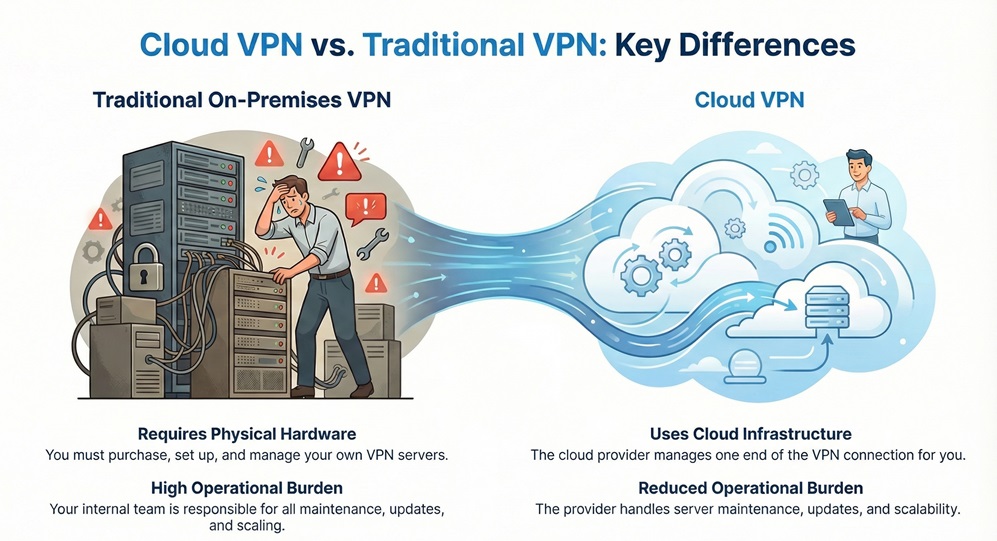
     

    Cloud VPN vs. Traditional On-Premises VPN


    On the other hand, a Cloud VPN uses the cloud provider's infrastructure to manage one end of the connection. The cloud provider handles the VPN server maintenance, updates, and scalability. This shift significantly reduces your operational burden.


    Basis for ComparisonCloud VPN (Virtual Private Network)Traditional On-Premises VPN
    ManagementMostly managed by the cloud providerFully managed by the user/organization
    ScalabilityCloud VPN offers easy, on-demand scalingScaling requires purchasing and installing new hardware
    Cost StructurePay-as-you-go, service-based pricingHigh upfront capital expenditure for hardware
    Location of EndpointOne endpoint is in the cloud provider's VPC networkBoth endpoints reside in the user's physical locations
    Latency/PerformanceOften optimized for the cloud environmentPerformance depends on the user's hardware and network

    What is Cloud VPN?

    Cloud VPN can be understood as a service that establishes a secure, encrypted connection—an IPsec VPN tunnel—between your non-cloud network (like your office network) and your Virtual Private Cloud (VPC) network within the cloud environment.


    This secure connection is vital for various reasons:


    • Secure Data Transfer: It provides a safe path for transferring data, files, and applications between the two environments.
    • Extended Network: It allows your on-premises network to virtually extend into the cloud, making cloud resources act as if they are local.


    Cloud VPN typically relies on the Internet Protocol Security (IPsec) protocol. IPsec ensures that data is encrypted before it leaves the source and decrypted only at the destination, guaranteeing confidentiality.


    Also Read: What is Disaster Recovery in Cloud Computing?


    Key Components of a Cloud VPN Connection

    To transfer data securely, a Cloud VPN connection consists of several essential components:


    1. VPN Gateway: This is the device or service that handles the encryption and decryption of traffic. Your cloud provider manages the cloud-side VPN gateway. You maintain the on-premises or customer gateway.
    2. IPsec Tunnel: This is the secure, encrypted channel that the data travels through. IPsec defines the cryptographic algorithms and key management for the data packets.
    3. Peer Gateway: This is your on-premises VPN device (or software) that connects to the cloud's VPN gateway. It acts as the local endpoint for the secure tunnel.


    Cloud VPN Servers and the Infrastructure

    Cloud VPN servers are not traditional physical boxes you own. Instead, the term refers to the VPN service running as a component of the cloud provider's infrastructure. This arrangement provides significant benefits for you, the user.


    Let us now discuss the advantages of using Cloud VPN servers.


    • High Availability: Cloud providers often design their Cloud VPN servers to be highly available, which means they use redundancy. If one component fails, another immediately takes over, ensuring that your connection remains live.
    • Automatic Scaling: As your data transfer needs increase or decrease, the Cloud VPN servers automatically scale their capacity. This adaptability is critical for businesses with variable traffic patterns.
    • Simplified Configuration: Cloud providers offer simple interfaces for setting up the VPN connection. You configure the tunnel settings, and the cloud takes care of the complex routing and VPN server management.


    Also Read: What is Zero Trust Security Model? All You Need to Know


    Hybrid Cloud VPN Explained

    Hybrid cloud VPN refers to the architecture that uses a Cloud VPN connection to link an organization’s on-premises infrastructure with its cloud infrastructure. This setup is a cornerstone of hybrid cloud computing.


    A hybrid cloud VPN allows you to leverage the benefits of both environments:


    • On-Premises Benefits: You keep sensitive data and core applications on your own servers for strict control.
    • Cloud Benefits: You use the cloud for tasks like data backup, disaster recovery, or running applications that require elastic scaling.


    Hybrid cloud VPN essentially makes the two separate environments—local and cloud—function as one single, seamless network.


    Hybrid Cloud VPN Use Cases

    Here are some common situations where businesses use a hybrid cloud VPN:


    1. Disaster Recovery: You can use the Cloud VPC as a secondary site. If your main data center fails, you can quickly spin up your services in the cloud using the VPN connection.
    2. Application Migration: You can move parts of an application to the cloud while leaving the database on-premises. The Cloud VPN ensures fast and secure communication between these components.
    3. Data Replication: Companies use the secure tunnel to replicate data from their local storage to cloud storage for long-term archiving and compliance.


    Also Read: What is an Email Security Gateway? Protecting Your Inbox


    What is VPN Cloud Storage?

    The term "VPN cloud storage" refers to the concept of securing access to data stored in the cloud using a Virtual Private Network. It is not a separate technology but rather a key application of Cloud VPN.


    When you store data in a cloud storage service, access to that data usually happens over the internet. By implementing a Cloud VPN, you ensure that any traffic accessing or transferring the data is encrypted and goes through a private tunnel.


    This secure access method provides two main advantages for VPN cloud storage:


    • Data in Transit Protection: The Cloud VPN encrypts data while it is moving from your network to the cloud or vice-versa. This prevents eavesdropping.
    • Network Isolation: It ensures that only devices connected to your private network or the secure VPN tunnel can reach the storage resources, adding an extra layer of access control.


    Setting Up a Cloud VPN Connection

    Establishing a secure Cloud VPN connection involves a sequential process. To understand this better, let us explore the steps you need to follow.


    1. Define Your Network: First, you define the IP address ranges of your on-premises network and your Cloud VPC network. The VPN gateway needs this information to know which traffic to route through the tunnel.
    2. Create the Cloud VPN Gateway: You create a VPN gateway instance within your cloud provider's console. This step generates the public IP address for the cloud endpoint.
    3. Configure the On-Premises Gateway: You set up your local VPN device (the peer gateway). You input the cloud gateway’s public IP address and configure the shared secret key for authentication.
    4. Create the IPsec Tunnel: You create the actual IPsec tunnel configuration on both the cloud and the on-premises side. This includes specifying the encryption algorithms (like AES-256) and the lifetime of the security associations.
    5. Establish Routing: Finally, you configure the routing rules. These rules instruct your networks to send specific traffic destined for the other network through the VPN tunnel.


    Also Read: What is Web Application Firewall? | WAF Explained


    Is Cloud VPN Free? Costs and Pricing Models

    A common question for businesses looking into this solution is, "Is Cloud VPN free?" The straightforward answer is no, Cloud VPN is typically not a free service.


    Cloud providers charge for the Cloud VPN service based on a few distinct components. This consumption-based model is different from the upfront cost of traditional VPN hardware.

    Let us look at the typical cost components:


    • Gateway Charges: You pay an hourly rate for having the Cloud VPN gateway provisioned and running, even if no data is currently passing through it.
    • Tunnel Charges: There may be a separate, smaller hourly charge for each active IPsec tunnel you create.
    • Egress Data Transfer: You pay for the amount of data that leaves the cloud network and travels through the VPN tunnel to your on-premises network. Cloud providers may waive the charge for ingress (data coming into the cloud).


    Understanding this model helps you accurately budget your cloud VPN usage. The flexibility means you only pay for the resources you actively use, which is a major advantage.


    Cloud VPN for Secure Remote Access

    Beyond connecting two corporate networks, Cloud VPN also plays a role in modern secure remote access. In a remote-work environment, your employees often need to access both on-premises applications and cloud-based services.


    A well-designed Cloud VPN can secure remote access for your users in the following manner:


    • Single Secure Gateway: You can configure a Cloud VPN endpoint to accept connections from individual remote user devices.
    • Unified Access: Once connected to the VPN, the remote user gains secure access to resources in both your local data center (via the VPN) and the Cloud VPC.


    This approach centralizes security, making management simpler and ensuring that all user access points—regardless of location—go through the same strong encryption protocols.


    What are the Key Cloud VPN Advantages?

    Implementing a Cloud VPN solution provides numerous benefits that help businesses modernize their IT infrastructure.


    • Cost-Effectiveness:Cloud VPN eliminates the need for large capital expenditure on hardware. You only pay for what you consume, making it a highly efficient solution.
    • Reliability: The service is backed by the cloud provider's robust, redundant infrastructure, which ensures higher uptime and reliability than most self-managed solutions.
    • Simplified Management: The cloud provider handles the patching, maintenance, and upkeep of the VPN server infrastructure, which frees up your IT team.
    • Speed of Deployment: You can provision a new VPN connection in minutes through the cloud console, which is much faster than ordering, shipping, and installing physical hardware.


    Conclusion

    Cloud VPN is a foundational technology for any organization operating a hybrid cloud environment. It solves the critical challenge of securely connecting disparate networks over the public internet. By adopting Cloud VPN, you significantly reduce your operational overhead, gain the flexibility of scalable bandwidth, and ensure that your sensitive data remains encrypted during transfer.


    Proactive Cloud VPN Contact our team
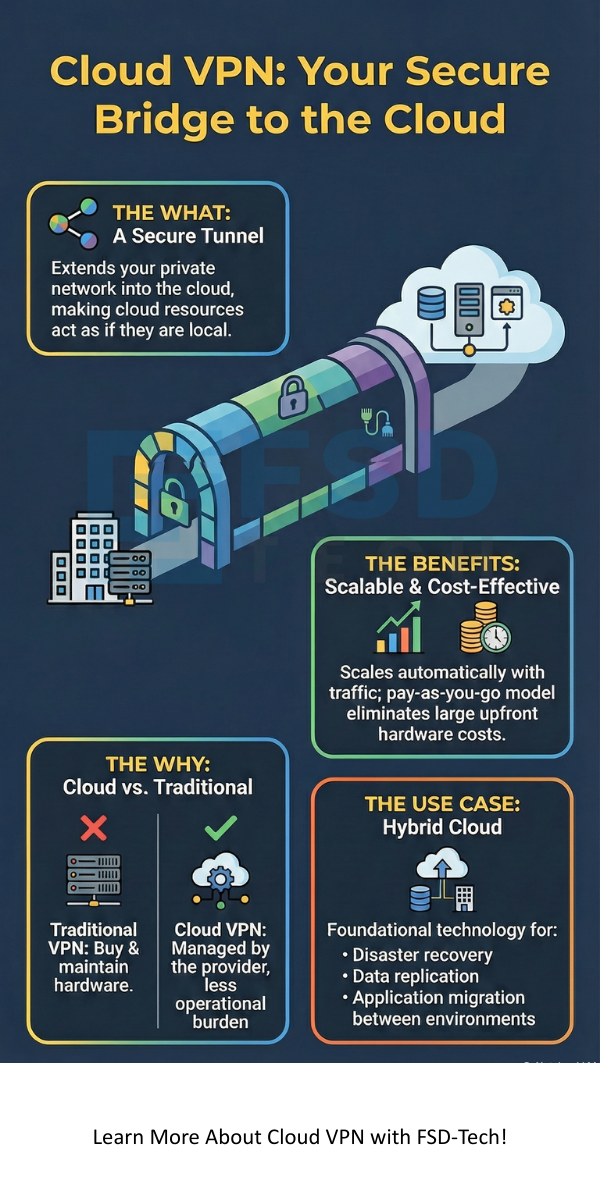
    Cloud VPN Infographic


    Key Takeaways

    Here are the essential points about Cloud VPN you should remember:


    • Cloud VPN establishes a secure, encrypted IPsec tunnel that connects your on-premises network directly to your Virtual Private Cloud (VPC) network within the cloud.
    • The primary distinction from traditional VPNs is that the cloud provider manages the VPN server infrastructure on the cloud side, reducing your hardware and maintenance burden.
    • Cloud VPN offers superior scalability and reliability because it leverages the cloud provider’s inherent redundancy and automatic scaling capabilities.
    • The service is crucial for establishing a functional hybrid cloud VPN architecture, allowing you to use both local and cloud resources as a single, unified network.
    • The concept of VPN cloud storage signifies the application of Cloud VPN to secure access to and transfer of data residing in the cloud environment.


    Frequently Asked Questions (Cloud VPN FAQs)

    Q: What is the main purpose of Cloud VPN?

    A: The main purpose is to create a secure, encrypted IPsec tunnel that securely connects your on-premises network to your Virtual Private Cloud (VPC) network in the cloud.


    Q: Does Cloud VPN secure my data in cloud storage?

    A: Yes. When you use a Cloud VPN to access or transfer data to and from cloud storage, the data is encrypted while in transit through the secure tunnel, ensuring VPN cloud storage is protected.


    Q: How does Cloud VPN handle high traffic?

    A: Cloud VPN servers are designed to automatically scale their capacity. As your traffic increases, the cloud infrastructure handles the additional load without requiring manual upgrades or new hardware purchases from you.


    Q: Can I use Cloud VPN for my remote employees?

    A: Yes, you can use a Cloud VPN or related cloud services to establish a secure path for remote employees. This allows them to securely access company resources that reside in both your data center and the cloud environment.

    What is Cloud Virtual Private Network (VPN)?

    About The Author

    Surbhi Suhane

    Surbhi Suhane is an experienced digital marketing and content specialist with deep expertise in Getting Things Done (GTD) methodology and process automation. Adept at optimizing workflows and leveraging automation tools to enhance productivity and deliver impactful results in content creation and SEO optimization.

    Like This Story?

    Share it with friends!

    Subscribe to our newsletter!

    Atera

    (48)

    Cato Networks

    (111)

    ClickUp

    (68)

    FishOS

    (7)

    Miradore

    (21)

    PointGuard AI

    (9)

    Vembu

    (22)

    Xcitium

    (33)

    ZETA HRMS

    (70)

    Workflow Automation(5)

    Workforce Automation(1)

    AI Project Management(1)

    HR Data Automation(1)

    RMM(1)

    IT Workflow Automation(1)

    GCC compliance(4)

    IT security(2)

    Payroll Integration(2)

    IT support automation(3)

    procurement automation(1)

    lost device management(1)

    IT Management(5)

    IoT Security(2)

    Cato XOps(2)

    IT compliance(4)

    Workflow Management(1)

    Task Automation(1)

    OpenStack automation(1)

    AI-powered cloud ops(1)

    Kubernetes lifecycle management(2)

    SMB Security(8)

    Data Security(1)

    MDR (Managed Detection & Response)(4)

    Atera Integrations(2)

    MSP Automation(3)

    XDR Security(2)

    SMB Cyber Protection(1)

    Ransomware Defense(3)

    HR Tech Solutions(1)

    Zero Trust Network Access(3)

    Zero Trust Security(2)

    Endpoint Management(1)

    SaaS Security(1)

    Payroll Automation(5)

    IT Monitoring(2)

    Xcitium EDR SOC(15)

    Ransomware Protection GCC(1)

    M&A IT Integration(1)

    Network Consolidation UAE(1)

    MSSP for SMBs(1)

    FSD-Tech MSSP(25)

    Ransomware Protection(3)

    SMB Cybersecurity GCC(1)

    Managed EDR FSD-Tech(1)

    Antivirus vs EDR(1)

    Cybersecurity GCC(12)

    Endpoint Security(1)

    Endpoint Protection(1)

    Data Breach Costs(1)

    Managed Security Services(2)

    SMB Cybersecurity(8)

    Zero Dwell Containment(31)

    Xcitium EDR(30)

    Cloud Backup(1)

    Hybrid Backup(1)

    Backup & Recovery(1)

    pointguard ai(4)

    disaster recovery myths(1)

    backup myths(1)

    vembu(9)

    SMB data protection(9)

    Vembu BDR Suite(19)

    Disaster Recovery(4)

    DataProtection(1)

    GCCBusiness(1)

    Secure Access Service Edge(4)

    GCC HR software(16)

    Miradore EMM(15)

    Cato SASE(7)

    Cloud Security(8)

    Talent Development(1)

    AI Cybersecurity(12)

    AI Risk Management(1)

    AI Governance(4)

    AI Security(2)

    AI Compliance(2)

    GCC business security(1)

    GCC network integration(1)

    compliance automation(4)

    GCC cybersecurity(2)

    education security(1)

    App management UAE(1)

    BYOD security Dubai(8)

    Miradore EMM Premium+(5)

    HealthcareSecurity(1)

    MiddleEast(1)

    Team Collaboration(1)

    IT automation(10)

    Zscaler(1)

    SD-WAN(6)

    HR Integration(4)

    Cloud Networking(3)

    device management(9)

    RemoteWork(1)

    ZeroTrust(2)

    VPN(1)

    MPLS(1)

    Project Management(9)

    HR automation(16)

    share your thoughts

    Cloud Virtual Private Network (VPN)

    What is Cloud Virtual Private Network (VPN)?

    🕓 January 9, 2026

    TACACS+

    What is TACACS+ Protocol? Features & RADIUS Comparison

    🕓 January 9, 2026

    Disaster Recovery in Cloud Computing

    What is Disaster Recovery in Cloud Computing?

    🕓 January 8, 2026

    Decoded(57)

    Cyber Security(112)

    BCP / DR(22)

    Zeta HRMS(69)

    SASE(21)

    Automation(68)

    Next Gen IT-Infra(111)

    Monitoring & Management(69)

    ITSM(22)

    HRMS(21)

    Automation(24)