.webp&w=3840&q=75)
How ClickUp Enables Outcome-Based Project Management (Not Just Task Tracking)
🕓 February 15, 2026




.webp&w=3840&q=75)


Surbhi Suhane is an experienced digital marketing and content specialist with deep expertise in Getting Things Done (GTD) methodology and process automation. Adept at optimizing workflows and leveraging automation tools to enhance productivity and deliver impactful results in content creation and SEO optimization.
Share it with friends!
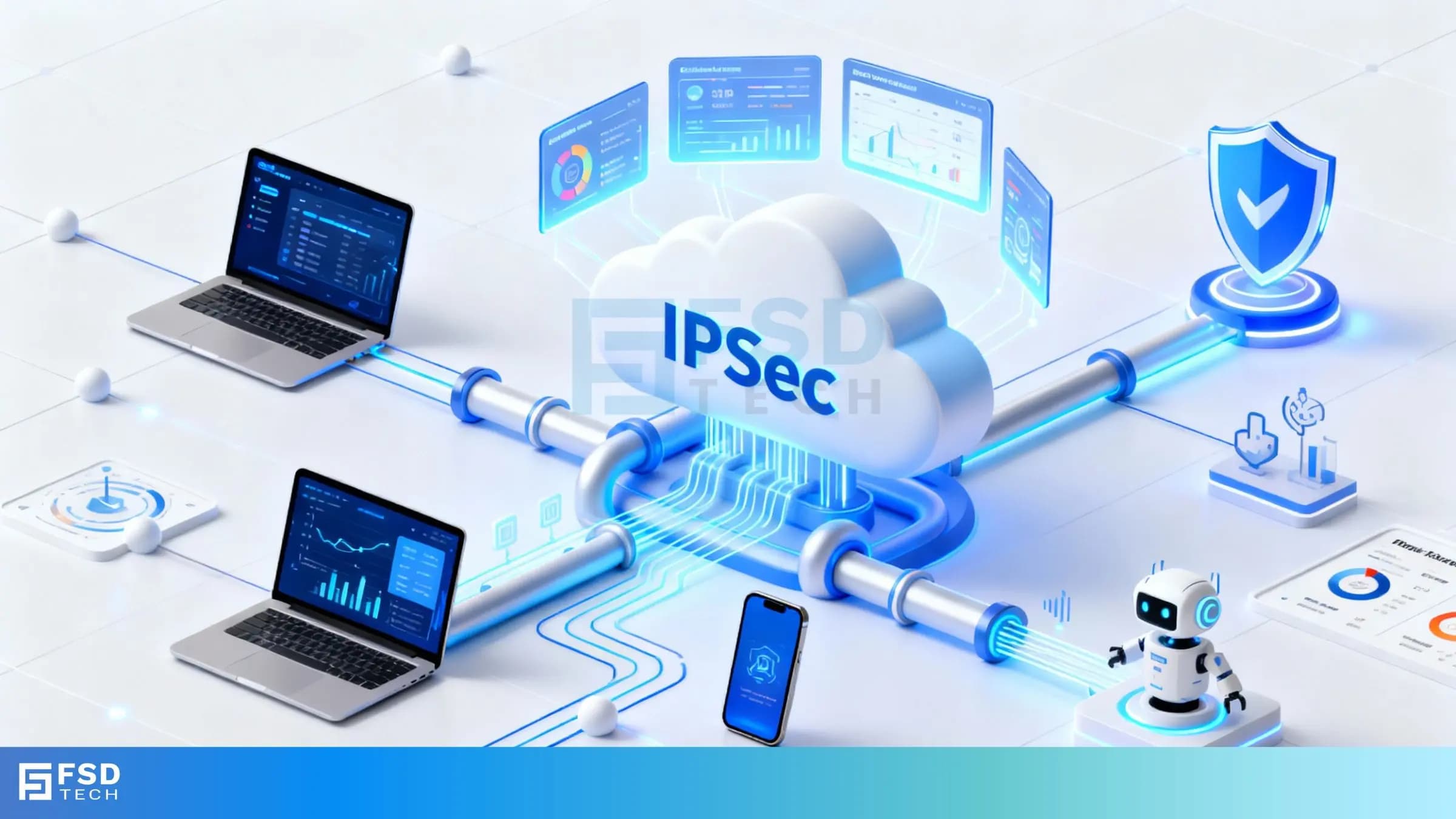
IPSec refers to a comprehensive suite of protocols and standards developed by the Internet Engineering Task Force (IETF) to secure communication across a network at the Internet Protocol (IP) layer. This technology is indispensable for building secure Virtual Private Networks (VPNs) and ensuring end-to-end data safety.
In simple words, IPSec is the technical framework that adds essential security features—such as encryption and authentication—directly to the data packets traveling over the internet.
Without this protocol suite, sensitive information would be exposed to various security threats during transmission. In this section, we will discuss the core architecture, components, and operational modes of IPSec.
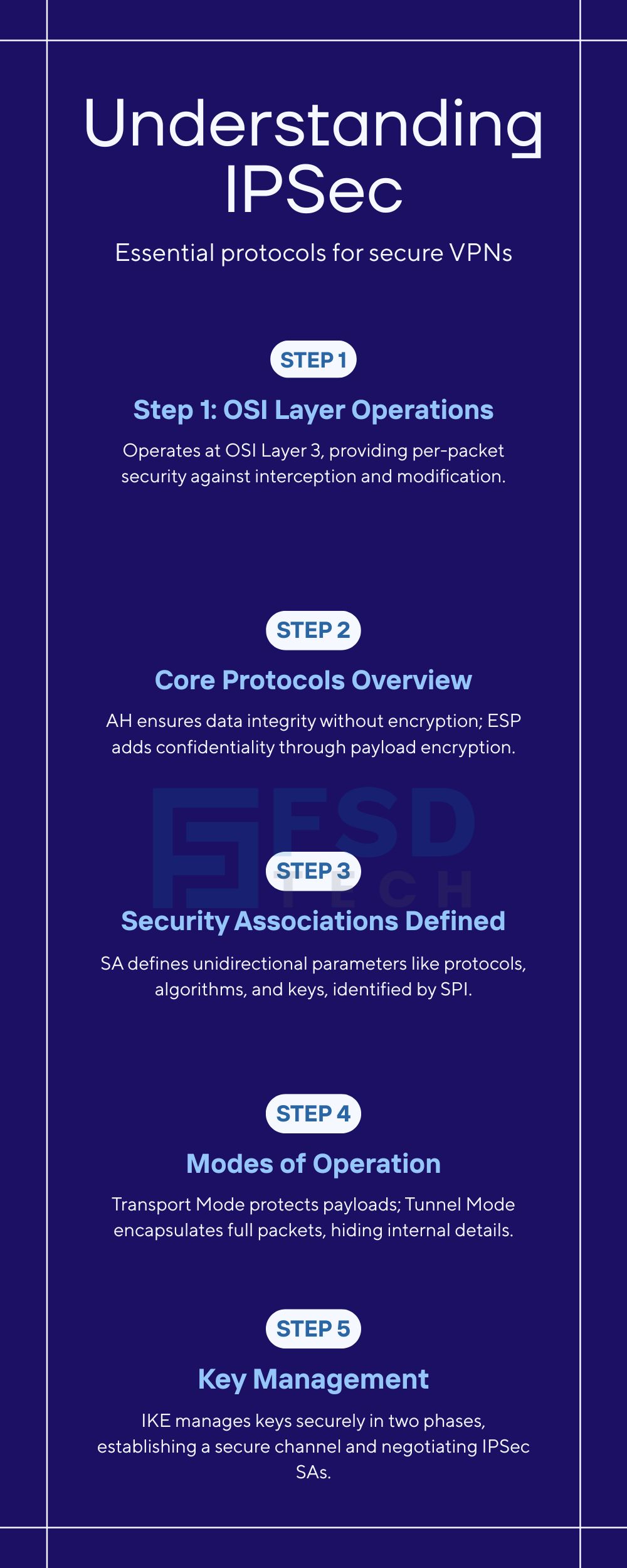
IPSec is defined as a set of cryptographic protocols that work at Layer 3 of the Open Systems Interconnection (OSI) model, known as the network layer. Its primary function is to provide security services on a per-packet basis. This means that security measures are applied to each individual IP data packet as it moves from the source to the destination.
The introduction of IPSec became necessary because the original Internet Protocol (IPv4) was designed without built-in security features. This design omission meant that data packets could be intercepted, read, or modified by unauthorized parties.
The security services provided by IPSec are applied independently of the application using the IP connection, offering a robust, system-wide layer of protection.
IPSec achieves its goals by utilizing two fundamental protocols: the Authentication Header (AH) and the Encapsulating Security Payload (ESP). Additionally, it relies on the establishment of a logical connection called a Security Association (SA) to define the necessary security parameters between communicating peers.
The IPSec framework is built upon two distinct yet complementary protocols. These protocols can be used separately or together to provide different levels of security for the data traffic. Both protocols involve adding a new header or a new header and a trailer to the standard IP packet structure.
The Authentication Header (AH) protocol provides integrity and authentication for data packets. AH ensures that the data received at the destination has not been tampered with while in transit, and it verifies that the data originated from the claimed sender.
The Encapsulating Security Payload (ESP) protocol is the most commonly used component of IPSec. ESP can provide both confidentiality (encryption) and optional authentication/integrity services.
The suite of IPSec protocols works in harmony to deliver four critical security services necessary for protecting digital communications. These services are the foundation of any secure network communication.
IPSec enables security services that protect data traffic at the IP layer.
Confidentiality (Encryption): This service ensures that the contents of a data packet are kept private from eavesdroppers. IPSec uses standardized encryption algorithms, such as the Advanced Encryption Standard (AES), to scramble the data. Only the intended recipient, who possesses the correct decryption key, can successfully read the original information.
Data Integrity: Integrity ensures that the data has not been altered or modified in any way during its transmission. IPSec achieves this by using keyed hash algorithms (like HMAC) to create a unique digital signature for the packet. If even a single bit of the packet is changed, the recipient's calculated hash will not match the one included in the packet, signaling a potential attack.
Data Origin Authentication: This service verifies the identity of the sender. It confirms that the data truly originated from the authorized source and not from an impostor. This protection is vital to prevent unauthorized entities from injecting false information into the communication stream.
In the architecture of IPSec, a fundamental concept is the Security Association (SA). A Security Association is not a protocol itself but rather a logical, one-way connection that defines the set of parameters necessary for a secure communication channel between two entities.
What happens is that for any two peers to communicate securely using IPSec, they must agree on several security settings. These settings—which include the protocol (AH or ESP), the encryption algorithm, the authentication algorithm, the keys to be used, and the lifetime of the connection—are all bundled together and referred to as an SA.
Also Read: Unified Device Visibility: Enhancements to Cato’s Device Inventory
IPSec is highly versatile because it can operate in one of two modes, which determine how the security headers (AH or ESP) are applied to the IP packet. The choice between these two modes depends on the security environment and the purpose of the connection.
In Transport Mode, IPSec provides protection primarily for the upper-layer protocols, such as TCP or UDP, that exist above the IP layer.
Tunnel Mode is the standard mode for building secure VPNs and is the most widely deployed. This mode is typically used for gateway-to-gateway communication, such as between two routers connecting two separate corporate networks.
| Basis for Comparison | Transport Mode | Tunnel Mode |
|---|---|---|
| Meaning (Scope of Protection) | This mode secures the upper-layer payload (e.g., TCP, UDP, ICMP) of the IP packet. The protection is applied strictly between the two end-hosts and does not involve any intermediary routers for security processing. | This mode secures the entire original IP packet—including the original IP header and the data payload—by treating it as the data payload for a new, outer IP packet. The original packet is encapsulated (tunneled). |
| Header Modification & Structure | The IPSec header (AH or ESP) is inserted after the original IP header and before the transport layer segment. The original source and destination IP addresses remain intact and visible in the outer (only) IP header. | The IPSec header (AH or ESP) is inserted between the original IP packet and a newly created, outer IP header. The entire original packet is now the data for the new packet, securing its contents. |
| End-points & Traffic Flow | Used for host-to-host communications. The endpoints for the IPSec Security Association (SA) are the source and destination hosts themselves. The traffic is usually encrypted end-to-end. | Used for gateway-to-gateway (e.g., site-to-site VPNs) or host-to-gateway (e.g., remote access VPNs) communications. The SA endpoints are typically the security gateways (routers/firewalls) protecting the networks, not the end-hosts. |
| IP Address Visibility & Anonymity | The original source and destination IP addresses are exposed because they are in the primary, unencrypted header. This allows intermediary devices (like firewalls) to inspect the addresses but reveals the private endpoints. | The original, internal IP addresses are hidden because they are part of the encapsulated, protected packet. The outer, visible IP header contains only the addresses of the two IPSec gateways. |
| Key Use & Typical Deployment | Ideal for securing application data between two specific servers or a client and a server within a private environment, or when the IP header information is necessary for network functionality. | The industry standard for creating Virtual Private Networks (VPNs) across public networks (like the internet). It is used to securely connect two geographically separated networks or a remote user to a corporate network. |
| Firewall & NAT Compatibility | Can be problematic with Network Address Translation (NAT) devices if the AH protocol is used, as AH authenticates the IP header, which NAT changes. ESP is generally more compatible, but still requires careful configuration. | Is generally more compatible with NAT devices, particularly when using ESP, because the outer IP header (containing the gateway addresses) can be modified by NAT without invalidating the integrity check of the inner (original) protected packet. |
Before any secure data can be transmitted using IPSec, the two communicating peers must establish a Security Association (SA) and agree on the cryptographic keys they will use. The process of managing these keys and establishing the SAs is handled by a separate but integrated protocol called the Internet Key Exchange (IKE).
IKE is a protocol that uses a secure method to automatically negotiate, create, and manage the cryptographic keys required for the IPSec SAs. While keys could be configured manually, this is not scalable or secure for large networks. IKE automates the entire process, making the deployment of complex IPSec environments practical.
IKE Phases
The IKE protocol operates in two distinct phases to establish the necessary security infrastructure.
IKE Phase One
The goal of IKE Phase One is to establish a secure, authenticated communication channel, known as the IKE Security Association (IKE SA) or Phase 1 SA. This tunnel is used solely to protect the negotiation of the Phase Two SAs.
IKE Phase Two
The goal of IKE Phase Two is to negotiate the specific IPSec Security Associations (IPSec SAs) that will protect the actual user data traffic. These are the SAs that utilize the AH or ESP protocols.
This two-phased approach separates the complex, long-lived key exchange (Phase One) from the negotiation of the shorter-lived, data-specific session keys (Phase Two), offering both efficiency and enhanced security.
Also Read: Reducing Network Latency and Enhancing User Experience Globally with Cato SASE
Like any advanced technical solution, IPSec provides significant benefits but also presents certain implementation challenges. Understanding these facets is essential for any network design decision.
Advantages
Disadvantages
In a nutshell, Internet Protocol Security (IPSec) is far more than just a single protocol; it is a meticulously designed framework that protects IP communications. It systematically addresses the major vulnerabilities of the original Internet Protocol by weaving together a set of cryptographic tools.
By defining clear Security Associations (SAs) and automating key management through the Internet Key Exchange (IKE), IPSec establishes a reliable, secure channel. The choice between Transport Mode for host-to-host security and Tunnel Mode for building robust Virtual Private Networks (VPNs) ensures that IPSec can meet a wide range of network security requirements.
All in all, for anyone serious about transmitting sensitive data across an untrusted network like the internet, a thorough implementation of this standardized security suite is an absolute necessity.
Talk to Our Cato SASE experts today!
The primary function of IPSec is to provide security services like confidentiality (encryption), data integrity, and authentication at the Internet Protocol (IP) layer (Layer 3). It is most commonly used for establishing secure Virtual Private Networks (VPNs).
The core difference is encryption. The Authentication Header (AH) provides authentication and integrity but does not encrypt the data. The Encapsulating Security Payload (ESP) provides encryption (confidentiality) and optional authentication, making it the more widely used protocol.
IPSec operates at the Network Layer (Layer 3). Operating at this layer means it can secure traffic for almost any application running over IP without the need to modify the application itself.
Tunnel Mode is preferred for securing traffic between two networks (e.g., gateway-to-gateway VPNs). It encapsulates the entire original IP packet and adds a new header, hiding the internal network addresses. Transport Mode is used for host-to-host security where only the data payload is encrypted.
A Security Association (SA) is a unidirectional logical connection that defines the set of parameters needed for secure communication between two peers. These parameters include the specific protocol (AH or ESP), the cryptographic algorithms, and the keys to be used.
The Internet Key Exchange (IKE) protocol's role is to automatically negotiate, create, and manage the cryptographic keys and the Security Associations (SAs) required for the IPSec connection. This automation is crucial for scalability and security.
IPSec delivers Confidentiality (encryption), Data Integrity (verifying data hasn't changed), Data Origin Authentication (verifying the sender's identity), and Anti-Replay Protection (preventing malicious retransmission of packets).
share your thoughts