.webp&w=3840&q=75)
How ClickUp Enables Outcome-Based Project Management (Not Just Task Tracking)
🕓 February 15, 2026
Most organizations believe they are managing projects effectively—until deadlines slip, priorities conflict, or teams stay busy without delivering meaningful results. The problem isn’t lack of effort. It’s the way work is measured.
Traditional project management focuses heavily on tasks: what’s assigned, what’s completed, and what’s overdue. While task tracking is necessary, it doesn’t answer the most important question leadership cares about-are we achieving the outcomes that matter?
Outcome-based project management shifts the focus from activity to impact. Instead of measuring success by the number of tasks completed, teams measure success by business results achieved.
ClickUp enables this shift by connecting daily execution directly to goals, milestones, and measurable outcomes. In this blog, we explore how ClickUp helps organizations move beyond task tracking and build a results-driven operating model.
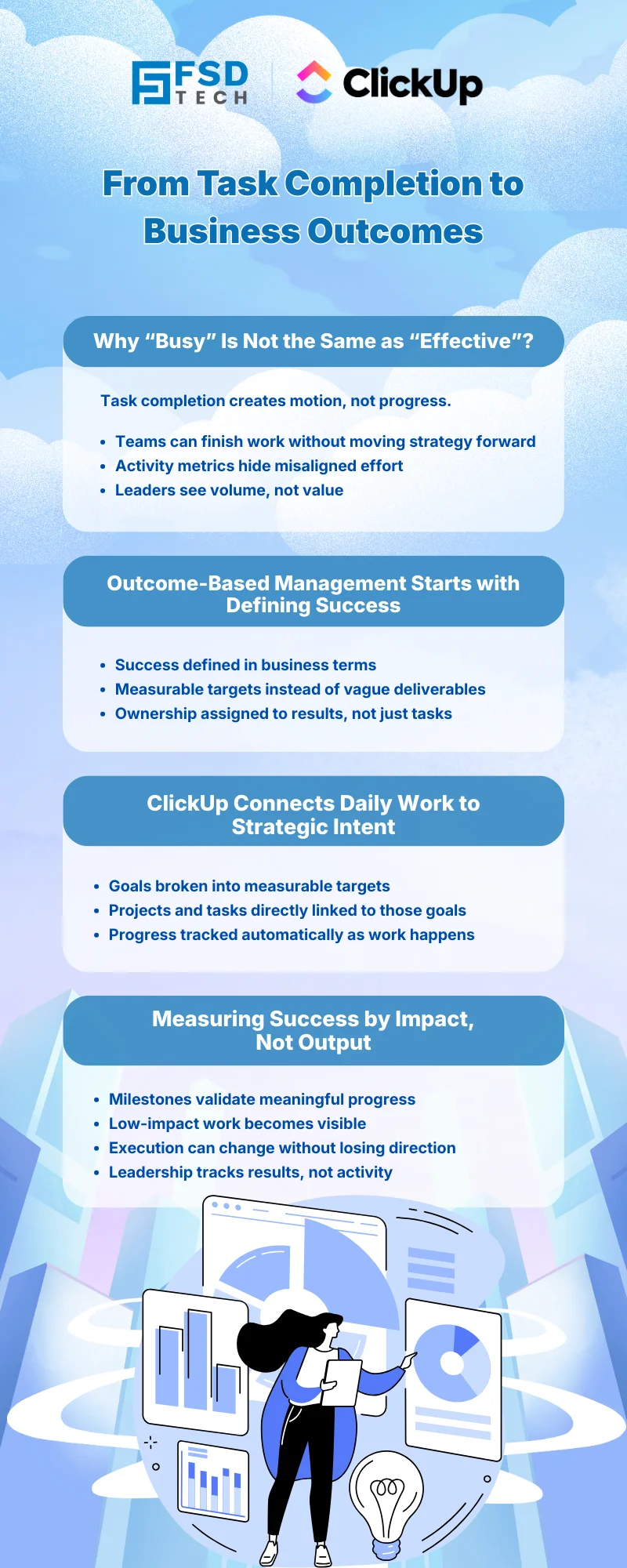
Task-based systems create the illusion of productivity. Teams check off items, update statuses, and attend meetings-yet strategic objectives still fall behind.
Common issues with task-focused management include:
When success is measured by busyness, teams optimize for speed rather than value.
Outcome-based management addresses this by ensuring every task contributes to a clearly defined goal.
Outcome-based project management is not about doing less work-it’s about doing the right work.
It focuses on:
In this model, tasks are simply vehicles for achieving outcomes-not the end goal themselves.
One of the biggest gaps in most organizations is the disconnect between leadership strategy and day-to-day work.
ClickUp bridges this gap by allowing organizations to:
This ensures that teams always understand why they are working-not just what they are working on.
Outcome-based work begins with clarity.
In ClickUp, teams can define outcomes by:
When outcomes are defined upfront, decision-making becomes easier throughout execution.
ClickUp enables teams to focus on impact by changing how progress is viewed.
Instead of asking:
“Are tasks completed?”
Teams start asking:
“Are we moving closer to the desired result?”
This shift is enabled through:
Teams can adjust tasks, timelines, or approaches-while keeping the outcome intact.
Not all progress is equal. Completing five low-impact tasks does not outweigh delivering one critical milestone.
ClickUp milestones help teams:
Milestones act as checkpoints that validate whether execution is actually delivering value.
When priorities are unclear, teams default to urgency rather than importance.
ClickUp helps organizations prioritize based on outcomes by:
This ensures resources are focused where they generate the highest return.
Outcomes rarely belong to a single team. Product launches, transformation initiatives, and growth programs span departments.
ClickUp enables outcome alignment across teams by:
Everyone understands how their work contributes to the bigger picture.
Traditional metrics focus on:
Outcome-based metrics focus on:
ClickUp supports this by turning execution data into insight-without manual reporting.
One of the biggest advantages of outcome-based management is flexibility.
If a task is no longer effective, teams can:
All without losing sight of the intended outcome.
ClickUp supports this adaptability by keeping goals stable while execution evolves.
For leadership, outcome-based management provides clarity without micromanagement.
With ClickUp, leaders can:
This creates confidence in execution without constant intervention.
Outcome-based management only works when it becomes part of the culture.
Best practices include:
Over time, teams naturally shift from “getting things done” to “getting the right things done.”
Being busy is easy. Delivering outcomes is hard.
Organizations that succeed focus relentlessly on impact-not activity. ClickUp enables this shift by connecting strategy, execution, and measurement in one unified platform.
With ClickUp, organizations can:
Outcome-based project management isn’t a trend-it’s the future of effective execution.
If work isn’t tied to results, it’s just activity → Build an outcome-first operating model with ClickUp.
It is an approach where work is measured by business results and goals achieved, not just tasks completed.
ClickUp links tasks and projects directly to goals and targets, allowing real-time tracking of progress toward outcomes.
Yes. Tasks remain essential, but they are always connected to larger objectives and milestones.
Absolutely. It is especially effective for enterprises where alignment and prioritization are critical.
Leaders gain visibility into what truly drives results, enabling faster, more informed decisions.

Nhaif is an AI Automation Engineer & Business Analyst focused on ClickUp, AI, Automation, and Workflow Optimization. He helps businesses shift from scattered processes to streamlined, data-driven operations. With hands-on expertise, he simplifies complex tools into clear, easy-to-apply solutions.
Share it with friends!


.webp&w=3840&q=75)

share your thoughts