HomeNext Gen IT-InfraMonitoring & ManagementCyber SecurityBCP / DRAutomationDecoded
Next Gen IT-Infra
Cato’s SASE Supports Cybersecurity Skills Development

How Cato’s SASE Supports Cybersecurity Skills Development

🕓 April 8, 2025

How SASE Supports the Security Needs of SMBs

How SASE Supports the Security Needs of SMBs

🕓 February 9, 2025

Attack Surface Reduction with Cato’s SASE

Attack Surface Reduction with Cato’s SASE

🕓 February 10, 2025

SASE for Digital Transformation in UAE

SASE for Digital Transformation in UAE

🕓 February 8, 2025

Monitoring & Management
Understanding Atera’s SLA Management

Understanding Atera’s SLA Management

🕓 February 7, 2025

Cost-Performance Ratio: Finding the Right Balance in IT Management Networks

Cost-Performance Ratio: Finding the Right Balance in IT Management Networks

🕓 June 16, 2025

Customizing Atera with APIs

Customizing Atera with APIs

🕓 March 3, 2025

Power Up Your IT Team’s Strategy with Atera’s Communication Tools

Power Up Your IT Team’s Strategy with Atera’s Communication Tools

🕓 February 8, 2025

Cyber Security
Visual guide showing Cato CMA interface for configuring Internet and WAN firewall rules, enabling threat protection, and monitoring security events in real time for UAE IT teams.

Enforcing Firewall and Threat Protection Policies in Cato

🕓 July 25, 2025

Isometric illustration of professionals managing network performance, bandwidth analytics, and cloud-based optimization around the Cato Networks platform, symbolizing bandwidth control and QoS visibility.

Mastering Bandwidth Control and QoS in Cato Networks

🕓 July 26, 2025

Illustration of the Cato Cloud architecture showing its role in delivering SASE for secure, optimized global connectivity.

Understanding the Cato Cloud and Its Role in SASE

🕓 January 29, 2025

Global network backbone powering Cato SASE solution for secure, high-performance connectivity across regions.

Global Backbone: The Engine Powering Cato’s SASE Solution

🕓 January 30, 2025

BCP / DR
Illustration showing diverse business and IT professionals collaborating with cloud, backup, and security icons, representing Vembu use cases for SMBs, MSPs, and IT teams.

Who Uses Vembu? Real-World Use Cases for SMBs, MSPs & IT Teams

🕓 July 12, 2025

Graphic showcasing Vembu’s all-in-one backup and disaster recovery platform with icons for cloud, data protection, and business continuity for IT teams and SMBs.

What Is Vembu? A Deep Dive Into the All in One Backup & Disaster Recovery Platform

🕓 July 6, 2025

Illustration showing Vembu backup and disaster recovery system with cloud storage, server racks, analytics dashboard, and IT professionals managing data.

The Rising Cost of Data Loss: Why Backup Is No Longer Optional?

🕓 August 14, 2025

3D isometric illustration of cloud backup and data recovery infrastructure with laptop, data center stack, and digital business icons — FSD Tech

RPO & RTO: The Heart of Business Continuity

🕓 August 15, 2025

Automation
Cross-Functional Collaboration with ClickUp

Fostering Cross-Functional Collaboration with ClickUp for Multi-Departmental Projects

🕓 February 11, 2025

ClickUp Project Reporting

Revolutionizing Enterprise Reporting with ClickUp’s Advanced Analytics and Dashboards

🕓 June 16, 2025

ClickUp’s Design Collaboration and Asset Management Tools

Empowering Creative Teams with ClickUp’s Design Collaboration and Asset Management Tools

🕓 February 26, 2025

ClickUp Communication and Collaboration Tools

ClickUp Communication and Collaboration Tools: Empowering Remote Teams

🕓 March 12, 2025

Decoded
Multi-Factor Authentication (MFA)

Multi-Factor Authentication (MFA): All You Need to Know

🕓 December 7, 2025

L3 Switch

What Is an L3 Switch? L2 vs L3 & Why You Need Layer 3?

🕓 December 8, 2025

IPSec

IPSec Explained: Protocols, Modes, IKE & VPN Security

🕓 December 3, 2025

 Datagram Transport Layer Security (DTLS)

What is Datagram Transport Layer Security (DTLS)? How it works?

🕓 December 4, 2025

    Subscribe to our newsletter!

    About Us

    Follow Us

    Copyright © 2024 | Powered by 

    Cato SASE Architecture

    Inside Cato’s SASE Architecture: A Blueprint for Modern Security

    🕓 January 26, 2025

    Enterprise Data Security and Privacy with ClickUp

    Ensuring Enterprise Data Security and Privacy with ClickUp

    🕓 February 9, 2025

    DDoS protection SASE

    DDoS Protection and Cato’s Defence Mechanisms

    🕓 February 11, 2025

    Table of Contents

    What is Attack Surface Management (ASM)? How it Works?

    Surbhi Suhane
    January 5, 2026
    Comments
    Attack Surface Management (ASM)

    Have you ever worried about invisible weak spots in your company's digital setup? You know that cyber threats are always changing. Digital growth is essential, but it also creates new doors for attackers to walk through. This growing risk makes many businesses feel uneasy.


    You need a way to see your entire security risk—everything an attacker could target—from their point of view. This is where Attack Surface Management (ASM) becomes absolutely critical.


    Attack Surface Management (ASM) provides you with a clear, complete picture of every part of your digital presence that an attacker could potentially exploit. By understanding your full attack surface, you take control. You can stop attackers before they even start looking for holes. 


    Do you want to find and fix those hidden risks right now? Let us understand how.


    What is Attack Surface Management (ASM)?

    Attack Surface Management (ASM) can be understood as the continuous process of discovering, inventorying, classifying, prioritizing, and monitoring all digital assets that are exposed to the internet. This includes the assets you know about and, more importantly, the ones you do not.
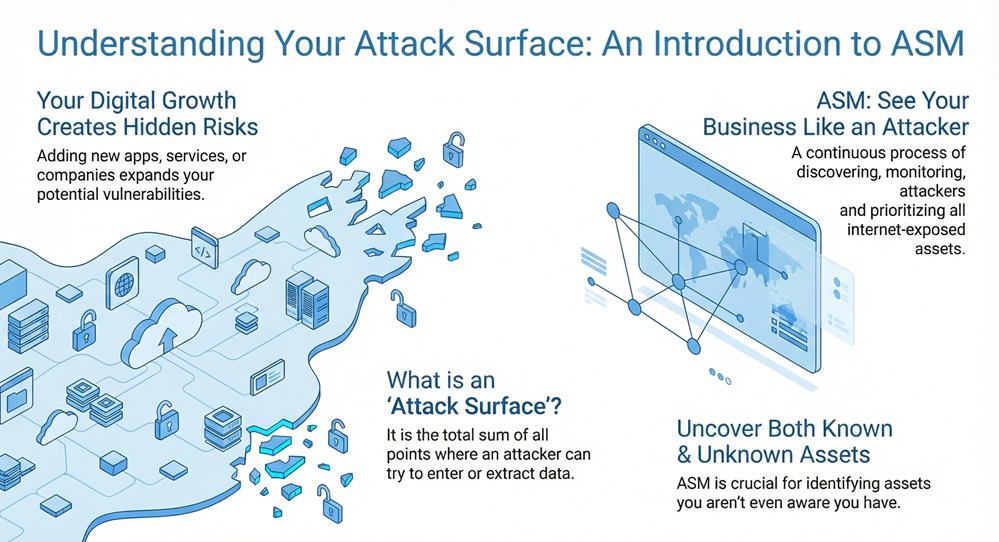
     

    Attack Surface Management (ASM) Infographic


    Attack Surface Management provides your security team with a continuous, outside-in view of your network. This view mirrors how a cybercriminal sees your company. ASM identifies all digital entry points. These entry points are collectively known as the attack surface.


    Proactive ASM Contact


    What is the Attack Surface in Cyber Security?

    The attack surface refers to the total sum of all possible points where an unauthorized user can try to enter or extract data from an environment. It consists of all the code, connections, and open ports that an attacker can exploit.


    The attack surface generally increases as your business grows. When you add new cloud services, merge with another company, or launch a new app, you also increase your attack surface. Understanding this surface is the first step toward reducing it.


    Also Read: What is Patch Management? Securing Your Digital Assets


    ASM vs. Vulnerability Management (VM)

    Many people confuse Attack Surface Management (ASM) with traditional Vulnerability Management (VM). While both aim to improve security, they focus on different areas. Attack Surface Management is broader; it tells you what you have exposed. Vulnerability Management is deeper; it tells you which flaws exist on the known assets.


    To understand this better, let us look at the key differences in a comparison chart.


    Basis for ComparisonAttack Surface Management (ASM)Vulnerability Management (VM)
    Primary FocusDiscovering all Internet-facing assets (known and unknown).Scanning known assets for known software flaws (CVEs).
    ViewpointOutside-in (Attacker's perspective).Inside-out (Defender's perspective).
    ScopeBroad: Includes unmanaged, orphaned, or shadow IT assets.Narrow: Limited to assets registered in the internal IT inventory.
    ActionInventory creation, asset classification, and monitoring.Patching, configuration changes, and remediation.
    GoalAchieve a complete asset inventory and reduce the external attack surface.Identify and fix known vulnerabilities on existing assets.


    Also Read: What is Vulnerability Assessment? Process & Tools

    Core Components of Attack Surface Management

    Attack Surface Management is a holistic security practice. It includes three main areas, ensuring you manage all parts of your risk. These three areas must work together effectively.


    1. External Attack Surface Management (EASM)

    External Attack Surface Management (EASM) focuses on assets visible from the public internet. This includes any component an attacker can reach without needing internal access. EASM deals with things you manage and things you do not know you have.


    This type of management includes:


    • Domains and Subdomains: Old, forgotten, or testing websites.
    • IP Addresses: Exposed servers, databases, and network devices.
    • Cloud Services: Misconfigured S3 buckets or other cloud storage.
    • Third-Party Code: Code libraries or APIs you use that have a public interface.


    EASM's main goal is to monitor for shadow IT. Shadow IT refers to systems and solutions used within your business without the knowledge of the IT or security team.


    2. Cyber Asset Attack Surface Management (CAASM)

    Cyber Asset Attack Surface Management (CAASM) helps you fix a common problem: fragmented asset data. Your asset data usually sits across many tools. CAASM works by bringing data together from your existing security tools, like inventory, EDR (Endpoint Detection and Response), and CMDB (Configuration Management Database).


    The CAASM solution performs the following key functions:


    • It helps you understand the security coverage for all your managed assets.
    • It asks simple questions, such as "Do all my laptops have an active antivirus agent?"
    • It improves the data quality in your existing security tools.


    CAASM focuses on internal and managed assets. It ensures you have proper security controls on the things you already track.


    3. Digital Risk Protection Services (DRPS)

    Digital Risk Protection Services (DRPS) goes beyond your technical assets. It monitors digital channels outside your network that can still harm your business. These threats are often related to your brand, people, or data.


    DRPS monitors:


    • Social Media: Fraudulent accounts impersonating your company.
    • Dark Web: Leaked employee credentials or stolen customer data.
    • Phishing: Fake websites designed to trick your users or employees.


    This area is critical because an attack often starts outside your network. Digital Risk Protection ensures attackers cannot use your name or brand against you.


    Also Read: What Is Endpoint Detection & Response (EDR) in Cybersecurity?


    Systematic Process of Attack Surface Management

    Attack Surface Management is not a one-time project. It is a continuous, cyclic process that security teams perform regularly. Consistent monitoring reduces the attack surface over time.


    The entire process involves four sequential steps.


    1. Asset Discovery and Inventory

    Attack Surface Management starts by answering a critical question: What exactly do you own and what is exposed?


    • First, the process identifies all internet-facing assets. This includes things like IP ranges, domains, code repositories, and public cloud accounts.
    • Next, it collects metadata for each asset, such as the owner, location, and the software running on it.
    • Finally, a comprehensive and up-to-date asset inventory is created. This inventory becomes the single source of truth for your security team.


    2. Classification and Contextualization

    Once you have discovered the assets, you must determine their value and risk. Classification helps your team prioritize.


    • In this way, you assign a business context to each asset. For example, a customer payment portal is a critical asset. A testing blog site is a low-priority asset.
    • Therefore, the security team knows exactly which assets need immediate attention and protection.


    3. Risk Assessment and Prioritization

    Not all security issues are equal. This step helps you focus your limited time and resources on the most serious problems.


    • The system analyzes the discovered asset for vulnerabilities and misconfigurations.
    • Then, it combines the asset's business context with the severity of the flaw. A severe flaw on a critical asset gets the highest priority.
    • As a result, security teams get a clear list of what to fix first. This process moves beyond a simple vulnerability score.


    4. Remediation and Monitoring

    This final step closes the loop. It is where you take action to reduce your overall risk.


    • Remediation involves fixing the identified issues. This can mean patching software, closing an unnecessary port, or taking down an old, forgotten server.
    • Continuous monitoring is essential. The process runs again immediately after remediation. Why? Because a new asset or misconfiguration can appear at any moment. Attack Surface Management must be continuous to be effective.


    Also Read: Cyber Threat Intelligence (CTI) in Cybersecurity


    Why Do We Need Attack Surface Management Solutions?

    You might wonder, "Can't my existing tools handle this?" The truth is that the modern digital environment has become too complex for traditional security tools alone.


    Complexity of the Attack Surface

    The average organization now uses multiple cloud environments and many third-party providers. This creates an attack surface that is volatile, variable, and dynamic.


    • For example, a developer might launch a new testing server in a public cloud, forget about it, and leave it exposed. Traditional tools will not see this.
    • Attack Surface Management solutions automatically discover these "shadow IT" assets, which your team does not know about.


    Identifying Blind Spots

    Your security team can only protect what they can see. Traditional tools often focus only on assets that are installed and managed within the corporate network.


    • However, cybercriminals only care about what they can see from the outside.
    • The ASM solution acts as an unbiased, external observer. It ensures there are no blind spots in your security coverage. This approach significantly minimizes the risk of a surprise attack.


    Finding the Best Attack Surface Management Tools

    Choosing the right Attack Surface Management solution is crucial for your company's defense. The best tools offer several key features. They focus on automation and context.


    • They must feature continuous asset discovery. This means the tool automatically scans the internet and your network for new exposures 24/7.
    • A vital feature is rich context and ownership. The solution must not only find an exposed asset but also tell you who owns it and what its business function is. This enables quick remediation.
    • Leading attack surface management tools also provide integration. The tool should easily connect with your existing security and IT systems, such as SIEM (Security Information and Event Management) and CMDB.


    For example, many large organizations consider Tenable Attack Surface Management and similar platforms. These systems provide the necessary visibility to handle a large, complex attack surface.


    Conclusion 

    The attack surface management approach shifts your security focus from a reactive position to a proactive one. You cannot defend what you cannot see. By fully mapping your digital presence from the outside, you gain the upper hand over potential threats.


    Attack Surface Management provides you with complete visibility. It helps you prioritize what matters most—critical assets with severe vulnerabilities. This process ensures that your security budget and team efforts are always focused on eliminating the highest-risk exposures first.


    We focus on helping you establish this continuous security cycle. We believe every company deserves a clear, complete, and current view of its risk. Contact us today to discuss how a tailored attack surface management solution can finally give you the confidence to grow your digital business securely.
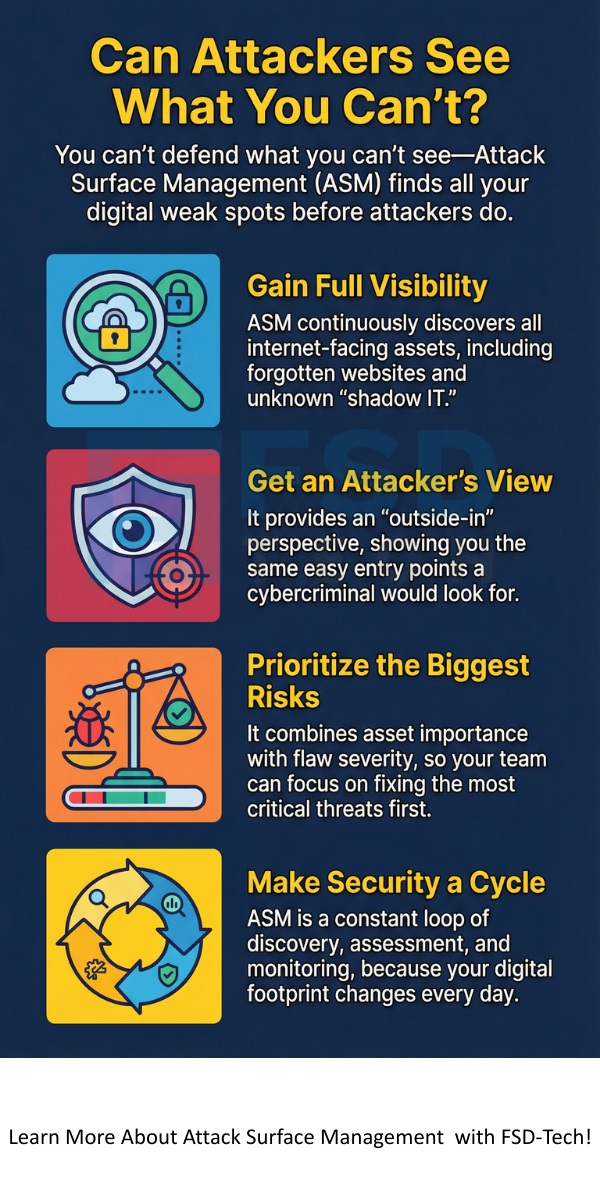
     

    Attack Surface Management (ASM)


    Key Takeaways

    Based on our discussion, here are five critical points you must remember about Attack Surface Management:


    1. ASM Provides Full Visibility: Attack Surface Management is nothing but a continuous method for discovering all internet-facing assets—both the ones you manage and the often-forgotten shadow IT. This visibility is crucial because you cannot defend what you cannot see.
    2. It Offers an Attacker's View: Unlike traditional internal scanning, ASM works from the outside-in. This outside-in perspective mirrors how a cybercriminal evaluates your security posture. It quickly identifies easy entry points and external vulnerabilities.
    3. ASM Focuses on Three Core Areas: Effective Attack Surface Management comprises three elements: External Attack Surface Management (EASM) for public exposures, Cyber Asset Attack Surface Management (CAASM) for consolidating internal data, and Digital Risk Protection Services (DRPS) for monitoring brand threats.
    4. Prioritization is Key: ASM solutions do not just list flaws. They combine asset importance (context) with vulnerability severity. This approach ensures your security team focuses on fixing the highest-risk exposures first, making remediation efficient.
    5. ASM is a Continuous Cycle: You must view Attack Surface Management as a constant, four-step process: discovery, classification, risk assessment, and continuous monitoring. Because your digital environment changes daily, ASM must run non-stop to keep your attack surface minimized.


    Frequently Asked Questions about Attack Surface Management

    What types of assets are included in the attack surface?

    The attack surface includes any digital asset that can be accessed or targeted by an attacker. These include public-facing web applications, open ports, forgotten FTP servers, exposed APIs, cloud services (like Amazon S3 buckets), and leaked credentials found on the dark web.


    How often should an organization perform Attack Surface Management?

    Attack Surface Management must be a continuous process, not an occasional audit. The digital environment changes constantly. New assets are added daily, and misconfigurations can happen instantly. Therefore, the attack surface management solution should monitor and scan continuously, or at least hourly, to maintain real-time visibility.


    How does ASM reduce security risk?

    ASM reduces risk by minimizing the unknown. By continuously discovering all exposed assets and prioritizing the most critical vulnerabilities on them, your security team can eliminate potential entry points. In other words, it shrinks the area an attacker has to work with.


    Is Attack Surface Management only for large enterprises?

    No, ASM is essential for businesses of all sizes. Even a small company with a simple website and a few cloud services has an attack surface. In fact, smaller companies often use fewer security resources, making the automated discovery of shadow IT and misconfigurations even more critical.

    What is Attack Surface Management (ASM)? How it Works?

    About The Author

    Surbhi Suhane

    Surbhi Suhane is an experienced digital marketing and content specialist with deep expertise in Getting Things Done (GTD) methodology and process automation. Adept at optimizing workflows and leveraging automation tools to enhance productivity and deliver impactful results in content creation and SEO optimization.

    Like This Story?

    Share it with friends!

    Subscribe to our newsletter!

    Atera

    (48)

    Cato Networks

    (111)

    ClickUp

    (68)

    FishOS

    (7)

    Miradore

    (21)

    PointGuard AI

    (9)

    Vembu

    (22)

    Xcitium

    (33)

    ZETA HRMS

    (69)

    Workflow Automation(5)

    Workforce Automation(1)

    AI Project Management(1)

    HR Data Automation(1)

    RMM(1)

    IT Workflow Automation(1)

    IT security(2)

    GCC compliance(4)

    Payroll Integration(2)

    IT support automation(3)

    procurement automation(1)

    lost device management(1)

    IT Management(5)

    IoT Security(2)

    Cato XOps(2)

    IT compliance(4)

    Task Automation(1)

    Workflow Management(1)

    OpenStack automation(1)

    Kubernetes lifecycle management(2)

    AI-powered cloud ops(1)

    SMB Security(8)

    Data Security(1)

    MDR (Managed Detection & Response)(4)

    Atera Integrations(2)

    MSP Automation(3)

    XDR Security(2)

    SMB Cyber Protection(1)

    Ransomware Defense(3)

    HR Tech Solutions(1)

    Zero Trust Network Access(3)

    Zero Trust Security(2)

    Endpoint Management(1)

    SaaS Security(1)

    Payroll Automation(5)

    IT Monitoring(2)

    Xcitium EDR SOC(15)

    Ransomware Protection GCC(1)

    M&A IT Integration(1)

    Network Consolidation UAE(1)

    MSSP for SMBs(1)

    FSD-Tech MSSP(25)

    SMB Cybersecurity GCC(1)

    Managed EDR FSD-Tech(1)

    Ransomware Protection(3)

    Antivirus vs EDR(1)

    Cybersecurity GCC(12)

    Endpoint Security(1)

    Endpoint Protection(1)

    Data Breach Costs(1)

    Managed Security Services(2)

    SMB Cybersecurity(8)

    Zero Dwell Containment(31)

    Xcitium EDR(30)

    Cloud Backup(1)

    Hybrid Backup(1)

    Backup & Recovery(1)

    pointguard ai(4)

    disaster recovery myths(1)

    backup myths(1)

    vembu(9)

    SMB data protection(9)

    Vembu BDR Suite(19)

    Disaster Recovery(4)

    DataProtection(1)

    GCCBusiness(1)

    Secure Access Service Edge(4)

    GCC HR software(15)

    Miradore EMM(15)

    Cato SASE(7)

    Cloud Security(8)

    Talent Development(1)

    AI Cybersecurity(12)

    AI Risk Management(1)

    AI Governance(4)

    AI Security(2)

    AI Compliance(2)

    GCC business security(1)

    GCC network integration(1)

    compliance automation(4)

    GCC cybersecurity(2)

    education security(1)

    App management UAE(1)

    BYOD security Dubai(8)

    Miradore EMM Premium+(5)

    HealthcareSecurity(1)

    MiddleEast(1)

    Team Collaboration(1)

    IT automation(10)

    Zscaler(1)

    SD-WAN(6)

    HR Integration(4)

    Cloud Networking(3)

    device management(9)

    RemoteWork(1)

    ZeroTrust(2)

    VPN(1)

    MPLS(1)

    Project Management(9)

    HR automation(16)

    share your thoughts

    Disaster Recovery in Cloud Computing

    What is Disaster Recovery in Cloud Computing?

    🕓 January 8, 2026

    Computer Virus

    What is Computer Virus? Types, Symptoms & Protection

    🕓 January 8, 2026

    Cyber Kill Chain

    What is the Cyber Kill Chain? Critical Cybersecurity Model

    🕓 January 7, 2026

    Decoded(55)

    Cyber Security(112)

    BCP / DR(22)

    Zeta HRMS(68)

    SASE(21)

    Automation(68)

    Next Gen IT-Infra(111)

    Monitoring & Management(69)

    ITSM(22)

    HRMS(21)

    Automation(24)