HomeNext Gen IT-InfraMonitoring & ManagementCyber SecurityBCP / DRAutomationDecoded
Next Gen IT-Infra
Cato’s SASE Supports Cybersecurity Skills Development

How Cato’s SASE Supports Cybersecurity Skills Development

🕓 April 8, 2025

How SASE Supports the Security Needs of SMBs

How SASE Supports the Security Needs of SMBs

🕓 February 9, 2025

Attack Surface Reduction with Cato’s SASE

Attack Surface Reduction with Cato’s SASE

🕓 February 10, 2025

SASE for Digital Transformation in UAE

SASE for Digital Transformation in UAE

🕓 February 8, 2025

Monitoring & Management
Understanding Atera’s SLA Management

Understanding Atera’s SLA Management

🕓 February 7, 2025

Cost-Performance Ratio: Finding the Right Balance in IT Management Networks

Cost-Performance Ratio: Finding the Right Balance in IT Management Networks

🕓 June 16, 2025

Customizing Atera with APIs

Customizing Atera with APIs

🕓 March 3, 2025

Power Up Your IT Team’s Strategy with Atera’s Communication Tools

Power Up Your IT Team’s Strategy with Atera’s Communication Tools

🕓 February 8, 2025

Cyber Security
Illustration of the Cato Cloud architecture showing its role in delivering SASE for secure, optimized global connectivity.

Understanding the Cato Cloud and Its Role in SASE

🕓 January 29, 2025

Isometric illustration of professionals managing network performance, bandwidth analytics, and cloud-based optimization around the Cato Networks platform, symbolizing bandwidth control and QoS visibility.

Mastering Bandwidth Control and QoS in Cato Networks

🕓 July 26, 2025

Global network backbone powering Cato SASE solution for secure, high-performance connectivity across regions.

Global Backbone: The Engine Powering Cato’s SASE Solution

🕓 January 30, 2025

Illustration of team analyzing application traffic and usage insights on a large laptop screen using Cato’s dashboard, surrounded by network and cloud icons.

Cato Networks Application Visibility | Monitoring & Control

🕓 July 27, 2025

BCP / DR
Illustration showing diverse business and IT professionals collaborating with cloud, backup, and security icons, representing Vembu use cases for SMBs, MSPs, and IT teams.

Who Uses Vembu? Real-World Use Cases for SMBs, MSPs & IT Teams

🕓 July 12, 2025

Graphic showcasing Vembu’s all-in-one backup and disaster recovery platform with icons for cloud, data protection, and business continuity for IT teams and SMBs.

What Is Vembu? A Deep Dive Into the All in One Backup & Disaster Recovery Platform

🕓 July 6, 2025

Illustration showing Vembu backup and disaster recovery system with cloud storage, server racks, analytics dashboard, and IT professionals managing data.

The Rising Cost of Data Loss: Why Backup Is No Longer Optional?

🕓 August 14, 2025

3D isometric illustration of cloud backup and data recovery infrastructure with laptop, data center stack, and digital business icons — FSD Tech

RPO & RTO: The Heart of Business Continuity

🕓 August 15, 2025

Automation
Cross-Functional Collaboration with ClickUp

Fostering Cross-Functional Collaboration with ClickUp for Multi-Departmental Projects

🕓 February 11, 2025

ClickUp Project Reporting

Revolutionizing Enterprise Reporting with ClickUp’s Advanced Analytics and Dashboards

🕓 June 16, 2025

ClickUp’s Design Collaboration and Asset Management Tools

Empowering Creative Teams with ClickUp’s Design Collaboration and Asset Management Tools

🕓 February 26, 2025

ClickUp Communication and Collaboration Tools

ClickUp Communication and Collaboration Tools: Empowering Remote Teams

🕓 March 12, 2025

Decoded
Multi-Factor Authentication (MFA)

Multi-Factor Authentication (MFA): All You Need to Know

🕓 December 7, 2025

L3 Switch

What Is an L3 Switch? L2 vs L3 & Why You Need Layer 3?

🕓 December 8, 2025

IPSec

IPSec Explained: Protocols, Modes, IKE & VPN Security

🕓 December 3, 2025

 Datagram Transport Layer Security (DTLS)

What is Datagram Transport Layer Security (DTLS)? How it works?

🕓 December 4, 2025

    Subscribe to our newsletter!

    About Us

    Follow Us

    Copyright © 2024 | Powered by 

    Atera

    (55)

    Cato Networks

    (121)

    ClickUp

    (78)

    FishOS

    (7)

    Miradore

    (21)

    PointGuard AI

    (9)

    Vembu

    (22)

    Xcitium

    (33)

    ZETA HRMS

    (79)

    Table of Contents

    Insider Threat Detection: How to Protect Your Business from the Inside Out

    Surbhi Suhane
    February 20, 2026
    Comments
    Insider Threat Detection

    Insider threat detection is the most vital part of a modern security plan because it addresses the risks coming from people you already trust. To be honest, most of us focus on hackers outside our walls. We build high fences and strong firewalls. But what happens when the risk is already inside? Whether it is a disgruntled employee or a careless contractor, internal threats can cause more damage than any external attack.


    In my experience, the hardest part of cybersecurity isn't stopping a stranger; it is noticing when a "friend" starts acting strangely. Have you ever wondered if someone on your team is accidentally sharing sensitive files? Or perhaps you've worried about a worker who might take company secrets to a competitor? These are the questions that keep IT managers up at night.


    That is where insider threat detection (ITD) comes into play. It isn't just about spying on people. Instead, it is about creating a safety net. This guide will walk you through how it works, why it matters, and how you can start protecting your assets today.


    What is Insider Threat Detection?

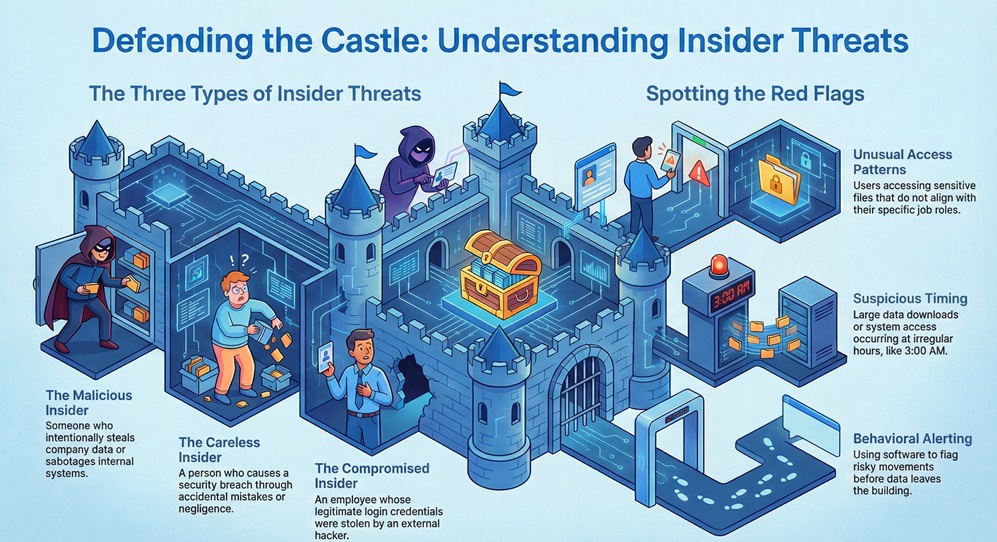
    When we talk about insider threat detection, we are talking about the tools and steps used to find risky behavior by people with authorized access. This includes current employees, former workers, and even third-party vendors. Unlike an outsider who has to break in, an insider already has the keys to the castle.


    Insider Threat Detection


    There are three main types of insiders we look for:


    1. The Malicious Insider: Someone who intentionally steals data or sabotages systems.
    2. The Careless Insider: A person who makes a mistake, like clicking a phishing link.
    3. The Compromised Insider: An employee whose login details were stolen by an outside hacker.


    So, how do we spot them? We look at patterns. If an accountant suddenly starts downloading engineering blueprints at 3:00 AM, that is a red flag. ITD systems use software to watch these movements and alert you before the data leaves the building.


    Automate My Data Protection


    Why Traditional Security Fails?

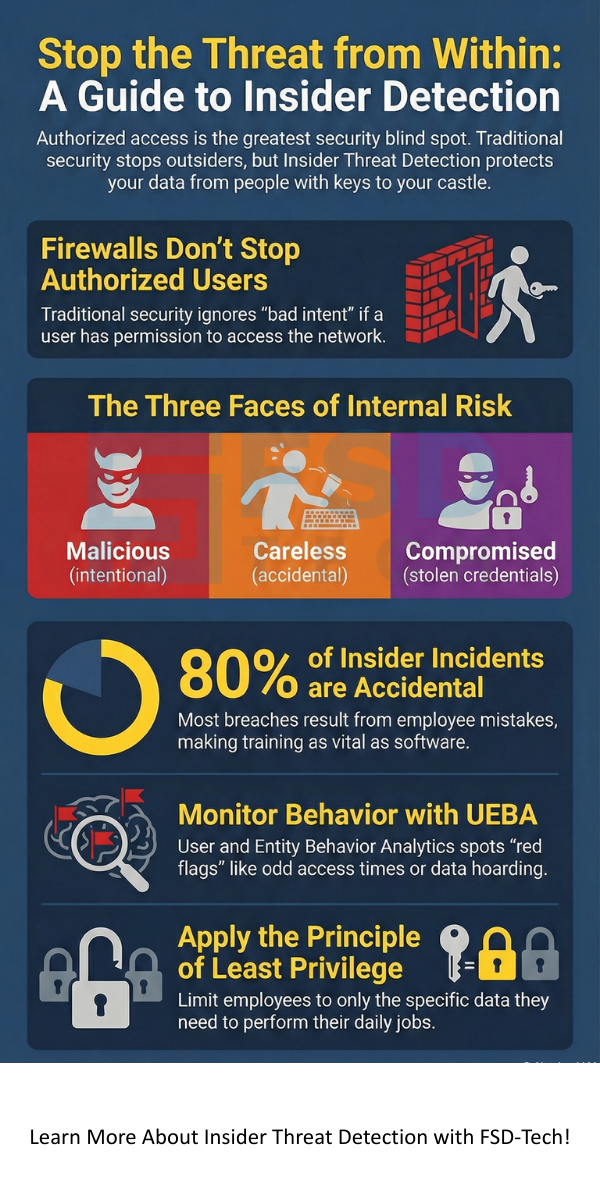
    Here is the thing: your firewall does not care if an admin downloads the entire client database. Why? Because the admin has "permission" to be there. Traditional security looks for "bad" code or "bad" IP addresses. It doesn't look for "bad" intent.


    To be honest, we've all been there—trusting our team so much that we forget to check the locks on the inside doors. Research shows that internal breaches often go unnoticed for months. By the time you find out, the damage is done. This is why a dedicated detection system is a must-have, not a nice-to-have.


    The Power of User and Entity Behavior Analytics (UEBA)

    The heart of modern insider threat detection is something called User and Entity Behavior Analytics. That's a big name for a simple concept: learning what "normal" looks like for every user.

    Think of it like a bank. If you usually spend $50 a day and suddenly try to buy a $10,000 watch in another country, the bank calls you. UEBA does the same for your data. It builds a baseline for every employee. It knows when they log in, what files they touch, and how much data they usually send in emails.


    When someone strays from that baseline, the system raises a hand. It doesn't necessarily mean the person is doing something wrong, but it tells you that you need to take a closer look.


    Also Read: What is Security Operations Center (SOC)?


    Key Signs of an Internal Threat

    How can you tell if a risk is brewing? In my view, the signs are often there if you know where to look. Here are some common indicators:


    • Odd Access Times: Working at strange hours without a reason.
    • Data Hoarding: Downloading massive amounts of data that they don't need for their daily job.
    • Foreign Travel: Accessing sensitive systems from countries where the company doesn't do business.
    • Frequent Policy Violations: Constantly trying to bypass security rules or using unapproved USB drives.


    Do you have a way to track these behaviors right now? If the answer is no, you might be flying blind.


    How to Build a Detection Strategy for Insider Threat Detection?

    You don't need to be a global tech giant to start with insider threat detection. You can start small and grow.


    First, identify your "crown jewels." What is the most important data you own? Is it your customer list? Your source code? Once you know what is most valuable, you can put the tightest controls around it.


    Second, use the principle of least privilege. This means giving people only the access they need to do their jobs. If a marketing person doesn't need access to HR files, don't give it to them. It sounds simple, but you would be surprised how many companies give everyone "admin" rights just to save time.


    Third, look into automated tools. It is impossible for a human to watch every click. Tools like Opentext or other UEBA platforms can do the heavy lifting for you. They sort through millions of events and only show you the ones that look suspicious.


    Also Read: What is Static Application Security Testing (SAST)?


    Role of Corporate Culture in Insider Threat Detection

    I want to be clear: security isn't just about software. It is about people. If your employees feel valued and supported, they are less likely to become malicious insiders. On the other hand, if the culture is toxic, the risk goes up.


    Roughly 80% of insider incidents are actually accidental. This means training is your best friend. Teach your team how to spot phishing. Show them how to handle sensitive data. When people understand the "why" behind the rules, they are much more likely to follow them.


    Common Challenges in Insider Threat Detection

    It isn't all easy. One of the biggest hurdles is privacy. You want to keep the company safe, but you don't want your employees to feel like they are in a reality TV show.


    To solve this, many companies use "anonymized" data. The system watches for bad patterns without showing the person's name until a high-risk alert is triggered. This balances safety with a healthy work environment.


    Another challenge is "false positives." Sometimes, an employee is just working late to finish a big project. You don't want to lock them out of their computer every time they work past 6 PM. This is why tuning your insider threat detection tools is so important.


    Cost of Doing Nothing

    Picture this: A lead developer leaves your company for a competitor. On their last day, they zip up your entire product roadmap and put it on a personal cloud drive. Without detection, you might not find out for a year. By then, your competitor has already launched your "secret" features.


    The financial hit from a breach is one thing. The loss of trust from your clients is another. Recovery can take years. When you look at it that way, the investment in a detection system is actually quite small.


    Let's Discuss Technology: SIEM and DLP

    Many professionals use a Security Information and Event Management (SIEM) system. Think of a SIEM as a giant logbook. It gathers data from your network, your servers, and your apps. While a SIEM is great for seeing what happened, it isn't always fast enough to stop an insider in the act.


    That is why we often pair it with Data Loss Prevention (DLP). A DLP tool is like a guard at the exit. It checks every "bag" (or email) leaving the building. If it sees a credit card number or a secret document, it stops the transfer.


    Together, SIEM, DLP, and UEBA create a strong shield. They give you the visibility you need to act fast.


    Conclusion

    All in all, protecting your company means looking inward as much as you look outward. An insider threat detection strategy combines smart software with a strong company culture. By watching for unusual behavior and limiting access to your most important files, you can stop a disaster before it starts.


    We've all seen the headlines about massive data leaks. Don't let your company be the next one. Start by looking at who has access to your data today. Are you sure they are using it correctly?

    At our core, we believe that every business deserves to feel secure. We focus on providing the tools and knowledge you need to protect your hard work. Our team is dedicated to your safety because your success is our success. Let’s work together to build a more secure future for your team and your clients.


    Contact us today for a security health check


    insider threat detection


    Key Takeaways on Insider Threat Detection

    • Identify Assets: Know where your sensitive data lives.
    • Watch Behavior: Use UEBA to spot changes in how people work.
    • Limit Access: Give people only what they need to perform their tasks.
    • Focus on Training: Most threats are accidental; education reduces risk.
    • Use Automation: Let software find the needles in the haystack.


    Frequently Asked Questions About Insider Threat Detection

    Is insider threat detection the same as spying?

    No. It focuses on protecting data and identifying risky patterns. It's about safety, not personal surveillance. Most systems focus on work-related actions and data movement.


    How much does a detection system cost?

    The price varies based on the size of your company. However, the cost of a single data breach is usually much higher than the annual cost of the software.


    Can small businesses use these tools?

    Yes. Many cloud-based security tools offer insider threat detection features that are affordable for smaller teams. You don't need a huge IT department to get started.


    What is a "Logic Bomb"?

    This is a type of malicious insider threat where an employee hides code in a system that "explodes" (deletes data or shuts things down) after they leave the company. Detection tools look for these hidden changes in code.

    Insider Threat Detection: How to Protect Your Business from the Inside Out

    About The Author

    Surbhi Suhane

    Surbhi Suhane is an experienced digital marketing and content specialist with deep expertise in Getting Things Done (GTD) methodology and process automation. Adept at optimizing workflows and leveraging automation tools to enhance productivity and deliver impactful results in content creation and SEO optimization.

    TRY OUR PRODUCTS

    Like This Story?

    Share it with friends!

    Subscribe to our newsletter!

    FishOSCato SASEVembuXcitiumZeta HRMSAtera
    Isometric illustration of a centralized performance platform connected to analytics dashboards and team members, representing goal alignment, measurable outcomes, risk visibility, and strategic project tracking within ClickUp.

    How ClickUp Enables Outcome-Based Project Management (Not Just Task Tracking)

    🕓 February 15, 2026
    Isometric illustration of a centralized executive dashboard platform connected to analytics panels, performance charts, security indicators, and strategic milestones, representing real-time business visibility and decision control within ClickUp.

    Executive Visibility in ClickUp – How CXOs Gain Real-Time Control Without Micromanaging

    🕓 February 13, 2026

    Cato SASE Architecture

    Inside Cato’s SASE Architecture: A Blueprint for Modern Security

    🕓 January 26, 2025

    share your thoughts

    Workflow Automation(8)

    Workforce Automation(1)

    AI Project Management(1)

    HR Data Automation(1)

    RMM(1)

    IT Workflow Automation(1)

    GCC compliance(4)

    IT security(2)

    Payroll Integration(2)

    IT support automation(3)

    procurement automation(1)

    lost device management(1)

    IT Management(5)

    IoT Security(2)

    Cato XOps(2)

    IT compliance(4)

    Task Automation(1)

    Workflow Management(1)

    Kubernetes lifecycle management(2)

    OpenStack automation(1)

    AI-powered cloud ops(1)

    SMB Security(8)

    Data Security(1)

    MDR (Managed Detection & Response)(4)

    MSP Automation(3)

    Atera Integrations(2)

    XDR Security(2)

    Ransomware Defense(3)

    SMB Cyber Protection(1)

    HR Tech Solutions(1)

    Zero Trust Network Access(3)

    Zero Trust Security(2)

    Endpoint Management(1)

    SaaS Security(1)

    Payroll Automation(5)

    IT Monitoring(2)

    Xcitium EDR SOC(15)

    Ransomware Protection GCC(1)

    Network Consolidation UAE(1)

    M&A IT Integration(1)

    MSSP for SMBs(1)

    FSD-Tech MSSP(25)

    Managed EDR FSD-Tech(1)

    SMB Cybersecurity GCC(1)

    Ransomware Protection(3)

    Antivirus vs EDR(1)

    Endpoint Security(1)

    Cybersecurity GCC(12)

    Data Breach Costs(1)

    Endpoint Protection(1)

    Xcitium EDR(30)

    Managed Security Services(2)

    SMB Cybersecurity(8)

    Zero Dwell Containment(31)

    Cloud Backup(1)

    Hybrid Backup(1)

    Backup & Recovery(1)

    pointguard ai(4)

    SMB data protection(9)

    backup myths(1)

    disaster recovery myths(1)

    vembu(9)

    Disaster Recovery(4)

    Vembu BDR Suite(19)

    DataProtection(1)

    GCCBusiness(1)

    GCC IT Solutions(1)

    Secure Access Service Edge(4)

    Unified Network Management(1)

    GCC HR software(20)

    CC compliance(1)

    open banking(1)

    financial cybersecurity(2)

    Miradore EMM(15)

    Government Security(1)

    Cato SASE(8)

    Hybrid Learning(1)

    Cloud Security(9)

    GCC Education(1)

    Talent Development(1)

    AI Risk Management(1)

    AI Compliance(2)

    AI Cybersecurity(12)

    AI Governance(4)

    AI Security(2)

    Secure Remote Access(1)

    GCC business security(1)

    GCC network integration(1)

    compliance automation(5)

    GCC cybersecurity(3)

    education security(1)

    BYOD security Dubai(8)

    Miradore EMM Premium+(5)

    App management UAE(1)

    MiddleEast(1)

    HealthcareSecurity(1)

    Team Collaboration(1)

    IT automation(12)

    Zscaler(1)

    SD-WAN(7)

    Insider Threat Detection

    Insider Threat Detection: How to Protect Your Business from the Inside Out

    🕓 February 20, 2026

    Recovery Point Objective

    What is Recovery Point Objective? Why Does Your Data Depend on It?

    🕓 February 20, 2026

    Offsite Data Backup Storage

    What is Offsite Data Backup Storage? Secure Remote Backups

    🕓 February 19, 2026

    Decoded(121)

    Cyber Security(118)

    BCP / DR(22)

    Zeta HRMS(78)

    SASE(21)

    Automation(78)

    Next Gen IT-Infra(118)

    Monitoring & Management(76)

    ITSM(22)

    HRMS(21)

    Automation(24)