Network Traffic Analysis (NTA) is nothing but the process of intercepting, recording, and examining network traffic to identify security threats, manage performance, and gain insights into network operations. This critical security discipline focuses on monitoring the data that flows across a computer network.
You can understand NTA as the security camera and the control room for your network. It ensures the network is running efficiently and, more importantly, ensures your digital assets are safe from intruders and suspicious activities.
In this section, we will explore the core concepts of NTA, its importance, the tools you can use, and how it acts as a vital component of cybersecurity.
What is Network Traffic Analysis (NTA)?
Network Traffic Analysis (NTA) is a cybersecurity technique that continuously monitors and analyzes network traffic to detect threats, anomalies, and suspicious behavior. Using flow data (e.g., NetFlow, sFlow), packet captures, and metadata, NTA tools establish baselines of normal activity and flag deviations—like unusual data volumes, unknown IP connections, or lateral movement—indicating malware, insider threats, or APTs.
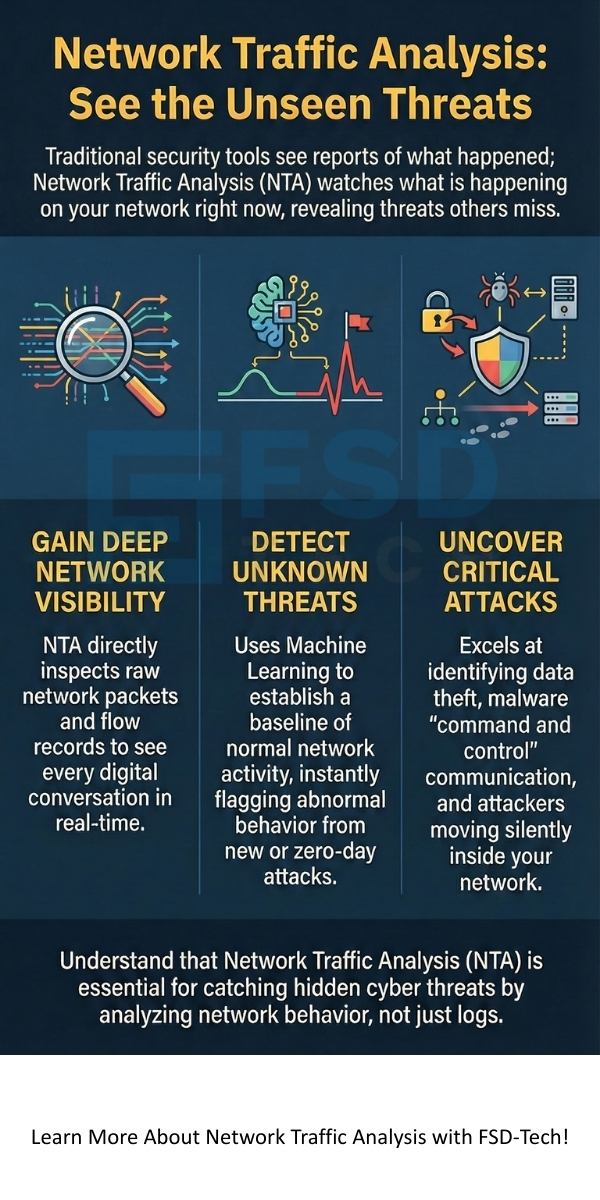
Unlike signature-based IDS, NTA relies on behavioral analysis and machine learning for zero-day detection. It provides real-time visibility, supports incident response, and integrates with SIEM/EDR systems.
Network Traffic Analysis vs. Traditional Security Monitoring
While you may already use other security tools, network traffic analysis in cyber security offers a deeper look. It does not just check who logged in or what file they opened. NTA scrutinizes the actual packets of data flowing back and forth.
Why network analysis is important? It acts as an early warning system. By constantly monitoring traffic patterns, NTA tools can spot subtle anomalies that other security tools might miss.
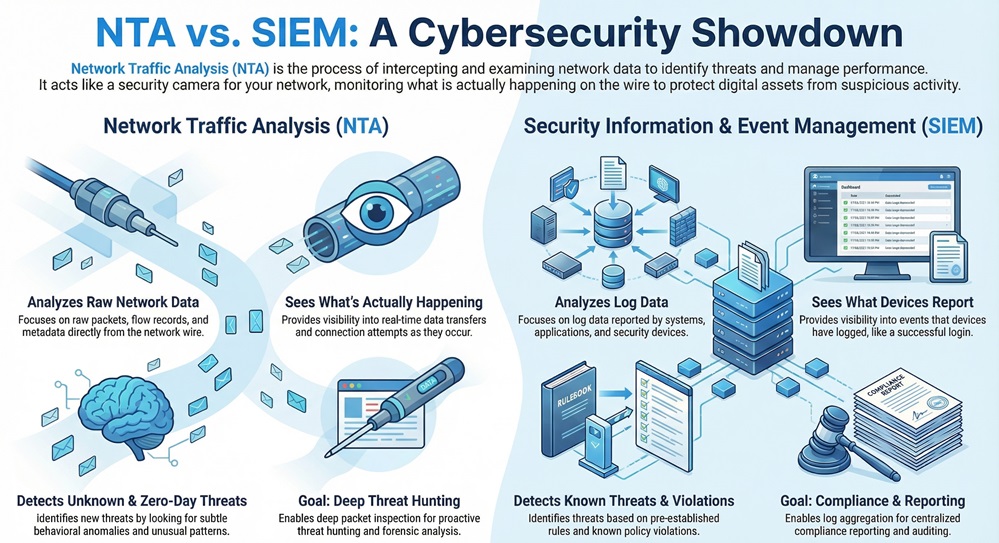
To understand this better, let us examine how NTA stands apart from traditional security methods like Security Information and Event Management (SIEM).
Basis for Comparison
Network Traffic Analysis (NTA)
Security Information and Event Management (SIEM)
Data Focus
Raw network packets, flow records (NetFlow, IPFIX), and metadata.
Log data from systems, applications, and security devices (firewalls, endpoints).
Visibility
Sees what is actually happening on the wire (e.g., data transfer volume, connection attempts).
Sees what devices report happened (e.g., login success, file modified).
Detection
Focuses on unknown threats and zero-day attacks by looking for behavioral anomalies.
Focuses on known threats and policy violations based on established correlation rules.
Primary Goal
Deep packet inspection for threat hunting and forensic analysis.
The network traffic analysis process involves three key steps: collection, analysis, and response.
1. Collecting Network Data: The Raw Material
The process starts with capturing the raw data that flows through the network. This includes:
Full Packet Capture (FPC): This means copying every single data packet that crosses a specific point in the network. FPC provides the highest level of detail for forensic analysis.
Flow Records (NetFlow/IPFIX): These records summarize network communication. They do not contain the actual data content but provide essential metadata like:
Source and destination IP address
Port numbers
Protocol (e.g., TCP, UDP)
Start and end time of the flow
Number of bytes and packets transferred
Network traffic analysis software uses specialized sensors (probes) or network taps to collect this data with minimal impact on network performance.
2. Analyzing Traffic Patterns: Spotting the Abnormal
After collecting the data, NTA tools start the analysis. They apply various techniques to determine if the traffic is normal or malicious.
What is the mode of analysis? The tools use signatures and behavioral models.
Signature-Based Analysis: This method compares current traffic against a known database of malware signatures and attack patterns. If a packet matches a known pattern, the tool flags it as suspicious.
Network traffic analysis using machine learning (ML): This is where NTA really excels. ML algorithms create a baseline of normal network behavior. When traffic deviates significantly from this baseline (e.g., a sudden, massive data transfer to an outside server), the system flags it as an anomaly. This helps in detecting new and unknown threats.
3. Generating Alerts and Responding: Taking Action
When the network traffic analysis security system spots a potential threat, it automatically generates an alert for your security team.
The system provides context around the alert, such as which devices were involved and the nature of the suspicious activity.
Security analysts then use the collected packet data for forensic investigation to confirm the attack and understand its scope.
The ultimate goal is to isolate the affected systems and prevent further damage.
Why Network Traffic Analysis is Essential for Cyber Security?
Network traffic analysis in cybersecurity is a fundamental defense strategy today. The ability to see and understand every digital conversation on your network is vital, especially since many attacks bypass traditional perimeter defences like firewalls.
Here are the key reasons why you must implement robust NTA.
Detecting Hidden Threats
Many modern attacks, such as Advanced Persistent Threats (APTs), involve attackers remaining inside a network for long periods. They use slow and low-volume communication to avoid detection.
NTA helps in this way: It monitors for subtle indicators like unusual internal reconnaissance, command and control (C2) communication attempts, or unauthorized lateral movement between servers.
What about the threats it detects? It detects malware that does not rely on files and instead lives "off the land" using legitimate system tools.
Improving Incident Response and Forensics
When an incident does occur, quick and accurate response is crucial.
NTA provides a complete historical record of network activity. This deep log of events allows your security team to:
Determine the initial access point of the attacker.
Trace the attacker's path through the network.
Determine what data the attacker accessed or stole.
This comprehensive view significantly reduces the time required to investigate and contain an attack.
Performance Optimization and Troubleshooting
Network traffic analysis is not just for security. It plays a vital role in keeping your network running smoothly.
The tools help in this way: By looking at the flow data, you can easily spot bandwidth hogs (users or applications consuming too much bandwidth).
What is web traffic analysis? It is a part of NTA that specifically looks at HTTP/HTTPS traffic to understand application performance, user activity, and resource consumption. This enables you to identify bottlenecks and troubleshoot slow network speeds quickly.
Supporting Compliance Requirements
Many industry regulations and government mandates require organizations to maintain detailed logs of network activity.
NTA ensures that you meet compliance requirements by providing verifiable records of data access and network transactions. This is particularly important for industries dealing with sensitive data, such as finance and healthcare.
Best Network Traffic Analysis Tools and Techniques
Choosing the right network traffic analysis tools is essential for an effective NTA strategy. These tools fall into two main categories: commercial products and open source network traffic analysis tools.
Commercial Network Traffic Analysis Software
These are typically comprehensive platforms that offer deep integration, machine learning capabilities, and enterprise-level support.
Full-Stack Visibility Platforms: These tools often combine NTA with Endpoint Detection and Response (EDR) and SIEM capabilities, offering a unified security view.
Specialized NTA/NDR Solutions:Network Detection and Response (NDR) is a term that refers to modern NTA solutions heavily relying on behavioral analysis and machine learning to automatically respond to threats.
Open Source Network Traffic Analysis Tools
For smaller organizations or security professionals who prefer a hands-on approach, several excellent open source network traffic analysis options exist.
Wireshark: This is a fundamental packet analyzer that allows you to see the actual contents of the packets. It is an essential tool for deep-dive network traffic analysis example and troubleshooting.
Zeek (formerly Bro): This powerful tool is not just an analyzer; it is an event logger and security monitoring system. Zeek generates comprehensive logs that summarize network events (e.g., HTTP requests, DNS queries) which are perfect for large-scale analysis.
tcpdump: This is a classic command-line packet sniffer. It is mainly used for real-time capture and quick analysis.
What is the technique used for analysis? Modern NTA platforms utilize a blend of techniques to ensure comprehensive security coverage.
Deep Packet Inspection (DPI): This is the ability to look beyond the packet header and examine the actual data payload. DPI helps the system understand the application and the content being transmitted.
Behavioral Modeling: This technique, often powered by network traffic analysis using machine learning, maps out what is normal for a user, device, or application. For example, if a database server suddenly starts communicating with an outside IP address at 3 AM, the system knows this is abnormal behavior.
Protocol Analysis: NTA tools can identify and understand various network protocols (e.g., HTTP, FTP, SSH). They look for protocols being used incorrectly or for malicious tunneling (e.g., using DNS to sneak data out).
Threat Intelligence Integration: The tools constantly cross-reference observed traffic against global threat intelligence feeds to immediately flag connections to known malicious domains or IP addresses.
Network Traffic Analysis Security Applications and Examples
Network traffic analysis security is not theoretical; it has concrete applications that protect your organization every day.
Network Traffic Analysis in Cyber Security
Detecting Data Exfiltration: Attackers aim to steal data. A sudden, massive transfer of data from an internal server to an external location (especially using an unusual protocol or port) is a strong indicator of data exfiltration. NTA tools immediately flag this anomaly.
Identifying Command and Control (C2) Traffic: Malware needs to communicate with its remote server to receive commands. NTA looks for the specific, often encrypted, low-volume communication patterns that indicate an established C2 channel.
Network traffic analysis example: An internal machine repeatedly sends a small, encrypted DNS query to a non-standard server every 60 seconds. This rhythmic, abnormal pattern signals a C2 beacon.
Locating Internal Lateral Movement: Once an attacker gains a foothold, they move laterally to find valuable assets. NTA spots this by looking for a user's machine suddenly attempting to access dozens of servers it has never connected to before.
Imagine a scenario where a user, Jane, receives a phishing email and accidentally downloads a piece of malware.
The malware activates and attempts to connect to a known malicious IP address (the C2 server).
The NTA system captures the flow record (source IP, destination IP, port).
The NTA tool checks the destination IP against a continuously updated threat intelligence feed and finds a match for a known malicious server.
Simultaneously, the behavioral analysis model flags the network connection as highly abnormal because Jane's machine has never communicated with this external country before, and it is using an unusual port.
Result: The NTA system immediately generates a critical alert, allowing the security team to block the connection and isolate Jane's machine before the malware can fully execute its payload or steal credentials.
Conclusion
Network traffic analysis plays a vital role in modern cybersecurity. You now understand that it is nothing less than the eyes and ears of your security team, providing deep visibility into every transaction that occurs on your network.
By employing robust network traffic analysis tools and techniques—from deep packet inspection to sophisticated machine learning—you move beyond simple perimeter defense. You create a system that can effectively detect the quiet, unseen threats that bypass traditional firewalls.
We believe that proactive security and clear visibility are the cornerstones of a successful digital operation. Therefore, you must start evaluating dedicated network traffic analysis software to gain full visibility into your network.
Are you ready to strengthen your security posture? Contact us today to learn how our expert team implements state-of-the-art Network Traffic Analysis solutions that ensure continuous security and optimal performance for your business.
Key Takeaways
So, with the above discussion, we can say that network traffic analysis is a fundamental and critical component of modern cybersecurity. Here are the most essential takeaways you should keep in mind about NTA:
NTA is Deep Visibility:What is network traffic analysis? It means getting deep visibility into all data packets and network flows (NetFlow/IPFIX). This allows you to see what is happening on the wire, not just what devices report.
Focus on Behavior: NTA excels at detecting unknown threats and zero-day attacks by employing network traffic analysis using machine learning. This technology establishes a baseline of normal network behavior, easily flagging any deviation as an anomaly.
Beyond the Firewall: While traditional firewalls protect the perimeter, NTA monitors internal (east-west) and external (north-south) traffic. This is crucial for catching threats that have already breached the perimeter, such as Advanced Persistent Threats (APTs).
Critical for Incident Response: The comprehensive record of network activity provided by NTA tools is vital for forensic analysis. This capability helps security teams quickly trace the attacker’s path and determine the scope of a breach.
Two Core Data Types: Effective NTA relies on two main data sources:
Flow Records: Essential for high-level monitoring and what is web traffic analysis (traffic volume, metadata).
Full Packet Capture (FPC): Provides the highest detail needed for deep-dive investigation and finding evidence.
NTA Tools are Diverse: You have various options for network traffic analysis tools, ranging from robust commercial Network Detection and Response (NDR) platforms to powerful open source network traffic analysis tools like Wireshark and Zeek.
Not Just Security:Why network analysis is important? It also plays a key role in network operations. You can use it to identify bandwidth bottlenecks, troubleshoot performance issues, and optimize resource allocation.
Security Use Cases are Clear:Network traffic analysis security is essential for detecting critical events like data exfiltration (unusual large transfers), Command and Control (C2) communication, and lateral movement inside your network.
Frequently Asked Questions (FAQs) on NTA
What is Network Traffic Analysis?
What is network traffic analysis? It is the practice of continuously monitoring network communication by inspecting raw packets and flow records to detect suspicious behavior, identify security threats, and maintain optimal network performance.
Is Network Traffic Analysis the Same as Network Monitoring?
No, they are different. Network monitoring usually focuses on the health and availability of network devices (is the router up? is the bandwidth utilization high?). Network traffic analysis focuses on the content and intent of the data flowing across the network to find threats or anomalies.
Which is a key advantage of network traffic analysis using machine learning?
The key advantage is the ability to detect zero-day attacks and unknown threats. Since ML creates a baseline of normal behavior, it can spot any significant deviation from that norm, even if the attack pattern has never been seen before.
What is the most common data source for Network Traffic Analysis?
The most common and most informative data source is the NetFlow or IPFIX records. These flow records summarize every conversation on the network, providing essential metadata about communication without needing to store the entire content of every packet.
About The Author
Surbhi Suhane
Surbhi Suhane is an experienced digital marketing and content specialist with deep expertise in Getting Things Done (GTD) methodology and process automation. Adept at optimizing workflows and leveraging automation tools to enhance productivity and deliver impactful results in content creation and SEO optimization.
.webp&w=3840&q=75)






.webp&w=3840&q=75)




share your thoughts