HomeNext Gen IT-InfraMonitoring & ManagementCyber SecurityBCP / DRAutomationDecoded
Next Gen IT-Infra
Cato’s SASE Supports Cybersecurity Skills Development

How Cato’s SASE Supports Cybersecurity Skills Development

🕓 April 8, 2025

How SASE Supports the Security Needs of SMBs

How SASE Supports the Security Needs of SMBs

🕓 February 9, 2025

Attack Surface Reduction with Cato’s SASE

Attack Surface Reduction with Cato’s SASE

🕓 February 10, 2025

SASE for Digital Transformation in UAE

SASE for Digital Transformation in UAE

🕓 February 8, 2025

Monitoring & Management
Understanding Atera’s SLA Management

Understanding Atera’s SLA Management

🕓 February 7, 2025

Cost-Performance Ratio: Finding the Right Balance in IT Management Networks

Cost-Performance Ratio: Finding the Right Balance in IT Management Networks

🕓 June 16, 2025

Customizing Atera with APIs

Customizing Atera with APIs

🕓 March 3, 2025

Power Up Your IT Team’s Strategy with Atera’s Communication Tools

Power Up Your IT Team’s Strategy with Atera’s Communication Tools

🕓 February 8, 2025

Cyber Security
Visual guide showing Cato CMA interface for configuring Internet and WAN firewall rules, enabling threat protection, and monitoring security events in real time for UAE IT teams.

Enforcing Firewall and Threat Protection Policies in Cato

🕓 July 25, 2025

Isometric illustration of professionals managing network performance, bandwidth analytics, and cloud-based optimization around the Cato Networks platform, symbolizing bandwidth control and QoS visibility.

Mastering Bandwidth Control and QoS in Cato Networks

🕓 July 26, 2025

Illustration of the Cato Cloud architecture showing its role in delivering SASE for secure, optimized global connectivity.

Understanding the Cato Cloud and Its Role in SASE

🕓 January 29, 2025

Global network backbone powering Cato SASE solution for secure, high-performance connectivity across regions.

Global Backbone: The Engine Powering Cato’s SASE Solution

🕓 January 30, 2025

BCP / DR
Illustration showing diverse business and IT professionals collaborating with cloud, backup, and security icons, representing Vembu use cases for SMBs, MSPs, and IT teams.

Who Uses Vembu? Real-World Use Cases for SMBs, MSPs & IT Teams

🕓 July 12, 2025

Graphic showcasing Vembu’s all-in-one backup and disaster recovery platform with icons for cloud, data protection, and business continuity for IT teams and SMBs.

What Is Vembu? A Deep Dive Into the All in One Backup & Disaster Recovery Platform

🕓 July 6, 2025

Illustration showing Vembu backup and disaster recovery system with cloud storage, server racks, analytics dashboard, and IT professionals managing data.

The Rising Cost of Data Loss: Why Backup Is No Longer Optional?

🕓 August 14, 2025

3D isometric illustration of cloud backup and data recovery infrastructure with laptop, data center stack, and digital business icons — FSD Tech

RPO & RTO: The Heart of Business Continuity

🕓 August 15, 2025

Automation
Cross-Functional Collaboration with ClickUp

Fostering Cross-Functional Collaboration with ClickUp for Multi-Departmental Projects

🕓 February 11, 2025

ClickUp Project Reporting

Revolutionizing Enterprise Reporting with ClickUp’s Advanced Analytics and Dashboards

🕓 June 16, 2025

ClickUp’s Design Collaboration and Asset Management Tools

Empowering Creative Teams with ClickUp’s Design Collaboration and Asset Management Tools

🕓 February 26, 2025

ClickUp Communication and Collaboration Tools

ClickUp Communication and Collaboration Tools: Empowering Remote Teams

🕓 March 12, 2025

Decoded
Multi-Factor Authentication (MFA)

Multi-Factor Authentication (MFA): All You Need to Know

🕓 December 7, 2025

L3 Switch

What Is an L3 Switch? L2 vs L3 & Why You Need Layer 3?

🕓 December 8, 2025

IPSec

IPSec Explained: Protocols, Modes, IKE & VPN Security

🕓 December 3, 2025

 Datagram Transport Layer Security (DTLS)

What is Datagram Transport Layer Security (DTLS)? How it works?

🕓 December 4, 2025

    Subscribe to our newsletter!

    About Us

    Follow Us

    Copyright © 2024 | Powered by 

    Cato SASE Architecture

    Inside Cato’s SASE Architecture: A Blueprint for Modern Security

    🕓 January 26, 2025

    Enterprise Data Security and Privacy with ClickUp

    Ensuring Enterprise Data Security and Privacy with ClickUp

    🕓 February 9, 2025

    DDoS protection SASE

    DDoS Protection and Cato’s Defence Mechanisms

    🕓 February 11, 2025

    Table of Contents

    What is Microservices Architecture? Guide & Benefits

    Surbhi Suhane
    January 21, 2026
    Comments
    Microservices Architecture

    If you build or manage modern applications, you know the pressure is constant. You need systems that scale instantly and resist failure. Perhaps you currently manage a massive, single application that slows down every time you try to update one small part. 


    This scenario is common and often leads development teams to search for a better way to structure their software. The solution many leading companies choose focuses on breaking that giant application into smaller, manageable pieces. This approach is what we call Microservices Architecture.


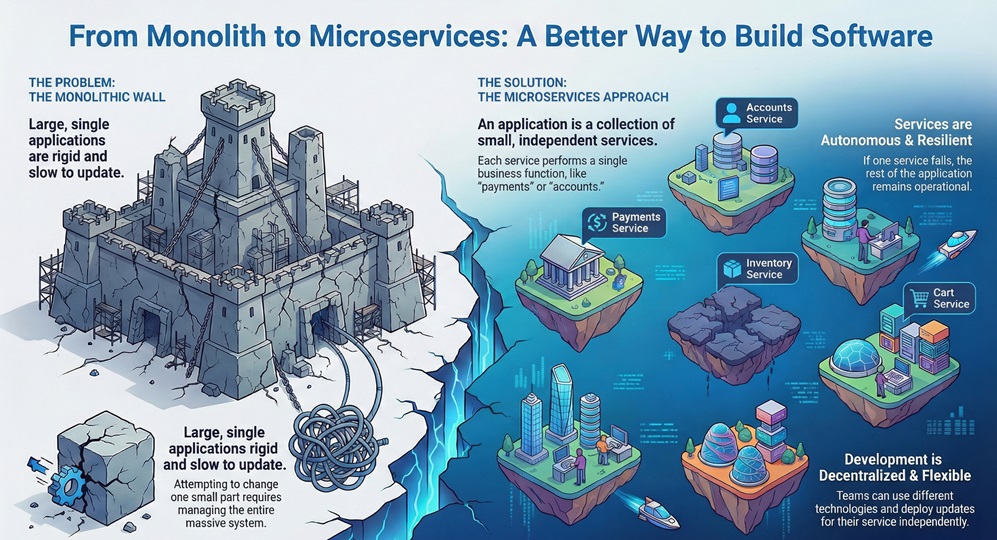
    Microservices Architecture is nothing but a special way to build software. It takes a single, large application and breaks it into many independent services. Each service performs one specific business function. For example, one service handles customer accounts. Another service manages the shopping cart. A third service processes payments. This separation makes the entire system easier to develop, test, and deploy. You gain flexibility and speed when you adopt a Microservices Architecture.


    Let us now discuss the fundamental question: What Microservices Architecture provides that traditional systems do not? It offers independence and resilience. Imagine a wall made of separate bricks instead of one huge slab of concrete. If one brick breaks, the rest of the wall remains standing. Similarly, if one service fails in a Microservices Architecture, the rest of your application continues to function smoothly. This isolation is a critical feature that modern digital platforms require.


    Defining the Architecture of Microservices

    We can understand what are microservices in software by focusing on their key characteristics. Each microservice is an independent application that communicates with others over a network. The defining principles of architecture of microservices ensure high performance and agility for development teams.
     

    Microservices


    Microservices can be understood as small, autonomous business services. They perform a single function and manage their own data storage. This design choice provides a key advantage: decentralized governance. This means different teams can use different programming languages and databases suitable for their specific service.


    Modernize Apps Contact


    Essential Characteristics of Microservices

    To understand the best microservices architecture, you must know what defines a microservice. These key characteristics ensure that your application remains flexible and robust.

    Microservices possess the following core traits:


    • Autonomous: Each service is developed and deployed independently. This means one team does not need to wait for another team to finish their work before deploying their own service.
    • Decentralized:Microservices Architecture favors decentralized data management. Each service has its own dedicated database. This helps in keeping the data isolated and consistent for that service only.
    • Technology Diversity: A single application can use multiple programming languages. For instance, your inventory service might use Python, while your payment service might use Java. This freedom allows teams to choose the optimal tool for the job.
    • Business Capability Focus: Each service organizes itself around a specific business domain. An order processing service deals only with orders, not customer profiles or payment details. This focus simplifies the development process greatly.
    • Resilience: If one microservice experiences a failure, the rest of the application remains operational. This fault isolation is a huge benefit of the Microservices Architecture.


    Therefore, when you build a system using Microservices Architecture, you build a series of small, cooperating components instead of one large block.


    Why Microservices Architecture is Vital for Modern Apps?

    Now, the question arises: Why Microservices Architecture has become the standard for companies like Netflix and Amazon? The answer lies in the benefits it provides for continuous delivery and rapid development. Microservices Architecture ensures a faster time to market for new features.


    Due to the independent nature of the services, teams can work concurrently on different parts of the application. This efficiency significantly speeds up the development lifecycle. This architecture also directly addresses the issues that arise when a single application becomes too large and difficult to manage.


    Also Read: What is Application Whitelisting in Cybersecurity?


    Key Advantages of Adopting Microservices

    Implementing a robust Microservices Architecture provides several crucial advantages for your business.


    1. Enhanced Scalability: Microservices allow you to scale only the components that need more resources. For example, if your checkout service is under high load during a sale, you can quickly deploy more instances of only the checkout service. You do not need to scale the entire application, which saves significant operational cost.
    2. Faster Development Cycles: Teams can focus completely on their service’s functionality. They do not worry about the complexity of the larger application. This focus leads to quicker development, testing, and deployment of features.
    3. Improved Fault Isolation: As mentioned before, a failure in one service does not crash the entire system. This stability ensures that the customer experience remains consistent, even when technical issues occur in the background.
    4. Flexibility in Technology: Teams are free to choose the best microservices architecture components based on technological suitability. This ability to mix and match languages and databases ensures that each service operates with maximum efficiency.
    5. Easier Maintenance: Since each service is small, the codebase is easier to understand and maintain. New developers can quickly learn and contribute to a small microservice without needing to master the entire complex application.


    Taking into account these benefits, it is clear why adopting Microservices Architecture allows companies to innovate and adapt faster than their competitors.


    Monolithic vs Microservices

    To fully grasp the power of Microservices Architecture, we must contrast it with the traditional monolithic vs microservices approach. The monolithic structure is the conventional way applications have been built for decades.


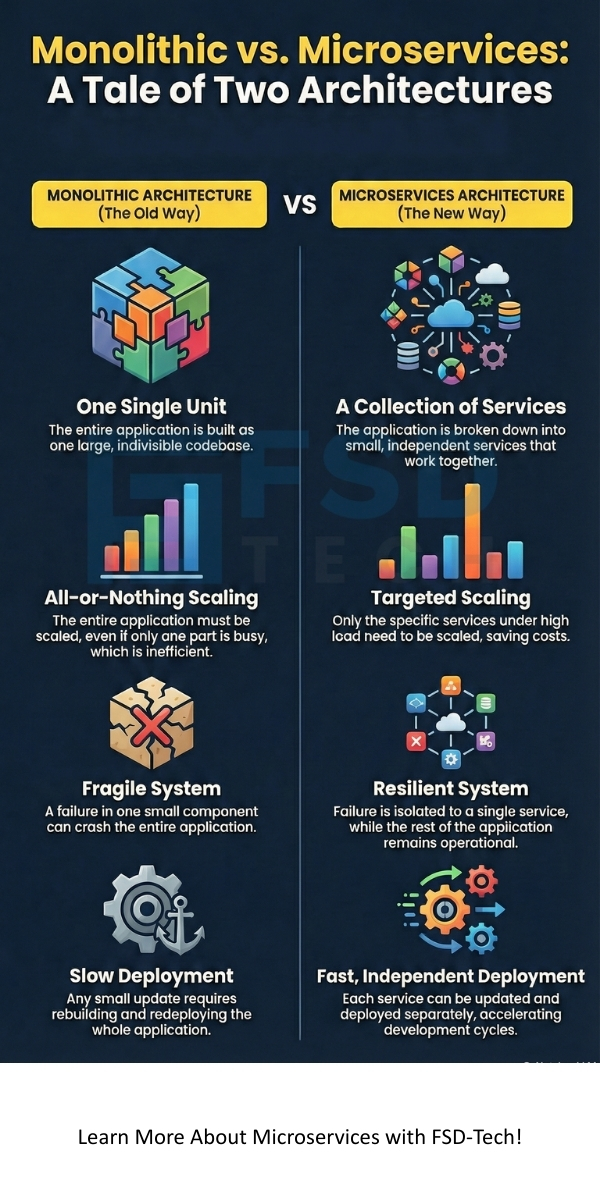
    A Monolithic application is built as a single, indivisible unit. All components, including the user interface, business logic, and data access layers, reside in one massive codebase. When you need to update one small function, you must rebuild and redeploy the entire application.


    Basis for ComparisonMonolithic ArchitectureMicroservices Architecture
    StructureSingle, indivisible unit.Collection of small, autonomous services.
    DeploymentRequires deploying the entire application.Each service deploys independently.
    ScalabilityMust scale the entire application.Scales individual services as needed.
    TechnologyFixed to one technology stack.Allows multiple technologies (polyglot).
    Fault ToleranceFailure in one component can crash all.Failure is isolated to one service.
    DevelopmentSlows down as the codebase grows large.Remains agile and fast regardless of size.

    Microservices Architecture overcomes the limitations of the monolithic approach. While monolithic applications start simple, they become increasingly complex over time. They tend to slow down development velocity.


    Also Read: What is Neuromorphic Computing? Future of AI & Hardware


    Key Differences: Why Microservices Win?

    Let us now list the specific distinctions in the monolithic vs microservices debate that favor the modern approach.


    1. Technology Stack: While a monolithic application is fixed to one language like Java or C#, Microservices Architecture allows for technology diversity. For example, you can use what is microservices in Spring Boot for one service and what are microservices in .NET for another.
    2. Codebase Complexity: Monolithic systems have one massive codebase. This makes new developer onboarding lengthy and complex. On the other hand, the small, focused codebase of a microservice simplifies management significantly.
    3. CI/CD Pipeline: With a monolithic application, continuous integration and continuous delivery (CI/CD) processes are slow because the build, test, and deploy stages take a long time. The independence of Microservices enables much quicker and more parallel CI/CD pipelines.
    4. Database Management: A monolithic system typically relies on a single, shared database. This coupling can create performance bottlenecks and data contention issues. Microservices Architecture mandates separate, dedicated databases for each service, removing this coupling.
    5. Organizational Alignment: The best microservices architecture aligns development teams with business domains (e.g., an Order Team, a Catalog Team). This setup improves communication and ensures faster decision-making compared to the functional teams often found managing monolithic systems.


    Therefore, building a system with Microservices Architecture helps your teams move faster and manage complexity better.


    How Microservices Work and Communicate?

    Understanding how microservices work is essential to implement them correctly. At its core, a microservice is a process that runs independently. It has a lightweight mechanism for communication with other services.


    In simple words, the way Microservices Architecture functions is by replacing internal method calls (common in monolithic systems) with network calls. This means two separate services must be able to send data back and forth reliably and efficiently.


    Understanding How Microservices Communicate with Each Other

    Now, the question is: how microservices communicate with each other? Since they run as separate processes, they rely on two main communication styles: synchronous and asynchronous.


    1. Synchronous Communication

    In this method, the client service sends a request to the server service and then pauses. It waits for the server service to process the request and send a response back.


    • REST (Representational State Transfer): This is the most common protocol. It uses standard HTTP requests.
    • gRPC: This uses Protocol Buffers and is known for being high-performance, often used for internal service-to-service communication.


    However, this method creates a tight coupling. If the server service is down, the client service must wait, which can cause cascading failures.


    2. Asynchronous Communication

    This is the preferred style for building resilient Microservices Architecture. The client service sends a message and continues its work without waiting for an immediate response. It relies on a message broker or queue.


    • Message Queues (e.g., RabbitMQ, Kafka): Services send messages to a channel, and other services subscribe to that channel to consume the messages. This de-coupling is a powerful feature of the best microservices architecture.
    • Event-Driven Architecture: In this approach, a service publishes an event (e.g., "Order Created"), and any interested service (e.g., Inventory, Shipping) reacts to that event. This allows services to remain truly independent.


    By choosing the right communication method, you ensure that how microservices communicate aligns with the necessary reliability and performance standards for your application.


    Also Read: What is the Cyber Kill Chain? Critical Cybersecurity Model


    Role of API Gateways in Microservices Architecture Diagrams

    A standard Microservices Architecture Diagram always includes an API Gateway. The API Gateway serves as the single entry point for all client requests.


    The API Gateway is nothing but a dedicated service that accepts all requests from users (web browser, mobile app) and then routes them to the appropriate back-end microservice. It also handles essential functions like security, rate limiting, and load balancing. This component helps to hide the complexity of the internal Microservices Architecture from the outside world.


    Implementing the Best Microservices Architecture with Key Frameworks

    To actually build and run Microservices, developers rely on specific software frameworks and platforms. These tools provide the necessary features for service discovery, configuration, and inter-service communication.


    The technology you choose dictates much of the implementation process. Let us explore some common and powerful platforms for Microservices Architecture.


    What is Microservices in Spring Boot

    Spring Boot is perhaps the most popular framework for building Java-based Microservices. Java is a mature language, and the Spring ecosystem provides all the tools developers need for a complete Microservices Architecture.


    Spring Boot Microservices simplifies the setup of Java applications. It ensures that developers can focus purely on business logic rather than on complex configuration. Due to its robustness and extensive community support, it remains a common choice for enterprise-level applications. This platform assists in quickly creating production-ready, standalone Spring applications. It helps teams manage services, handle security, and integrate easily with cloud platforms.


    What are Microservices in .NET?

    Microsoft's .NET platform offers strong tools for building Microservices Architecture. Specifically, Microservices in .NET use .NET Core or the newer .NET framework. This platform is known for its high performance and robust developer tooling.


    The .NET ecosystem provides excellent integration with Microsoft Azure cloud services. This makes it a perfect choice for organizations committed to the Microsoft stack. Using C#, developers can create high-speed, scalable services. The platform also includes built-in features for handling networking and serialization, which are essential for how microservices communicate.


    What is Microservices in Node JS?

    For applications requiring speed, high concurrency, and a lightweight footprint, Microservices in Node JS are an excellent option. Node.js uses JavaScript, a language that allows developers to use the same language for both the front-end and back-end services.


    Node.js is an efficient choice for creating I/O-intensive microservices. It is based on a non-blocking, event-driven model that handles many simultaneous connections without needing high memory. This efficiency allows Node.js services to deliver fast response times, which is a vital factor for achieving the best microservices architecture performance.


    Essential Microservices Architecture Diagrams and Design Patterns

    A well-designed Microservices Architecture requires careful planning and the use of established patterns. Understanding these concepts helps you avoid common pitfalls when moving from a monolithic application.


    A proper Microservices Architecture Diagram is a visual map. It shows all the services, the API Gateway, the service discovery component, and the message broker. This map helps teams understand the flow of data and the dependencies between services.


    Core Design Patterns for Microservices

    Successful implementation relies on applying proven design patterns. These patterns solve recurring problems in distributed systems.


    1. Database Per Service: This pattern is fundamental. Each service must maintain its own private database. This ensures low coupling and high cohesion. It allows a service to change its database schema without affecting other services.
    2. Service Discovery: When a new service instance starts, how does the API Gateway know its network location? Service Discovery solves this. It is a mechanism that allows clients to find and communicate with a service instance without hardcoding the location.
    3. Circuit Breaker: This pattern ensures system resilience. When a service constantly fails, the Circuit Breaker prevents the client service from repeatedly calling it. This allows the failing service time to recover, which prevents cascading failures. This is a critical component for high-availability systems.
    4. Saga Pattern: This pattern helps manage transactions that span across multiple services. Since there is no central database in Microservices Architecture, a transaction must be completed by a sequence of local transactions. The Saga pattern ensures that if one step fails, the previous steps are compensated for, maintaining data consistency.


    Addressing Transaction Management

    Managing transactions is often considered one of the hardest parts of Microservices Architecture. Since each service has its own data, a simple process like placing an order requires coordination across the Order Service, the Inventory Service, and the Payment Service.


    The Saga pattern is used to coordinate these complex business workflows. It is to be noted that adopting Microservices Architecture means accepting the complexity of distributed transactions. This is a trade-off for the gains in scalability and fault isolation.


    Conclusion

    Microservices Architecture changes large applications into small, independent services that teams can build, update, and scale separately. This approach brings faster development, better fault isolation, easier maintenance, and the freedom to use the best tools for each job. Although it adds some complexity in operations and communication, the gains in speed, reliability, and flexibility make it worthwhile for most growing systems. 


    Companies that adopt microservices stay agile and respond quickly to new needs. Moving to this style is a practical step toward building software that lasts and performs well under real-world pressure.


    Proactive Microservices Contact our team
     

    Microservices infographic


    Key Takeaways

    ·  Fundamental Shift in Development: Microservices Architecture moves development away from large, rigid monolithic applications. It focuses instead on creating small, flexible, and powerful services.

    ·  Enhanced Team Autonomy and Speed: This architectural shift provides development teams with the autonomy they need. This enables them to innovate quickly and meet the constantly evolving demands of the business.

    ·  Targeted Scaling and Efficiency: Microservices allow you to scale specific business functions as required. You can choose the optimal technology stack for each service, improving resource efficiency.

    ·  Guaranteed Platform Resilience: The architecture ensures that a single service failure does not crash the entire platform. This fault isolation is vital for maintaining stability in today's digital world.

    ·  Alignment with Business Goals: Transitioning to a true Microservices Architecture is necessary for organizations seeking adaptability and responsiveness. It ensures that technology actively serves, rather than limits, your strategic business goals.


    Frequently Asked Questions (FAQs) on Microservices

    What is the primary difference between a Monolith and Microservices?

    The primary difference refers to the structure and deployment. A Monolithic application is one codebase, deployed as a single unit. In contrast, Microservices Architecture comprises many small, independent services, each deployed separately. This fundamental difference dictates the team structure, scalability, and overall development speed.


    How are microservices deployed and managed in the cloud?

    Microservices are typically deployed using containerization technologies like Docker and orchestration platforms like Kubernetes. Kubernetes facilitates service discovery, load balancing, and auto-scaling, which are essential for managing a complex Microservices Architecture.


    What is the most critical challenge of adopting Microservices Architecture?

    The most critical challenge is often the increased operational complexity. The transition requires new skills for monitoring, logging, and tracing across dozens or hundreds of services. How microservices communicate with each other also requires careful management of network latency and distributed transactions.


    Can Microservices be written in different languages, and why is this allowed?

    Yes, they can be written in different languages—a concept known as polyglot persistence or programming. This is a feature of the Microservices Architecture. It allows teams to choose the language (what is microservices in Spring Boot, what are microservices in Node JS, etc.) that is most efficient for that specific service’s function.


    What is service discovery, and why is it needed?

    Service discovery is nothing but a mechanism that allows services to find the network location (IP address and port) of other services. It is needed because services in a Microservices Architecture are dynamic, meaning they frequently scale up or down. Service discovery ensures communication remains effective even when service locations change constantly.


    What is Microservices Architecture? Guide & Benefits

    About The Author

    Surbhi Suhane

    Surbhi Suhane is an experienced digital marketing and content specialist with deep expertise in Getting Things Done (GTD) methodology and process automation. Adept at optimizing workflows and leveraging automation tools to enhance productivity and deliver impactful results in content creation and SEO optimization.

    Like This Story?

    Share it with friends!

    Subscribe to our newsletter!

    Atera

    (48)

    Cato Networks

    (116)

    ClickUp

    (70)

    FishOS

    (7)

    Miradore

    (21)

    PointGuard AI

    (9)

    Vembu

    (22)

    Xcitium

    (33)

    ZETA HRMS

    (73)

    Workflow Automation(8)

    Workforce Automation(1)

    AI Project Management(1)

    HR Data Automation(1)

    RMM(1)

    IT Workflow Automation(1)

    IT security(2)

    GCC compliance(4)

    Payroll Integration(2)

    IT support automation(3)

    procurement automation(1)

    lost device management(1)

    IT Management(5)

    IoT Security(2)

    Cato XOps(2)

    IT compliance(4)

    Task Automation(1)

    Workflow Management(1)

    AI-powered cloud ops(1)

    Kubernetes lifecycle management(2)

    OpenStack automation(1)

    SMB Security(8)

    Data Security(1)

    MDR (Managed Detection & Response)(4)

    Atera Integrations(2)

    MSP Automation(3)

    XDR Security(2)

    SMB Cyber Protection(1)

    Ransomware Defense(3)

    HR Tech Solutions(1)

    Zero Trust Network Access(3)

    Zero Trust Security(2)

    Endpoint Management(1)

    SaaS Security(1)

    Payroll Automation(5)

    IT Monitoring(2)

    Xcitium EDR SOC(15)

    Ransomware Protection GCC(1)

    Network Consolidation UAE(1)

    M&A IT Integration(1)

    MSSP for SMBs(1)

    Antivirus vs EDR(1)

    FSD-Tech MSSP(25)

    Ransomware Protection(3)

    Managed EDR FSD-Tech(1)

    SMB Cybersecurity GCC(1)

    Cybersecurity GCC(12)

    Endpoint Security(1)

    Endpoint Protection(1)

    Data Breach Costs(1)

    Xcitium EDR(30)

    Zero Dwell Containment(31)

    SMB Cybersecurity(8)

    Managed Security Services(2)

    Hybrid Backup(1)

    Cloud Backup(1)

    Backup & Recovery(1)

    pointguard ai(4)

    backup myths(1)

    vembu(9)

    SMB data protection(9)

    disaster recovery myths(1)

    Disaster Recovery(4)

    Vembu BDR Suite(19)

    GCCBusiness(1)

    DataProtection(1)

    Secure Access Service Edge(4)

    GCC HR software(16)

    Miradore EMM(15)

    Cato SASE(7)

    Cloud Security(8)

    Talent Development(1)

    AI Governance(4)

    AI Risk Management(1)

    AI Security(2)

    AI Cybersecurity(12)

    AI Compliance(2)

    GCC business security(1)

    GCC network integration(1)

    compliance automation(5)

    education security(1)

    GCC cybersecurity(2)

    BYOD security Dubai(8)

    App management UAE(1)

    Miradore EMM Premium+(5)

    MiddleEast(1)

    HealthcareSecurity(1)

    Team Collaboration(1)

    IT automation(12)

    Zscaler(1)

    SD-WAN(6)

    HR Integration(4)

    Cloud Networking(3)

    device management(9)

    VPN(1)

    RemoteWork(1)

    ZeroTrust(2)

    MPLS(1)

    Project Management(9)

    HR automation(16)

    share your thoughts

    Cloud access security broker

    What is Cloud Access Security Broker (CASB)?

    🕓 January 23, 2026

    Geofencing-technology

    What is Geofencing Technology? All You Need to Know

    🕓 January 23, 2026

    Advanced Persistent Threat (APT)

    What is Advanced Persistent Threat (APT)?

    🕓 January 22, 2026

    Decoded(80)

    Cyber Security(116)

    BCP / DR(22)

    Zeta HRMS(72)

    SASE(21)

    Automation(70)

    Next Gen IT-Infra(116)

    Monitoring & Management(69)

    ITSM(22)

    HRMS(21)

    Automation(24)