HomeNext Gen IT-InfraMonitoring & ManagementCyber SecurityBCP / DRAutomationDecoded
Next Gen IT-Infra
Cato’s SASE Supports Cybersecurity Skills Development

How Cato’s SASE Supports Cybersecurity Skills Development

🕓 April 8, 2025

How SASE Supports the Security Needs of SMBs

How SASE Supports the Security Needs of SMBs

🕓 February 9, 2025

Attack Surface Reduction with Cato’s SASE

Attack Surface Reduction with Cato’s SASE

🕓 February 10, 2025

SASE for Digital Transformation in UAE

SASE for Digital Transformation in UAE

🕓 February 8, 2025

Monitoring & Management
Understanding Atera’s SLA Management

Understanding Atera’s SLA Management

🕓 February 7, 2025

Cost-Performance Ratio: Finding the Right Balance in IT Management Networks

Cost-Performance Ratio: Finding the Right Balance in IT Management Networks

🕓 June 16, 2025

Customizing Atera with APIs

Customizing Atera with APIs

🕓 March 3, 2025

Power Up Your IT Team’s Strategy with Atera’s Communication Tools

Power Up Your IT Team’s Strategy with Atera’s Communication Tools

🕓 February 8, 2025

Cyber Security
Illustration of the Cato Cloud architecture showing its role in delivering SASE for secure, optimized global connectivity.

Understanding the Cato Cloud and Its Role in SASE

🕓 January 29, 2025

Isometric illustration of professionals managing network performance, bandwidth analytics, and cloud-based optimization around the Cato Networks platform, symbolizing bandwidth control and QoS visibility.

Mastering Bandwidth Control and QoS in Cato Networks

🕓 July 26, 2025

Global network backbone powering Cato SASE solution for secure, high-performance connectivity across regions.

Global Backbone: The Engine Powering Cato’s SASE Solution

🕓 January 30, 2025

Illustration of team analyzing application traffic and usage insights on a large laptop screen using Cato’s dashboard, surrounded by network and cloud icons.

Cato Networks Application Visibility | Monitoring & Control

🕓 July 27, 2025

BCP / DR
Illustration showing diverse business and IT professionals collaborating with cloud, backup, and security icons, representing Vembu use cases for SMBs, MSPs, and IT teams.

Who Uses Vembu? Real-World Use Cases for SMBs, MSPs & IT Teams

🕓 July 12, 2025

Graphic showcasing Vembu’s all-in-one backup and disaster recovery platform with icons for cloud, data protection, and business continuity for IT teams and SMBs.

What Is Vembu? A Deep Dive Into the All in One Backup & Disaster Recovery Platform

🕓 July 6, 2025

Illustration showing Vembu backup and disaster recovery system with cloud storage, server racks, analytics dashboard, and IT professionals managing data.

The Rising Cost of Data Loss: Why Backup Is No Longer Optional?

🕓 August 14, 2025

3D isometric illustration of cloud backup and data recovery infrastructure with laptop, data center stack, and digital business icons — FSD Tech

RPO & RTO: The Heart of Business Continuity

🕓 August 15, 2025

Automation
Cross-Functional Collaboration with ClickUp

Fostering Cross-Functional Collaboration with ClickUp for Multi-Departmental Projects

🕓 February 11, 2025

ClickUp Project Reporting

Revolutionizing Enterprise Reporting with ClickUp’s Advanced Analytics and Dashboards

🕓 June 16, 2025

ClickUp’s Design Collaboration and Asset Management Tools

Empowering Creative Teams with ClickUp’s Design Collaboration and Asset Management Tools

🕓 February 26, 2025

ClickUp Communication and Collaboration Tools

ClickUp Communication and Collaboration Tools: Empowering Remote Teams

🕓 March 12, 2025

Decoded
Multi-Factor Authentication (MFA)

Multi-Factor Authentication (MFA): All You Need to Know

🕓 December 7, 2025

L3 Switch

What Is an L3 Switch? L2 vs L3 & Why You Need Layer 3?

🕓 December 8, 2025

IPSec

IPSec Explained: Protocols, Modes, IKE & VPN Security

🕓 December 3, 2025

 Datagram Transport Layer Security (DTLS)

What is Datagram Transport Layer Security (DTLS)? How it works?

🕓 December 4, 2025

    Subscribe to our newsletter!

    About Us

    Follow Us

    Copyright © 2024 | Powered by 

    Atera

    (56)

    Cato Networks

    (130)

    ClickUp

    (78)

    FishOS

    (7)

    Miradore

    (21)

    PointGuard AI

    (9)

    Vembu

    (22)

    Xcitium

    (33)

    ZETA HRMS

    (79)

    Table of Contents

    What is an Identity Provider? Guide to IdP & Security

    Surbhi Suhane
    March 12, 2026
    Comments
     Identity Provider (IdP)

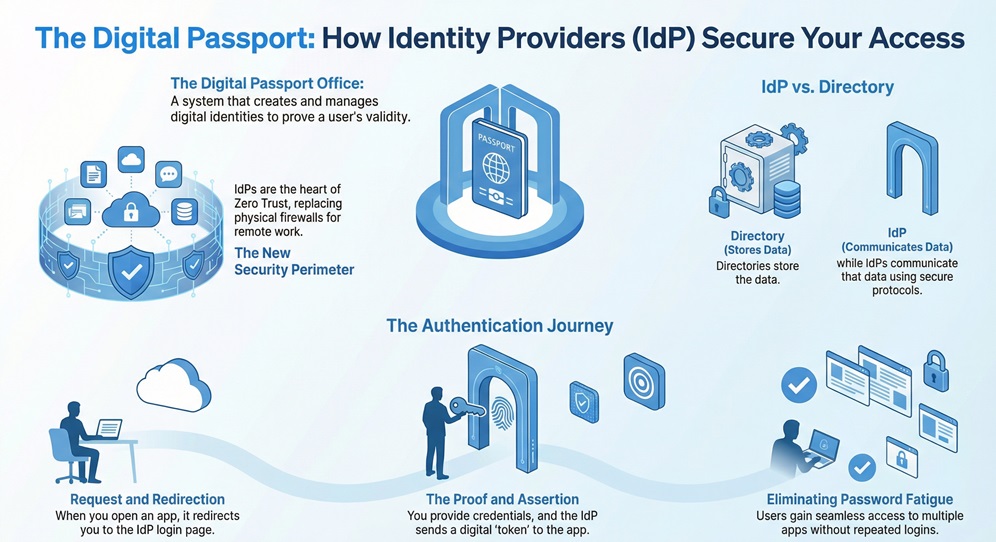
    Have you ever wondered how you can log into ten different work apps without typing your password ten times? It feels like magic, but it is actually the work of an Identity Provider. In the tech world, we call this an IdP. Think of it as a digital passport office. It proves you are who you say you are so you can enter different digital "countries" or applications safely.


    But why should you care about how these systems work? To be honest, the way we handle digital identities has changed fast. We no longer just sit in an office behind a physical firewall. We work from home, cafes, and airports. This shift makes the Identity Provider the new perimeter of security. It is the heart of a Zero Trust strategy, where we trust no one until they prove their identity.


    What is an Identity Provider?

    An Identity Provider is a system that creates, maintains, and manages digital identity information. It tells other programs that a user is valid. When you try to access a cloud app, the app asks the IdP, "Hey, do I know this person?" The IdP checks your credentials—like a username or a thumbprint—and sends back a "yes" or "no."

    Identity Provider


    In my experience, people often confuse an IdP with a simple directory. While they are related, they aren't the same. A directory, like Active Directory (AD), holds the data. The Identity Provider is the service that actually communicates that data to other platforms using secure protocols.


    Get a Free Identity Audit


    How does an Identity Provider Work?

    The process is like showing your ID at a concert. You don’t give the security guard your birth certificate and social security card. You show them a state-issued license. They trust the state, so they trust you.


    1. The Request: You try to open an app like Slack or SAP.
    2. The Redirection: The app sends you to your IdP login page.
    3. The Proof: You enter your password or use a hardware key.
    4. The Assertion: The IdP sends a digital "token" back to the app.
    5. The Access: You are in!


    Does this sound familiar? You likely use this every day without realizing it. It saves time and stops "password fatigue."


    Also Read: Threat Actors: Who is Behind Your Cyber Security Risks?


    The Critical Role of an Identity Provider in Modern Security

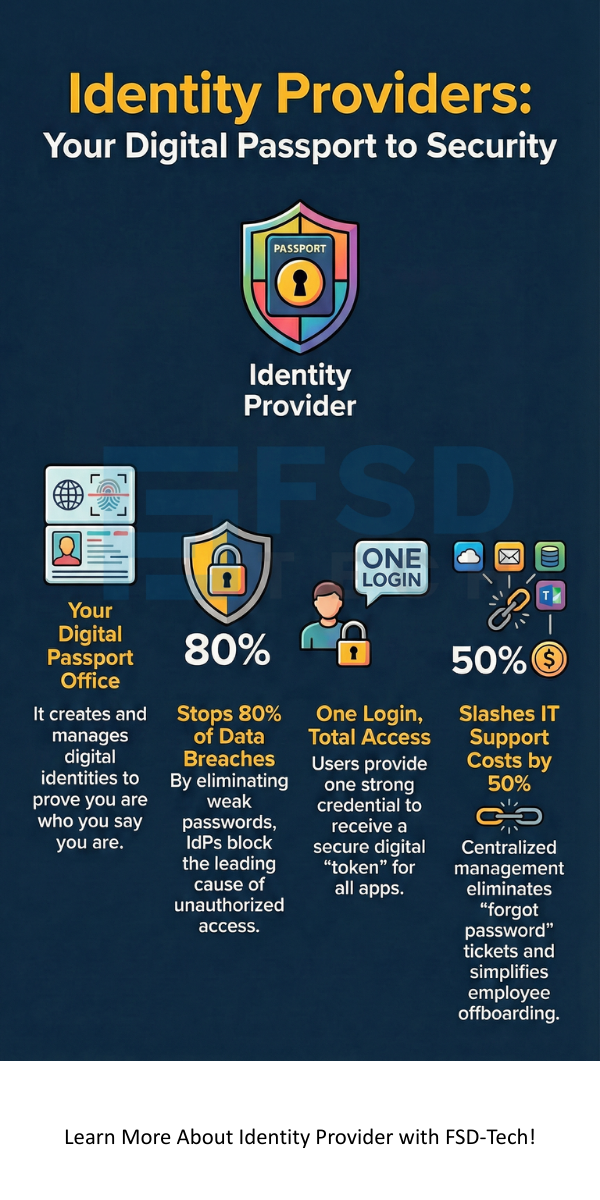
    We've all been there—trying to remember if the password had an exclamation point or a capital "Q." When companies don't use a central Identity Provider, employees make weak passwords. This is a huge risk. An IdP allows for Single Sign-On (SSO), which means you only need one very strong password (and hopefully a second factor) to get everywhere.


    Supporting a Zero Trust Model

    In a Zero Trust world, the Identity Provider is king. It doesn't just check your password once. It looks at your location, your device health, and the time of day. If you usually log in from New York but suddenly appear in London five minutes later, the IdP will stop you.


    Roughly 80% of data breaches involve weak or stolen credentials. By using an IdP, you shrink the "attack surface." You give hackers fewer doors to knock on.


    Key Benefits of Using an Identity Provider

    Why do IT teams love these systems? It isn’t just about security; it’s about making life easier for everyone.


    • Better User Experience: Users love not having to log in constantly. It keeps them in the "flow" of work.
    • Centralized Control: If an employee leaves, the admin disables one account in the Identity Provider. Instantly, that person loses access to every company app.
    • Lower IT Costs: Think about how many "I forgot my password" tickets your IT team gets. A central IdP cuts those tickets by more than half.
    • Compliance: Most industries require strict logs of who accessed what. An IdP provides a clear audit trail.


    Common Protocols Used by an Identity Provider

    To talk to different apps, an IdP needs a common language. You might see these acronyms in your settings.


    SAML (Security Assertion Markup Language)

    This is the "old reliable" of the bunch. It uses XML to pass data between the Identity Provider and the service provider. It is very common in corporate tools like SAP Single Sign-On.


    OIDC (OpenID Connect)

    This is a newer, lighter language. It sits on top of OAuth 2.0. If you use "Sign in with Google" on a website, you are likely using OIDC. It’s great for mobile apps.


    Identity Provider in the Cloud vs. On-Premise

    Should you keep your IdP in your own basement or put it in the cloud? In my view, the cloud is winning for a reason.


    On-Premise IdPs give you total control. However, they are hard to maintain. You have to handle updates, hardware, and security patches yourself.


    Cloud IdPs (like Okta or Azure AD) are "Identity as a Service" (IDaaS). They scale automatically. If you have 10 employees today and 1,000 tomorrow, the cloud handles it. Plus, they stay updated against the latest threats without you lifting a finger.


    Also Read: What is the Shared Responsibility Model and Why Does it Matter?


    Connecting an Identity Provider to SAP Systems

    For big businesses, connecting an IdP to SAP is a game changer. SAP Identity Management works with your IdP to make sure permissions are right. When the Identity Provider confirms a user, SAP then checks exactly what that user is allowed to do inside the finance or HR modules.


    This creates a "Single Point of Truth." You don't have different lists of users in different places. Everything stays in sync.


    Challenges to Consider

    Is it all sunshine and rainbows? Not quite. Here is the thing: if your Identity Provider goes down, no one can work. It is a "single point of failure."


    This is why choosing a provider with high availability is a must. You also need to ensure your IdP supports Multi-Factor Authentication (MFA). A password alone is no longer enough. Are you using an authenticator app or a physical key? You should be.


    How to Choose the Right Identity Provider

    Don't just pick the first name you see. Think about your specific needs.


    1. Integration: Does it work with the apps you already use?
    2. Ease of Use: Is the interface clean for your employees?
    3. Security Features: Does it offer "risk-based" authentication?
    4. Support: If things break at 2 AM, who can you call?


    The Future of Identity

    We are moving toward a "passwordless" future. Your Identity Provider will soon rely entirely on biometrics (like FaceID) and hardware signals. This will make things even faster and safer.


    Picture this: You walk up to your laptop, it sees your face, checks your phone's location, and opens all your apps. No typing. No stress. That is the goal of a modern IdP.


    Conclusion

    At our core, we believe that security should never get in the way of great work. A strong Identity Provider balances safety with a smooth experience. It protects your data while letting your team move fast. We focus on building trust through technology. If you want to secure your future, start with how you identify your people.


    Identity Provider infographic


    Secure Your Team Now


    Key Takeaways

    • An Identity Provider (IdP) is the central hub for managing digital identities and verifying users.
    • It is the foundation of Zero Trust security, moving beyond simple firewalls.
    • The Identity Provider uses protocols like SAML and OIDC to communicate with apps.
    • Using an IdP reduces IT costs by cutting down on password reset requests.
    • Cloud-based IdPs offer better scalability and faster updates than on-premise versions.


    Frequently Asked Questions About Identity Provider

    What is the difference between an IdP and a Service Provider (SP)?

    The IdP holds the user info and proves identity. The Service Provider is the app (like Gmail or Salesforce) that provides the service once the IdP gives the green light.


    Can I have more than one Identity Provider?

    Yes, some companies use "identity federation." This links multiple IdPs so users from different organizations can work together safely.


    Is an Identity Provider the same as SSO?

    Not exactly. SSO is the benefit you get. The Identity Provider is the engine that makes SSO happen.

    What is an Identity Provider? Guide to IdP & Security

    About The Author

    Surbhi Suhane

    Surbhi Suhane is an experienced digital marketing and content specialist with deep expertise in Getting Things Done (GTD) methodology and process automation. Adept at optimizing workflows and leveraging automation tools to enhance productivity and deliver impactful results in content creation and SEO optimization.

    TRY OUR PRODUCTS

    Like This Story?

    Share it with friends!

    Subscribe to our newsletter!

    FishOSCato SASEVembuXcitiumZeta HRMSAtera
    Isometric illustration of a centralized performance platform connected to analytics dashboards and team members, representing goal alignment, measurable outcomes, risk visibility, and strategic project tracking within ClickUp.

    How ClickUp Enables Outcome-Based Project Management (Not Just Task Tracking)

    🕓 February 15, 2026

    Isometric illustration of a centralized executive dashboard platform connected to analytics panels, performance charts, security indicators, and strategic milestones, representing real-time business visibility and decision control within ClickUp.

    Executive Visibility in ClickUp – How CXOs Gain Real-Time Control Without Micromanaging

    🕓 February 13, 2026

    Cato SASE Architecture

    Inside Cato’s SASE Architecture: A Blueprint for Modern Security

    🕓 January 26, 2025

    Workflow Automation(8)

    Workforce Automation(1)

    AI Project Management(1)

    HR Data Automation(1)

    RMM(2)

    IT Workflow Automation(1)

    IT security(2)

    GCC compliance(4)

    Payroll Integration(2)

    IT support automation(3)

    procurement automation(1)

    lost device management(1)

    IT Management(5)

    IoT Security(2)

    Cato XOps(1)

    IT compliance(4)

    Workflow Management(1)

    Task Automation(1)

    Kubernetes lifecycle management(2)

    AI-powered cloud ops(1)

    OpenStack automation(1)

    SMB Security(8)

    Data Security(1)

    MDR (Managed Detection & Response)(3)

    MSP Automation(3)

    Atera Integrations(2)

    XDR Security(2)

    Threat Detection & Response(1)

    Ransomware Defense(3)

    SMB Cyber Protection(1)

    HR Tech Solutions(1)

    Zero Trust Network Access(3)

    Post-Quantum Cryptography(1)

    Quantum Threat UAE & GCC(1)

    Quantum Security(1)

    Cloud IDE Security(1)

    Zero Trust Security(2)

    Endpoint Management(1)

    SaaS Security(2)

    Payroll Automation(5)

    IT Monitoring(2)

    Xcitium EDR SOC(15)

    Ransomware Protection GCC(1)

    M&A IT Integration(1)

    Network Consolidation UAE(1)

    MSSP for SMBs(1)

    Antivirus vs EDR(1)

    Managed EDR FSD-Tech(1)

    Ransomware Protection(3)

    SMB Cybersecurity GCC(1)

    FSD-Tech MSSP(25)

    Endpoint Security(1)

    Cybersecurity GCC(14)

    Data Breach Costs(1)

    Endpoint Protection(1)

    SMB Cybersecurity(8)

    Xcitium EDR(30)

    Zero Dwell Containment(31)

    Managed Security Services(2)

    Cloud Backup(1)

    Hybrid Backup(1)

    Backup & Recovery(1)

    pointguard ai(4)

    vembu(9)

    SMB data protection(9)

    backup myths(1)

    disaster recovery myths(1)

    Disaster Recovery(4)

    Vembu BDR Suite(19)

    DataProtection(1)

    GCCBusiness(1)

    Secure Access Service Edge(4)

    GCC IT Solutions(1)

    Unified Network Management(1)

    GCC HR software(20)

    open banking(1)

    financial cybersecurity(2)

    CC compliance(1)

    Miradore EMM(15)

    Government Security(1)

    Cato SASE(9)

    GCC Education(1)

    Cloud Security(9)

    Hybrid Learning(1)

    Talent Development(1)

    AI Governance(4)

    AI Cybersecurity(13)

    AI Compliance(2)

    AI Security(2)

    AI Risk Management(1)

    Secure Remote Access(1)

    GCC business security(1)

    GCC network integration(1)

    compliance automation(5)

    education security(1)

    GCC cybersecurity(3)

    App management UAE(1)

    BYOD security Dubai(8)

    Miradore EMM Premium+(5)

    HealthcareSecurity(1)

    share your thoughts

     Identity Provider (IdP)

    What is an Identity Provider? Guide to IdP & Security

    🕓 March 12, 2026

    Code signing

    Why Code Signing Matters for Your Software Security?

    🕓 March 12, 2026

    Rootkit Attacks

    Rootkit Attacks: How Stealthy Malware Hides Inside Your System

    🕓 March 11, 2026

    Decoded(152)

    Cyber Security(127)

    BCP / DR(22)

    Zeta HRMS(78)

    SASE(21)

    Automation(78)

    Next Gen IT-Infra(127)

    Monitoring & Management(77)

    ITSM(22)

    HRMS(21)

    Automation(24)