HomeNext Gen IT-InfraMonitoring & ManagementCyber SecurityBCP / DRAutomationDecoded
Next Gen IT-Infra
Cato’s SASE Supports Cybersecurity Skills Development

How Cato’s SASE Supports Cybersecurity Skills Development

🕓 April 8, 2025

How SASE Supports the Security Needs of SMBs

How SASE Supports the Security Needs of SMBs

🕓 February 9, 2025

Attack Surface Reduction with Cato’s SASE

Attack Surface Reduction with Cato’s SASE

🕓 February 10, 2025

SASE for Digital Transformation in UAE

SASE for Digital Transformation in UAE

🕓 February 8, 2025

Monitoring & Management
Understanding Atera’s SLA Management

Understanding Atera’s SLA Management

🕓 February 7, 2025

Cost-Performance Ratio: Finding the Right Balance in IT Management Networks

Cost-Performance Ratio: Finding the Right Balance in IT Management Networks

🕓 June 16, 2025

Customizing Atera with APIs

Customizing Atera with APIs

🕓 March 3, 2025

Power Up Your IT Team’s Strategy with Atera’s Communication Tools

Power Up Your IT Team’s Strategy with Atera’s Communication Tools

🕓 February 8, 2025

Cyber Security
Visual guide showing Cato CMA interface for configuring Internet and WAN firewall rules, enabling threat protection, and monitoring security events in real time for UAE IT teams.

Enforcing Firewall and Threat Protection Policies in Cato

🕓 July 25, 2025

Isometric illustration of professionals managing network performance, bandwidth analytics, and cloud-based optimization around the Cato Networks platform, symbolizing bandwidth control and QoS visibility.

Mastering Bandwidth Control and QoS in Cato Networks

🕓 July 26, 2025

Illustration of the Cato Cloud architecture showing its role in delivering SASE for secure, optimized global connectivity.

Understanding the Cato Cloud and Its Role in SASE

🕓 January 29, 2025

Global network backbone powering Cato SASE solution for secure, high-performance connectivity across regions.

Global Backbone: The Engine Powering Cato’s SASE Solution

🕓 January 30, 2025

BCP / DR
Illustration showing diverse business and IT professionals collaborating with cloud, backup, and security icons, representing Vembu use cases for SMBs, MSPs, and IT teams.

Who Uses Vembu? Real-World Use Cases for SMBs, MSPs & IT Teams

🕓 July 12, 2025

Graphic showcasing Vembu’s all-in-one backup and disaster recovery platform with icons for cloud, data protection, and business continuity for IT teams and SMBs.

What Is Vembu? A Deep Dive Into the All in One Backup & Disaster Recovery Platform

🕓 July 6, 2025

Illustration showing Vembu backup and disaster recovery system with cloud storage, server racks, analytics dashboard, and IT professionals managing data.

The Rising Cost of Data Loss: Why Backup Is No Longer Optional?

🕓 August 14, 2025

3D isometric illustration of cloud backup and data recovery infrastructure with laptop, data center stack, and digital business icons — FSD Tech

RPO & RTO: The Heart of Business Continuity

🕓 August 15, 2025

Automation
Cross-Functional Collaboration with ClickUp

Fostering Cross-Functional Collaboration with ClickUp for Multi-Departmental Projects

🕓 February 11, 2025

ClickUp Project Reporting

Revolutionizing Enterprise Reporting with ClickUp’s Advanced Analytics and Dashboards

🕓 June 16, 2025

ClickUp’s Design Collaboration and Asset Management Tools

Empowering Creative Teams with ClickUp’s Design Collaboration and Asset Management Tools

🕓 February 26, 2025

ClickUp Communication and Collaboration Tools

ClickUp Communication and Collaboration Tools: Empowering Remote Teams

🕓 March 12, 2025

Decoded
Multi-Factor Authentication (MFA)

Multi-Factor Authentication (MFA): All You Need to Know

🕓 December 7, 2025

L3 Switch

What Is an L3 Switch? L2 vs L3 & Why You Need Layer 3?

🕓 December 8, 2025

IPSec

IPSec Explained: Protocols, Modes, IKE & VPN Security

🕓 December 3, 2025

 Datagram Transport Layer Security (DTLS)

What is Datagram Transport Layer Security (DTLS)? How it works?

🕓 December 4, 2025

    Subscribe to our newsletter!

    About Us

    Follow Us

    Copyright © 2024 | Powered by 

    Cato SASE Architecture

    Inside Cato’s SASE Architecture: A Blueprint for Modern Security

    🕓 January 26, 2025

    Enterprise Data Security and Privacy with ClickUp

    Ensuring Enterprise Data Security and Privacy with ClickUp

    🕓 February 9, 2025

    DDoS protection SASE

    DDoS Protection and Cato’s Defence Mechanisms

    🕓 February 11, 2025

    Table of Contents

    What is the Cyber Kill Chain? Critical Cybersecurity Model

    Surbhi Suhane
    January 7, 2026
    Comments
    Cyber Kill Chain

    The Cyber Kill Chain framework refers to the process an intruder uses to attack your network. By understanding the attacker’s approach, you can create effective defenses and stop an intrusion before it causes serious damage.


    The Cyber Kill Chain is nothing but a structured methodology. It helps security teams analyze attacks, improve system defenses, and prioritize their security investments. This approach significantly enhances the ability to predict and prevent cyber-attacks, moving your team from a reactive to a proactive security stance.


    The name “kill chain” originally describes the structure of an attack. In simple words, it refers to the chain of steps an adversary takes to achieve their objective. Now, the question arises: What is the Cyber Kill Chain in cybersecurity?


    In cybersecurity, the Cyber Kill Chain is a model that breaks down the attack process into distinct, observable stages. This framework, developed by Lockheed Martin, gives defenders specific points where they can stop an attack. You, the reader, need to understand each phase to effectively protect your organization.


    Who Developed the Cyber Kill Chain Model?

    It is important to note that Lockheed Martin developed the Cyber Kill Chain framework. They formalized this model to improve the identification and prevention of cyber intrusions.


    The original model acts as a defense-oriented view of the steps an external attacker takes. This understanding allows security teams to identify key indicators of compromise (IOCs) and prevent the attack from progressing.


    What is the Cyber Kill Chain Model?

    The Cyber Kill Chain model provides a clear, sequential path. An adversary must successfully complete this path to execute an attack on a target network. By breaking the attack into stages, you can focus on disrupting the chain at any point. Successfully disrupting the chain means you stop the attack.
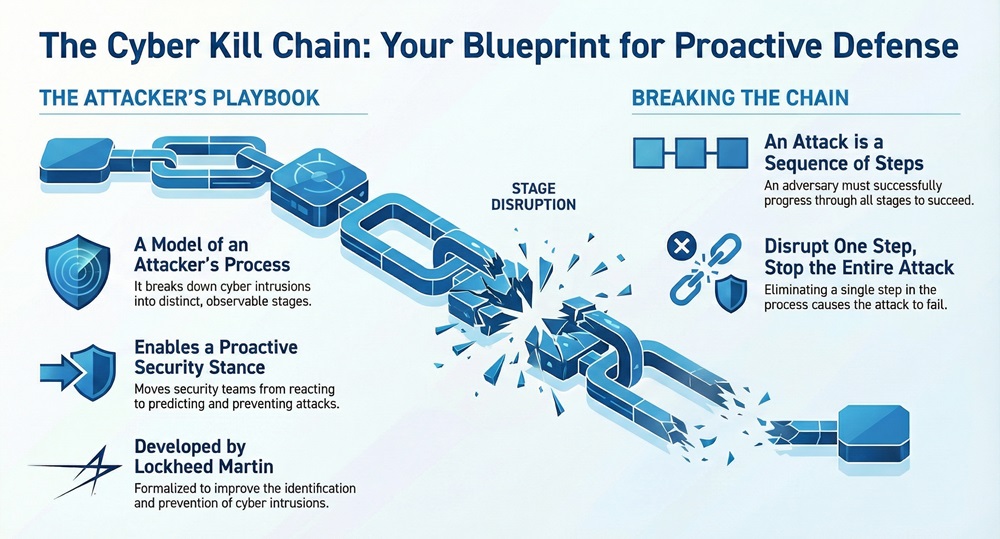
     

    Cyber kill chain


    The entire Cyber Kill Chain methodology relies on the principle that the attacker must progress through all stages. Therefore, if you, the defender, eliminate a single step, the entire attack fails. This is a very powerful concept for building resilient security strategies.


    Let us now discuss the seven essential Cyber Kill Chain stages.


    Break Cyber Kill Chain


    Cyber Kill Chain Stages

    The original Cyber Kill Chain process consists of seven distinct steps. Each step plays a vital role in the attacker's journey to infiltrate and compromise a target system. Cyber Kill Chain steps are sequential and provide a roadmap for detection and mitigation.


    The following are the seven Cyber Kill Chain phases that you need to know:


    1. Reconnaissance

    Reconnaissance is the first step in the Cyber Kill Chain process. The attacker gathers information about the target before the attack. This stage aims to collect data on the target's organization, systems, and personnel.


    Information gathering activities include:


    • Scanning the network to find open ports and running services.
    • Searching public websites and social media for employee names or system details.
    • Reviewing the company’s technology stack or public-facing assets.


    The attacker uses this information to formulate their attack strategy.


    2. Weaponization

    Once the attacker gathers sufficient information, they move to the Weaponization stage. Weaponization refers to the coupling of a malicious payload with an exploitable vulnerability.


    The attacker creates a weapon suitable for the target environment. This weapon typically comprises two main parts:


    • The Payload: The malicious code (e.g., malware, backdoor) that achieves the objective.
    • The Exploit: The mechanism (e.g., a vulnerable software feature) that delivers and executes the payload.


    The combination of exploit and payload creates the ultimate cyber weapon.


    3. Delivery

    The Delivery phase focuses on transmitting the cyber weapon to the target. This step means using various communication channels to send the malicious package to the victim’s environment.


    Common Delivery methods include:


    • Email: Sending spear-phishing emails containing malicious attachments or links.
    • Web: Directing victims to compromised websites with drive-by downloads.
    • USB Media: Using physical devices to introduce the weapon into the network.
    • Network Protocols: Exploiting direct network connections.


    Successful Delivery places the weapon within the target’s network perimeter.


    4. Exploitation

    Exploitation is the phase where the attacker triggers the vulnerability within the system. After the weapon is delivered, the Exploitation step executes the exploit code.


    This action allows the attacker to gain unauthorized access to the target system. The exploit code uses a weakness in the target's software or operating system. For example, the exploit may leverage a buffer overflow to execute arbitrary code.


    Successful Exploitation creates a breach, allowing the attacker to continue the Cyber Kill Chain steps.


    5. Installation

    After successful Exploitation, the attacker performs the Installation phase. Installation refers to placing persistent access mechanisms on the compromised system.


    This step ensures the attacker can maintain control over the system even after a restart or patched vulnerability. The attacker typically installs one or more of the following:


    • Backdoor: A secret way to bypass normal authentication methods.
    • Web Shell: A malicious script that provides remote administrative access via a web browser.
    • Persistence Mechanisms: Settings that ensure the malware runs automatically upon boot-up.


    This guarantees the attacker a firm foothold in the network.


    6. Command and Control (C2)

    The Command and Control (C2) phase is where the installed malware opens a two-way communication channel. The attacker uses this channel to control the compromised system remotely.


    The C2 communication allows the attacker to:


    • Issue Commands: Direct the malware to perform specific actions.
    • Receive Data: Exfiltrate stolen information from the network.
    • Download Updates: Update the malware with new capabilities.


    The compromised system is now under the attacker's direct control.


    7. Actions on Objectives

    The final stage of the Cyber Kill Chain is the Actions on Objectives. In this phase, the attacker achieves their ultimate goal. The goal varies depending on the attacker's intent.


    The attacker utilizes the established Command and Control channel to:


    • Data Theft (Exfiltration): Copying sensitive data out of the network.
    • Data Destruction/Manipulation: Deleting or corrupting critical files.
    • Financial Gain: Carrying out fraudulent transactions.
    • Disruption: Damaging the target’s operational capability.


    Successfully completing this stage signifies a successful attack.


    Also Read: What is Phishing Simulation? Benefits & Best Practices


    Cyber Kill Chain Examples and Practical Application

    Understanding the Cyber Kill Chain framework becomes easier with practical examples. The model provides a checklist for security teams to analyze any intrusion attempt.


    Example: A Targeted Phishing Campaign

    Let us consider a common Cyber Kill Chain example involving spear-phishing.


    Kill Chain StageAttacker’s ActionDefender’s Goal (Mitigation)
    ReconnaissanceAttacker finds an employee's email and their system type.Blocking external scanning; Monitoring external information sources.
    WeaponizationAttacker creates a document with an embedded exploit for the target’s PDF reader.Using secure operating systems; Employing patch management to eliminate vulnerabilities.
    DeliveryAttacker sends the malicious document via a targeted email.Using email filters to block suspicious attachments; Implementing Cyber Kill Chain security training for employees.
    ExploitationThe employee opens the attachment, triggering the exploit code.Deploying an Intrusion Prevention System (IPS) to detect exploit attempts; Using application whitelisting.
    InstallationMalware installs a backdoor to guarantee future access.Using Endpoint Detection and Response (EDR) to prevent unauthorized installations; Monitoring registry and file system changes.
    Command & ControlThe backdoor connects to the attacker’s external server.Blocking suspicious outbound network traffic; Analyzing DNS and network logs for C2 beacons.
    Actions on ObjectivesAttacker searches for and steals intellectual property files.Implementing network segmentation; Monitoring data loss prevention (DLP) alerts; Applying the Cyber Kill Chain methodology to stop lateral movement.


    By analyzing the attempt through this structured lens, security teams can pinpoint exactly where they failed and implement stronger controls at those specific Cyber Kill Chain steps.


    Also Read: What is Robotic Process Automation (RPA)?


     Cyber Kill Chain vs. MITRE ATT&CK

    The Cyber Kill Chain framework is often compared to the MITRE ATT&CK framework. While both help defend against attacks, they serve different primary purposes.


    Basis for ComparisonCyber Kill ChainMITRE ATT&CK
    FocusHigh-level attack progression (The What and When of an attack).Specific TTPs (Tactics, Techniques, and Procedures) (The How of an attack).
    StructureSequential, linear phases (must follow in order).Non-linear, matrix of tactics and techniques.
    Level of DetailGeneral, focused on external intrusion stages.Highly granular, mapping specific adversary actions.
    PurposeTo interrupt the attack at any phase.To emulate and detect specific adversary behavior.
    Use CaseIncident response and high-level defense planning.Threat intelligence, hunting, and security control validation.


    While autonomous investment is unrelated to national income, induced investment is positively related to national income, the Cyber Kill Chain provides a foundational view of an attack's progression. On the other hand, MITRE ATT&CK offers a deeper catalog of the specific methods (TTPs) used within those phases. Both are essential tools in a complete cybersecurity strategy.

    Conclusion

    Understanding the Cyber Kill Chain allows your team to stop thinking reactively and start acting proactively. By focusing your resources on defense across all Cyber Kill Chain phases, you create a resilient environment that reduces the chances of a successful intrusion.


    If you are serious about protecting your digital assets, learning to map your security controls against the Cyber Kill Chain stages is essential. This crucial methodology ensures you meet and exceed the current demands of a dynamic threat environment. 


    We at FSD-tech focus on implementing robust, multi-layered security solutions that directly target each step of the Cyber Kill Chain process, guaranteeing a strong line of defense for your critical infrastructure. Contact us today to learn how our tailored security services can help you secure your future.
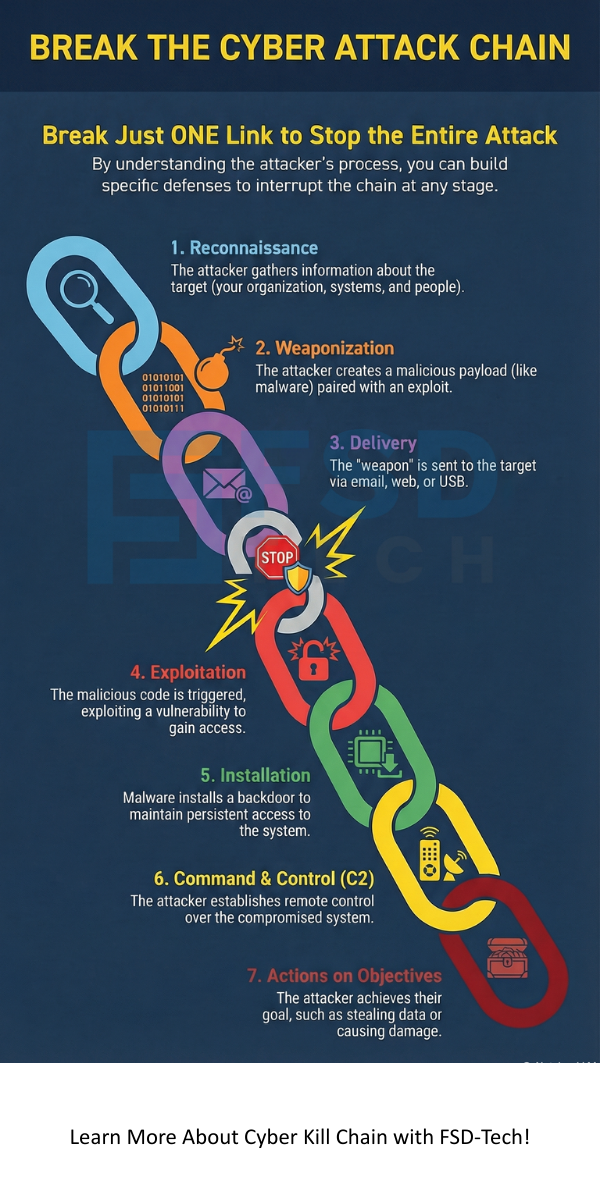
     

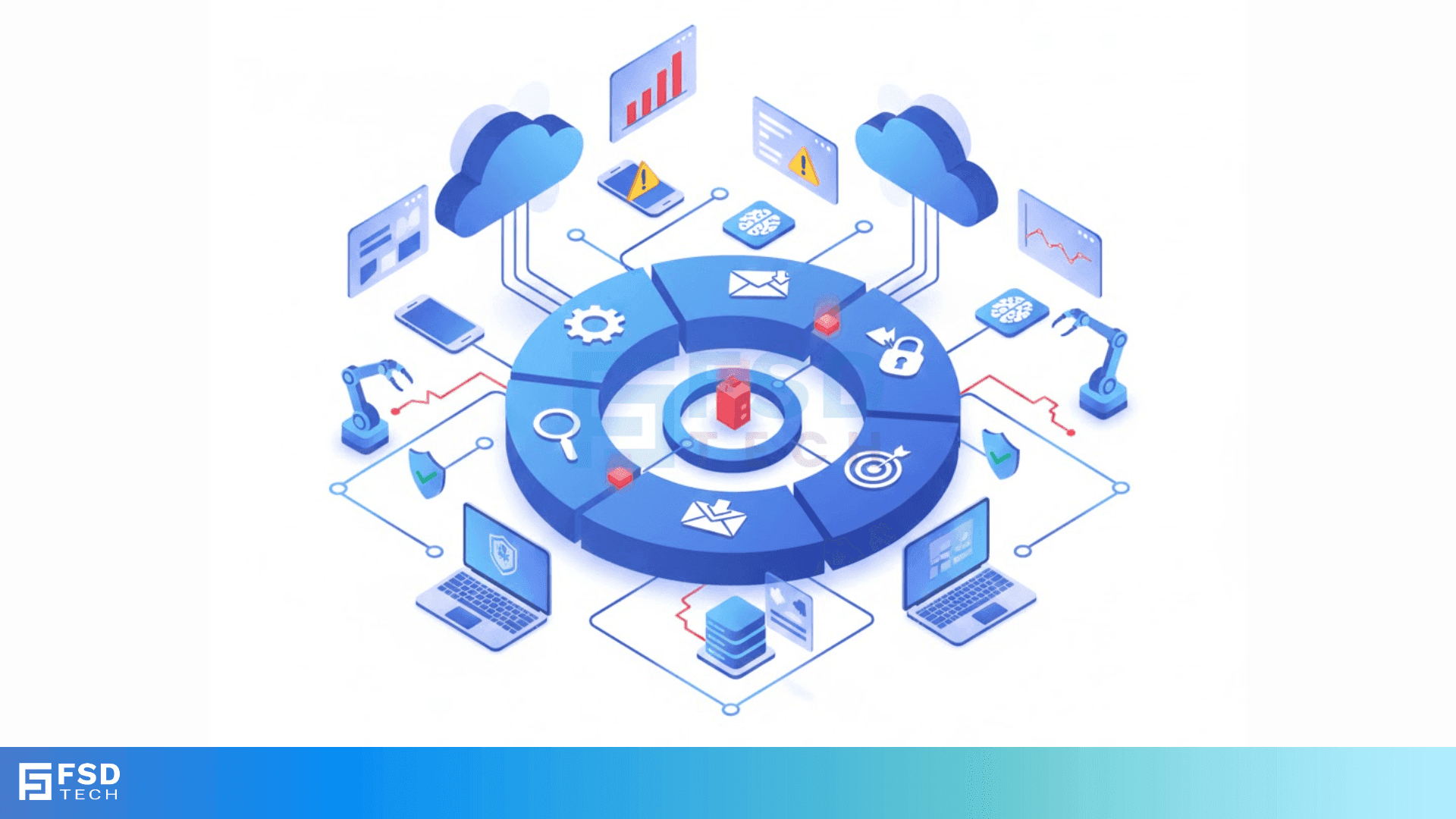
    Cyber kill chain infographic


    Key Takeaways

    So, with the above discussion, we can say that the Cyber Kill Chain is a critical, foundational framework in modern cybersecurity. It offers you a clear, step-by-step understanding of how external attacks unfold.


    • The Cyber Kill Chain framework comprises seven sequential phases: Reconnaissance, Weaponization, Delivery, Exploitation, Installation, Command and Control (C2), and Actions on Objectives.
    • Breaking the chain at any single phase is the ultimate goal. For example, blocking the Delivery prevents the Exploitation.
    • This model, developed by Lockheed Martin, acts as a blueprint for developing robust defenses and enhancing your security monitoring capabilities.


    Frequently Asked Questions About the Cyber Kill Chain

    What statement describes the Cyber Kill Chain?

    The Cyber Kill Chain is a model that describes the external attack process in seven distinct, sequential stages. This model helps defenders identify and stop an intrusion at any point before the attacker achieves their goal. It essentially provides a roadmap of the adversary's actions.


    What is Cyber Kill Chain in Cyber Security?

    Cyber Kill Chain in cyber security refers to a framework that helps security professionals understand, analyze, and mitigate cyber-attacks. The framework identifies the necessary phases an attacker must complete, giving the defender specific points of intervention or "choke points" to break the attack chain.


    What is the primary purpose of the Cyber Kill Chain methodology?

    The primary purpose of the Cyber Kill Chain methodology is to improve defensive measures. By clearly defining the attack stages, it enables security teams to create defenses specifically targeted at each stage. This proactive defense aims to detect and disrupt the attack early, minimizing the damage.

    What is the Cyber Kill Chain? Critical Cybersecurity Model

    About The Author

    Surbhi Suhane

    Surbhi Suhane is an experienced digital marketing and content specialist with deep expertise in Getting Things Done (GTD) methodology and process automation. Adept at optimizing workflows and leveraging automation tools to enhance productivity and deliver impactful results in content creation and SEO optimization.

    Like This Story?

    Share it with friends!

    Subscribe to our newsletter!

    Atera

    (48)

    Cato Networks

    (111)

    ClickUp

    (68)

    FishOS

    (7)

    Miradore

    (21)

    PointGuard AI

    (9)

    Vembu

    (22)

    Xcitium

    (33)

    ZETA HRMS

    (69)

    Workflow Automation(5)

    Workforce Automation(1)

    AI Project Management(1)

    HR Data Automation(1)

    RMM(1)

    IT Workflow Automation(1)

    IT security(2)

    GCC compliance(4)

    Payroll Integration(2)

    IT support automation(3)

    procurement automation(1)

    lost device management(1)

    IT Management(5)

    IoT Security(2)

    Cato XOps(2)

    IT compliance(4)

    Task Automation(1)

    Workflow Management(1)

    OpenStack automation(1)

    Kubernetes lifecycle management(2)

    AI-powered cloud ops(1)

    SMB Security(8)

    Data Security(1)

    MDR (Managed Detection & Response)(4)

    Atera Integrations(2)

    MSP Automation(3)

    XDR Security(2)

    SMB Cyber Protection(1)

    Ransomware Defense(3)

    HR Tech Solutions(1)

    Zero Trust Network Access(3)

    Zero Trust Security(2)

    Endpoint Management(1)

    SaaS Security(1)

    Payroll Automation(5)

    IT Monitoring(2)

    Xcitium EDR SOC(15)

    Ransomware Protection GCC(1)

    M&A IT Integration(1)

    Network Consolidation UAE(1)

    MSSP for SMBs(1)

    FSD-Tech MSSP(25)

    SMB Cybersecurity GCC(1)

    Managed EDR FSD-Tech(1)

    Ransomware Protection(3)

    Antivirus vs EDR(1)

    Cybersecurity GCC(12)

    Endpoint Security(1)

    Endpoint Protection(1)

    Data Breach Costs(1)

    Managed Security Services(2)

    SMB Cybersecurity(8)

    Zero Dwell Containment(31)

    Xcitium EDR(30)

    Cloud Backup(1)

    Hybrid Backup(1)

    Backup & Recovery(1)

    pointguard ai(4)

    disaster recovery myths(1)

    backup myths(1)

    vembu(9)

    SMB data protection(9)

    Vembu BDR Suite(19)

    Disaster Recovery(4)

    DataProtection(1)

    GCCBusiness(1)

    Secure Access Service Edge(4)

    GCC HR software(15)

    Miradore EMM(15)

    Cato SASE(7)

    Cloud Security(8)

    Talent Development(1)

    AI Cybersecurity(12)

    AI Risk Management(1)

    AI Governance(4)

    AI Security(2)

    AI Compliance(2)

    GCC business security(1)

    GCC network integration(1)

    compliance automation(4)

    GCC cybersecurity(2)

    education security(1)

    App management UAE(1)

    BYOD security Dubai(8)

    Miradore EMM Premium+(5)

    HealthcareSecurity(1)

    MiddleEast(1)

    Team Collaboration(1)

    IT automation(10)

    Zscaler(1)

    SD-WAN(6)

    HR Integration(4)

    Cloud Networking(3)

    device management(9)

    RemoteWork(1)

    ZeroTrust(2)

    VPN(1)

    MPLS(1)

    Project Management(9)

    HR automation(16)

    share your thoughts

    Disaster Recovery in Cloud Computing

    What is Disaster Recovery in Cloud Computing?

    🕓 January 8, 2026

    Computer Virus

    What is Computer Virus? Types, Symptoms & Protection

    🕓 January 8, 2026

    Cyber Kill Chain

    What is the Cyber Kill Chain? Critical Cybersecurity Model

    🕓 January 7, 2026

    Decoded(55)

    Cyber Security(112)

    BCP / DR(22)

    Zeta HRMS(68)

    SASE(21)

    Automation(68)

    Next Gen IT-Infra(111)

    Monitoring & Management(69)

    ITSM(22)

    HRMS(21)

    Automation(24)