HomeNext Gen IT-InfraMonitoring & ManagementCyber SecurityBCP / DRAutomationDecoded
Next Gen IT-Infra
Cato’s SASE Supports Cybersecurity Skills Development

How Cato’s SASE Supports Cybersecurity Skills Development

🕓 April 8, 2025

How SASE Supports the Security Needs of SMBs

How SASE Supports the Security Needs of SMBs

🕓 February 9, 2025

Attack Surface Reduction with Cato’s SASE

Attack Surface Reduction with Cato’s SASE

🕓 February 10, 2025

SASE for Digital Transformation in UAE

SASE for Digital Transformation in UAE

🕓 February 8, 2025

Monitoring & Management
Understanding Atera’s SLA Management

Understanding Atera’s SLA Management

🕓 February 7, 2025

Cost-Performance Ratio: Finding the Right Balance in IT Management Networks

Cost-Performance Ratio: Finding the Right Balance in IT Management Networks

🕓 June 16, 2025

Customizing Atera with APIs

Customizing Atera with APIs

🕓 March 3, 2025

Power Up Your IT Team’s Strategy with Atera’s Communication Tools

Power Up Your IT Team’s Strategy with Atera’s Communication Tools

🕓 February 8, 2025

Cyber Security
Visual guide showing Cato CMA interface for configuring Internet and WAN firewall rules, enabling threat protection, and monitoring security events in real time for UAE IT teams.

Enforcing Firewall and Threat Protection Policies in Cato

🕓 July 25, 2025

Isometric illustration of professionals managing network performance, bandwidth analytics, and cloud-based optimization around the Cato Networks platform, symbolizing bandwidth control and QoS visibility.

Mastering Bandwidth Control and QoS in Cato Networks

🕓 July 26, 2025

Illustration of the Cato Cloud architecture showing its role in delivering SASE for secure, optimized global connectivity.

Understanding the Cato Cloud and Its Role in SASE

🕓 January 29, 2025

Global network backbone powering Cato SASE solution for secure, high-performance connectivity across regions.

Global Backbone: The Engine Powering Cato’s SASE Solution

🕓 January 30, 2025

BCP / DR
Illustration showing diverse business and IT professionals collaborating with cloud, backup, and security icons, representing Vembu use cases for SMBs, MSPs, and IT teams.

Who Uses Vembu? Real-World Use Cases for SMBs, MSPs & IT Teams

🕓 July 12, 2025

Graphic showcasing Vembu’s all-in-one backup and disaster recovery platform with icons for cloud, data protection, and business continuity for IT teams and SMBs.

What Is Vembu? A Deep Dive Into the All in One Backup & Disaster Recovery Platform

🕓 July 6, 2025

Illustration showing Vembu backup and disaster recovery system with cloud storage, server racks, analytics dashboard, and IT professionals managing data.

The Rising Cost of Data Loss: Why Backup Is No Longer Optional?

🕓 August 14, 2025

3D isometric illustration of cloud backup and data recovery infrastructure with laptop, data center stack, and digital business icons — FSD Tech

RPO & RTO: The Heart of Business Continuity

🕓 August 15, 2025

Automation
Cross-Functional Collaboration with ClickUp

Fostering Cross-Functional Collaboration with ClickUp for Multi-Departmental Projects

🕓 February 11, 2025

ClickUp Project Reporting

Revolutionizing Enterprise Reporting with ClickUp’s Advanced Analytics and Dashboards

🕓 June 16, 2025

ClickUp’s Design Collaboration and Asset Management Tools

Empowering Creative Teams with ClickUp’s Design Collaboration and Asset Management Tools

🕓 February 26, 2025

ClickUp Communication and Collaboration Tools

ClickUp Communication and Collaboration Tools: Empowering Remote Teams

🕓 March 12, 2025

Decoded
Multi-Factor Authentication (MFA)

Multi-Factor Authentication (MFA): All You Need to Know

🕓 December 7, 2025

L3 Switch

What Is an L3 Switch? L2 vs L3 & Why You Need Layer 3?

🕓 December 8, 2025

IPSec

IPSec Explained: Protocols, Modes, IKE & VPN Security

🕓 December 3, 2025

 Datagram Transport Layer Security (DTLS)

What is Datagram Transport Layer Security (DTLS)? How it works?

🕓 December 4, 2025

    Subscribe to our newsletter!

    About Us

    Follow Us

    Copyright © 2024 | Powered by 

    Cato SASE Architecture

    Inside Cato’s SASE Architecture: A Blueprint for Modern Security

    🕓 January 26, 2025

    Enterprise Data Security and Privacy with ClickUp

    Ensuring Enterprise Data Security and Privacy with ClickUp

    🕓 February 9, 2025

    DDoS protection SASE

    DDoS Protection and Cato’s Defence Mechanisms

    🕓 February 11, 2025

    Table of Contents

    What is Asymmetric Encryption? Keys and How It Works

    Surbhi Suhane
    January 14, 2026
    Comments
    Asymmetric Encryption

    You understand the importance of keeping your sensitive data secret, especially when you send information over the internet. You want to know that only the right person reads your private message. How do secure systems like online banking and encrypted emails achieve this? They use a smart method called asymmetric encryption.


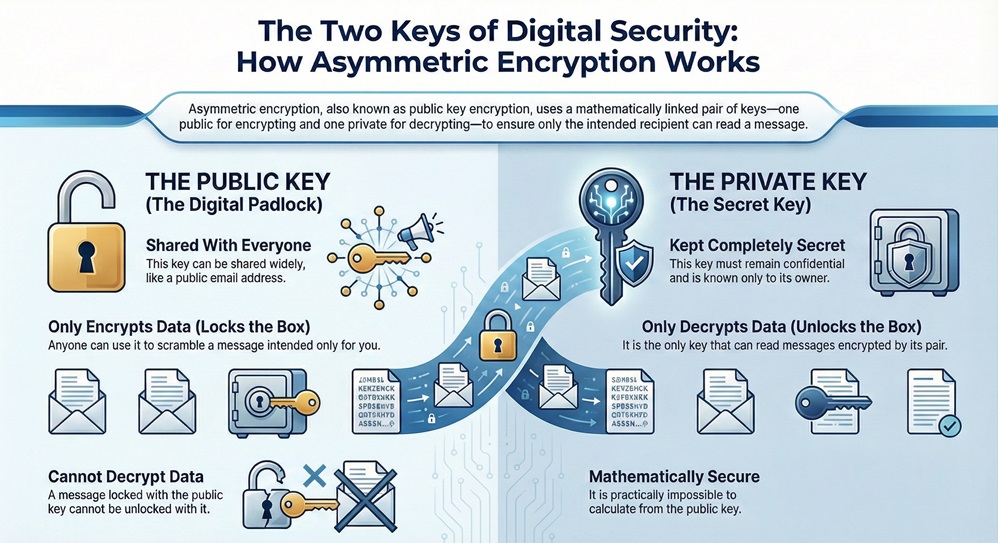
    Asymmetric encryption, which people also call public key encryption, is a cornerstone of modern cybersecurity. It ensures safe communication because it solves a critical problem: sharing the secret needed to read the message. Unlike simpler methods, this system uses two separate keys for its job. This two-key approach makes it much more secure for sharing data with someone you might not have met before.
     

    Asymmetric encryption


    Let us explore this essential concept of public key asymmetric encryption. We will show you exactly how it works and why it plays a vital role in securing your digital life.


    Understanding the Asymmetric Encryption Key Pair

    The whole idea of asymmetric encryption depends on a mathematically linked pair of keys. Every user in this system gets two distinct keys: a public key and a private key.


    What is the Public Key?

    The public key is open for everyone to see. You can share this key widely, like a public email address. Anyone who wants to send you an encrypted message uses your public key to scramble the data. The important point is that the public key can encrypt information, but it cannot decrypt it. Think of it as a special digital padlock; anyone can put a lock on a box using the public key, but only one person holds the key to open it.


    What is the Private Key?

    The private key is your secret. You must keep this key completely confidential. It is the only key that can reverse the encryption done by its paired public key. Since only you possess the private key, only you can read the message that others encrypted using your public key. The private key acts as the single key to open the padlock.


    Asymmetric encryption relies on the fact that while the two keys are linked, it is practically impossible to calculate the private key if someone only knows the public key. This feature provides the essential security.


    Protect Data Fast


    How Does Asymmetric Encryption Work?

    The process of how asymmetric encryption works is simple to understand. Let us use an asymmetric encryption example involving two parties, Alice and Bob.


    1. Key Generation: First, Bob creates his unique key pair: a public key (Bob's Public Key) and a private key (Bob's Private Key).
    2. Key Sharing: Bob gives Alice his Public Key. The key does not need a secret or secure channel, because it only encrypts data.
    3. Encryption: Alice writes a secret message. She uses Bob’s Public Key to perform the encryption. This turns her readable message (plaintext) into an unreadable mess (ciphertext).
    4. Transmission: Alice sends the ciphertext to Bob across the internet. An attacker might intercept this data, but they cannot read it.
    5. Decryption: Bob receives the ciphertext. He uses his Private Key—and only his Private Key—to perform the decryption, which changes the ciphertext back into Alice's original readable message.


    In this way, the asymmetric encryption key pair ensures that even if the public key falls into the wrong hands, the data remains safe. The method ensures only the intended receiver can unlock the secret.


    Now, the question arises: What is the underlying mathematics that makes this happen? Asymmetric encryption algorithms rely on mathematical problems that are simple to perform in one direction but extremely difficult to reverse. For example, the Rivest-Shamir-Adleman or asymmetric encryption RSA algorithm depends on the difficulty of factoring very large numbers.


    Also Read: What Is Endpoint Detection & Response (EDR) in Cybersecurity?


    Why is Asymmetric Encryption Considered More Secure?

    You may ask, why is asymmetric encryption considered more secure than its alternative? The key advantage lies in key distribution.


    The Problem of Symmetric Encryption

    Symmetric encryption uses a single, shared secret key for both encryption and decryption. This process is very fast, making it efficient for large amounts of data. However, how do the two parties securely share that initial secret key over an untrusted network like the internet? This key distribution problem is a significant weakness of symmetric asymmetric encryption models.


    The Solution of Asymmetric Encryption

    Asymmetric encryption eliminates this problem entirely. Since the key used for encryption (the Public Key) is openly shared and cannot decrypt, there is no need for a secret channel to distribute it. This makes secure communication scalable and much easier to initiate. The security of the data depends only on keeping the one private key confidential.

    Because of this design, asymmetric encryption plays a vital role in establishing trust and security on the internet.


    Differentiate Between Symmetric and Asymmetric Encryption

    We now clearly differentiate between symmetric and asymmetric encryption. Both methods serve the purpose of data confidentiality, but they work on very different principles.


    Key Usage

    • Symmetric Encryption: It uses a single, shared secret key.
    • Asymmetric Encryption: It uses a pair of keys: a public key for encryption and a private key for decryption.

    Speed and Efficiency

    • Symmetric Encryption: Generally faster and more efficient. It is better for encrypting large files.
    • Asymmetric Encryption: Generally slower and needs more resources. It is typically used for smaller tasks like securely exchanging the secret key for a symmetric system.

    Key Distribution

    • Symmetric Encryption: Requires a secure channel to share the single key before communication can begin.
    • Asymmetric Encryption: Does not require a secure channel because the encryption key (public key asymmetric encryption) is public.
    Basis for ComparisonSymmetric EncryptionAsymmetric Encryption
    Key UsageSingle key for both encryption and decryption.A key pair: Public Key for encryption, Private Key for decryption.
    SpeedFaster; ideal for large data volumes.Slower; computationally intensive.
    Key SharingRequires a secure channel for key exchange.Does not require a secure channel; public key is open.
    Primary UseBulk data encryption (after a secure session is established).Key exchange, digital signatures, and establishing secure channels (like SSL/TLS).
    Known AlgorithmsAES, DES, 3DES.RSA, ECC, ElGamal.
    Security RiskThe single key must remain secret; compromised key exposes all data.Only the private key must remain secret.


    Also Read: Unified Threat Management (UTM): Key Security Functions

    Asymmetric Encryption Algorithms

    Several algorithms provide the complex mathematical framework for asymmetric encryption. These algorithms rely on mathematical problems that are easy to process in one direction but extremely difficult to reverse.


    RSA (Rivest-Shamir-Adleman)

    Asymmetric encryption RSA is one of the first and most widely used asymmetric encryption algorithms.

    • Principle: RSA works on the principle that it is easy to multiply two large prime numbers together, but it is extremely difficult to factor the resulting product back into the original primes.
    • Function: RSA is used for secure data transmission, digital signatures, and key exchange. It is an accurate description of asymmetric encryption technology because it perfectly illustrates the two-key system.


    ECC (Elliptic Curve Cryptography)

    • Principle: ECC relies on the algebraic structure of elliptic curves over finite fields.
    • Advantage: ECC offers a similar level of security to RSA but uses significantly smaller key sizes. This makes it more efficient, requiring less computational power and bandwidth, which is essential for mobile and resource-constrained devices.


    Diffie-Hellman (Key Exchange)

    • Principle: Diffie-Hellman allows two parties to agree on a shared secret key over an insecure channel.
    • Function: This protocol does not encrypt the actual message data. Instead, it securely exchanges the session key that a faster symmetric algorithm (like AES) will use for the actual bulk data encryption.


    These algorithms ensure that the complexity of how asymmetric encryption works remains a strong defense against digital attackers.


    The Dual Purpose of Asymmetric Encryption

    Asymmetric encryption has a dual function that goes beyond simple confidentiality. The asymmetric encryption key pair can be used in two ways.


    1. Confidentiality (Encryption)

    This is the standard use we already discussed.

    • Action: The sender uses the receiver's public key to encrypt the message.
    • Result: Only the receiver's private key can decrypt it. This ensures only the intended recipient can read the data.


    2. Authentication and Integrity (Digital Signatures)

    Asymmetric encryption also plays a vital role in confirming who sent a message and that the message has not changed.

    • Action: The sender uses their private key to "sign" a message (actually, they encrypt a hash of the message).
    • Result: Anyone can use the sender's public key to verify this signature. If the public key successfully decrypts the signature, it proves two things:
      1. Authenticity: The message truly came from the person who owns the private key.
      2. Integrity: The message was not tampered with after it was signed.


    This secondary use makes public key asymmetric encryption an indispensable tool for digital documents, code signing, and SSL/TLS certificates.


    Also Read: Cloud Encryption Gateway (CEG): Keep Keys, Secure Data


    Applications of Asymmetric Encryption

    You interact with asymmetric encryption every day. It underpins many secure communications on the internet.


    • Secure Web Browsing (SSL/TLS): When you see "HTTPS" in your browser's address bar, asymmetric encryption is establishing a secure connection between your computer and the website's server. It securely exchanges the fast symmetric key used for the rest of the session.
    • Email Security: Protocols like PGP and S/MIME use the asymmetric encryption key to ensure that only the correct recipient can read the email.
    • Digital Certificates: The security of digital certificates, which confirm a website's identity, depends on the private key being kept secret.


    Conclusion

    You now have a deep understanding of public key asymmetric encryption and its vital role in digital security. We believe that robust security is not an option but a requirement in the modern digital world. By leveraging sophisticated, proven technologies like asymmetric encryption, our company ensures your data remains confidential and your communications are always authentic. You deserve the best defense against digital threats, and we deliver that security by design.


    Secure Your Keys Reach our experts
     

    asymmetric encryption


    Key Takeaways

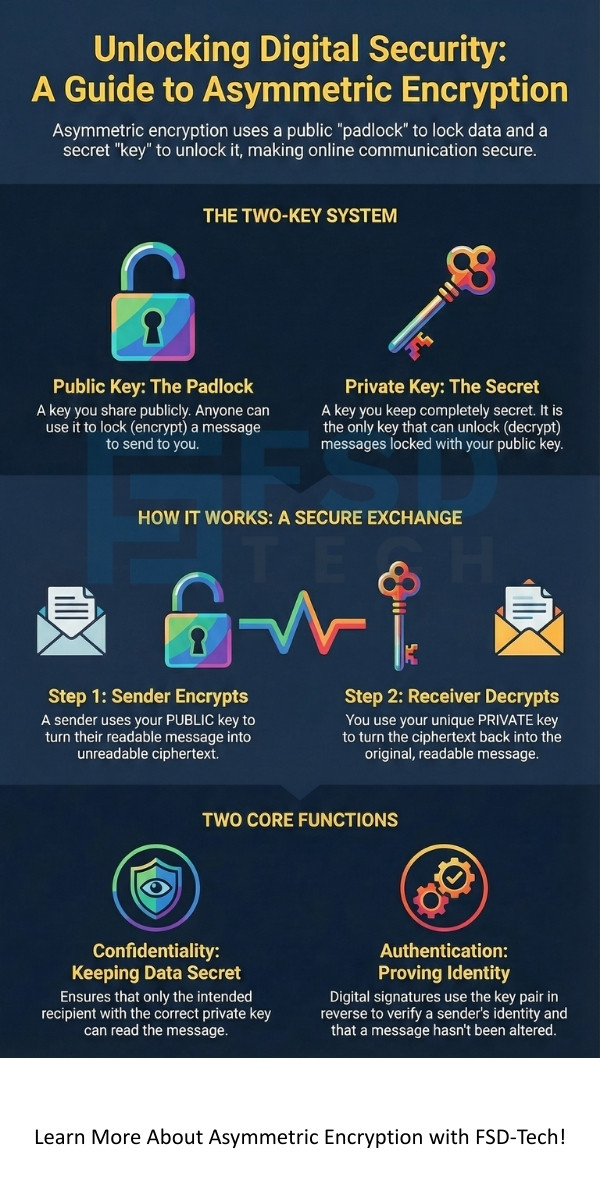
    • Asymmetric Encryption uses two keys: a public key (to encrypt) and a private key (to decrypt).
    • It solves the key distribution problem inherent in symmetric systems, making it excellent for secure communication over untrusted networks.
    • The system ensures both confidentiality and authentication (via digital signatures).
    • RSA and ECC are the most common asymmetric encryption algorithms.


    Frequently Asked Questions

    What is Asymmetric Encryption also Known as?

    Asymmetric encryption is also known as public key encryption or public-key cryptography.


    Which Algorithm Provides Asymmetric Encryption?

    The most common algorithms providing asymmetric encryption are RSA and ECC (Elliptic Curve Cryptography). Diffie-Hellman also uses asymmetric principles for key exchange.


    What is an Accurate Description of Asymmetric Encryption Technology?

    An accurate description of asymmetric encryption technology is a cryptographic system that uses a pair of mathematically linked keys—a public key for encryption and a private key for decryption—to secure data and verify digital identities.


    How Asymmetric Encryption Works in Simple Terms?

    In simple terms, how asymmetric encryption works is like this: You use an open, public padlock to lock your message. Only the person with the secret, private key can unlock the padlock and read the message.

    What is Asymmetric Encryption? Keys and How It Works

    About The Author

    Surbhi Suhane

    Surbhi Suhane is an experienced digital marketing and content specialist with deep expertise in Getting Things Done (GTD) methodology and process automation. Adept at optimizing workflows and leveraging automation tools to enhance productivity and deliver impactful results in content creation and SEO optimization.

    Like This Story?

    Share it with friends!

    Subscribe to our newsletter!

    Atera

    (48)

    Cato Networks

    (111)

    ClickUp

    (68)

    FishOS

    (7)

    Miradore

    (21)

    PointGuard AI

    (9)

    Vembu

    (22)

    Xcitium

    (33)

    ZETA HRMS

    (71)

    Workflow Automation(5)

    Workforce Automation(1)

    AI Project Management(1)

    HR Data Automation(1)

    RMM(1)

    IT Workflow Automation(1)

    GCC compliance(4)

    IT security(2)

    Payroll Integration(2)

    IT support automation(3)

    procurement automation(1)

    lost device management(1)

    IT Management(5)

    IoT Security(2)

    Cato XOps(2)

    IT compliance(4)

    Workflow Management(1)

    Task Automation(1)

    OpenStack automation(1)

    AI-powered cloud ops(1)

    Kubernetes lifecycle management(2)

    SMB Security(8)

    Data Security(1)

    MDR (Managed Detection & Response)(4)

    Atera Integrations(2)

    MSP Automation(3)

    XDR Security(2)

    SMB Cyber Protection(1)

    Ransomware Defense(3)

    HR Tech Solutions(1)

    Zero Trust Network Access(3)

    Zero Trust Security(2)

    Endpoint Management(1)

    SaaS Security(1)

    Payroll Automation(5)

    IT Monitoring(2)

    Xcitium EDR SOC(15)

    Ransomware Protection GCC(1)

    M&A IT Integration(1)

    Network Consolidation UAE(1)

    MSSP for SMBs(1)

    FSD-Tech MSSP(25)

    Ransomware Protection(3)

    SMB Cybersecurity GCC(1)

    Managed EDR FSD-Tech(1)

    Antivirus vs EDR(1)

    Cybersecurity GCC(12)

    Endpoint Security(1)

    Endpoint Protection(1)

    Data Breach Costs(1)

    Managed Security Services(2)

    SMB Cybersecurity(8)

    Zero Dwell Containment(31)

    Xcitium EDR(30)

    Cloud Backup(1)

    Hybrid Backup(1)

    Backup & Recovery(1)

    pointguard ai(4)

    disaster recovery myths(1)

    backup myths(1)

    vembu(9)

    SMB data protection(9)

    Vembu BDR Suite(19)

    Disaster Recovery(4)

    DataProtection(1)

    GCCBusiness(1)

    Secure Access Service Edge(4)

    GCC HR software(16)

    Miradore EMM(15)

    Cato SASE(7)

    Cloud Security(8)

    Talent Development(1)

    AI Cybersecurity(12)

    AI Risk Management(1)

    AI Governance(4)

    AI Security(2)

    AI Compliance(2)

    GCC business security(1)

    GCC network integration(1)

    compliance automation(4)

    GCC cybersecurity(2)

    education security(1)

    App management UAE(1)

    BYOD security Dubai(8)

    Miradore EMM Premium+(5)

    HealthcareSecurity(1)

    MiddleEast(1)

    Team Collaboration(1)

    IT automation(10)

    Zscaler(1)

    SD-WAN(6)

    HR Integration(4)

    Cloud Networking(3)

    device management(9)

    RemoteWork(1)

    ZeroTrust(2)

    VPN(1)

    MPLS(1)

    Project Management(9)

    HR automation(16)

    share your thoughts

    Asymmetric Encryption

    What is Asymmetric Encryption? Keys and How It Works

    🕓 January 14, 2026

    Attribute Based Access Control (ABAC)

    What is Attribute Based Access Control (ABAC)?

    🕓 January 14, 2026

    Biometric Authentication

    What is Biometric Authentication? Methods & Security Guide

    🕓 January 13, 2026

    Decoded(64)

    Cyber Security(112)

    BCP / DR(22)

    Zeta HRMS(70)

    SASE(21)

    Automation(68)

    Next Gen IT-Infra(111)

    Monitoring & Management(69)

    ITSM(22)

    HRMS(21)

    Automation(24)