Spear phishing refers to a highly targeted cyberattack aimed at specific individuals, organizations, or businesses to steal confidential data, money, or access to sensitive computer systems. This sophisticated form of the phishing attack is not a random net-casting attempt; rather, it uses personalized and carefully researched information to build trust and trick the victim.
This is a critical threat because it bypasses basic security controls and targets the human element in an organization's defense.
The two essential components of spear phishing are social engineering and a malicious payload. The attacker uses social engineering tactics to craft a convincing email, message, or communication that appears to come from a trusted source, like a colleague or a senior executive (whaling attack). The malicious part, or payload, often consists of a link to a malicious website or an attachment containing malware or a ransomware attack. It consists of a convincing pretext, a targeted victim, and a criminal motive.
In this section, we will discuss spear phishing in detail along with its techniques, impact, and how to prevent it. We are going to explore why these targeted attacks are so dangerous and what you can do to protect your personal and company information from a spear phishing attack.
What is Spear Phishing?
Spear phishing can be defined as a malicious email or electronic communication attempt that targets a specific individual or organization. The criminal uses personal details about the victim to make the email seem legitimate and urgent. The primary function of spear phishing is to trick the recipient into revealing sensitive information, transferring funds, or clicking a link that installs malware.
The attacker does careful research before launching a spear phishing campaign. They gather information from social media, company websites, and other online sources. This allows them to personalize the message, making it look like it is from someone you know, like your boss or a vendor. This high level of customization is what makes spear phishing much more successful than a typical, broad phishing attack.
Consider the following. A criminal sends an email to a company’s Chief Financial Officer (CFO), asking for an urgent wire transfer to a new vendor. The email looks like it came from the CEO, uses the CEO’s real signature block, and mentions a recent project the CFO knows about. This shows the sophistication of a spear phishing attack. Business Email Compromise (BEC) is a type of spear phishing that targets employees with access to company funds.
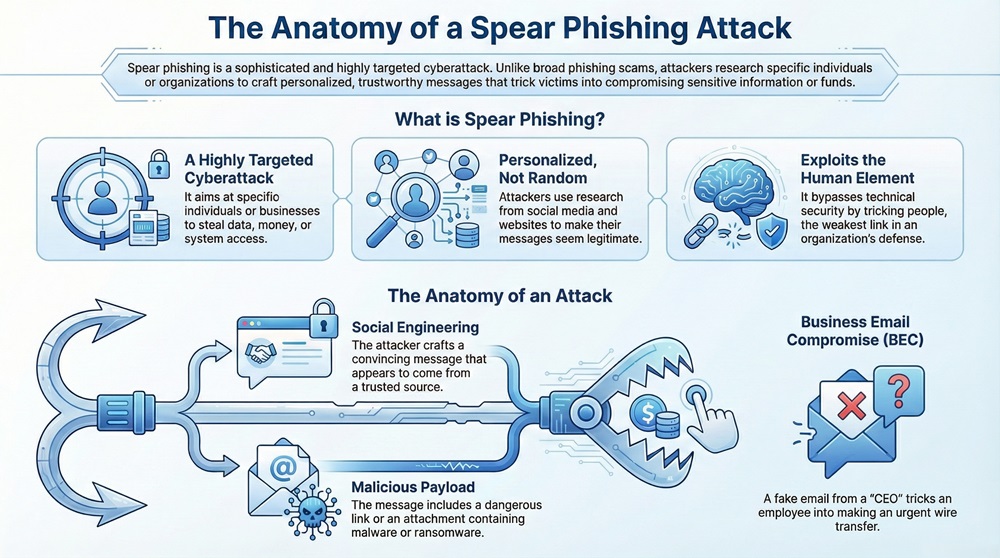
Let us now understand how a spear phishing attack unfolds in a step-by-step manner. Spear phishing is a process that involves four main stages: research, preparation, execution, and harvest. Observe the figure given below.
In the figure above, you can see the complete lifecycle of a spear phishing operation. The attacker invests time and effort in the initial steps to ensure a high success rate.
1. Research and Reconnaissance
The initial stage of a spear phishing operation is the research stage. The attacker collects information about the target. This step is vital for creating a believable pretext.
They may use social media platforms like LinkedIn or Facebook to find names, job titles, and relationships.
Company websites give clues about organization structure, current projects, and vendor names.
The attacker looks for email addresses and internal jargon to use in the fake message.
2. Preparation and Crafting the Lure
After gathering enough data, the attacker crafts a believable email. The attacker prepares the lure. This is the phishing email itself, which looks professional and uses the gathered personal details.
The email's sender address is often spoofed to look exactly like an internal colleague or a senior manager.
The content creates a sense of urgency or fear to make the victim act quickly without thinking.
The attacker chooses the malicious payload, such as a malware-laden attachment or a link to a fake login page.
3. Execution and Delivery
The spear phishing email is then sent to the target. This stage is about getting the message into the victim's inbox without being flagged by email security systems.
They often use little-known email services or compromised accounts to send the email.
The time of sending is sometimes chosen strategically, such as late on a Friday afternoon, when security staff might be less alert.
4. Harvest and Goal Accomplishment
If the victim falls for the trick, the attacker achieves their goal. Spear phishing is successful when the victim performs the desired action.
This might be clicking a link, downloading the malware, or giving away login credentials.
The criminal then steals the data, installs spyware, or drains the bank account. The goal of the attacker is to gain unauthorized access.
Key Characteristics of a Spear Phishing Attack
Spear phishing has several key features that set it apart from general phishing attacks. These features make the attack much more potent and difficult to spot.
Following are the key characteristics of spear phishing:
Targeted and Personalized: The attack focuses on a specific person, department, or company. It is not random. The message is customized using the victim's name, job title, and details about their work.
Use of Social Engineering: Spear phishing heavily relies on psychological manipulation. The attacker pretends to be a trusted source to exploit the victim's willingness to help or fear of authority. This type of trickery is the core of the attack.
Low Volume, High Impact: Unlike mass phishing attacks that send millions of emails, spear phishing sends only a few, very convincing messages. The goal is to get one successful hit that leads to a huge payout or data breach.
Evasion of Security Filters: Because the email content is unique and highly relevant to the recipient, it often passes through spam filters and standard email security checks. The criminal avoids using common phishing phrases.
The Element of Urgency: The message almost always asks the victim to act immediately, such as "Wire transfer needed by EOD" or "Password reset required right now." This prevents the victim from taking time to think or verify.
Spear Phishing Vs Phishing
To understand why spear phishing is so dangerous, it helps to compare it with regular phishing. Both aim to steal information, but the methods and targets are very different. The table below shows the key differences.
Basis for Comparison
Spear Phishing
Phishing
Meaning
It refers to a highly customized and targeted attack against a specific individual or organization.
It refers to a mass, non-targeted attack sent to a large number of random recipients.
Nature
It is a sophisticated, low-volume attack with a high rate of success.
It is a simple, high-volume attack with a low rate of success.
Definition
An attack that uses prior research to make a message look like it came from a known, trusted source.
An attack that uses generic, fake emails to trick a broad audience into revealing credentials.
Examples
An email from a fake "HR department" asking a specific employee to review a private salary document.
A generic email from a fake "Bank of America" asking all customers to verify their account details.
Function/Purpose
The purpose is to steal targeted data, intellectual property, or large sums of money.
The purpose is to collect as many random login credentials and credit card numbers as possible.
Customization
The email is highly personalized, using the recipient's name, job details, and recent work events.
The email is generic and uses a standard template for all recipients.
Based on
It is based on social engineering and careful reconnaissance of the target.
It is based on luck and the sheer volume of emails sent.
When Used
It is used to get sensitive data from high-value targets, such as executives and IT staff.
It is used to get a large number of credentials from the general public.
Security Risk
It poses an extremely high security risk because it is hard to detect and bypasses firewalls.
It poses a medium security risk as most of it is caught by spam filters.
Key Differences Between Spear Phishing and Phishing
Upcoming points discuss the differences between spear phishing and phishing:
Scope and Target:Spear phishing is very focused, aiming at one person or group, using their specific details to gain trust. On the contrary, phishing is broad, aimed at thousands of random people with generic emails hoping for a few quick wins.
Whilespear phishing relies heavily on deep background research and personalized content to trick the recipient, phishing relies on volume and urgency with boilerplate, non-specific language. Spear phishing is a custom key; phishing is a master key that rarely works.
Whereas the success of a spear phishing attack is often measured by the high value of a single compromised account (e.g., a CEO’s credentials or a CFO’s access), the success of a phishing attack is measured by the sheer number of low-value accounts stolen.
On the other hand, a typical phishing email is easy to spot due to grammar mistakes, generic greetings, and obvious sender addresses. Spear phishing emails are grammatically perfect, use known sender names, and look identical to legitimate corporate communications.
In contrast, the main goal of spear phishing often involves financial fraud through wire transfers or corporate espionage to steal intellectual property. The main goal of generic phishing is usually just to steal common login credentials for resale on the dark web.
Spear phishing often requires advanced social engineering skills to craft a convincing backstory and pretext. Phishing requires little skill, mostly just access to an email list and basic phishing tools.
While a phishing attack is typically mitigated by standard spam filters and basic email security, spear phishing often requires specialized security awareness training and advanced threat detection systems to prevent it.
On the contrary, the whaling attack, which targets high-level executives, is a sub-type of spear phishing. Phishing has no such specialized, high-value sub-types; it remains a broad, low-effort attack.
Spear phishing often uses details like a person's upcoming vacation dates or recent company announcements to make the message more credible. Phishing uses universal, unspecific events like "account maintenance."
In contrast, recovery from a successful spear phishing attack is very costly, often involving massive data loss, significant financial penalties, and huge damage to the company’s reputation. Recovery from a simple phishing incident is often limited to a single password change.
Spear phishing is focused on exploiting internal company relationships and chains of command. Phishing exploits general human curiosity and fear.
Types of Spear Phishing
Spear phishing is a category of attacks, and it has several common sub-types. These different kinds of spear phishing aim at different targets within an organization.
Let us now discuss the major types of spear phishing that you should know:
Whaling:
This is a spear phishing attack that specifically targets senior executives or high-profile individuals, such as the CEO, CFO, or CIO.
The goal is to trick these high-value targets into making a major financial decision or revealing key corporate secrets.
The term implies catching a "big fish," meaning someone who can authorize large sums of money.
Business Email Compromise (BEC):
This type of spear phishing targets employees who have access to company finances or customer data.
The attacker sends an email from a spoofed executive account to an employee in the finance department.
The email usually demands an immediate, unauthorized wire transfer to a criminal's account, often citing a secret or urgent business deal. This is a common and very expensive form of financial fraud.
Vishing (Voice Phishing):
While not purely email-based, vishing is a form of spear phishing that uses voice calls.
The attacker calls the target, often using personal details to build trust.
They might pretend to be from tech support or a government agency to scare the victim into giving up personal information or access codes.
Smishing (SMS Phishing):
This is spear phishing that happens through text messages (SMS).
The message often uses a personalized context, like a fake delivery notification or a bank alert, to trick the user into clicking a link on their mobile device.
The aim is usually to steal login credentials or install malware on the phone.
Spear phishing poses a huge threat. When a spear phishing attack is successful, the consequences can be devastating for both individuals and companies.
The significant factors that result from a successful spear phishing attack are discussed below:
Massive Financial Loss: The most direct and immediate consequence is the unauthorized transfer of funds, especially in BEC attacks. Companies have lost millions of dollars through a single fraudulent wire transfer request.
Data Breach and Intellectual Property Theft: Attackers steal sensitive information, including customer records, login credentials, trade secrets, and intellectual property. This can lead to compliance fines and loss of competitive advantage.
Malware Installation: The attack can lead to the installation of ransomware, which encrypts all company data until a ransom is paid, or spyware, which continuously steals information over time.
Reputation Damage: A successful data breach damages a company's image and trustworthiness. Customers, partners, and investors may lose confidence in the organization's security posture.
System Compromise: Once an attacker gets a foothold, they can move through the network, gaining unauthorized access to core systems. This can halt business operations for days or weeks.
Techniques Used by Attackers
Spear phishing criminals use a specific set of techniques to make their scams work. They are masters of deception and detail.
Following are the techniques used by spear phishing attackers:
Domain Spoofing: The attacker creates an email address that is almost identical to a real one.
The victim often overlooks the small difference in the sender's address.
Pretexting: This is the act of creating a believable story, or "pretext," to trick the victim.
The attacker may claim to be a new employee, a senior manager on an urgent trip, or an external auditor.
The pretext is always designed to make the target lower their guard and act quickly.
Zero-day Exploits: In very advanced spear phishing cases, the attachment or link contains a zero-day exploit.
This is a piece of code that takes advantage of a security flaw in software that the vendor does not yet know about.
Since the flaw is unknown, there is no patch, making the attack highly effective against even well-protected systems.
Content-Based Social Proof: The attacker uses specific, verifiable details in the email that only someone from the inside or someone who did deep research would know.
These details can include project names, meeting times, or personal life events mentioned on social media.
You can take strong, simple steps to protect yourself and your organization from a spear phishing attack. Spear phishing prevention is always better than cure.
Here, we will see how to stop spear phishing:
Verify Sender Identity: Always check the full email address, not just the sender's name. If a senior executive requests a financial transfer, call them back using a known, verified number. Do not reply to the suspicious email.
Enable Multi-Factor Authentication (MFA): This is vital. Even if a criminal steals your login credentials, they cannot access your account without the second code from your phone. Multi-factor authentication blocks the criminal's access.
Use Advanced Email Security: Employ email security systems that can scan emails for suspicious links, check for domain spoofing, and flag attachments. This technical control is a must-have for spear phishing defense.
Security Awareness Training: Train employees to spot the warning signs of spear phishing. Regular, interactive training helps make employees the first line of defense.
Limit Information Sharing: Be careful about the personal and professional details you share on social media platforms. The less an attacker knows about you, the harder it is for them to create a convincing email.
It is possible to spot a spear phishing attempt if you know what to look for. Detecting a spear phishing email requires vigilance and attention to detail.
Spear phishing emails often show these warning signs:
Unusual Sender Details: The email address is slightly wrong (e.g., a .co instead of a .com) or the sender's name is misspelled.
Creation of Extreme Urgency: The message pressures you to act immediately without consulting anyone, often saying "This is highly confidential" or "Transfer funds now!"
Unexpected Requests: The email asks you to do something you would not normally do, such as wire money to a new, unverified bank account or click an unknown file.
Suspicious Links and Attachments: Hover your mouse over any link to see the real destination address before clicking. Do not open attachments from unexpected senders or with strange file names.
Unusual Tone or Timing: If the email from your boss is less formal than usual, or if a request comes in late at night when the person is known to be offline, it should raise a red flag.
Case Studies and Examples
To understand the real-world danger, it is helpful to look at how spear phishing has been used successfully. These examples show how a single, focused attack can lead to major consequences.
The significant spear phishing examples are discussed below:
The FACC Attack: The Austrian aerospace parts maker FACC lost about 50 million euros (over $55 million) due to a BEC attack. A criminal impersonated the CEO and asked a finance employee to transfer a huge amount for a fake acquisition project. The employee did it because the email was highly personalized and seemed to come from the highest authority.
The EvilGinex Phishing Kit: This is not a single attack but a tool used by criminals. This kit lets attackers create convincing fake login pages for various corporate services. The use of such kits shows that the tools for launching a professional-looking spear phishing attack are easily available to criminals. The goal is to steal login credentials in bulk.
The Democratic National Committee (DNC) Breach: In 2016, attackers used spear phishing emails to target DNC staff. The emails, which looked like Google security alerts, tricked staff into changing their passwords on a malicious website. This led to the theft of internal communications and is a powerful example of corporate espionage using spear phishing.
Conclusion
Spear phishing is a complex and dangerous cyber threat that relies on trust and human error rather than purely technical flaws. It is a highly personalized attack that uses careful research and social engineering to steal valuable assets, money, and sensitive information. Understanding the difference between a broad phishing attack and a targeted spear phishing attack is the first step toward defense.
Successful defense against spear phishing requires strong security controls and, most importantly, a vigilant and well-trained workforce. We must all remain skeptical of urgent or unusual requests, even if they appear to come from trusted colleagues. Implementing multi-factor authentication and having clear verification protocols for financial transfers are critical safeguards. Thus, a blend of security awareness training and advanced email security is the best defense.
Our company values your security and privacy above all else. We are committed to providing you with the knowledge and tools you need to stay safe from threats like spear phishing. Our focus is always on securing your digital life, ensuring you can work with confidence, knowing you have a partner dedicated to your protection. We provide robust security awareness training and advanced threat detection solutions.
Here are the essential points to remember about spear phishing:
Targeted Attack:Spear phishing is a highly personalized form of attack aimed at specific individuals or organizations to steal sensitive information or funds. It is not random like general phishing.
The Power of Social Engineering: The success of a spear phishing attack rests on social engineering—using detailed, personal information (gathered from social media platforms and public records) to create a sense of trust, urgency, or authority.
High-Value Consequences: Successful attacks, especially Business Email Compromise (BEC) and whaling attacks, lead to massive financial losses, theft of intellectual property, and severe damage to a company's reputation and security posture.
Look for Red Flags: Be skeptical of any unexpected request, especially those demanding immediate financial transfers or login credentials. Always verify the sender's identity using a separate, trusted method (like calling the person's known phone number).
Layered Defense is Key: The best defense against spear phishing combines technical safeguards like advanced email security systems and multi-factor authentication (MFA) with consistent security awareness training for all employees.
Frequently Asked Questions
What is the most common goal of a spear phishing attack?
The most common goal of a spear phishing attack is to achieve financial fraud by tricking an employee into wiring money to a criminal's account. Another primary goal is to steal login credentials to gain unauthorized access to a company's network and steal sensitive data or intellectual property.
What makes spear phishing more effective than regular phishing?
Spear phishing is more effective because it is highly personalized. The attacker uses prior research to include specific, accurate details about the victim's work or life, making the email appear trustworthy and authentic. This bypasses the typical warning signs found in generic phishing emails.
Can firewalls and anti-malware software stop spear phishing?
While firewalls and anti-malware software are essential security controls, they may not be enough to stop spear phishing. These attacks often rely on social engineering to trick the user into willingly clicking a link or opening a file. Therefore, strong security awareness training for employees is a vital additional layer of defense.
What is 'whaling' in the context of spear phishing?
Whaling is a sub-type of spear phishing that targets high-profile, senior executives, such as the CEO or CFO. The term refers to targeting the "biggest fish" in the company. The messages are tailored to the executive's role and often involve a request related to a major corporate event, like an acquisition or lawsuit.
What should I do if I think I clicked on a spear phishing link?
If you believe you have clicked a spear phishing link or entered your login credentials on a malicious website, you must act immediately. First, disconnect the device from the network (turn off Wi-Fi or unplug the Ethernet cable). Second, change your password for the compromised account and any other accounts that use the same password. Third, immediately report the incident to your company's IT or security department.
About The Author
Surbhi Suhane
Surbhi Suhane is an experienced digital marketing and content specialist with deep expertise in Getting Things Done (GTD) methodology and process automation. Adept at optimizing workflows and leveraging automation tools to enhance productivity and deliver impactful results in content creation and SEO optimization.
.webp&w=3840&q=75)





.webp&w=3840&q=75)





share your thoughts