HomeNext Gen IT-InfraMonitoring & ManagementCyber SecurityBCP / DRAutomationDecoded
Next Gen IT-Infra
Cato’s SASE Supports Cybersecurity Skills Development

How Cato’s SASE Supports Cybersecurity Skills Development

🕓 April 8, 2025

How SASE Supports the Security Needs of SMBs

How SASE Supports the Security Needs of SMBs

🕓 February 9, 2025

Attack Surface Reduction with Cato’s SASE

Attack Surface Reduction with Cato’s SASE

🕓 February 10, 2025

SASE for Digital Transformation in UAE

SASE for Digital Transformation in UAE

🕓 February 8, 2025

Monitoring & Management
Understanding Atera’s SLA Management

Understanding Atera’s SLA Management

🕓 February 7, 2025

Cost-Performance Ratio: Finding the Right Balance in IT Management Networks

Cost-Performance Ratio: Finding the Right Balance in IT Management Networks

🕓 June 16, 2025

Customizing Atera with APIs

Customizing Atera with APIs

🕓 March 3, 2025

Power Up Your IT Team’s Strategy with Atera’s Communication Tools

Power Up Your IT Team’s Strategy with Atera’s Communication Tools

🕓 February 8, 2025

Cyber Security
Illustration of the Cato Cloud architecture showing its role in delivering SASE for secure, optimized global connectivity.

Understanding the Cato Cloud and Its Role in SASE

🕓 January 29, 2025

Isometric illustration of professionals managing network performance, bandwidth analytics, and cloud-based optimization around the Cato Networks platform, symbolizing bandwidth control and QoS visibility.

Mastering Bandwidth Control and QoS in Cato Networks

🕓 July 26, 2025

Global network backbone powering Cato SASE solution for secure, high-performance connectivity across regions.

Global Backbone: The Engine Powering Cato’s SASE Solution

🕓 January 30, 2025

Illustration of team analyzing application traffic and usage insights on a large laptop screen using Cato’s dashboard, surrounded by network and cloud icons.

Cato Networks Application Visibility | Monitoring & Control

🕓 July 27, 2025

BCP / DR
Illustration showing diverse business and IT professionals collaborating with cloud, backup, and security icons, representing Vembu use cases for SMBs, MSPs, and IT teams.

Who Uses Vembu? Real-World Use Cases for SMBs, MSPs & IT Teams

🕓 July 12, 2025

Graphic showcasing Vembu’s all-in-one backup and disaster recovery platform with icons for cloud, data protection, and business continuity for IT teams and SMBs.

What Is Vembu? A Deep Dive Into the All in One Backup & Disaster Recovery Platform

🕓 July 6, 2025

Illustration showing Vembu backup and disaster recovery system with cloud storage, server racks, analytics dashboard, and IT professionals managing data.

The Rising Cost of Data Loss: Why Backup Is No Longer Optional?

🕓 August 14, 2025

3D isometric illustration of cloud backup and data recovery infrastructure with laptop, data center stack, and digital business icons — FSD Tech

RPO & RTO: The Heart of Business Continuity

🕓 August 15, 2025

Automation
Cross-Functional Collaboration with ClickUp

Fostering Cross-Functional Collaboration with ClickUp for Multi-Departmental Projects

🕓 February 11, 2025

ClickUp Project Reporting

Revolutionizing Enterprise Reporting with ClickUp’s Advanced Analytics and Dashboards

🕓 June 16, 2025

ClickUp’s Design Collaboration and Asset Management Tools

Empowering Creative Teams with ClickUp’s Design Collaboration and Asset Management Tools

🕓 February 26, 2025

ClickUp Communication and Collaboration Tools

ClickUp Communication and Collaboration Tools: Empowering Remote Teams

🕓 March 12, 2025

Decoded
Multi-Factor Authentication (MFA)

Multi-Factor Authentication (MFA): All You Need to Know

🕓 December 7, 2025

L3 Switch

What Is an L3 Switch? L2 vs L3 & Why You Need Layer 3?

🕓 December 8, 2025

IPSec

IPSec Explained: Protocols, Modes, IKE & VPN Security

🕓 December 3, 2025

 Datagram Transport Layer Security (DTLS)

What is Datagram Transport Layer Security (DTLS)? How it works?

🕓 December 4, 2025

    Subscribe to our newsletter!

    About Us

    Follow Us

    Copyright © 2024 | Powered by 

    Atera

    (56)

    Cato Networks

    (130)

    ClickUp

    (78)

    FishOS

    (7)

    Miradore

    (21)

    PointGuard AI

    (9)

    Vembu

    (22)

    Xcitium

    (33)

    ZETA HRMS

    (79)

    Table of Contents

    Mesh Architecture: How to Decentralize Your Data

    Surbhi Suhane
    March 13, 2026
    Comments
    Mesh Architecture

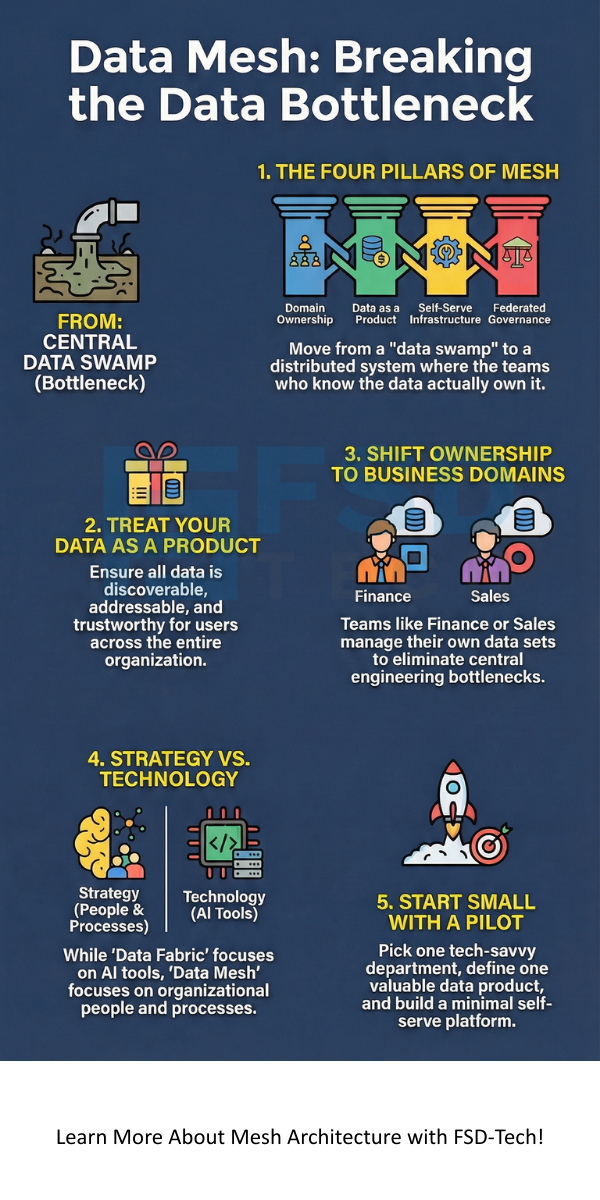
    Mesh Architecture is the modern answer to the massive data bottlenecks we've all faced in the last decade. To be honest, we’ve spent years trying to cram every piece of company info into one giant, central lake, only to realize it’s nearly impossible to manage. If you've ever waited weeks for a data engineer to build a simple report, you know exactly what I mean.


    Here is the thing: the old way of doing things just doesn't scale anymore. In my experience, treating data like a product rather than a byproduct of code changes everything for a growing business. But what does this shift actually look like in practice?


    What is Mesh Architecture?

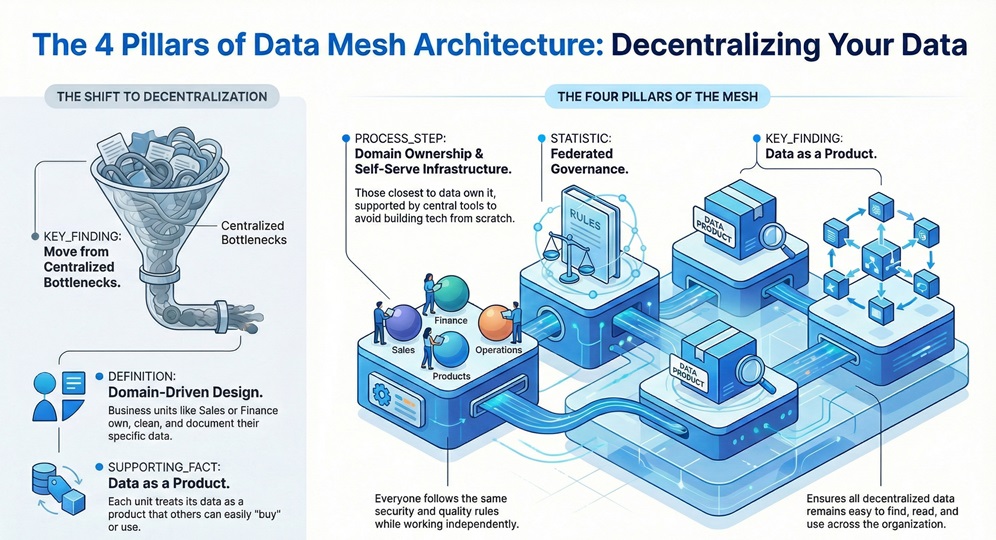
    At its heart, Mesh Architecture refers to a decentralized approach where different business units own their own data. Instead of a single central team managing a massive "data swamp," the people who know the data best—like the marketing or finance teams—take responsibility for it.


    Mesh Architecture


    Picture this: your sales team creates sales data, so they should be the ones to clean it, document it, and share it. This shift moves us away from monolithic systems toward a distributed, "domain-driven" design. We call these units "domains." Each domain treats its data as a product that other people in the company can "buy" or use easily.


    Get My Free Mesh Roadmap


    The Four Pillars of the Mesh

    To truly understand this setup, we need to look at the four main rules that keep it running. Without these, you just have a mess of disconnected databases.


    1. Domain Ownership: The people closest to the data own it.
    2. Data as a Product: Data must be easy to find, read, and use.
    3. Self-Serve Infrastructure: A central platform team provides the tools so domains don't have to build their own tech from scratch.
    4. Federated Governance: Everyone follows the same security and quality rules, even though they work separately.


    Why Domain Ownership Changes Everything

    When we talk about Mesh Architecture, we have to talk about domains. In a traditional setup, if the accounting department changes how they label "revenue," the central data team has to scramble to fix every dashboard. It's a nightmare, right?


    With domain ownership, the accounting team manages that change themselves. They provide a clean "data product" to the rest of the company. In my view, this is the only way to stay agile. You stop being a victim of "upstream" changes because the experts are in charge of their own output.


    Benefits of Localized Control

    • Faster Decisions: You don't wait for a central gatekeeper.
    • Higher Quality: The people who created the records know if a value looks "wrong."
    • Scalability: You can add ten new departments without crashing a central server.


    Also Read: Network Firewalls vs. Next-Generation Firewalls: Which One Wins?


    How Data as a Product Works in Mesh Architecture

    Treating data as a product is a mental shift. We've all seen spreadsheets with titles like "Final_Report_v2_USE_THIS_ONE.csv." That is exactly what we are trying to avoid.


    In a Mesh Architecture, a data product must be "discoverable." This means there's a catalog where you can search for it. It must also be "addressable," meaning it has a permanent spot where you can find it. Most importantly, it must be trustworthy. If the marketing team provides a "Customer Lead" product, they guarantee it’s accurate and updated daily.


    "If the user of your data is unhappy, your product has failed."


    This mindset forces teams to care about the "customer experience" of someone in another department using their numbers.


    Building a Self-Serve Data Platform

    You might wonder, "If every team owns their data, doesn't that mean we need 50 sets of data engineers?" Well, not exactly. This is where the self-serve platform comes in.


    The central IT team stops moving data and starts building "vending machines." They provide the storage, the compute power, and the security templates. A domain team then uses these tools to build their products. Roughly speaking, the platform team handles the "how," while the domain teams handle the "what."


    The Platform Layer

    • Storage: Cloud buckets or warehouses.
    • Identity: Who can see what?
    • Orchestration: Running jobs on a schedule.
    • Lineage: Tracking where the data came from.


    Governance in a Decentralized World

    Can we really trust every team to follow the rules? This is the scariest part of Mesh Architecture for many leaders. We solve this through "Federated Governance."


    Think of it like a group of independent countries that all agree to use the same currency and follow the same trade laws. We create a council with members from each domain. They decide on global standards—like how to format a date or how to mask credit card numbers. Then, we bake these rules into the platform so they happen automatically.


    Also Read: Database Fingerprinting: Secure Your Data Assets


    Real-World Examples: Insurance and Finance

    Let's look at how this plays out in the insurance world. Insurance companies have tons of data: claims, policyholders, risk assessments, and marketing leads.


    In a legacy system, these are all tangled together. When the "Claims" team wants to see "Policy" data, they have to ask IT for an export. In a Mesh Architecture, the Policy team publishes a "Policy Product." The Claims team simply connects to it.


    I've seen this reduce the time to launch new insurance products from months to weeks. Since the risk models are already built as "products," the actuaries can just plug them into new applications without starting from zero.


    Common Hurdles You Will Face

    To be honest, switching to this model is hard. It's 80% culture and 20% technology. Here are a few things that might trip you up:


    • Skill Gaps: Your analysts now need to think a bit more like product managers.
    • Redundancy: Sometimes two teams might build similar things. That's okay! A little overlap is better than a total bottleneck.
    • Initial Cost: Building the self-serve platform takes time and money upfront.


    Does it feel overwhelming? It can. But compare it to the cost of your business slowing down because no one can find the right numbers. Which is worse?


    Mesh Architecture vs. Data Fabric

    We often hear these two terms used together. While they sound similar, they are different. A Data Fabric is like a smart layer of software that connects all your data automatically using AI.


    On the other hand, Mesh Architecture is about people and processes. You can use a Data Fabric to help build your mesh. One is the tool (Fabric); the other is the organizational strategy (Mesh).


    FeatureData MeshData Fabric
    FocusPeople & DomainsTech & Metadata
    ControlDecentralizedUsually Centralized
    OwnershipDomain TeamsCentral IT/AI


    Steps to Get Started

    If you're ready to dive in, don't try to change the whole company at once. That's a recipe for disaster.


    1. Pick one "Pilot" domain: Choose a team that is tech-savvy and has a clear problem to solve.
    2. Define the first Product: What is the most valuable piece of data they have?
    3. Build a MVP Platform: Give them just enough tools to share that one product.
    4. Show the value: Prove that other teams are using it and saving time.


    Conclusion

    The shift toward Mesh Architecture represents a major turning point in how we handle information. We are moving away from rigid, central control and toward a flexible, team-centered model. It's about empowering the people who know the data best to share it with the rest of the world.


    At our core, we value innovation and client agility above all else. We believe that by giving your teams the right structure, you're not just managing data—you're fueling the next generation of your business. We are here to help you navigate this transition and ensure your data works for you, not the other way around.


    Mesh Architecture infographic


    Talk to a Data Expert


    Key Takeaways

    • Mesh Architecture solves the bottleneck of central data teams by spreading ownership.
    • Treating data as a product ensures quality and usability across the company.
    • Self-serve platforms allow non-technical teams to manage their data easily.
    • Governance stays strong through shared standards, not central control.
    • Success depends more on changing your company culture than buying new software.


    Frequently Asked Questions About Mesh Architecture

    Is Mesh Architecture only for big companies?

    Not necessarily. While it's designed for complex organizations, any company with more than three or four distinct departments can benefit from clearer data ownership.


    Do I need to move all my data to the cloud?

    It helps. Cloud tools make the "self-serve" part much easier. However, you can technically build a mesh on-premise, though it requires more manual effort.


    Who leads the governance council?

    Usually, it's a mix. You want a "Head of Data" to facilitate, but the actual rules should be decided by the people from the domains.


    How do we measure success?

    Look at "Time to Value." How long does it take for a new team to get the data they need? If that number goes down, your mesh is working.

    Mesh Architecture: How to Decentralize Your Data

    About The Author

    Surbhi Suhane

    Surbhi Suhane is an experienced digital marketing and content specialist with deep expertise in Getting Things Done (GTD) methodology and process automation. Adept at optimizing workflows and leveraging automation tools to enhance productivity and deliver impactful results in content creation and SEO optimization.

    TRY OUR PRODUCTS

    Like This Story?

    Share it with friends!

    Subscribe to our newsletter!

    FishOSCato SASEVembuXcitiumZeta HRMSAtera
    Isometric illustration of a centralized performance platform connected to analytics dashboards and team members, representing goal alignment, measurable outcomes, risk visibility, and strategic project tracking within ClickUp.

    How ClickUp Enables Outcome-Based Project Management (Not Just Task Tracking)

    🕓 February 15, 2026
    Isometric illustration of a centralized executive dashboard platform connected to analytics panels, performance charts, security indicators, and strategic milestones, representing real-time business visibility and decision control within ClickUp.

    Executive Visibility in ClickUp – How CXOs Gain Real-Time Control Without Micromanaging

    🕓 February 13, 2026

    Cato SASE Architecture

    Inside Cato’s SASE Architecture: A Blueprint for Modern Security

    🕓 January 26, 2025

    Workflow Automation(8)

    Workforce Automation(1)

    AI Project Management(1)

    HR Data Automation(1)

    RMM(2)

    IT Workflow Automation(1)

    GCC compliance(4)

    IT security(2)

    Payroll Integration(2)

    IT support automation(3)

    procurement automation(1)

    lost device management(1)

    IT Management(5)

    IoT Security(2)

    Cato XOps(1)

    IT compliance(4)

    Task Automation(1)

    Workflow Management(1)

    Kubernetes lifecycle management(2)

    OpenStack automation(1)

    AI-powered cloud ops(1)

    SMB Security(8)

    Data Security(1)

    MDR (Managed Detection & Response)(3)

    Atera Integrations(2)

    MSP Automation(3)

    XDR Security(2)

    Threat Detection & Response(1)

    SMB Cyber Protection(1)

    Ransomware Defense(3)

    HR Tech Solutions(1)

    Zero Trust Network Access(3)

    Quantum Threat UAE & GCC(1)

    Post-Quantum Cryptography(1)

    Quantum Security(1)

    Cloud IDE Security(1)

    Zero Trust Security(2)

    Endpoint Management(1)

    SaaS Security(2)

    Payroll Automation(5)

    IT Monitoring(2)

    Xcitium EDR SOC(15)

    Ransomware Protection GCC(1)

    Network Consolidation UAE(1)

    M&A IT Integration(1)

    MSSP for SMBs(1)

    Managed EDR FSD-Tech(1)

    SMB Cybersecurity GCC(1)

    FSD-Tech MSSP(25)

    Ransomware Protection(3)

    Antivirus vs EDR(1)

    Endpoint Security(1)

    Cybersecurity GCC(14)

    Data Breach Costs(1)

    Endpoint Protection(1)

    SMB Cybersecurity(8)

    Xcitium EDR(30)

    Zero Dwell Containment(31)

    Managed Security Services(2)

    Cloud Backup(1)

    Hybrid Backup(1)

    Backup & Recovery(1)

    pointguard ai(4)

    vembu(9)

    backup myths(1)

    disaster recovery myths(1)

    SMB data protection(9)

    Disaster Recovery(4)

    Vembu BDR Suite(19)

    DataProtection(1)

    GCCBusiness(1)

    Secure Access Service Edge(4)

    GCC IT Solutions(1)

    Unified Network Management(1)

    GCC HR software(20)

    open banking(1)

    financial cybersecurity(2)

    CC compliance(1)

    Miradore EMM(15)

    Government Security(1)

    Cato SASE(9)

    GCC Education(1)

    Hybrid Learning(1)

    Cloud Security(9)

    Talent Development(1)

    AI Governance(4)

    AI Compliance(2)

    AI Cybersecurity(13)

    AI Security(2)

    AI Risk Management(1)

    Secure Remote Access(1)

    GCC business security(1)

    GCC network integration(1)

    compliance automation(5)

    GCC cybersecurity(3)

    education security(1)

    App management UAE(1)

    BYOD security Dubai(8)

    Miradore EMM Premium+(5)

    MiddleEast(1)

    share your thoughts

    Mesh Architecture

    Mesh Architecture: How to Decentralize Your Data

    🕓 March 13, 2026

    Security Posture

    What is Security Posture? For a Better Digital Defense

    🕓 March 13, 2026

     Identity Provider (IdP)

    What is an Identity Provider? Guide to IdP & Security

    🕓 March 12, 2026

    Decoded(154)

    Cyber Security(127)

    BCP / DR(22)

    Zeta HRMS(78)

    SASE(21)

    Automation(78)

    Next Gen IT-Infra(127)

    Monitoring & Management(77)

    ITSM(22)

    HRMS(21)

    Automation(24)