HomeNext Gen IT-InfraMonitoring & ManagementCyber SecurityBCP / DRAutomationDecoded
Next Gen IT-Infra
Cato’s SASE Supports Cybersecurity Skills Development

How Cato’s SASE Supports Cybersecurity Skills Development

🕓 April 8, 2025

How SASE Supports the Security Needs of SMBs

How SASE Supports the Security Needs of SMBs

🕓 February 9, 2025

Attack Surface Reduction with Cato’s SASE

Attack Surface Reduction with Cato’s SASE

🕓 February 10, 2025

SASE for Digital Transformation in UAE

SASE for Digital Transformation in UAE

🕓 February 8, 2025

Monitoring & Management
Understanding Atera’s SLA Management

Understanding Atera’s SLA Management

🕓 February 7, 2025

Cost-Performance Ratio: Finding the Right Balance in IT Management Networks

Cost-Performance Ratio: Finding the Right Balance in IT Management Networks

🕓 June 16, 2025

Customizing Atera with APIs

Customizing Atera with APIs

🕓 March 3, 2025

Power Up Your IT Team’s Strategy with Atera’s Communication Tools

Power Up Your IT Team’s Strategy with Atera’s Communication Tools

🕓 February 8, 2025

Cyber Security
Visual guide showing Cato CMA interface for configuring Internet and WAN firewall rules, enabling threat protection, and monitoring security events in real time for UAE IT teams.

Enforcing Firewall and Threat Protection Policies in Cato

🕓 July 25, 2025

Isometric illustration of professionals managing network performance, bandwidth analytics, and cloud-based optimization around the Cato Networks platform, symbolizing bandwidth control and QoS visibility.

Mastering Bandwidth Control and QoS in Cato Networks

🕓 July 26, 2025

Illustration of the Cato Cloud architecture showing its role in delivering SASE for secure, optimized global connectivity.

Understanding the Cato Cloud and Its Role in SASE

🕓 January 29, 2025

Global network backbone powering Cato SASE solution for secure, high-performance connectivity across regions.

Global Backbone: The Engine Powering Cato’s SASE Solution

🕓 January 30, 2025

BCP / DR
Illustration showing diverse business and IT professionals collaborating with cloud, backup, and security icons, representing Vembu use cases for SMBs, MSPs, and IT teams.

Who Uses Vembu? Real-World Use Cases for SMBs, MSPs & IT Teams

🕓 July 12, 2025

Graphic showcasing Vembu’s all-in-one backup and disaster recovery platform with icons for cloud, data protection, and business continuity for IT teams and SMBs.

What Is Vembu? A Deep Dive Into the All in One Backup & Disaster Recovery Platform

🕓 July 6, 2025

Illustration showing Vembu backup and disaster recovery system with cloud storage, server racks, analytics dashboard, and IT professionals managing data.

The Rising Cost of Data Loss: Why Backup Is No Longer Optional?

🕓 August 14, 2025

3D isometric illustration of cloud backup and data recovery infrastructure with laptop, data center stack, and digital business icons — FSD Tech

RPO & RTO: The Heart of Business Continuity

🕓 August 15, 2025

Automation
Cross-Functional Collaboration with ClickUp

Fostering Cross-Functional Collaboration with ClickUp for Multi-Departmental Projects

🕓 February 11, 2025

ClickUp Project Reporting

Revolutionizing Enterprise Reporting with ClickUp’s Advanced Analytics and Dashboards

🕓 June 16, 2025

ClickUp’s Design Collaboration and Asset Management Tools

Empowering Creative Teams with ClickUp’s Design Collaboration and Asset Management Tools

🕓 February 26, 2025

ClickUp Communication and Collaboration Tools

ClickUp Communication and Collaboration Tools: Empowering Remote Teams

🕓 March 12, 2025

Decoded
Multi-Factor Authentication (MFA)

Multi-Factor Authentication (MFA): All You Need to Know

🕓 December 7, 2025

L3 Switch

What Is an L3 Switch? L2 vs L3 & Why You Need Layer 3?

🕓 December 8, 2025

IPSec

IPSec Explained: Protocols, Modes, IKE & VPN Security

🕓 December 3, 2025

 Datagram Transport Layer Security (DTLS)

What is Datagram Transport Layer Security (DTLS)? How it works?

🕓 December 4, 2025

    Subscribe to our newsletter!

    About Us

    Follow Us

    Copyright © 2024 | Powered by 

    Cato SASE Architecture

    Inside Cato’s SASE Architecture: A Blueprint for Modern Security

    🕓 January 26, 2025

    Enterprise Data Security and Privacy with ClickUp

    Ensuring Enterprise Data Security and Privacy with ClickUp

    🕓 February 9, 2025

    DDoS protection SASE

    DDoS Protection and Cato’s Defence Mechanisms

    🕓 February 11, 2025

    Table of Contents

    Domain Spoofing Explained: How It Works & How to Stop It

    Surbhi Suhane
    November 28, 2025
    Comments
    Domain Spoofing

    In 2025, domain spoofing remains a significant threat with over 90% of the world's top email domains vulnerable to spoofing, enabling cybercriminals to launch sophisticated phishing attacks. Only about 7.7% of the top 1.8 million email domains have implemented strict DMARC policies to effectively block spoofing attempts. 


    Most domains either have weak or no DMARC policies, resulting in easy email spoofing opportunities for attackers. Around 62% of phishing attacks in 2025 used domain spoofing or lookalike URLs as a tactic to deceive recipients.


    Key Data on Domain Spoofing


    Domain spoofing and lookalike URLs are key parts of modern phishing. Around 62% of all phishing attacks in 2025 used these methods to trick people.


    Further, the sheer number of attacks is alarming:


    • About 1.5 million domain names were used in phishing attacks during 2025.
    • This is a large jump, marking a 38% increase compared to the previous year.
    • 77% of these fake domains were maliciously registered by the criminals themselves.
    • A significant amount, 37%, of these fake domains were acquired through bulk registrations.


    Domain spoofing attacks are becoming harder to stop. Attackers are abusing legitimate cloud hosting services. They host their phishing sites there. This practice helps them bypass common network defenses.


    Now, we also see AI-powered phishing making things worse. It is designed to create highly convincing fake emails and spoofed websites. This clearly contributes to a rise in identity-based phishing incidents.


    Despite efforts to encourage DMARC adoption, progress is slow. Over 50% of domains still lack basic email authentication records. Also, enforcement visibility remains low. 


    This widespread vulnerability fuels continuous phishing campaigns. These campaigns lead to credential theft, financial fraud, and business email compromise attacks that are costing billions worldwide.


    In this blog, we are going to understand what exactly is domain spoofing and how you can prevent it.


    What is Domain Spoofing?

    Domain Spoofing refers to the act of faking a website’s identity. It makes the malicious site look like a legitimate, well-known one. The threat actor spoofs the website's address. They want you to believe you are visiting the real bank or email provider. You should note here that this is a type of deception.


    Domain spoofing often creates a digital illusion. This illusion steals your attention and your private information. The functional purpose of domain spoofing is almost always financial gain. It is also used for planting malware on your computer.


    As the name suggests, Domain Spoofing uses a fake domain name. This fake domain name looks very much like the real domain. Consequently, you enter your login details on the malicious website. Always remember that this is how threat actors gain access to your accounts.


    • It is a form of cyberattack.
    • Domain spoofing tricks users with a fake, trusted web address.
    • It aims to steal data or spread harmful software.


    Get Prevention from Domain Spoofing


    How Does Domain Spoofing Work?

    The core of Domain Spoofing lies in exploiting trust and technical vulnerabilities. To understand domain spoofing in better terms, we must look at how websites connect. When you type a website name, your computer asks for the site's address. This address is a numerical one, like 192.168.1.1. The Domain Name System (DNS) is what translates the name to the number.


    Domain spoofing threat actors interfere with this translation process. They want your computer to receive the wrong address. They send you to their fake server instead of the real one. Further, they make the fake site look exactly like the real one.


    Now, we will look at how a common type of domain spoofing attack, known as DNS Cache Poisoning, happens. 


    Here, the threat actor corrupts the local storage of your DNS resolver. This resolver stores past address lookups to speed things up. So, when you look up "www.realbank.com," the poisoned cache gives you the fake IP address. The fake IP address belongs to the attacker's server.


    Domain Spoofing is highly effective because you see the correct name in your browser. You trust the name, so you trust the page. The threat actor builds curiosity by making you think the solution is simple. However, the solutions are multi-layered, and we will cover them soon.


    • Domain spoofing often uses the DNS system as a weak point.
    • It makes your computer connect to a hostile IP address.
    • The whole process happens quickly, without you noticing the swap.


    Types of Domain Spoofing

    There are various types of Domain Spoofing worth understanding:


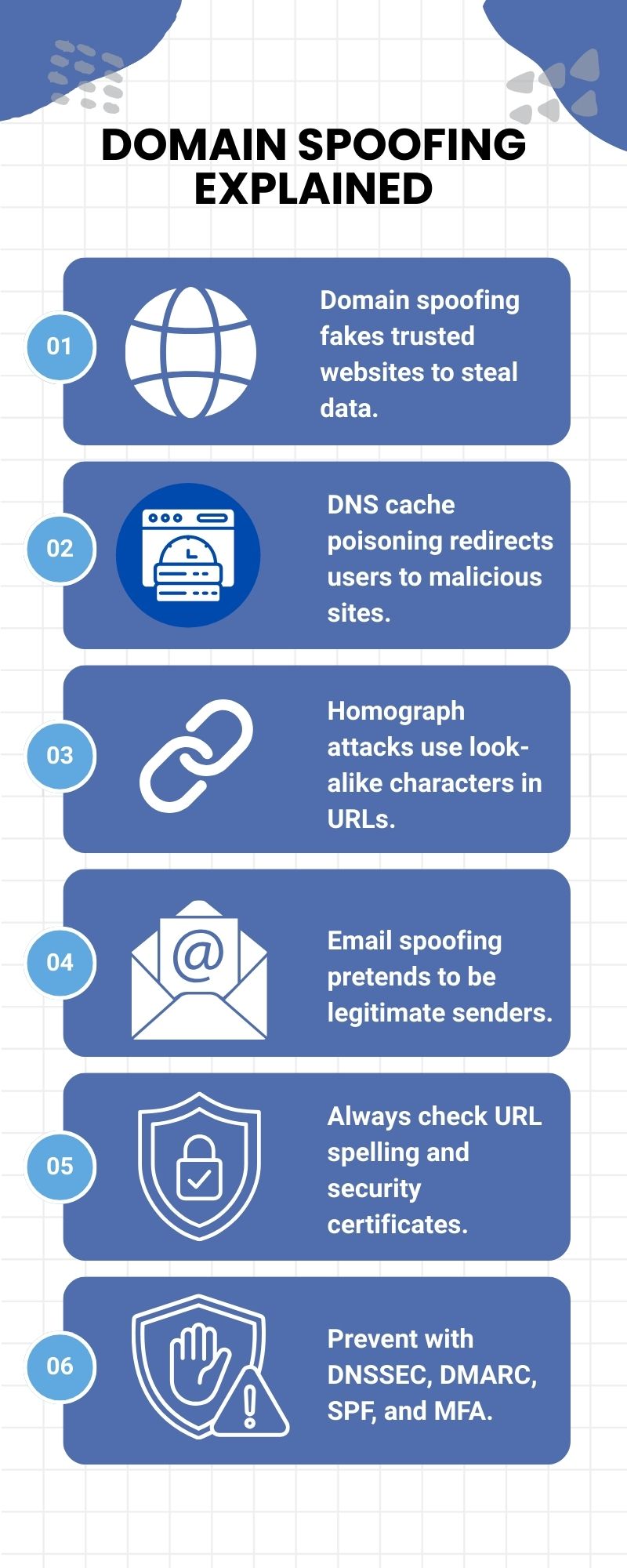
    DNS Spoofing (Cache Poisoning)

    This is the most technical form of domain spoofing. It targets the DNS server itself. It is a critical attack that manipulates the DNS records. 


    Consequently, the user is redirected to a malicious IP address without their knowledge. This method is dangerous because it affects many users at once. It is not easily fixed on the user’s side.


    URL Spoofing (Visual Spoofing/Homograph Attacks)

    This type of domain spoofing targets the user directly. The threat actor uses domain names that look very similar to the real one. 


    For instance, they might swap a lowercase "L" for the number "1." Or they might use characters from a different alphabet that look identical. Always remember to look closely at the web address. It is to be noted that this form of domain spoofing is used often in phishing emails.


    Email Domain Spoofing

    This is when the sender's email address is faked. The email appears to come from a trusted company or person. The actual website link in the email leads to a malicious page. 


    Resultantly, you click the link and land on a domain spoofing site. This site then tries to steal your information. Email domain spoofing relies on social engineering to work.


    Man-in-the-Middle Spoofing

    In this, the threat actor sits between your computer and the legitimate server. They intercept your traffic. They can then send you to a fake login page. This form of domain spoofing is harder to detect without specific tools.


    Domain Spoofing comes in many forms. But they all share the same goal: deception.


    Also Read: What Is Antimalware? Your Guide to Threat Defense


    Impact of Domain Spoofing

    Domain Spoofing causes major damage to both individuals and large organizations.


    Financial and Personal Loss Due to Domain Spoofing

    When you fall for domain spoofing, the consequences are severe. Always remember that your information becomes valuable to the threat actor.


    • Leads to data theft, including login credentials, credit card numbers, and other personal data.
    • It can cause identity theft. The threat actor can use your data to open new accounts.
    • Domain spoofing might install malware or ransomware. This software can lock down your computer files.
    • It causes financial loss directly. They often empty bank accounts.


    Business Reputation and Trust Issues from Domain Spoofing

    The impact is huge for the companies whose domains are being spoofed.


    • It erodes customer trust. When customers get fooled by a fake site, they blame the real company.
    • Leads to costly security cleanups. The business must spend money to tell customers about the breach.
    • It causes loss of business, which means customers may switch to a competitor they feel is safer.
    • Domain spoofing forces companies to spend on stronger email authentication methods.


    Keep this in mind that the long-term damage from loss of trust is hard to measure. Consequently, companies must actively educate their clients.


    Detection and Prevention of Domain Spoofing Attacks

    How can you protect yourself from falling victim to Domain Spoofing? Take a read of these essential steps. You must remember that being vigilant is your best defense.


    How to Spot a Domain Spoofing Attempt?

    The main defense against Domain Spoofing is careful observation. You must learn to check small details.


    1. Check the URL Bar Closely:
      • Domain spoofing often uses misspellings. Look for swapped letters or extra characters.
      • Look for the lock icon. A secure site has a small lock symbol next to the address.
      • Always check the full domain name. Make sure it ends correctly (e.g., .com, .org).
    2. Verify the Security Certificate:
      • Click on the lock icon. It shows the site’s security certificate.
      • This certificate should show the correct company name. If it looks generic or wrong, it may be a domain spoofing site.
    3. Be Wary of Urgent Requests:
      • Domain spoofing emails often create a false sense of urgency. They say your account will be locked if you do not act now.
      • Always go to the known, real website directly. Do not click the link in the email.
    4. Look for Poor Quality:
      • While not always true, sometimes a domain spoofing site has poor graphics or typos. This happens because the threat actors are sloppy.


    Also Read: Why Cybersecurity Is a Business Growth Strategy – Not Just a Cost


    Tools to Prevent Domain Spoofing

    To understand prevention in clearer terms, we can look at technical tools. These tools offer better protection.


    • Implement DNSSEC (Domain Name System Security Extensions): DNSSEC helps secure the DNS process. It digitally signs the DNS data. This makes it harder for threat actors to perform DNS spoofing attacks.
    • Use Multi-Factor Authentication (MFA): Even if domain spoofing steals your password, MFA stops the login. It asks for a second code from your phone.
    • Keep Software Updated: Using old browsers or operating systems leaves you open to vulnerabilities. Threat actors use these weaknesses for domain spoofing. Always update your software immediately.


    Domain Spoofing vs. Phishing: Key Differences

    Often, people confuse Domain Spoofing with phishing. While they work together, they are not the same thing. To understand the difference between Domain Spoofing and Phishing in clearer terms, consider the following key points:


    Point of ComparisonDomain SpoofingPhishing
    Primary GoalTo deceive the user about the origin of the message or website (identity theft).To trick the user into giving up sensitive information (data theft).
    Nature of AttackA technical manipulation of data, like DNS records or URL appearance.A social engineering attack focused on human psychology and manipulation.
    Method FocusTechnical trickery involving URLs, DNS records, or sender addresses.Emotional exploitation through emails, texts, or phone calls (Vishing/Smishing).
    RelationshipDomain Spoofing is often a tool used to make a phishing attack look more believable.Phishing is the end goal or the overall attack that may utilize spoofing.
    Direct Action Needed?Can occur in the background (e.g., DNS cache poisoning) without the victim clicking anything.Requires the victim to take an action, such as clicking a link or downloading a file.
    AppearanceThe website URL looks legitimate, or the DNS record is faked to match a real one.The email/message often creates a sense of urgency, fear, or overwhelming reward.
    Scope of DeceptionSpecific to forging an identity or address (email, IP, domain, caller ID).Broader—it is the entire fraudulent communication process (the "bait").
    Technical RequirementMay require exploiting network protocols or DNS vulnerabilities.Primarily requires strong social tactics and minimal technical skills to set up.
    Legal StatusConsidered a method of impersonation or identity fraud.Considered a direct act of fraud or attempt to commit fraud.
    TargetOften targets the computer or network to bypass security mechanisms (like DNS servers).Specifically targets the human user to exploit their trust and emotion.


    Also Read: Cyber Insurance & Cybersecurity – Why SMBs Need Both to Survive in GCC & Africa


    Protecting Your Business from Email Domain Spoofing

    Email domain spoofing is a huge risk for businesses. It damages their brand name. We and you must work to prevent this.


    There are three key protocols to combat email domain spoofing:


    1. Sender Policy Framework (SPF): This record lists all the servers allowed to send email for your domain. Consequently, if a server not on the list tries to send email, it is flagged as fake.
    2. DomainKeys Identified Mail (DKIM): DKIM adds a digital signature to the emails sent from your domain. This lets the receiving server check the email. It makes sure no one tampered with the email during transit. Domain spoofing emails often fail this check.
    3. Domain-based Message Authentication, Reporting, and Conformance (DMARC): This builds on SPF and DKIM. DMARC tells the receiving email server what to do if an email fails both checks. Should it be rejected, quarantined, or just allowed? This is a strong defense against domain spoofing.


    Always remember that setting up these protocols is complex but necessary. It stops criminals from sending emails that look like they come from your company. This prevents them from using your domain for domain spoofing.


    Final thoughts

    So, we have now covered the complete picture of Domain Spoofing. We understand how this digital deceit works. We know it ranges from complex DNS spoofing to simple URL tricks.


    Therefore, when you are asked for login details, take a moment to pause. It preys on rushing. Your attention is the best firewall you have. Always check the URL, the lock icon, and the overall quality of the site.


    In summary, protecting your data is a shared task. We aim to provide you with the best knowledge to stay safe. When faced with any doubt, choose caution. This is why we focus on transparency and education. We believe that an informed client is a secure client.
     

    Domain-spoofing

    Frequently Asked Questions About Domain Spoofing

    We know you have many questions about this serious threat. Here are answers to some common points:

    Is Domain Spoofing illegal? 

    Domain spoofing is definitely illegal. It is a form of cybercrime and fraud. Threat actors who engage in domain spoofing are often prosecuted for their actions. It is an act of deception used for malicious purposes.


    What happens if I accidentally click on a domain spoofing link? 

    If you click the link, you are on the malicious site. Immediately, do not type in any information. Close the browser window right away. Run a virus or malware scan on your device. Change your passwords right away on a trusted device.


    Can my VPN stop domain spoofing? 

    A VPN adds a layer of privacy. However, it cannot stop a DNS spoofing attack directly. This is because DNS spoofing often tricks your DNS resolver before the VPN is fully engaged. But a strong, reputable VPN can sometimes use its own secure DNS servers. This makes you much safer.


    How is domain spoofing related to website clones? 

    Domain spoofing is the act of redirecting you to a fake site. The fake site itself is the website clone. The spoofing makes the cloning successful. They are two parts of the same attack plan.

    Domain Spoofing Explained: How It Works & How to Stop It

    About The Author

    Surbhi Suhane

    Surbhi Suhane is an experienced digital marketing and content specialist with deep expertise in Getting Things Done (GTD) methodology and process automation. Adept at optimizing workflows and leveraging automation tools to enhance productivity and deliver impactful results in content creation and SEO optimization.

    Like This Story?

    Share it with friends!

    Subscribe to our newsletter!

    Atera

    (48)

    Cato Networks

    (113)

    ClickUp

    (68)

    FishOS

    (7)

    Miradore

    (21)

    PointGuard AI

    (9)

    Vembu

    (22)

    Xcitium

    (33)

    ZETA HRMS

    (71)

    Workflow Automation(5)

    Workforce Automation(1)

    AI Project Management(1)

    HR Data Automation(1)

    RMM(1)

    IT Workflow Automation(1)

    GCC compliance(4)

    IT security(2)

    Payroll Integration(2)

    IT support automation(3)

    procurement automation(1)

    lost device management(1)

    IT Management(5)

    IoT Security(2)

    Cato XOps(2)

    IT compliance(4)

    Task Automation(1)

    Workflow Management(1)

    Kubernetes lifecycle management(2)

    OpenStack automation(1)

    AI-powered cloud ops(1)

    SMB Security(8)

    Data Security(1)

    MDR (Managed Detection & Response)(4)

    Atera Integrations(2)

    MSP Automation(3)

    XDR Security(2)

    SMB Cyber Protection(1)

    Ransomware Defense(3)

    HR Tech Solutions(1)

    Zero Trust Network Access(3)

    Zero Trust Security(2)

    Endpoint Management(1)

    SaaS Security(1)

    Payroll Automation(5)

    IT Monitoring(2)

    Xcitium EDR SOC(15)

    Ransomware Protection GCC(1)

    M&A IT Integration(1)

    Network Consolidation UAE(1)

    MSSP for SMBs(1)

    FSD-Tech MSSP(25)

    Ransomware Protection(3)

    Antivirus vs EDR(1)

    SMB Cybersecurity GCC(1)

    Managed EDR FSD-Tech(1)

    Cybersecurity GCC(12)

    Endpoint Security(1)

    Data Breach Costs(1)

    Endpoint Protection(1)

    Managed Security Services(2)

    Xcitium EDR(30)

    SMB Cybersecurity(8)

    Zero Dwell Containment(31)

    Cloud Backup(1)

    Hybrid Backup(1)

    Backup & Recovery(1)

    pointguard ai(4)

    backup myths(1)

    vembu(9)

    SMB data protection(9)

    disaster recovery myths(1)

    Vembu BDR Suite(19)

    Disaster Recovery(4)

    DataProtection(1)

    GCCBusiness(1)

    Secure Access Service Edge(4)

    GCC HR software(16)

    Miradore EMM(15)

    Cato SASE(7)

    Cloud Security(8)

    Talent Development(1)

    AI Cybersecurity(12)

    AI Security(2)

    AI Governance(4)

    AI Risk Management(1)

    AI Compliance(2)

    GCC business security(1)

    GCC network integration(1)

    compliance automation(4)

    education security(1)

    GCC cybersecurity(2)

    Miradore EMM Premium+(5)

    BYOD security Dubai(8)

    App management UAE(1)

    HealthcareSecurity(1)

    MiddleEast(1)

    Team Collaboration(1)

    IT automation(10)

    Zscaler(1)

    SD-WAN(6)

    HR Integration(4)

    Cloud Networking(3)

    device management(9)

    RemoteWork(1)

    ZeroTrust(2)

    VPN(1)

    MPLS(1)

    Project Management(9)

    HR automation(16)

    share your thoughts

    Asymmetric Encryption

    What is Asymmetric Encryption? Keys and How It Works

    🕓 January 14, 2026

    Attribute Based Access Control (ABAC)

    What is Attribute Based Access Control (ABAC)?

    🕓 January 14, 2026

    Biometric Authentication

    What is Biometric Authentication? Methods & Security Guide

    🕓 January 13, 2026

    Decoded(64)

    Cyber Security(112)

    BCP / DR(22)

    Zeta HRMS(70)

    SASE(21)

    Automation(68)

    Next Gen IT-Infra(113)

    Monitoring & Management(69)

    ITSM(22)

    HRMS(21)

    Automation(24)