HomeNext Gen IT-InfraMonitoring & ManagementCyber SecurityBCP / DRAutomationDecoded
Next Gen IT-Infra
Cato’s SASE Supports Cybersecurity Skills Development

How Cato’s SASE Supports Cybersecurity Skills Development

🕓 April 8, 2025

How SASE Supports the Security Needs of SMBs

How SASE Supports the Security Needs of SMBs

🕓 February 9, 2025

Attack Surface Reduction with Cato’s SASE

Attack Surface Reduction with Cato’s SASE

🕓 February 10, 2025

SASE for Digital Transformation in UAE

SASE for Digital Transformation in UAE

🕓 February 8, 2025

Monitoring & Management
Understanding Atera’s SLA Management

Understanding Atera’s SLA Management

🕓 February 7, 2025

Cost-Performance Ratio: Finding the Right Balance in IT Management Networks

Cost-Performance Ratio: Finding the Right Balance in IT Management Networks

🕓 June 16, 2025

Customizing Atera with APIs

Customizing Atera with APIs

🕓 March 3, 2025

Power Up Your IT Team’s Strategy with Atera’s Communication Tools

Power Up Your IT Team’s Strategy with Atera’s Communication Tools

🕓 February 8, 2025

Cyber Security
Visual guide showing Cato CMA interface for configuring Internet and WAN firewall rules, enabling threat protection, and monitoring security events in real time for UAE IT teams.

Enforcing Firewall and Threat Protection Policies in Cato

🕓 July 25, 2025

Isometric illustration of professionals managing network performance, bandwidth analytics, and cloud-based optimization around the Cato Networks platform, symbolizing bandwidth control and QoS visibility.

Mastering Bandwidth Control and QoS in Cato Networks

🕓 July 26, 2025

Illustration of the Cato Cloud architecture showing its role in delivering SASE for secure, optimized global connectivity.

Understanding the Cato Cloud and Its Role in SASE

🕓 January 29, 2025

Global network backbone powering Cato SASE solution for secure, high-performance connectivity across regions.

Global Backbone: The Engine Powering Cato’s SASE Solution

🕓 January 30, 2025

BCP / DR
Illustration showing diverse business and IT professionals collaborating with cloud, backup, and security icons, representing Vembu use cases for SMBs, MSPs, and IT teams.

Who Uses Vembu? Real-World Use Cases for SMBs, MSPs & IT Teams

🕓 July 12, 2025

Graphic showcasing Vembu’s all-in-one backup and disaster recovery platform with icons for cloud, data protection, and business continuity for IT teams and SMBs.

What Is Vembu? A Deep Dive Into the All in One Backup & Disaster Recovery Platform

🕓 July 6, 2025

Illustration showing Vembu backup and disaster recovery system with cloud storage, server racks, analytics dashboard, and IT professionals managing data.

The Rising Cost of Data Loss: Why Backup Is No Longer Optional?

🕓 August 14, 2025

3D isometric illustration of cloud backup and data recovery infrastructure with laptop, data center stack, and digital business icons — FSD Tech

RPO & RTO: The Heart of Business Continuity

🕓 August 15, 2025

Automation
Cross-Functional Collaboration with ClickUp

Fostering Cross-Functional Collaboration with ClickUp for Multi-Departmental Projects

🕓 February 11, 2025

ClickUp Project Reporting

Revolutionizing Enterprise Reporting with ClickUp’s Advanced Analytics and Dashboards

🕓 June 16, 2025

ClickUp’s Design Collaboration and Asset Management Tools

Empowering Creative Teams with ClickUp’s Design Collaboration and Asset Management Tools

🕓 February 26, 2025

ClickUp Communication and Collaboration Tools

ClickUp Communication and Collaboration Tools: Empowering Remote Teams

🕓 March 12, 2025

Decoded
Multi-Factor Authentication (MFA)

Multi-Factor Authentication (MFA): All You Need to Know

🕓 December 7, 2025

L3 Switch

What Is an L3 Switch? L2 vs L3 & Why You Need Layer 3?

🕓 December 8, 2025

IPSec

IPSec Explained: Protocols, Modes, IKE & VPN Security

🕓 December 3, 2025

 Datagram Transport Layer Security (DTLS)

What is Datagram Transport Layer Security (DTLS)? How it works?

🕓 December 4, 2025

    Subscribe to our newsletter!

    About Us

    Follow Us

    Copyright © 2024 | Powered by 

    Cato SASE Architecture

    Inside Cato’s SASE Architecture: A Blueprint for Modern Security

    🕓 January 26, 2025

    Enterprise Data Security and Privacy with ClickUp

    Ensuring Enterprise Data Security and Privacy with ClickUp

    🕓 February 9, 2025

    DDoS protection SASE

    DDoS Protection and Cato’s Defence Mechanisms

    🕓 February 11, 2025

    Table of Contents

    What is Security Information and Event Management (SIEM)?

    Surbhi Suhane
    January 19, 2026
    Comments
    Security Information and Event Management (SIEM)

    You hear about data breaches and constant threats. Therefore, organizations need tools to watch their entire IT network constantly. Security Information and Event Management (SIEM) is nothing but a solution that provides this continuous watch.


    To understand this better, a security information and event management platform collects, analyzes, and presents security data from all the different parts of your IT setup. This includes firewalls, servers, applications, and network devices. Simply put, SIEM helps you detect security threats and respond to them quickly.


    We will discuss how a security information and event management system works and why it plays a vital role in protecting your data.


    Core Components of Security Information and Event Management

    The security information and event management solution is based on two primary functions: Security Information Management (SIM) and Security Event Management (SEM).
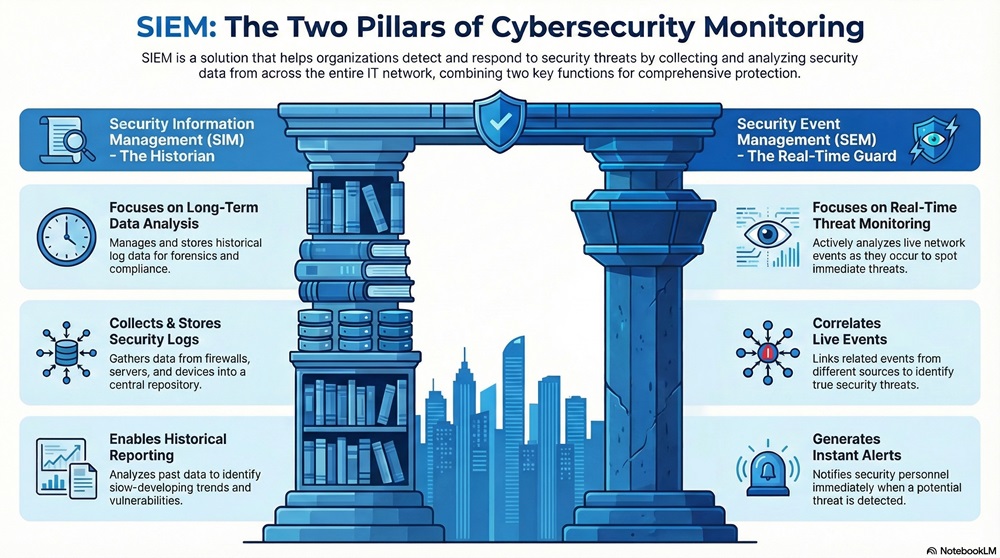
     

    Core Components of Security Information and Event Management


    Security Information Management (SIM)

    SIM mainly deals with log data management. It refers to the process of collecting log data from various sources and then storing this information for a long period. This is essential for forensics and compliance.


    SIM provides these services:


    • Data Collection: The SIM component compiles log data from firewalls, routers, servers, and endpoints.
    • Storage and Retention: It maintains a centralized repository of all this security log data. Organizations must preserve this historical log data to meet compliance regulations, such as HIPAA or PCI DSS.
    • Analysis and Reporting: This process performs historical analysis on the stored data. This helps identify trends and potential vulnerabilities that were not immediately visible.


    Security Event Management (SEM)

    SEM, on the other hand, deals with real-time event monitoring and analysis. It focuses on identifying and responding to active threats.


    SEM performs the following:


    • Real-time Event Correlation: The SEM component analyzes incoming events as they occur. It correlates or links related events from different sources. This helps distinguish a true security threat from regular network noise.
    • Threat Detection: It identifies unusual or suspicious activity based on pre-defined security rules and patterns.
    • Alerting and Notification: When the system detects a potential threat or violation, it generates immediate alerts and notifies security personnel.


    The security information and event management solution brings these two functions together. It provides both a real-time watch and a long-term record.


    SIEM Today Contact our experts now


    How Does a Security Information and Event Management System Work?

    The functioning of a security information and event management system is a systematic, step-by-step process. This process ensures that no critical security event goes unnoticed.


    1. Data Aggregation and Collection

    The SIEM process begins with data aggregation. The platform collects security logs and event data from every source in your network.


    • Sources of Data: Examples include operating systems, applications, network devices (routers, switches), security tools (firewalls, anti-virus software), and cloud environments.
    • Data Normalization: The original log data comes in many different formats. The SIEM system must normalize this data, which means converting all logs into a common, standard format. This ensures that the system can analyze and compare logs easily.
    • Data Enrichment: The platform may enrich the data by adding context, such as user identity, geographic location, or known threat intelligence data.


    2. Data Analysis and Correlation

    Once the system collects and normalizes the data, it begins the vital process of analysis. This is where the core security information and event management (SIEM) technology comes into play.


    • Event Correlation: The system uses correlation rules to search for patterns. For example, a single failed login attempt on a server is not alarming. However, if the system observes 100 failed login attempts across 50 different user accounts in 5 minutes, followed by a successful login from a foreign country, the SIEM platform will link these events. This action leads to a significant security alert.
    • Rule-Based Detection: Security teams define specific rules. For instance, "If a user tries to access a sensitive database after business hours, trigger an alert."
    • Behavioral Analysis: Advanced systems use User and Entity Behavior Analytics (UEBA). This technology establishes a baseline of normal behavior for every user and device. When a user or device deviates significantly from this normal behavior, the system triggers an alert.


    3. Threat Monitoring and Alerting

    The ultimate purpose of a security information and event management system is to alert the security team to real threats.


    • Dashboard View: Security professionals use a centralized dashboard for monitoring. This dashboard shows the overall security posture and highlights the most critical events.
    • Alert Generation: When a rule is violated or an unusual pattern is detected, the platform generates a high-priority alert.
    • Prioritization: The system prioritizes alerts based on the severity of the threat and the impact on the business. This ensures that the security team focuses its limited resources on the most critical issues first.


    4. Security Incident Management and Reporting

    Finally, the SIEM system facilitates the response and compliance aspects of cybersecurity.


    • Incident Response: The security team uses the SIEM data to investigate the alert. They can trace the attack from beginning to end, determine the extent of the breach, and then take action to contain the threat.
    • Reporting: The system generates various reports. These reports demonstrate compliance with regulations, show system performance, and provide a record of all security incidents.


    Also Read: What is Threat Hunting? Proactive Cyber Security


    What are the Benefits of a Security Information and Event Management Platform?

    Deploying a security information and event management platform provides several crucial advantages for any organization focused on protecting its valuable data.


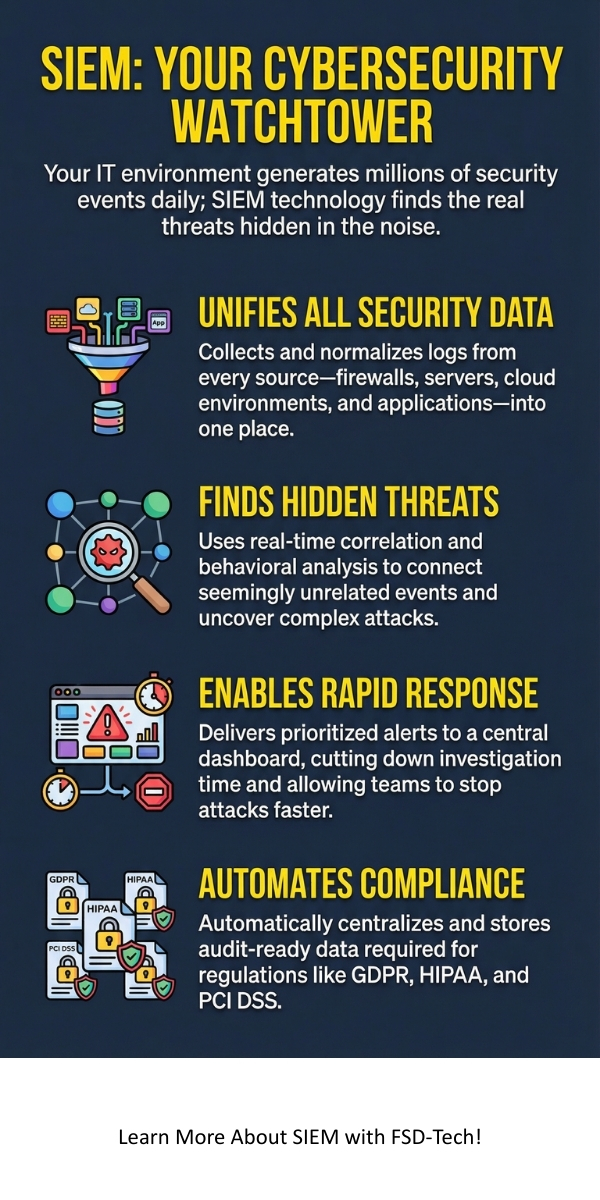
    • Real-Time Threat Detection: The system provides immediate visibility into your network. It does not just record events; it actively connects the dots in real time. This capability means you can stop an attack while it is happening, rather than discovering a breach weeks later.
    • Compliance Management: Many industry and government regulations, such as GDPR and PCI DSS, demand that companies maintain detailed logs of security events. The security information and event management solution automatically centralizes and stores this audit-ready data.
    • Faster Incident Response: The platform significantly reduces the time between an attack starting and the security team responding to it. Since the system provides all the context and related events, analysts do not have to waste time manually gathering logs.
    • Centralized Visibility: It creates a single pane of glass view for the entire security environment. This helps security analysts manage and understand events across diverse systems, whether they are on-premises or in the cloud.
    • Improved Security Posture: By analyzing historical trends and identifying recurring vulnerabilities, the SIEM system helps security teams make proactive changes to strengthen the overall security posture.


    Key Differences: SIEM vs. Log Management

    People often confuse SIEM with simple log management. While the two concepts are related, they serve different primary purposes. Let us compare them clearly.


    Basis for ComparisonSecurity Information and Event Management (SIEM)Log Management
    Primary GoalThreat Detection and Incident ResponseData Storage and Searching
    AnalysisReal-time correlation, behavioral analysis, and threat prioritizationHistorical search and retrieval of individual events
    Data ScopeFocuses on security-relevant logs and eventsCollects all logs from all IT sources
    AlertingGenerates immediate, high-priority alerts based on patternsRequires manual creation of reports or basic threshold alerts
    Data UsageUsed primarily by Security Operations Center (SOC) teamsUsed by IT Operations, developers, and auditors
    TechnologyIncludes correlation engines and advanced analyticsMainly involves collection, indexing, and storage


    SIEM is a step far beyond simple log storage. Log management simply collects and archives the raw data. The security information and event management system takes that raw data, makes sense of it, and alerts you when something bad is about to happen. This distinction is critical.


    Also Read: Cyber Threat Intelligence (CTI) in Cybersecurity


    Best Practices for Security Information and Event Management Systems

    To ensure that you get the maximum value from the best security information and event management systems, you must follow certain practices.


    1. Define Clear Use Cases

    Before deployment, security teams must define specific use cases that the SIEM will monitor.


    • Examples: Monitoring for suspicious service account usage, detecting malware communication with external servers, or tracking unauthorized access to sensitive files.
    • Action: By focusing on these defined threats, you avoid alert fatigue and ensure the system targets the most relevant risks.


    2. Proper Rule Tuning

    The correlation rules and alerts in the SIEM must be accurate.


    • False Positives: If the system generates too many false alerts (false positives), security analysts begin to ignore the warnings. This defeats the purpose of a security information and event management system.
    • Tuning: Security professionals must continuously tune the rules and logic to reduce the number of false alerts.


    3. Continuous Monitoring and Review

    A SIEM solution is not a "set it and forget it" tool.


    • Regular Review: Security analysts must review the dashboards and reports daily.
    • Updates: Organizations must update the system’s threat intelligence feeds and correlation rules frequently to keep pace with new and evolving threats.


    4. Effective Data Prioritization

    Do not try to ingest every single log file. This can become too costly and difficult to manage.


    • Focus: Focus on logs from critical systems first. These include domain controllers, firewalls, and servers that hold sensitive customer data.
    • Prioritization: You must prioritize the data that offers the highest security value.


    Conclusion

    The modern threat landscape is complex and constantly changing. Simply installing point security products, like a firewall or an antivirus program, is no longer enough to protect your organization. You need a way to connect all the security information and respond to the most critical threats in real time.


    The security information and event management platform provides this capability. It empowers your security team by providing comprehensive visibility and smart analysis.

    Thus, we can say the security information and event management (SIEM) technology is an essential investment. It ensures that your security professionals can quickly detect, analyze, and manage security incidents, thereby protecting your most vital assets.
     

    SIEM Security? Contact us


    SIEM infographic


    Key Takeaways

    1. SIEM is a security information and event management solution that merges real-time event monitoring (SEM) with historical log management (SIM).
    2. The purpose of a security information and event management system is to aggregate diverse logs, normalize them, and correlate events to spot complex, multi-stage threats instantly.
    3. A security information and event management platform is crucial for compliance (like GDPR) and provides a centralized view of all security events across the entire IT environment.
    4. Unlike simple log management, the SIEM system uses advanced analytics to prioritize alerts and enables a much faster incident response to attacks.
    5. To maximize the value of the best security information and event management systems, teams must continuously tune correlation rules and define clear threat use cases.


    Frequently Asked Questions about Security Information and Event Management

    Q: What is the main difference between SIEM and a firewall?

    A: The firewall acts as a gatekeeper. It blocks known bad traffic at the network border. The SIEM acts as a security investigator. It collects data from the firewall (and other devices) to detect complex, multi-stage attacks that the firewall alone cannot see.


    Q: What is a SIEM event?

    A: An event refers to any change in the state of a system or network. Examples include a user logging in, a file being accessed, or a connection being made between two devices. The security information and event management solution collects millions of these events.


    Q: Does SIEM replace my existing security tools?

    A: No, the security information and event management system does not replace your existing tools like antivirus software or intrusion detection systems. Instead, it integrates with them. The SIEM platform collects the output (logs and alerts) from these existing tools and makes them more powerful by correlating the data.


    Q: Why do I need a SIEM system if I have good security controls?

    A: Even with good security controls, a determined attacker can still get past them. The purpose of a security information and event management system is to find the residual threats—the attacks that slipped past your initial defenses. It finds the tiny pieces of evidence left behind and links them together.


    What is Security Information and Event Management (SIEM)?

    About The Author

    Surbhi Suhane

    Surbhi Suhane is an experienced digital marketing and content specialist with deep expertise in Getting Things Done (GTD) methodology and process automation. Adept at optimizing workflows and leveraging automation tools to enhance productivity and deliver impactful results in content creation and SEO optimization.

    Like This Story?

    Share it with friends!

    Subscribe to our newsletter!

    Atera

    (48)

    Cato Networks

    (113)

    ClickUp

    (70)

    FishOS

    (7)

    Miradore

    (21)

    PointGuard AI

    (9)

    Vembu

    (22)

    Xcitium

    (33)

    ZETA HRMS

    (71)

    Workflow Automation(8)

    Workforce Automation(1)

    AI Project Management(1)

    HR Data Automation(1)

    RMM(1)

    IT Workflow Automation(1)

    IT security(2)

    GCC compliance(4)

    Payroll Integration(2)

    IT support automation(3)

    procurement automation(1)

    lost device management(1)

    IT Management(5)

    IoT Security(2)

    Cato XOps(2)

    IT compliance(4)

    Workflow Management(1)

    Task Automation(1)

    AI-powered cloud ops(1)

    Kubernetes lifecycle management(2)

    OpenStack automation(1)

    SMB Security(8)

    Data Security(1)

    MDR (Managed Detection & Response)(4)

    MSP Automation(3)

    Atera Integrations(2)

    XDR Security(2)

    Ransomware Defense(3)

    SMB Cyber Protection(1)

    HR Tech Solutions(1)

    Zero Trust Network Access(3)

    Zero Trust Security(2)

    Endpoint Management(1)

    SaaS Security(1)

    Payroll Automation(5)

    IT Monitoring(2)

    Xcitium EDR SOC(15)

    Ransomware Protection GCC(1)

    M&A IT Integration(1)

    Network Consolidation UAE(1)

    MSSP for SMBs(1)

    FSD-Tech MSSP(25)

    Antivirus vs EDR(1)

    Ransomware Protection(3)

    Managed EDR FSD-Tech(1)

    SMB Cybersecurity GCC(1)

    Cybersecurity GCC(12)

    Endpoint Security(1)

    Data Breach Costs(1)

    Endpoint Protection(1)

    Zero Dwell Containment(31)

    Managed Security Services(2)

    Xcitium EDR(30)

    SMB Cybersecurity(8)

    Cloud Backup(1)

    Hybrid Backup(1)

    Backup & Recovery(1)

    pointguard ai(4)

    backup myths(1)

    vembu(9)

    SMB data protection(9)

    disaster recovery myths(1)

    Vembu BDR Suite(19)

    Disaster Recovery(4)

    DataProtection(1)

    GCCBusiness(1)

    Secure Access Service Edge(4)

    GCC HR software(16)

    Miradore EMM(15)

    Cato SASE(7)

    Cloud Security(8)

    Talent Development(1)

    AI Cybersecurity(12)

    AI Security(2)

    AI Governance(4)

    AI Risk Management(1)

    AI Compliance(2)

    GCC business security(1)

    GCC network integration(1)

    compliance automation(4)

    education security(1)

    GCC cybersecurity(2)

    Miradore EMM Premium+(5)

    BYOD security Dubai(8)

    App management UAE(1)

    HealthcareSecurity(1)

    MiddleEast(1)

    Team Collaboration(1)

    IT automation(12)

    Zscaler(1)

    SD-WAN(6)

    HR Integration(4)

    Cloud Networking(3)

    device management(9)

    RemoteWork(1)

    ZeroTrust(2)

    VPN(1)

    MPLS(1)

    Project Management(9)

    HR automation(16)

    share your thoughts

    Dynamic Application Security Testing (DAST)

    What is Dynamic Application Security Testing (DAST)?

    🕓 January 19, 2026

    Security Information and Event Management (SIEM)

    What is Security Information and Event Management (SIEM)?

    🕓 January 19, 2026

    Role-Based Access Control (RBAC)

    What is Role-Based Access Control (RBAC)?

    🕓 January 17, 2026

    Decoded(72)

    Cyber Security(112)

    BCP / DR(22)

    Zeta HRMS(70)

    SASE(21)

    Automation(70)

    Next Gen IT-Infra(113)

    Monitoring & Management(69)

    ITSM(22)

    HRMS(21)

    Automation(24)