.webp&w=3840&q=75)
How ClickUp Enables Outcome-Based Project Management (Not Just Task Tracking)
🕓 February 15, 2026
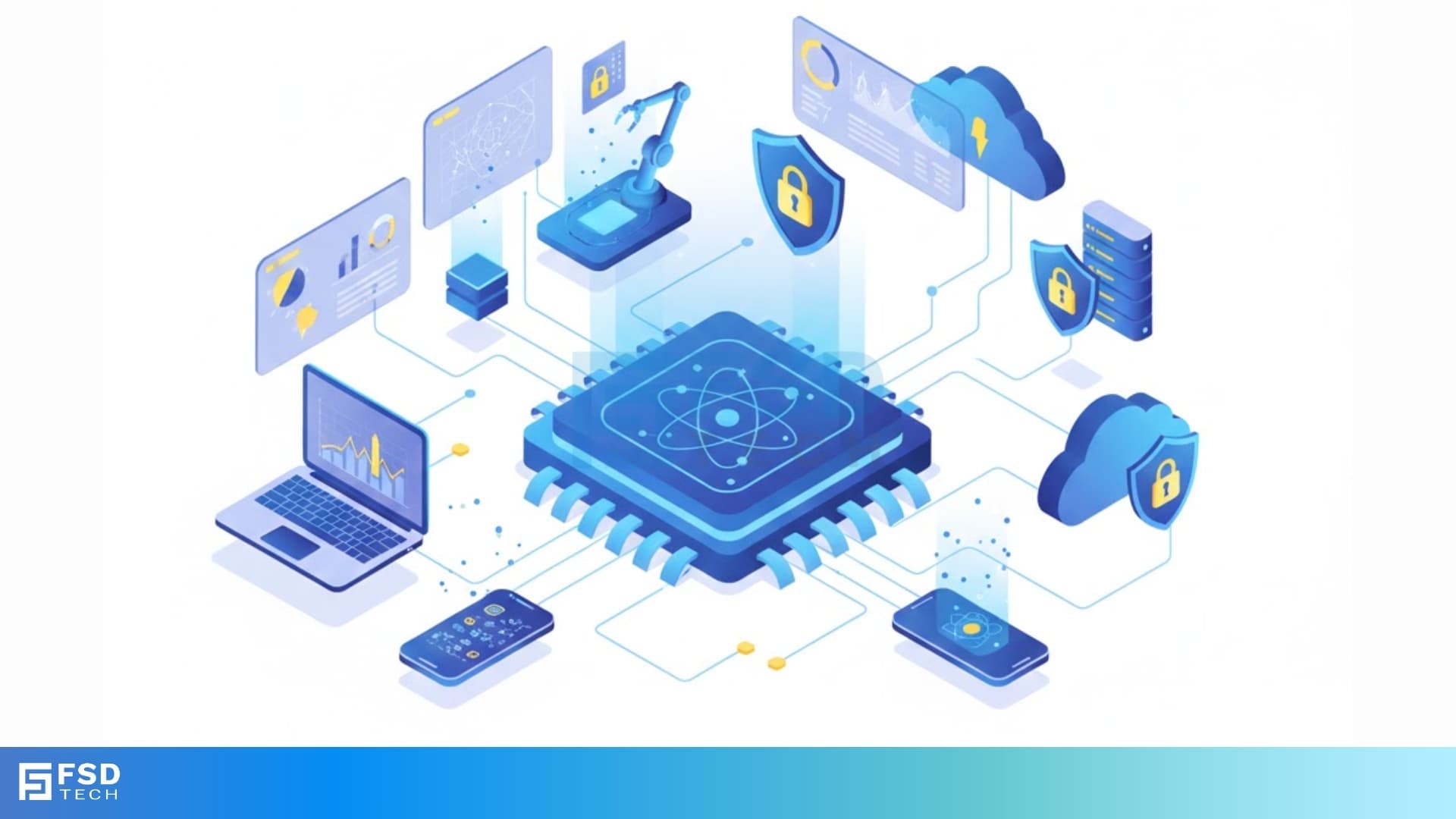
You probably rely on encryption to protect your financial transactions, private emails, and confidential work. But did you know a massive, silent threat already exists that could shatter this security? The development of powerful quantum computers means that the encryption protecting our digital world—RSA, ECC—will soon be useless. This isn't a problem for the future; it is happening now.
How can we possibly create a communication link so secure that even the laws of physics protect it? The answer is quantum cryptography. This revolutionary field provides keys that become instantly self-destructing if anyone tries to look at them. Stay with us to discover how this technology harnesses the bizarre rules of the quantum world to build a truly unbreakable shield around your most critical data.
Quantum cryptography can be understood as a new field of cryptography. It uses the principles of quantum mechanics—the physics governing the smallest particles, like photons—to create unbreakable encryption keys and secure communication channels.
In simple words, classical cryptography uses complex mathematical problems. If you solve the problem, you break the code. Quantum cryptography, on the other hand, uses physics to protect the keys. Quantum crypto does not secure the message itself, but it ensures that the cryptography quantum computing key—the secret code used for encryption—is completely safe from any eavesdropping attempt. If someone tries to intercept the key, the laws of physics immediately alert both the sender and the receiver.
Key takeaway: Quantum cryptography provides a physical guarantee of security, which is a major difference from the mathematical guarantee offered by classical methods.
Classical and quantum cryptography solve the same problem—securing communication—but they use completely different methods. To understand this better, let us now look at the key differences between the two.
| Basis for Comparison | Classical Cryptography | Quantum Cryptography |
|---|---|---|
| Underlying Principle | Mathematical complexity | Laws of Quantum Physics |
| Security Mechanism | The difficulty of factoring large numbers (e.g., RSA) | The property of quantum states that prevents undetectable measurement (No-Cloning Theorem) |
| Key Distribution | Requires a pre-shared secret key or uses mathematically derived public/private keys | Uses quantum states (photons) to distribute the key securely (Quantum Key Distribution or QKD) |
| Future Vulnerability | Vulnerable to powerful quantum computers | Theoretically immune to both classical and quantum computing attacks |
| Main Use | Encrypting and digitally signing data | Securely sharing the secret encryption key |
Also Read: Threat Modeling in Cyber Security - Process, STRIDE & Benefits
Now, the question arises: why does quantum cryptography offer this seemingly unbreakable security? The answer lies in two fundamental concepts of quantum mechanics.
1. The Heisenberg Uncertainty Principle
In this section, we will discuss the Heisenberg Uncertainty Principle. It is a principle of physics. It implies that you cannot accurately measure two specific properties of a particle—like its position and momentum, or in cryptography, its polarization—at the same time. The act of measuring one property inherently and fundamentally disturbs the other.
This is the central defense mechanism of quantum cryptography. If an eavesdropper, often called Eve, tries to measure the quantum key (which is sent as a stream of photons), her attempt to read the photons changes their state. This change is noticeable, alerting the legitimate users, Alice and Bob, that someone is listening. The act of observation is detectable.
2. The No-Cloning Theorem
The No-Cloning Theorem is also a law of quantum mechanics. It simply states that you cannot create an identical copy of an unknown quantum state.
In terms of quantum crypto, this means that Eve cannot simply copy the quantum key stream she intercepts and then send the original to Bob, keeping the copy for later analysis. She cannot make a perfect copy without disturbing the original state, which again gives away her presence. This property prevents both passive eavesdropping and impersonation.
Quantum cryptography mainly focuses on Quantum Key Distribution (QKD). QKD is a secure protocol for producing and distributing a secret cryptographic key between two parties, typically Alice and Bob. The security of the key is based on the laws of physics, not on mathematics.
Let us now discuss the sequential process of the most famous QKD protocol, BB84.
The BB84 protocol, developed by Charles Bennett and Gilles Brassard in 1984, is the first and most widely implemented quantum cryptography example.
This new secret key is then used with a standard classical cipher, such as AES, to encrypt the actual message. QKD is used only for key exchange.
Also Read: What is a Botnet? How Botnet Attacks Work & Prevention
Now, the question arises: Why quantum computing is such a massive threat to our current security infrastructure? The answer lies in the algorithms used by these powerful new computers.
Quantum computing is a type of computation. It works on the principle of quantum mechanics, utilizing properties like superposition and entanglement. This allows a quantum computer to process massive amounts of information simultaneously.
This capability fundamentally changes which problems are hard and which are easy for a computer to solve. How quantum computing works means that problems considered computationally infeasible for a classical supercomputer become solvable in minutes.
In 1994, mathematician Peter Shor developed an algorithm, now called Shor’s algorithm. It runs on a quantum computer. This algorithm efficiently factors very large numbers.
The security of modern public-key cryptography, including RSA and the Elliptic Curve Cryptography (ECC), relies on the fact that factoring large numbers is incredibly hard for classical computers. Shor’s algorithm makes this task easy for a powerful enough quantum computer.
While how many quantum computers are there today that pose this immediate threat is small, governments and large corporations are investing heavily. The development of a functional, large-scale quantum machine is considered a matter of when, not if. This leads us to the two main solutions.
Many people confuse quantum cryptography with post-quantum cryptography. While both aim to achieve security in a quantum future, they represent completely different approaches.
| Basis for Comparison | Quantum Cryptography (QKD) | Post-Quantum Cryptography (PQC) |
|---|---|---|
| Mechanism | Uses quantum physics (photons) to distribute keys securely | Uses new mathematical algorithms run on classical computers |
| Security Foundation | Laws of physics | New hard mathematical problems (e.g., Lattice-based, Code-based) |
| Focus | Key exchange only; requires special quantum hardware (fibers, sensors) | Encryption, digital signatures, and key exchange; runs on existing classical hardware |
| Vulnerability to Quantum Attacks | Considered immune (theoretically unbreakable key) | Believed to be safe, but security relies on the hardness of the new math problems |
Post-quantum cryptography (PQC) involves developing new, quantum-resistant classical algorithms. These algorithms rely on mathematical problems that even quantum computers find difficult to solve (e.g., lattice-based cryptography). They can be implemented on our existing classical hardware and internet infrastructure.
Also Read: What Is Data Leakage? Causes, Prevention & ML Risks
Quantum cryptography plays a vital role in securing communication where the highest level of long-term secrecy is required. The aim is to ensure confidentiality that lasts for decades, even as computing power increases.
While quantum cryptography offers exceptional security, implementing it requires significant investment and careful planning.
Scientists are actively working on ways to overcome these limitations.
So, with the above discussion, we can say that the future of data security depends on proactively adopting these quantum-safe methods.
Thus, we can say that the shift toward quantum-safe security is vital and already underway. Quantum computing represents a clear and present danger to all classical encryption methods. Quantum cryptography (QKD) stands ready as the ultimate physical defense, offering theoretically unbreakable keys based on the immutable laws of physics.
While the technology requires specialized hardware, its security guarantee is unparalleled. We must proactively adopt a robust, hybrid security architecture, combining QKD and post-quantum cryptography, to protect your most critical data for decades to come. This ensures your confidentiality in the face of rapidly advancing technology.
Your Security Matters Reach FSD-Tech
The main purpose of quantum cryptography is to securely distribute an encryption key between two parties, which is a process known as Quantum Key Distribution (QKD). It does not encrypt the actual message; it makes the key unbreakable.
Quantum cryptography secures the key based on the laws of physics, making it theoretically unbreakable. Classical encryption (like RSA) secures the data based on the difficulty of solving a complex mathematical problem, which powerful quantum computers can efficiently solve.
Quantum computing is a threat to current encryption methods because of its massive processing power. Quantum cryptography is a defense against this threat. It uses quantum physics to create unbreakable keys.
Yes, QKD systems are commercially available and are currently used by some financial institutions and government agencies for high-security, point-to-point communication over short-to-medium distances.

Surbhi Suhane is an experienced digital marketing and content specialist with deep expertise in Getting Things Done (GTD) methodology and process automation. Adept at optimizing workflows and leveraging automation tools to enhance productivity and deliver impactful results in content creation and SEO optimization.
Share it with friends!




.webp&w=3840&q=75)



share your thoughts