HomeNext Gen IT-InfraMonitoring & ManagementCyber SecurityBCP / DRAutomationDecoded
Next Gen IT-Infra
Cato’s SASE Supports Cybersecurity Skills Development

How Cato’s SASE Supports Cybersecurity Skills Development

🕓 April 8, 2025

How SASE Supports the Security Needs of SMBs

How SASE Supports the Security Needs of SMBs

🕓 February 9, 2025

Attack Surface Reduction with Cato’s SASE

Attack Surface Reduction with Cato’s SASE

🕓 February 10, 2025

SASE for Digital Transformation in UAE

SASE for Digital Transformation in UAE

🕓 February 8, 2025

Monitoring & Management
Understanding Atera’s SLA Management

Understanding Atera’s SLA Management

🕓 February 7, 2025

Cost-Performance Ratio: Finding the Right Balance in IT Management Networks

Cost-Performance Ratio: Finding the Right Balance in IT Management Networks

🕓 June 16, 2025

Customizing Atera with APIs

Customizing Atera with APIs

🕓 March 3, 2025

Power Up Your IT Team’s Strategy with Atera’s Communication Tools

Power Up Your IT Team’s Strategy with Atera’s Communication Tools

🕓 February 8, 2025

Cyber Security
Illustration of the Cato Cloud architecture showing its role in delivering SASE for secure, optimized global connectivity.

Understanding the Cato Cloud and Its Role in SASE

🕓 January 29, 2025

Isometric illustration of professionals managing network performance, bandwidth analytics, and cloud-based optimization around the Cato Networks platform, symbolizing bandwidth control and QoS visibility.

Mastering Bandwidth Control and QoS in Cato Networks

🕓 July 26, 2025

Global network backbone powering Cato SASE solution for secure, high-performance connectivity across regions.

Global Backbone: The Engine Powering Cato’s SASE Solution

🕓 January 30, 2025

Illustration of team analyzing application traffic and usage insights on a large laptop screen using Cato’s dashboard, surrounded by network and cloud icons.

Cato Networks Application Visibility | Monitoring & Control

🕓 July 27, 2025

BCP / DR
Illustration showing diverse business and IT professionals collaborating with cloud, backup, and security icons, representing Vembu use cases for SMBs, MSPs, and IT teams.

Who Uses Vembu? Real-World Use Cases for SMBs, MSPs & IT Teams

🕓 July 12, 2025

Graphic showcasing Vembu’s all-in-one backup and disaster recovery platform with icons for cloud, data protection, and business continuity for IT teams and SMBs.

What Is Vembu? A Deep Dive Into the All in One Backup & Disaster Recovery Platform

🕓 July 6, 2025

Illustration showing Vembu backup and disaster recovery system with cloud storage, server racks, analytics dashboard, and IT professionals managing data.

The Rising Cost of Data Loss: Why Backup Is No Longer Optional?

🕓 August 14, 2025

3D isometric illustration of cloud backup and data recovery infrastructure with laptop, data center stack, and digital business icons — FSD Tech

RPO & RTO: The Heart of Business Continuity

🕓 August 15, 2025

Automation
Cross-Functional Collaboration with ClickUp

Fostering Cross-Functional Collaboration with ClickUp for Multi-Departmental Projects

🕓 February 11, 2025

ClickUp Project Reporting

Revolutionizing Enterprise Reporting with ClickUp’s Advanced Analytics and Dashboards

🕓 June 16, 2025

ClickUp’s Design Collaboration and Asset Management Tools

Empowering Creative Teams with ClickUp’s Design Collaboration and Asset Management Tools

🕓 February 26, 2025

ClickUp Communication and Collaboration Tools

ClickUp Communication and Collaboration Tools: Empowering Remote Teams

🕓 March 12, 2025

Decoded
Multi-Factor Authentication (MFA)

Multi-Factor Authentication (MFA): All You Need to Know

🕓 December 7, 2025

L3 Switch

What Is an L3 Switch? L2 vs L3 & Why You Need Layer 3?

🕓 December 8, 2025

IPSec

IPSec Explained: Protocols, Modes, IKE & VPN Security

🕓 December 3, 2025

 Datagram Transport Layer Security (DTLS)

What is Datagram Transport Layer Security (DTLS)? How it works?

🕓 December 4, 2025

    Subscribe to our newsletter!

    About Us

    Follow Us

    Copyright © 2024 | Powered by 

    Isometric illustration of a centralized executive dashboard platform connected to analytics panels, performance charts, security indicators, and strategic milestones, representing real-time business visibility and decision control within ClickUp.

    Executive Visibility in ClickUp – How CXOs Gain Real-Time Control Without Micromanaging

    🕓 February 13, 2026

    Cato SASE Architecture

    Inside Cato’s SASE Architecture: A Blueprint for Modern Security

    🕓 January 26, 2025

    Enterprise Data Security and Privacy with ClickUp

    Ensuring Enterprise Data Security and Privacy with ClickUp

    🕓 February 9, 2025

    Table of Contents

    What is Throughput? Definition, OS & Networking

    Surbhi Suhane
    February 14, 2026
    Comments
    Throughput

    Throughput refers to the actual rate at which a system processes or moves data, products, or information from one point to another within a specific timeframe. In computing and networking, it represents the successful delivery of data packets over a communication channel. It acts as a vital measure of efficiency, showing you how much "work" a system actually completes versus its theoretical maximum capacity.


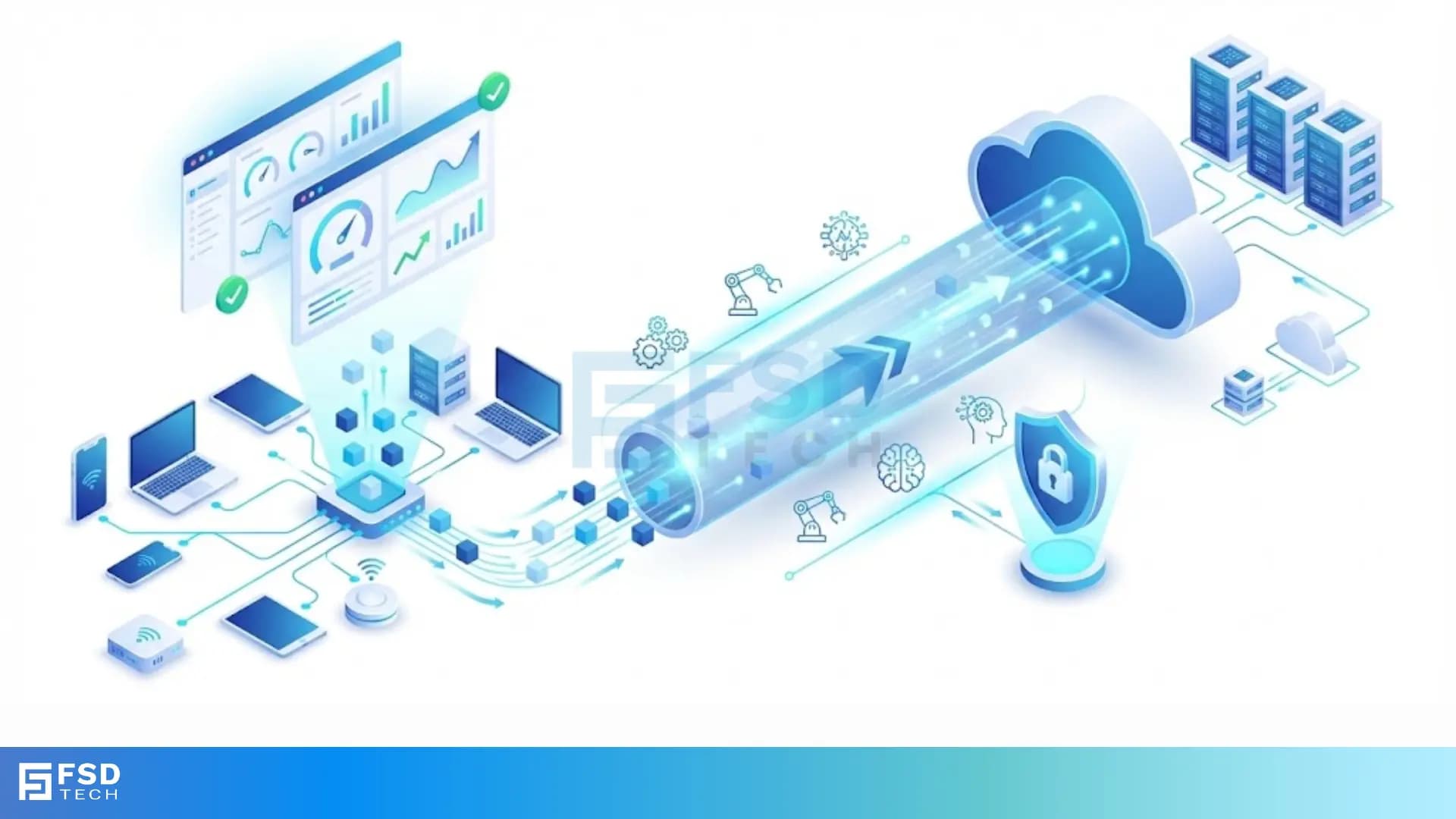
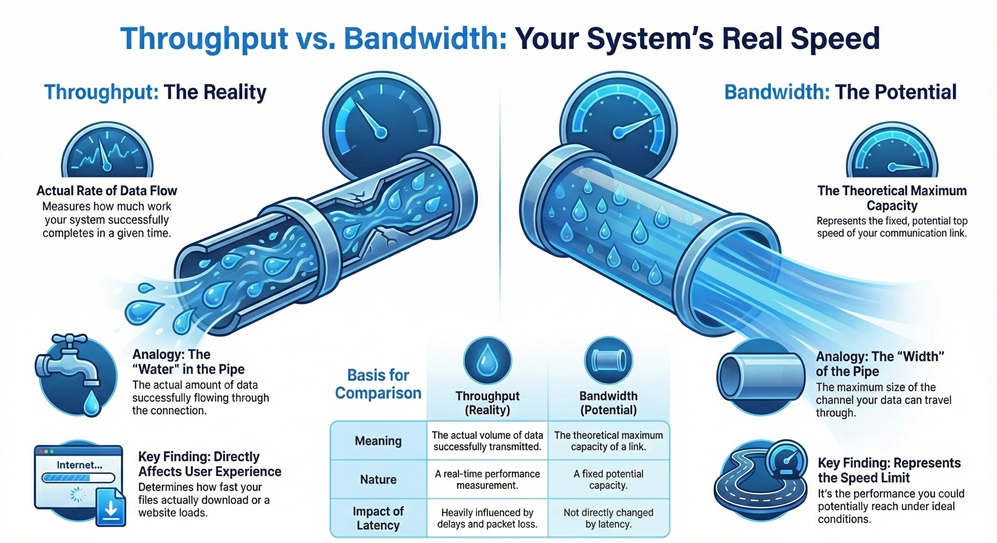
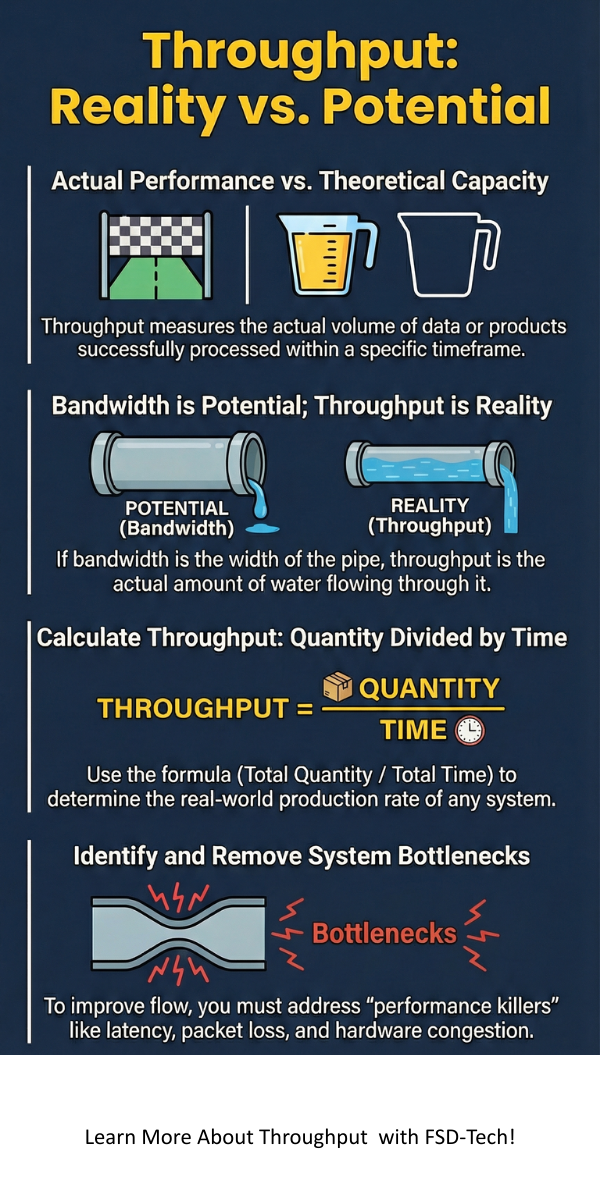
    To understand this concept, you need to think about the difference between potential and reality. Many people confuse throughput with bandwidth. However, while bandwidth represents the maximum width of the "pipe," throughput measures the actual amount of "water" flowing through it at any given moment. One may wonder why a fast connection still feels slow; the answer usually lies in the difference between these two metrics.


    Comparison Chart: Throughput vs Bandwidth

    Basis for ComparisonThroughputBandwidth
    MeaningThe actual volume of data successfully transmitted over a period.The theoretical maximum capacity of a communication link.
    NatureIt is a real-time performance measurement.It is a fixed potential capacity.
    Impact of LatencyHeavily influenced by delays and packet loss.Not directly changed by latency.
    User ExperienceDirectly determines how fast a file downloads for you.Represents the limit of what you could potentially reach.
    CalculationMeasured as (Total Data) / (Total Time taken).Measured based on signal frequency and physical hardware.


    What does Throughput mean?

    Throughput involves looking at the output of a process. In the simplest terms, it is the production rate of a system. If you operate a manufacturing plant, your throughput is the number of finished goods leaving the assembly line per hour. In the digital world, it is the number of bits that successfully arrive at their destination.
     

    Throughput


    To be honest, most users care more about this metric than any other. Have you ever wondered how much traffic does a website get and why it crashes? That happens because the incoming requests exceed the system's ability to process them. When the "load" surpasses the throughput, the system starts to lag or fail. It is nothing but a reality check for your hardware and software.


    Optimize your throughput now


    What is Throughput in OS?

    Throughput in Operating System refers to the number of processes or tasks the CPU completes in a unit of time. It is a primary goal of scheduling algorithms to maximize this number. In a multi-programming environment, the OS tries to keep the CPU busy at all times to ensure that more jobs are finished quickly.


    The throughput of network systems and operating systems are linked. If the OS cannot process data packets fast enough due to high CPU usage, the network performance will drop. In this context, the OS acts as a gatekeeper. If the gate is narrow or the guard is slow, the flow of data stalls.


    Throughput of network

    The throughput of network systems represents the actual speed of data transfer across a local or wide area network. Here's the thing: your network is only as fast as its slowest link. Even if you have a fiber-optic cable, a congested router can kill your speed.


    According to research from Tetcos, several elements define this performance:


    • Packet Loss: If data packets disappear, they must be resent, which lowers the rate.
    • Latency: The time it takes for a packet to travel from sender to receiver.
    • Jitter: Variations in the delay of received packets.


    When we talk about what throughput means in a network, we are looking at the "Goodput." Goodput is a sub-set of throughput that excludes protocol overhead and retransmitted packets. It is the "useful" data you actually receive.


    Also Read: What is Latency in Networking? Definition, Causes & Solutions


    What is the Throughput rate?

    The what is throughput rate question is best answered by looking at the formula:


    Throughput = Total Quantity/Time


    In supply chain management and order fulfillment, this rate determines how quickly a company can satisfy customer demand. A high rate suggests an efficient, lean process, while a low rate indicates "bottlenecks."


    Let us discuss the components of this rate:

    • Inventory: The items currently in the system.
    • Flow Time: The time an item spends in the process from start to finish.
    • Bottlenecks: The point where the flow is restricted.


    If you are managing a warehouse, you want your throughput rate to match your order volume. If you can’t ship items as fast as they are ordered, your "backlog" grows, and customer satisfaction drops.


    What is High Throughput sequencing?

    In the field of biology, what is high throughput sequencing (HTS) refers to a modern technology that allows researchers to sequence DNA and RNA much faster than traditional methods. It has revolutionized genomic research by allowing millions of sequences to be processed simultaneously.


    HTS is a perfect example of scaling. By parallelizing the work, scientists can map an entire human genome in days rather than years. This massive "data dump" requires significant computing power to analyze, but the throughput of the sequencing machines themselves is what opened the door to personalized medicine.


    Also Read: What is a Wireless LAN Controller? Configuration & Setup 101


    What is Throughput accounting?

    Throughput accounting is a principle used in the Theory of Constraints. It focuses on how much money a company makes through sales minus the "totally variable costs" (like raw materials). It differs from traditional cost accounting because it views everything as a system.


    The goal here is simple:


    1. Increase Throughput (Sales).
    2. Decrease Inventory (Money stuck in the system).
    3. Decrease Operating Expense (Money spent turning inventory into throughput).


    In my experience, many businesses fail because they focus on "local efficiencies" (making one machine go fast) rather than "system throughput" (getting the product to the customer).


    Factors affecting Throughput

    There are several reasons why your system might not be reaching its full potential. Let us understand these limitations:


    • Hardware Limitations: The physical speed of your CPU, RAM, or NIC.
    • Congestion: Too many users trying to use the same resource at once. Think of a highway during rush hour.
    • Errors: Corrupted data that requires re-transmission.
    • Protocol Overhead: The "extra" data needed to route and manage your files.


    Conclusion

    Understanding what does throughput mean is the first step toward optimizing any system, whether it is a computer network or a manufacturing line. By focusing on the actual output rather than just the potential capacity, you can find the real "choke points" in your operations.


    We are committed to helping you understand these technical concepts so you can make better decisions for your business or studies. Our goal is to provide clear, actionable insights that drive real-world results.


    Master network metrics today, Contact our Experts
     

    Throughput infographic


    Key Takeaways

    • Throughput is the actual amount of data or work completed, not the theoretical maximum.
    • In Operating Systems, it measures how many tasks the CPU finishes per second.
    • Network Throughput is affected by latency, packet loss, and congestion.
    • Throughput Accounting helps businesses focus on sales rather than just cutting costs.
    • To improve performance, you must identify and remove the bottleneck.


    FAQs on Throughput

    Q: Is higher throughput always better?

    A: Generally, yes. However, if you push a system too hard, you might increase the error rate, which eventually causes the throughput to collapse.


    Q: How do I measure my network throughput?

    A: You can use tools like iPerf or simple speed tests. These tools send a known amount of data and measure how long it takes to arrive.


    Q: What is the difference between Throughput and Latency?

    A: Throughput is how much data moves; Latency is how fast a single piece of data moves. You can have high throughput with high latency (like a large truck moving slowly).


    What is Throughput? Definition, OS & Networking

    About The Author

    Surbhi Suhane

    Surbhi Suhane is an experienced digital marketing and content specialist with deep expertise in Getting Things Done (GTD) methodology and process automation. Adept at optimizing workflows and leveraging automation tools to enhance productivity and deliver impactful results in content creation and SEO optimization.

    Like This Story?

    Share it with friends!

    Subscribe to our newsletter!

    Atera

    (55)

    Cato Networks

    (121)

    ClickUp

    (72)

    FishOS

    (7)

    Miradore

    (21)

    PointGuard AI

    (9)

    Vembu

    (22)

    Xcitium

    (33)

    ZETA HRMS

    (79)

    Workflow Automation(8)

    Workforce Automation(1)

    AI Project Management(1)

    HR Data Automation(1)

    RMM(1)

    IT Workflow Automation(1)

    GCC compliance(4)

    IT security(2)

    Payroll Integration(2)

    IT support automation(3)

    procurement automation(1)

    lost device management(1)

    IT Management(5)

    IoT Security(2)

    Cato XOps(2)

    IT compliance(4)

    Task Automation(1)

    Workflow Management(1)

    Kubernetes lifecycle management(2)

    AI-powered cloud ops(1)

    OpenStack automation(1)

    SMB Security(8)

    Data Security(1)

    MDR (Managed Detection & Response)(4)

    MSP Automation(3)

    Atera Integrations(2)

    XDR Security(2)

    Ransomware Defense(3)

    SMB Cyber Protection(1)

    HR Tech Solutions(1)

    Zero Trust Network Access(3)

    Zero Trust Security(2)

    Endpoint Management(1)

    SaaS Security(1)

    Payroll Automation(5)

    IT Monitoring(2)

    Xcitium EDR SOC(15)

    Ransomware Protection GCC(1)

    M&A IT Integration(1)

    Network Consolidation UAE(1)

    MSSP for SMBs(1)

    Antivirus vs EDR(1)

    Managed EDR FSD-Tech(1)

    FSD-Tech MSSP(25)

    SMB Cybersecurity GCC(1)

    Ransomware Protection(3)

    Cybersecurity GCC(12)

    Endpoint Security(1)

    Endpoint Protection(1)

    Data Breach Costs(1)

    SMB Cybersecurity(8)

    Zero Dwell Containment(31)

    Managed Security Services(2)

    Xcitium EDR(30)

    Hybrid Backup(1)

    Cloud Backup(1)

    Backup & Recovery(1)

    pointguard ai(4)

    backup myths(1)

    vembu(9)

    SMB data protection(9)

    disaster recovery myths(1)

    Disaster Recovery(4)

    Vembu BDR Suite(19)

    GCCBusiness(1)

    DataProtection(1)

    Secure Access Service Edge(4)

    GCC HR software(20)

    Miradore EMM(15)

    Cato SASE(7)

    Cloud Security(9)

    Hybrid Learning(1)

    GCC Education(1)

    Talent Development(1)

    AI Compliance(2)

    AI Governance(4)

    AI Cybersecurity(12)

    AI Risk Management(1)

    AI Security(2)

    GCC business security(1)

    GCC network integration(1)

    compliance automation(5)

    education security(1)

    GCC cybersecurity(3)

    Miradore EMM Premium+(5)

    App management UAE(1)

    BYOD security Dubai(8)

    HealthcareSecurity(1)

    MiddleEast(1)

    Team Collaboration(1)

    IT automation(12)

    Zscaler(1)

    SD-WAN(7)

    HR Integration(4)

    Cloud Networking(4)

    device management(9)

    VPN(1)

    ZeroTrust(2)

    RemoteWork(1)

    MPLS(1)

    share your thoughts

    Unicast

    What is Unicast? Definition, Working & WAN Role

    🕓 February 14, 2026

    Throughput

    What is Throughput? Definition, OS & Networking

    🕓 February 14, 2026

    Full Duplex Communication

    What is Full Duplex Communication? Full vs Half Duplex

    🕓 February 13, 2026

    Decoded(111)

    Cyber Security(118)

    BCP / DR(22)

    Zeta HRMS(78)

    SASE(21)

    Automation(72)

    Next Gen IT-Infra(118)

    Monitoring & Management(76)

    ITSM(22)

    HRMS(21)

    Automation(24)