HomeNext Gen IT-InfraMonitoring & ManagementCyber SecurityBCP / DRAutomationDecoded
Next Gen IT-Infra
Cato’s SASE Supports Cybersecurity Skills Development

How Cato’s SASE Supports Cybersecurity Skills Development

🕓 April 8, 2025

How SASE Supports the Security Needs of SMBs

How SASE Supports the Security Needs of SMBs

🕓 February 9, 2025

Attack Surface Reduction with Cato’s SASE

Attack Surface Reduction with Cato’s SASE

🕓 February 10, 2025

SASE for Digital Transformation in UAE

SASE for Digital Transformation in UAE

🕓 February 8, 2025

Monitoring & Management
Understanding Atera’s SLA Management

Understanding Atera’s SLA Management

🕓 February 7, 2025

Cost-Performance Ratio: Finding the Right Balance in IT Management Networks

Cost-Performance Ratio: Finding the Right Balance in IT Management Networks

🕓 June 16, 2025

Customizing Atera with APIs

Customizing Atera with APIs

🕓 March 3, 2025

Power Up Your IT Team’s Strategy with Atera’s Communication Tools

Power Up Your IT Team’s Strategy with Atera’s Communication Tools

🕓 February 8, 2025

Cyber Security
Visual guide showing Cato CMA interface for configuring Internet and WAN firewall rules, enabling threat protection, and monitoring security events in real time for UAE IT teams.

Enforcing Firewall and Threat Protection Policies in Cato

🕓 July 25, 2025

Isometric illustration of professionals managing network performance, bandwidth analytics, and cloud-based optimization around the Cato Networks platform, symbolizing bandwidth control and QoS visibility.

Mastering Bandwidth Control and QoS in Cato Networks

🕓 July 26, 2025

Illustration of the Cato Cloud architecture showing its role in delivering SASE for secure, optimized global connectivity.

Understanding the Cato Cloud and Its Role in SASE

🕓 January 29, 2025

Global network backbone powering Cato SASE solution for secure, high-performance connectivity across regions.

Global Backbone: The Engine Powering Cato’s SASE Solution

🕓 January 30, 2025

BCP / DR
Illustration showing diverse business and IT professionals collaborating with cloud, backup, and security icons, representing Vembu use cases for SMBs, MSPs, and IT teams.

Who Uses Vembu? Real-World Use Cases for SMBs, MSPs & IT Teams

🕓 July 12, 2025

Graphic showcasing Vembu’s all-in-one backup and disaster recovery platform with icons for cloud, data protection, and business continuity for IT teams and SMBs.

What Is Vembu? A Deep Dive Into the All in One Backup & Disaster Recovery Platform

🕓 July 6, 2025

Illustration showing Vembu backup and disaster recovery system with cloud storage, server racks, analytics dashboard, and IT professionals managing data.

The Rising Cost of Data Loss: Why Backup Is No Longer Optional?

🕓 August 14, 2025

3D isometric illustration of cloud backup and data recovery infrastructure with laptop, data center stack, and digital business icons — FSD Tech

RPO & RTO: The Heart of Business Continuity

🕓 August 15, 2025

Automation
Cross-Functional Collaboration with ClickUp

Fostering Cross-Functional Collaboration with ClickUp for Multi-Departmental Projects

🕓 February 11, 2025

ClickUp Project Reporting

Revolutionizing Enterprise Reporting with ClickUp’s Advanced Analytics and Dashboards

🕓 June 16, 2025

ClickUp’s Design Collaboration and Asset Management Tools

Empowering Creative Teams with ClickUp’s Design Collaboration and Asset Management Tools

🕓 February 26, 2025

ClickUp Communication and Collaboration Tools

ClickUp Communication and Collaboration Tools: Empowering Remote Teams

🕓 March 12, 2025

Decoded
Multi-Factor Authentication (MFA)

Multi-Factor Authentication (MFA): All You Need to Know

🕓 December 7, 2025

L3 Switch

What Is an L3 Switch? L2 vs L3 & Why You Need Layer 3?

🕓 December 8, 2025

IPSec

IPSec Explained: Protocols, Modes, IKE & VPN Security

🕓 December 3, 2025

 Datagram Transport Layer Security (DTLS)

What is Datagram Transport Layer Security (DTLS)? How it works?

🕓 December 4, 2025

    Subscribe to our newsletter!

    About Us

    Follow Us

    Copyright © 2024 | Powered by 

    Cato SASE Architecture

    Inside Cato’s SASE Architecture: A Blueprint for Modern Security

    🕓 January 26, 2025

    Enterprise Data Security and Privacy with ClickUp

    Ensuring Enterprise Data Security and Privacy with ClickUp

    🕓 February 9, 2025

    DDoS protection SASE

    DDoS Protection and Cato’s Defence Mechanisms

    🕓 February 11, 2025

    Table of Contents

    Threat Modeling in Cyber Security - Process, STRIDE & Benefits

    Surbhi Suhane
    December 20, 2025
    Comments
    Threat Modeling in Cyber Security

    Threat modeling is an essential process that helps you secure your systems and applications. It aims at identifying, understanding, and mitigating potential security risks before a system goes live. If you build software without understanding the threats it faces, you risk significant and costly security breaches.


    We are living in a digital world where security must be a core part of building anything. This method ensures that your team focuses on the most critical security issues early in the development lifecycle.


    But, how does this process help you build stronger systems? And what makes a good threat model so vital for modern cyber security? Let us explore how you can use this technique to safeguard your business assets.


    What is a Threat Model in Cybersecurity?

    A threat model can be understood as a structured representation of all the information that affects an application’s security. Simply put, it is a living document that captures the security design of your system, identifies potential weaknesses, and determines the necessary actions to reduce risk.
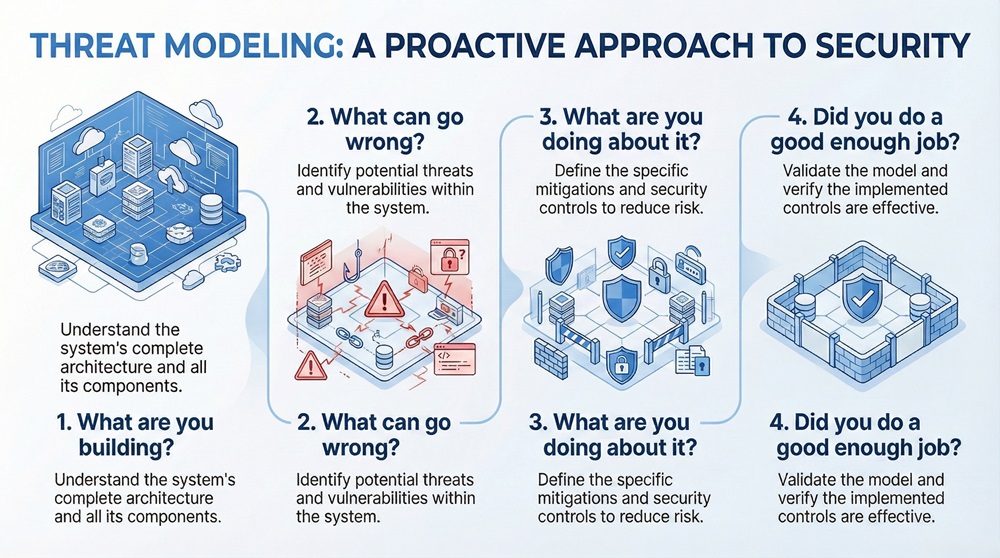
     

    Threat Modeling Infographic


    The core goal of a threat model in cybersecurity is to provide a systematic way to answer four fundamental questions about your application:


    1. What are you building? (Understanding the system's architecture and components.)
    2. What can go wrong? (Identifying potential threats and vulnerabilities.)
    3. What are you doing about it? (Defining the mitigations and controls.)
    4. Did you do a good enough job? (Validating the model and the implemented controls.)


    This proactive approach means you are building security in, rather than patching weaknesses later.


    Proactive Security with Cato SASE


    Threat Modeling Process

    The threat modeling process systematically breaks down your system to find vulnerabilities. While different methodologies exist, the core steps remain consistent.


    The process follows a logical sequence to ensure comprehensive security review. Here, we will discuss the four major steps in the threat modeling process.


    1. Model the Application (What are you building?)

    The first step in the threat modeling process is defining the system clearly. You cannot secure what you do not understand.


    • Decompose the System: This involves breaking the complex application into smaller, more manageable components.
    • Create Data Flow Diagrams (DFDs): A DFD is a visual representation that shows how data moves through the system. This includes processes, external entities, data stores, and the flow of data between them.
    • Identify Trust Boundaries: These are lines that separate components with different levels of trust. Data moving across a trust boundary often requires validation and sanitization.


    Understanding the data flow helps you see where critical data resides and how attackers might access it.


    2. Identify Threats (What can go wrong?)

    Once you understand the system architecture, you must ask: What are the possible threats? This step uses structured approaches to find potential security issues.


    • Use a Structured Framework: Tools like STRIDE (Spoofing, Tampering, Repudiation, Information Disclosure, Denial of Service, Elevation of Privilege) help categorize and systematically find threats. We will cover this in detail shortly.
    • Identify Assets: Assets include sensitive data, system resources, and business-critical functions.
    • Determine Attack Vectors: This refers to the paths an attacker can take to compromise an asset.


    When you use a framework, you ensure that you do not miss common types of attacks.


    3. Rate and Prioritize Threats (What are you doing about it?)

    Not all threats present the same level of risk. Your team must focus efforts where they matter most. This involves rating the identified threats.


    • Calculate Risk: Risk is typically calculated by considering the likelihood of the threat occurring and the impact if it does occur.
    • Use a Rating System: Systems like DREAD (Damage, Reproducibility, Exploitability, Affected Users, Discoverability) or CVSS (Common Vulnerability Scoring System) help in consistently scoring risks.


    The result is a prioritized list of security issues. You will address the high-risk threats first, which is the most efficient way to use security resources.


    4. Define and Verify Mitigations (Did you do a good enough job?)

    The final step in the threat modeling process is defining and applying security controls, and then confirming their effectiveness.


    • Define Mitigations: For each prioritized threat, you define specific security controls. For example, to mitigate a Tampering threat on a data flow, you might implement data encryption.
    • Verify Controls: You must then verify that the implemented controls actually work and effectively reduce the risk to an acceptable level. This often involves security testing.


    In this way, the process confirms that the implemented security is adequate for the risks identified.


    Also Read: Unified Threat Management (UTM): Key Security Functions


    Threat Modelling Methods

    To successfully identify threats, you need a systematic method. Threat modelling methods provide this structure. They help teams think like an attacker and categorize the security vulnerabilities.


    STRIDE: A Foundational Approach

    The STRIDE method is one of the most popular and comprehensive threat modelling methods. It uses a mnemonic to ensure you consider six specific categories of threats:


    Threat CategoryDescriptionSecurity Property ViolatedExample Mitigation
    SpoofingImpersonating another user or system component.AuthenticationImplement strong authentication mechanisms.
    TamperingModifying data in transit or at rest.IntegrityUse digital signatures or encryption.
    RepudiationDenying an action without proof.Non-RepudiationImplement comprehensive auditing and logging.
    Information DisclosureExposing sensitive data to unauthorized parties.ConfidentialityEncrypt data both in transit and at rest.
    Denial of ServicePreventing legitimate users from accessing the system.AvailabilityImplement rate limiting and load balancing.
    Elevation of PrivilegeGaining capabilities beyond those initially granted.AuthorizationUse the principle of least privilege.


    The STRIDE approach helps you systematically check for common threats associated with different elements in your system’s DFD.


    DREAD: Assessing Risk

    While STRIDE identifies what can go wrong, DREAD helps you assess the severity of the threat. DREAD is a simple scoring system where each factor is rated, typically from 1 (low) to 10 (high), and the scores are averaged to get a final risk rating.


    • Damage potential: How bad is the impact if the vulnerability is exploited?
    • Reproducibility: How easy is it to reproduce the attack?
    • Exploitability: How much effort and skill are needed to launch the attack?
    • Affected users: How many users are impacted by the vulnerability?
    • Discoverability: How easy is it for an attacker to find the vulnerability?


    When you combine STRIDE (threat identification) with DREAD (risk rating), you get a strong foundation for the threat modeling process.


    Threat Modeling in SDLC

    What is threat modeling in SDLC (Software Development Life Cycle)? It is the practice of integrating security analysis throughout the entire development process, not just at the end. This shift is crucial for catching design flaws when they are cheapest and easiest to fix.


    Integration Points


    • Requirements Phase: The team starts by defining security requirements based on business needs and compliance. Threat modeling at this stage ensures security is a primary design goal.
    • Design Phase: This is the most critical stage for threat modeling. The team creates DFDs and applies STRIDE to the design, identifying and mitigating design flaws before a single line of code is written.
    • Implementation Phase: Developers use the defined mitigations, such as using specific encryption libraries or input validation functions, to build the code securely.
    • Testing Phase: Security testing and penetration testing directly verify the mitigations defined in the threat model.
    • Deployment and Maintenance: The threat model must be updated whenever the system changes or new threats are discovered.


    This integration makes security an ongoing task, not a final checkpoint. Threat modeling in SDLC dramatically reduces security costs and risks.


    Also Read: What is an Intrusion Prevention System (IPS)?


     What Does a Threat Model Look Like?

    A completed threat model is not just a list of risks; it is a structured document that guides security decisions.


    What does a threat model look like in its final, usable form? It is an actionable security report that contains:


    1. System Description: The scope, assets, and architecture (often with DFDs).
    2. Identified Threats: A detailed list of threats categorized by method (e.g., STRIDE).
    3. Risk Analysis: A score for each threat (e.g., using DREAD) to prioritize work.
    4. Mitigation Plan: Specific, actionable controls for each high-risk threat.
    5. Validation: Proof that the mitigations have been implemented and tested.


    This clear, concise, and structured report is the threat model report. It serves as the single source of truth for the system's security posture.


    What is the Purpose of Threat Modelling?

    The purpose of threat modelling is simple yet profound: to build more secure systems by adopting a proactive, attacker-focused mindset.


    • Proactive Security: It moves security from a reactive "fix-it" approach to a proactive "design-it-secure" approach.
    • Focus on High-Risk Areas: It helps security teams and developers focus their valuable time and resources on the parts of the system where the risk is highest.
    • Better Communication: It provides a common language and a clear document for developers, testers, and product managers to discuss security issues.
    • Compliance: It assists companies in meeting various regulatory compliance standards by demonstrating a systematic approach to risk management.
    • Reduced Cost: It is much less expensive to fix a flaw in the design phase than in the production phase.


    In essence, the process ensures you are ready for the threats your application faces.


    Also Read: Multi-Factor Authentication (MFA): All You Need to Know


    Where Can Threat Modelling Be Applied To?

    Threat modelling can be applied to virtually any system that processes data or performs critical functions. It is not limited to just web applications.


    • Software Applications: This is the most common use case, covering web, mobile, and desktop apps.
    • Cloud Infrastructure: Modeling the security of cloud services, configurations, and network segmentation.
    • IoT Devices: Analyzing threats related to the physical device, its firmware, and its communication channels.
    • Business Processes: Modeling threats to human processes, such as the steps an employee takes to grant account access.
    • Operational Technology (OT): Applying security analysis to industrial control systems and critical infrastructure.


    Considering the widespread application, threat modelling is a fundamental skill for modern security teams.


    Conclusion

    By adopting this proactive and structured approach, you ensure that security is a core element of your development. This means you are not just building software; you are building trust and resilience. We help you secure your digital assets by making security design your primary focus. If you are ready to secure your next project with a robust, clear, and actionable security strategy, reach out to us today.


    Need Threat Modeling? Reach us for immediate help
     

    Threat Modeling


    Key Takeaways

    Threat modeling offers a powerful and systematic way to address the complexities of modern cyber security. The methodology provides clarity on what you need to protect and how to protect it.


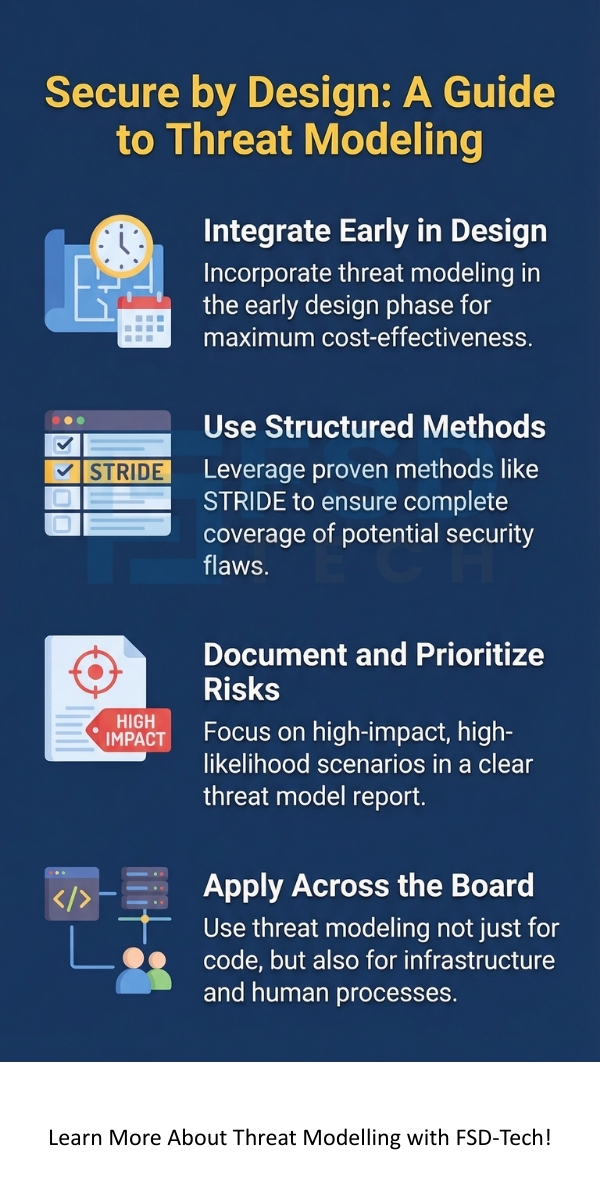
    • Start Early: Integrate the threat modeling process into the early design phase of your SDLC for maximum cost-effectiveness.
    • Use Structured Methods: Leverage proven threat modelling methods like STRIDE to ensure complete coverage of potential security flaws.
    • Document and Prioritize: Always create a clear threat model report that prioritizes risks, focusing on high-impact, high-likelihood scenarios.
    • Apply Broadly: Remember that threat modelling can be applied to infrastructure, code, and even human processes.


    Frequently Asked Questions (FAQs) on Threat Modeling

    Q: Why is a Data Flow Diagram essential for threat modeling?

    A DFD is essential because it visually maps the path of data, system components, and trust boundaries. It allows the team to pinpoint exactly where data is stored, processed, and transmitted, making it the ideal base for applying methods like STRIDE.


    Q: What is the main difference between a threat and a vulnerability?

    A threat is a potential harm (e.g., "A hacker tries to log in as another user"). A vulnerability is a weakness that a threat can exploit (e.g., "The application uses a weak password policy"). Threat modeling identifies both threats and the underlying vulnerabilities.

    Q: How often should we update the threat model report?

    You should update the threat model report whenever a significant change occurs in the system's architecture, new features are added, or a new, critical threat is discovered in the wider security environment. The model is a living document that must evolve with the system.

    Threat Modeling in Cyber Security - Process, STRIDE & Benefits

    About The Author

    Surbhi Suhane

    Surbhi Suhane is an experienced digital marketing and content specialist with deep expertise in Getting Things Done (GTD) methodology and process automation. Adept at optimizing workflows and leveraging automation tools to enhance productivity and deliver impactful results in content creation and SEO optimization.

    Like This Story?

    Share it with friends!

    Subscribe to our newsletter!

    Atera

    (48)

    Cato Networks

    (109)

    ClickUp

    (61)

    FishOS

    (7)

    Miradore

    (21)

    PointGuard AI

    (9)

    Vembu

    (22)

    Xcitium

    (33)

    ZETA HRMS

    (63)

    Workflow Automation(2)

    Workforce Automation(1)

    AI Project Management(1)

    HR Data Automation(1)

    RMM(1)

    IT Workflow Automation(1)

    IT security(2)

    GCC compliance(3)

    Payroll Integration(2)

    IT support automation(2)

    procurement automation(1)

    lost device management(1)

    IT Management(5)

    IoT Security(2)

    Cato XOps(2)

    IT compliance(4)

    Workflow Management(1)

    Task Automation(1)

    OpenStack automation(1)

    AI-powered cloud ops(1)

    Kubernetes lifecycle management(2)

    SMB Security(8)

    Data Security(1)

    MDR (Managed Detection & Response)(4)

    MSP Automation(2)

    Atera Integrations(2)

    XDR Security(2)

    SMB Cyber Protection(1)

    Ransomware Defense(3)

    HR Tech Solutions(1)

    Zero Trust Network Access(3)

    Zero Trust Security(2)

    Endpoint Management(1)

    SaaS Security(1)

    Payroll Automation(5)

    IT Monitoring(2)

    Xcitium EDR SOC(15)

    Ransomware Protection GCC(1)

    M&A IT Integration(1)

    Network Consolidation UAE(1)

    MSSP for SMBs(1)

    Ransomware Protection(3)

    Managed EDR FSD-Tech(1)

    SMB Cybersecurity GCC(1)

    Antivirus vs EDR(1)

    FSD-Tech MSSP(25)

    Cybersecurity GCC(12)

    Endpoint Security(1)

    Endpoint Protection(1)

    Data Breach Costs(1)

    SMB Cybersecurity(8)

    Managed Security Services(2)

    Xcitium EDR(30)

    Zero Dwell Containment(31)

    Hybrid Backup(1)

    Cloud Backup(1)

    Backup & Recovery(1)

    pointguard ai(4)

    disaster recovery myths(1)

    backup myths(1)

    vembu(9)

    SMB data protection(9)

    Vembu BDR Suite(19)

    Disaster Recovery(4)

    GCCBusiness(1)

    DataProtection(1)

    Secure Access Service Edge(4)

    GCC HR software(14)

    Miradore EMM(15)

    Cato SASE(7)

    Cloud Security(8)

    Talent Development(1)

    AI Compliance(2)

    AI Governance(4)

    AI Risk Management(1)

    AI Security(2)

    AI Cybersecurity(12)

    GCC business security(1)

    GCC network integration(1)

    compliance automation(3)

    GCC cybersecurity(2)

    education security(1)

    Miradore EMM Premium+(5)

    BYOD security Dubai(8)

    App management UAE(1)

    MiddleEast(1)

    HealthcareSecurity(1)

    Team Collaboration(1)

    IT automation(9)

    Zscaler(1)

    SD-WAN(6)

    HR Integration(4)

    Cloud Networking(3)

    device management(9)

    VPN(1)

    ZeroTrust(2)

    RemoteWork(1)

    MPLS(1)

    Project Management(9)

    HR automation(14)

    share your thoughts

    Threat Modeling in Cyber Security

    Threat Modeling in Cyber Security - Process, STRIDE & Benefits

    🕓 December 20, 2025

    Brute Force Attack in Cybersecurity

    Brute Force Attack in Cybersecurity - How it Works?

    🕓 December 20, 2025

    Botnet

    What is a Botnet? How Botnet Attacks Work & Prevention

    🕓 December 19, 2025

    Decoded(29)

    Cyber Security(110)

    BCP / DR(22)

    Zeta HRMS(62)

    SASE(21)

    Automation(61)

    Next Gen IT-Infra(109)

    Monitoring & Management(69)

    ITSM(22)

    HRMS(21)

    Automation(24)