HomeNext Gen IT-InfraMonitoring & ManagementCyber SecurityBCP / DRAutomationDecoded
Next Gen IT-Infra
Cato’s SASE Supports Cybersecurity Skills Development

How Cato’s SASE Supports Cybersecurity Skills Development

🕓 April 8, 2025

How SASE Supports the Security Needs of SMBs

How SASE Supports the Security Needs of SMBs

🕓 February 9, 2025

Attack Surface Reduction with Cato’s SASE

Attack Surface Reduction with Cato’s SASE

🕓 February 10, 2025

SASE for Digital Transformation in UAE

SASE for Digital Transformation in UAE

🕓 February 8, 2025

Monitoring & Management
Understanding Atera’s SLA Management

Understanding Atera’s SLA Management

🕓 February 7, 2025

Cost-Performance Ratio: Finding the Right Balance in IT Management Networks

Cost-Performance Ratio: Finding the Right Balance in IT Management Networks

🕓 June 16, 2025

Customizing Atera with APIs

Customizing Atera with APIs

🕓 March 3, 2025

Power Up Your IT Team’s Strategy with Atera’s Communication Tools

Power Up Your IT Team’s Strategy with Atera’s Communication Tools

🕓 February 8, 2025

Cyber Security
Illustration of the Cato Cloud architecture showing its role in delivering SASE for secure, optimized global connectivity.

Understanding the Cato Cloud and Its Role in SASE

🕓 January 29, 2025

Isometric illustration of professionals managing network performance, bandwidth analytics, and cloud-based optimization around the Cato Networks platform, symbolizing bandwidth control and QoS visibility.

Mastering Bandwidth Control and QoS in Cato Networks

🕓 July 26, 2025

Global network backbone powering Cato SASE solution for secure, high-performance connectivity across regions.

Global Backbone: The Engine Powering Cato’s SASE Solution

🕓 January 30, 2025

Illustration of team analyzing application traffic and usage insights on a large laptop screen using Cato’s dashboard, surrounded by network and cloud icons.

Cato Networks Application Visibility | Monitoring & Control

🕓 July 27, 2025

BCP / DR
Illustration showing diverse business and IT professionals collaborating with cloud, backup, and security icons, representing Vembu use cases for SMBs, MSPs, and IT teams.

Who Uses Vembu? Real-World Use Cases for SMBs, MSPs & IT Teams

🕓 July 12, 2025

Graphic showcasing Vembu’s all-in-one backup and disaster recovery platform with icons for cloud, data protection, and business continuity for IT teams and SMBs.

What Is Vembu? A Deep Dive Into the All in One Backup & Disaster Recovery Platform

🕓 July 6, 2025

Illustration showing Vembu backup and disaster recovery system with cloud storage, server racks, analytics dashboard, and IT professionals managing data.

The Rising Cost of Data Loss: Why Backup Is No Longer Optional?

🕓 August 14, 2025

3D isometric illustration of cloud backup and data recovery infrastructure with laptop, data center stack, and digital business icons — FSD Tech

RPO & RTO: The Heart of Business Continuity

🕓 August 15, 2025

Automation
Cross-Functional Collaboration with ClickUp

Fostering Cross-Functional Collaboration with ClickUp for Multi-Departmental Projects

🕓 February 11, 2025

ClickUp Project Reporting

Revolutionizing Enterprise Reporting with ClickUp’s Advanced Analytics and Dashboards

🕓 June 16, 2025

ClickUp’s Design Collaboration and Asset Management Tools

Empowering Creative Teams with ClickUp’s Design Collaboration and Asset Management Tools

🕓 February 26, 2025

ClickUp Communication and Collaboration Tools

ClickUp Communication and Collaboration Tools: Empowering Remote Teams

🕓 March 12, 2025

Decoded
Multi-Factor Authentication (MFA)

Multi-Factor Authentication (MFA): All You Need to Know

🕓 December 7, 2025

L3 Switch

What Is an L3 Switch? L2 vs L3 & Why You Need Layer 3?

🕓 December 8, 2025

IPSec

IPSec Explained: Protocols, Modes, IKE & VPN Security

🕓 December 3, 2025

 Datagram Transport Layer Security (DTLS)

What is Datagram Transport Layer Security (DTLS)? How it works?

🕓 December 4, 2025

    Subscribe to our newsletter!

    About Us

    Follow Us

    Copyright © 2024 | Powered by 

    Isometric illustration of a centralized executive dashboard platform connected to analytics panels, performance charts, security indicators, and strategic milestones, representing real-time business visibility and decision control within ClickUp.

    Executive Visibility in ClickUp – How CXOs Gain Real-Time Control Without Micromanaging

    🕓 February 13, 2026

    Cato SASE Architecture

    Inside Cato’s SASE Architecture: A Blueprint for Modern Security

    🕓 January 26, 2025

    Enterprise Data Security and Privacy with ClickUp

    Ensuring Enterprise Data Security and Privacy with ClickUp

    🕓 February 9, 2025

    Table of Contents

    What is Full Duplex Communication? Full vs Half Duplex

    Surbhi Suhane
    February 13, 2026
    Comments
    Full Duplex Communication

    Full duplex transmission is a communication mode where data flows in both directions simultaneously over a single medium. In this setup, two connected devices can transmit and receive data at the same time without waiting for the other to finish. This bidirectional flow ensures that communication remains fluid, much like a natural conversation between two people where both can speak and hear each other at once.


    In the world of networking and telecommunications, efficiency is everything. Have you ever wondered why your phone calls feel so seamless while old-school walkie-talkies require a "push-to-talk" button? The answer lies in how the system handles the data stream. Full duplex data transmission represents the pinnacle of this efficiency, removing the "stop-and-go" lag found in simpler systems.


    Comparison Chart: Simplex vs. Half Duplex vs. Full Duplex

    To truly grasp what is full duplex communication, it helps to see it side-by-side with its predecessors.


    Basis for ComparisonSimplexHalf DuplexFull Duplex
    Direction of FlowUnidirectional (One-way)Bidirectional (One way at a time)Bidirectional (Simultaneous)
    Sending/ReceivingOnly send or only receiveCan do both, but not at onceCan do both simultaneously
    PerformanceLowestModerateHighest
    ExampleKeyboard to MonitorWalkie-TalkieTelephone Conversation
    Bandwidth UsageMinimal efficiencyPartial efficiencyMaximum efficiency


    Optimize your network today

    What is Full Duplex Mode?

    Full duplex mode is a transmission method that utilizes two physical or logical channels. One channel is dedicated to outgoing data, while the other handles incoming data. Because these paths are independent, the signals do not collide.
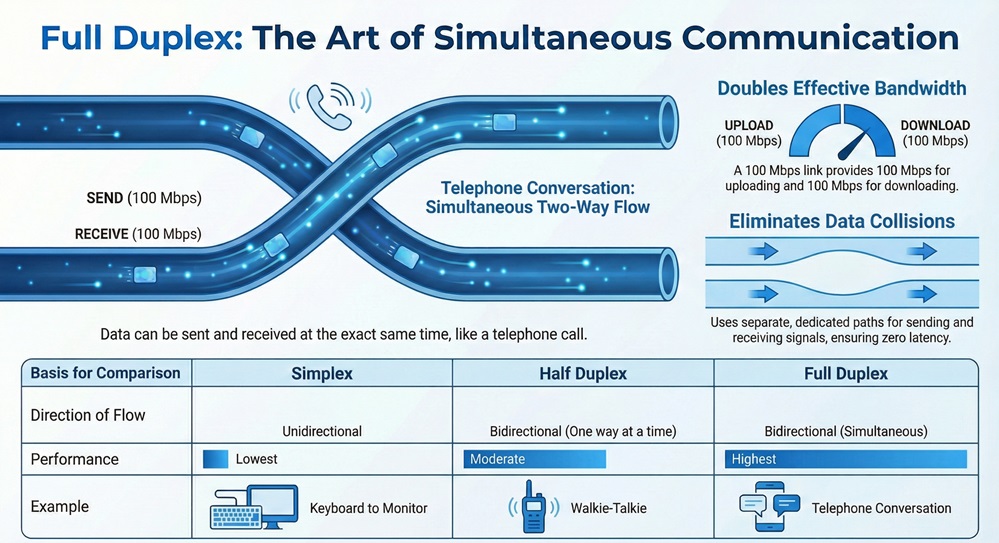
     

    full duplex communication infographic


    In computer architecture and data science, this is often called "simultaneous bidirectional" communication. Full duplex in computer network environments allows for a doubling of the effective bandwidth. For instance, if you have a 100 Mbps link operating in this mode, you actually have 100 Mbps for uploading and 100 Mbps for downloading at the exact same moment.


    Key Characteristics:

    • Dual Paths: It uses separate paths for transmission ($Tx$) and reception ($Rx$).
    • No Collisions: Since the paths are separate, there is no need for collision detection protocols like CSMA/CD.
    • Zero Latency: There is no "turn-around" time required to switch from sending to receiving.


    Also Read: What is Latency in Networking? Definition, Causes & Solutions


    Difference Between Full and Half Duplex

    One of the most common points of confusion for students is the difference between full and half duplex. To be honest, it is quite simple once you visualize the traffic flow.


    In a half duplex system, the communication is bidirectional, but the devices must take turns. Think of a one-lane bridge where cars can go both ways, but only one car can cross at a time. If both try to go at once, they crash. This is why walkie-talkie users say "Over"—it’s a signal to the other person that the lane is now clear.


    Conversely, the difference between duplex and full duplex is often a matter of terminology. "Duplex" is the general category for bidirectional communication, while "Full Duplex" specifies the simultaneous nature of that communication. Here's a quick breakdown of why the full mode wins:


    1. Time Efficiency: Full duplex does not waste time switching modes.
    2. Throughput: It provides higher data rates because the link is never "waiting."
    3. User Experience: It feels natural. In a full duplex intercom system, you can interrupt the other person, just like in real life.


    How Full Duplex Data Transmission Works?

    The mechanics of what is full duplex transmission depend on the physical medium being used. There are two primary ways engineers achieve this:


    1. Frequency Division Duplexing (FDD)

    In FDD, the system uses two different frequencies. One frequency is for the "Upstream" and another for the "Downstream." Because they operate on different "channels" in the air or wire, they never interfere. This is commonly used in full duplex radio communication.


    2. Time Division Duplexing (TDD)

    While TDD looks like full duplex to the user, it actually switches back and forth very fast. However, true full duplex data transmission in modern fiber optics and copper cables usually involves physical separation of the wire pairs.


    Role of the Full Duplex Switch

    In a modern office, the full duplex switch is the unsung hero. Unlike an old "hub" which shared one path among all users, a switch creates a dedicated, private, full-speed lane for every connected device. This prevents "collisions" and ensures that your Zoom call doesn't lag just because someone else is printing a large file.


    Also Read: What is Bandwidth? | Types, Working, and Network Capacity Explained


    Full Duplex in Networking and Ethernet

    When we discuss what is full duplex in networking, we are usually talking about full duplex ethernet. In the early days, Ethernet used a shared cable (10Base2 or 10Base5) where only one person could talk at a time. If two people talked, a "collision" occurred.


    Full Duplex Ethernet

    Today, full duplex ethernet uses twisted-pair cabling (like Cat6). Inside these cables, different pairs of wires are used for sending and receiving.


    • Pair 1 & 2: Transmit data.
    • Pair 3 & 6: Receive data.


    Because the "sending" wires never touch the "receiving" wires, the network can operate at full speed in both directions. This is the standard for almost all modern Local Area Networks (LANs).


    Expert Insight: One of the biggest performance killers in old networks was a "duplex mismatch." This happens when one side of a cable thinks it is in full duplex while the other thinks it is in half duplex. The result? A massive number of dropped packets and slow internet.


    Real-World Full Duplex Transmission Example

    To make this concrete, let's look at a full duplex transmission example you likely use every day:


    1. The Smartphone

    When you are on a call, you are using full-duplex radio communication. You can hear the background noise from your friend's house while you are telling them a story. If your phone was half duplex, your friend's voice would be cut off every time you spoke.


    2. Full Duplex Intercoms

    In high-security environments or broadcast television studios, crews use a full-duplex intercom. This allows the director to give instructions to the camera operator while the operator is still providing verbal updates. It is essential for high-pressure, real-time coordination.


    3. Video Conferencing

    Apps like Microsoft Teams or Skype rely on full-duplex data transmission. The software must manage your outgoing video stream and the incoming streams of everyone else at the same time. If this were half duplex, the "lag" would make the meeting impossible.


    Also Read: What is a Wireless LAN Controller? Configuration & Setup 101


    Advantages and Disadvantages

    Advantages of Full Duplex


    • Doubled Bandwidth: Effectively doubles the capacity of the communication link.
    • No Collisions: Eliminates the wasted time spent re-transmitting data after a collision.
    • Continuous Flow: Ideal for real-time applications like gaming, voice, and video.
    • Improved Efficiency: Full duplex switch technology ensures that data reaches its destination without competing for the "lane."


    Disadvantages of Full Duplex


    • Complexity: Requires more sophisticated hardware and cabling.
    • Cost: Historically, full-duplex equipment was more expensive than simplex or half-duplex.
    • Power Consumption: Sending and receiving at the same time requires more energy, which can be a factor in mobile or IoT devices.


    Conclusion

    Understanding full duplex communication is essential for anyone looking to master networking or telecommunications. It is the backbone of our connected world, enabling everything from high-speed fiber optics to the smartphone in your pocket. By removing the limitations of "taking turns," full duplex mode ensures that our data—and our conversations—keep moving at the speed of life.


    In my experience, the move to full duplex was the single greatest leap in networking history. It turned the "clunky" internet of the 90s into the smooth, high-definition experience we enjoy today. At our company, we prioritize these high-efficiency standards because we know your business can't afford to wait for a "clear lane." We focus on building infrastructures that support maximum throughput and zero downtime, ensuring your communication is always as fluid as a face-to-face chat.


    Contact our Networking Experts today!
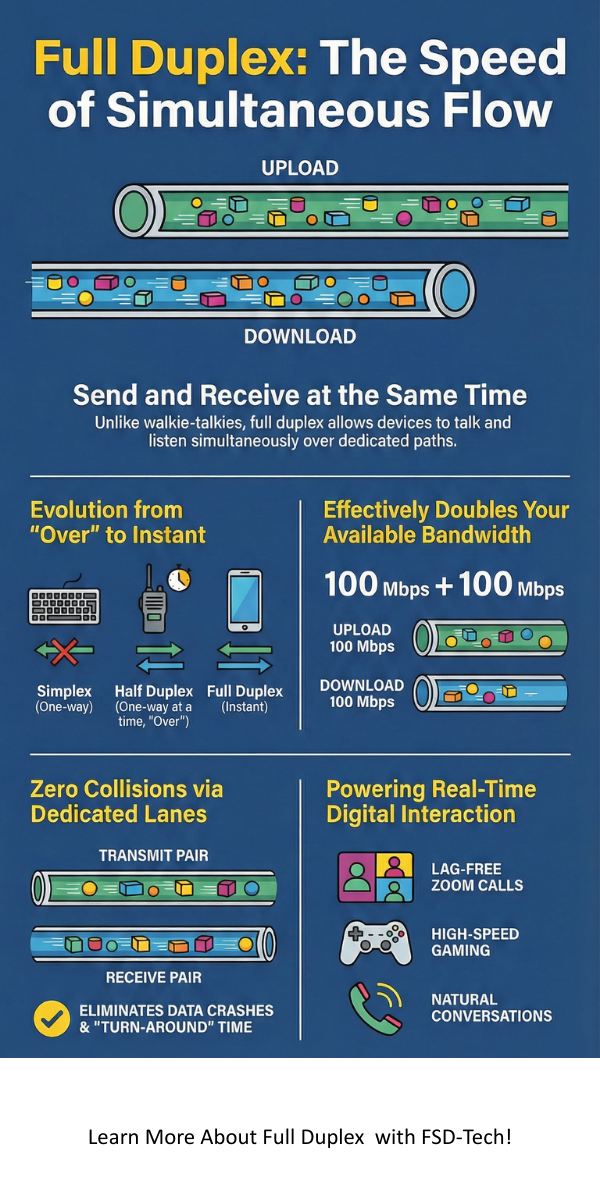
     

    full duplex communication


    Key Takeaways

    • Full duplex allows for simultaneous two-way communication.
    • It is the standard for full duplex ethernet and modern cellular networks.
    • The difference between full and half duplex is the ability to send and receive at the exact same time without waiting.
    • It requires dedicated paths for transmission and reception to avoid signal interference.


    Frequently Asked Questions (FAQs)

    1. Is Wi-Fi full duplex?

    Technically, most current Wi-Fi standards (like Wi-Fi 5 and 6) are half duplex. They switch between sending and receiving so fast that it feels like full duplex, but they cannot do both on the same frequency at the exact same microsecond. However, newer Wi-Fi 7 technologies are moving toward true full-duplex capabilities.


    2. What happens during a duplex mismatch?

    A duplex mismatch occurs when one device is set to "Full" and the other to "Half." The half-duplex side will detect "collisions" that aren't actually there, while the full-duplex side will see "late collisions" or CRC errors. This results in incredibly slow network speeds.


    3. Can I use full duplex on an old Hub?

    No. Hubs are "dumb" devices that broadcast every signal to every port on a shared path. You need a full duplex switch to enable simultaneous two-way communication.


    4. What is a common full-duplex transmission example in daily life?

    The most common example is a telephone call or a mobile phone conversation. Both parties can talk and hear each other simultaneously.


    What is Full Duplex Communication? Full vs Half Duplex

    About The Author

    Surbhi Suhane

    Surbhi Suhane is an experienced digital marketing and content specialist with deep expertise in Getting Things Done (GTD) methodology and process automation. Adept at optimizing workflows and leveraging automation tools to enhance productivity and deliver impactful results in content creation and SEO optimization.

    Like This Story?

    Share it with friends!

    Subscribe to our newsletter!

    Atera

    (55)

    Cato Networks

    (121)

    ClickUp

    (72)

    FishOS

    (7)

    Miradore

    (21)

    PointGuard AI

    (9)

    Vembu

    (22)

    Xcitium

    (33)

    ZETA HRMS

    (79)

    Workflow Automation(8)

    Workforce Automation(1)

    AI Project Management(1)

    HR Data Automation(1)

    RMM(1)

    IT Workflow Automation(1)

    GCC compliance(4)

    IT security(2)

    Payroll Integration(2)

    IT support automation(3)

    procurement automation(1)

    lost device management(1)

    IT Management(5)

    IoT Security(2)

    Cato XOps(2)

    IT compliance(4)

    Workflow Management(1)

    Task Automation(1)

    Kubernetes lifecycle management(2)

    AI-powered cloud ops(1)

    OpenStack automation(1)

    SMB Security(8)

    Data Security(1)

    MDR (Managed Detection & Response)(4)

    MSP Automation(3)

    Atera Integrations(2)

    XDR Security(2)

    Ransomware Defense(3)

    SMB Cyber Protection(1)

    HR Tech Solutions(1)

    Zero Trust Network Access(3)

    Zero Trust Security(2)

    Endpoint Management(1)

    SaaS Security(1)

    Payroll Automation(5)

    IT Monitoring(2)

    Xcitium EDR SOC(15)

    Ransomware Protection GCC(1)

    Network Consolidation UAE(1)

    M&A IT Integration(1)

    MSSP for SMBs(1)

    Managed EDR FSD-Tech(1)

    Antivirus vs EDR(1)

    FSD-Tech MSSP(25)

    SMB Cybersecurity GCC(1)

    Ransomware Protection(3)

    Cybersecurity GCC(12)

    Endpoint Security(1)

    Endpoint Protection(1)

    Data Breach Costs(1)

    SMB Cybersecurity(8)

    Zero Dwell Containment(31)

    Managed Security Services(2)

    Xcitium EDR(30)

    Hybrid Backup(1)

    Cloud Backup(1)

    Backup & Recovery(1)

    pointguard ai(4)

    vembu(9)

    backup myths(1)

    SMB data protection(9)

    disaster recovery myths(1)

    Disaster Recovery(4)

    Vembu BDR Suite(19)

    GCCBusiness(1)

    DataProtection(1)

    Secure Access Service Edge(4)

    GCC HR software(20)

    Miradore EMM(15)

    Cato SASE(7)

    Cloud Security(9)

    GCC Education(1)

    Hybrid Learning(1)

    Talent Development(1)

    AI Compliance(2)

    AI Governance(4)

    AI Cybersecurity(12)

    AI Risk Management(1)

    AI Security(2)

    GCC business security(1)

    GCC network integration(1)

    compliance automation(5)

    GCC cybersecurity(3)

    education security(1)

    Miradore EMM Premium+(5)

    App management UAE(1)

    BYOD security Dubai(8)

    MiddleEast(1)

    HealthcareSecurity(1)

    Team Collaboration(1)

    IT automation(12)

    Zscaler(1)

    SD-WAN(7)

    HR Integration(4)

    Cloud Networking(4)

    device management(9)

    VPN(1)

    ZeroTrust(2)

    RemoteWork(1)

    MPLS(1)

    share your thoughts

    Full Duplex Communication

    What is Full Duplex Communication? Full vs Half Duplex

    🕓 February 13, 2026

    wide-area-network-wan

    What is a Wide Area Network (WAN)? Architecture & Types Explained

    🕓 February 13, 2026

    Latency in Networking

    What is Latency in Networking? Definition, Causes & Solutions

    🕓 February 12, 2026

    Decoded(109)

    Cyber Security(118)

    BCP / DR(22)

    Zeta HRMS(78)

    SASE(21)

    Automation(72)

    Next Gen IT-Infra(118)

    Monitoring & Management(76)

    ITSM(22)

    HRMS(21)

    Automation(24)