HomeNext Gen IT-InfraMonitoring & ManagementCyber SecurityBCP / DRAutomationDecoded
Next Gen IT-Infra
Cato’s SASE Supports Cybersecurity Skills Development

How Cato’s SASE Supports Cybersecurity Skills Development

🕓 April 8, 2025

How SASE Supports the Security Needs of SMBs

How SASE Supports the Security Needs of SMBs

🕓 February 9, 2025

Attack Surface Reduction with Cato’s SASE

Attack Surface Reduction with Cato’s SASE

🕓 February 10, 2025

SASE for Digital Transformation in UAE

SASE for Digital Transformation in UAE

🕓 February 8, 2025

Monitoring & Management
Understanding Atera’s SLA Management

Understanding Atera’s SLA Management

🕓 February 7, 2025

Cost-Performance Ratio: Finding the Right Balance in IT Management Networks

Cost-Performance Ratio: Finding the Right Balance in IT Management Networks

🕓 June 16, 2025

Customizing Atera with APIs

Customizing Atera with APIs

🕓 March 3, 2025

Power Up Your IT Team’s Strategy with Atera’s Communication Tools

Power Up Your IT Team’s Strategy with Atera’s Communication Tools

🕓 February 8, 2025

Cyber Security
Visual guide showing Cato CMA interface for configuring Internet and WAN firewall rules, enabling threat protection, and monitoring security events in real time for UAE IT teams.

Enforcing Firewall and Threat Protection Policies in Cato

🕓 July 25, 2025

Isometric illustration of professionals managing network performance, bandwidth analytics, and cloud-based optimization around the Cato Networks platform, symbolizing bandwidth control and QoS visibility.

Mastering Bandwidth Control and QoS in Cato Networks

🕓 July 26, 2025

Illustration of the Cato Cloud architecture showing its role in delivering SASE for secure, optimized global connectivity.

Understanding the Cato Cloud and Its Role in SASE

🕓 January 29, 2025

Global network backbone powering Cato SASE solution for secure, high-performance connectivity across regions.

Global Backbone: The Engine Powering Cato’s SASE Solution

🕓 January 30, 2025

BCP / DR
Illustration showing diverse business and IT professionals collaborating with cloud, backup, and security icons, representing Vembu use cases for SMBs, MSPs, and IT teams.

Who Uses Vembu? Real-World Use Cases for SMBs, MSPs & IT Teams

🕓 July 12, 2025

Graphic showcasing Vembu’s all-in-one backup and disaster recovery platform with icons for cloud, data protection, and business continuity for IT teams and SMBs.

What Is Vembu? A Deep Dive Into the All in One Backup & Disaster Recovery Platform

🕓 July 6, 2025

Illustration showing Vembu backup and disaster recovery system with cloud storage, server racks, analytics dashboard, and IT professionals managing data.

The Rising Cost of Data Loss: Why Backup Is No Longer Optional?

🕓 August 14, 2025

3D isometric illustration of cloud backup and data recovery infrastructure with laptop, data center stack, and digital business icons — FSD Tech

RPO & RTO: The Heart of Business Continuity

🕓 August 15, 2025

Automation
Cross-Functional Collaboration with ClickUp

Fostering Cross-Functional Collaboration with ClickUp for Multi-Departmental Projects

🕓 February 11, 2025

ClickUp Project Reporting

Revolutionizing Enterprise Reporting with ClickUp’s Advanced Analytics and Dashboards

🕓 June 16, 2025

ClickUp’s Design Collaboration and Asset Management Tools

Empowering Creative Teams with ClickUp’s Design Collaboration and Asset Management Tools

🕓 February 26, 2025

ClickUp Communication and Collaboration Tools

ClickUp Communication and Collaboration Tools: Empowering Remote Teams

🕓 March 12, 2025

Decoded
Multi-Factor Authentication (MFA)

Multi-Factor Authentication (MFA): All You Need to Know

🕓 December 7, 2025

L3 Switch

What Is an L3 Switch? L2 vs L3 & Why You Need Layer 3?

🕓 December 8, 2025

IPSec

IPSec Explained: Protocols, Modes, IKE & VPN Security

🕓 December 3, 2025

 Datagram Transport Layer Security (DTLS)

What is Datagram Transport Layer Security (DTLS)? How it works?

🕓 December 4, 2025

    Subscribe to our newsletter!

    About Us

    Follow Us

    Copyright © 2024 | Powered by 

    Cato SASE Architecture

    Inside Cato’s SASE Architecture: A Blueprint for Modern Security

    🕓 January 26, 2025

    Enterprise Data Security and Privacy with ClickUp

    Ensuring Enterprise Data Security and Privacy with ClickUp

    🕓 February 9, 2025

    DDoS protection SASE

    DDoS Protection and Cato’s Defence Mechanisms

    🕓 February 11, 2025

    Table of Contents

    What Is Data Leakage? Causes, Prevention & ML Risks

    Surbhi Suhane
    December 18, 2025
    Comments
    Data leakage

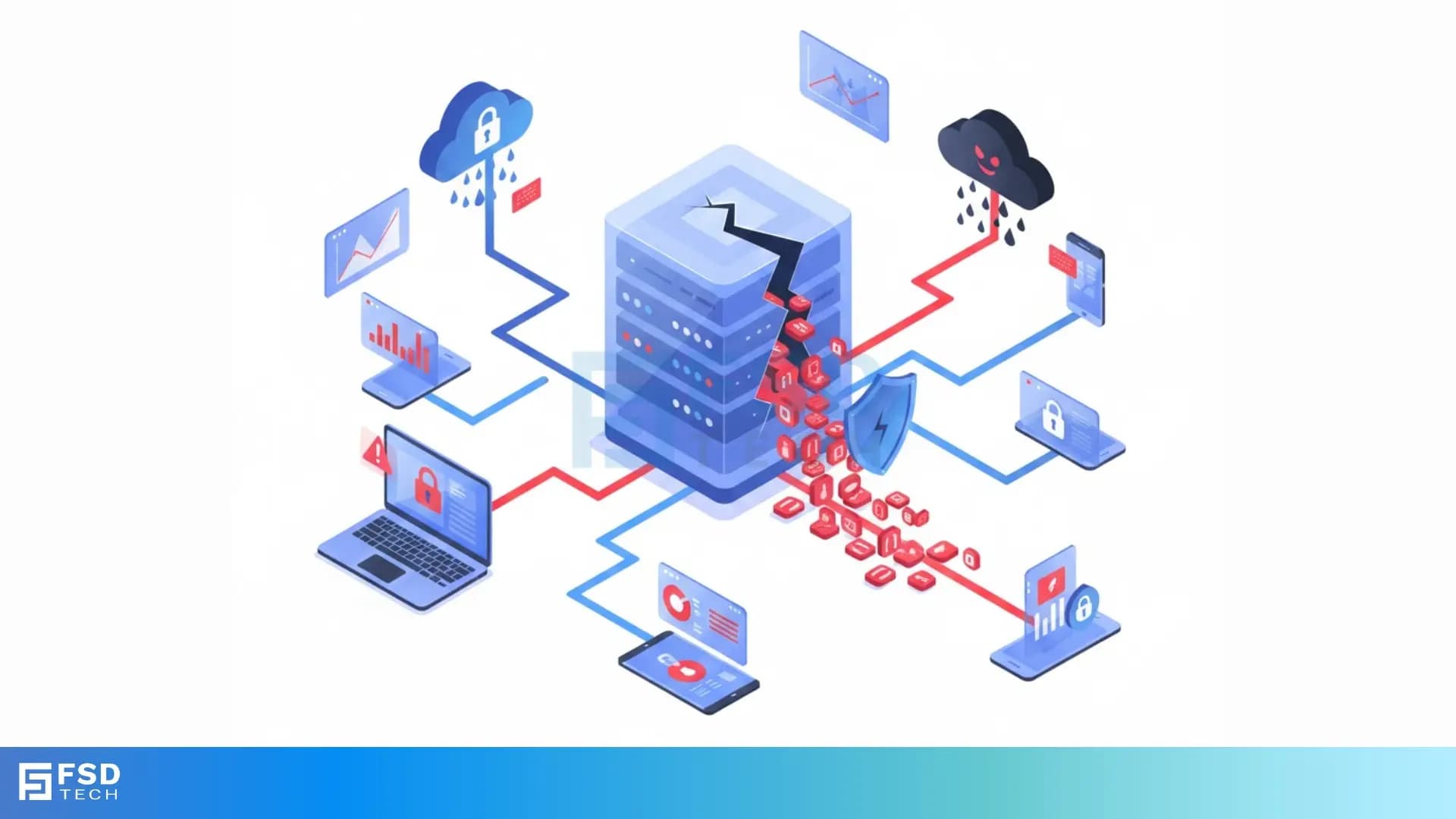
    Data leakage refers to the unauthorized flow of information from within an organization to an external destination or recipient.


    Basically, data leakage is nothing but the accidental exposure of sensitive data. This can be anything from internal emails and financial records to customer data and intellectual property. Data leakage is a serious problem. It means that sensitive information is going outside your control.


    Data leakage is a major concern for every modern business. Why? Because it can cause huge financial losses. It can also cause legal trouble and damage a company's reputation. Protecting your data is essential in today's digital world.


    Let us now understand this concept of data leakage in more detail.


    What is Data Leakage?

    Data leakage is defined as the situation where sensitive data is exposed to unauthorized users. This exposure can happen physically or electronically. The key point here is that the data leaves the secured perimeter of the organization.
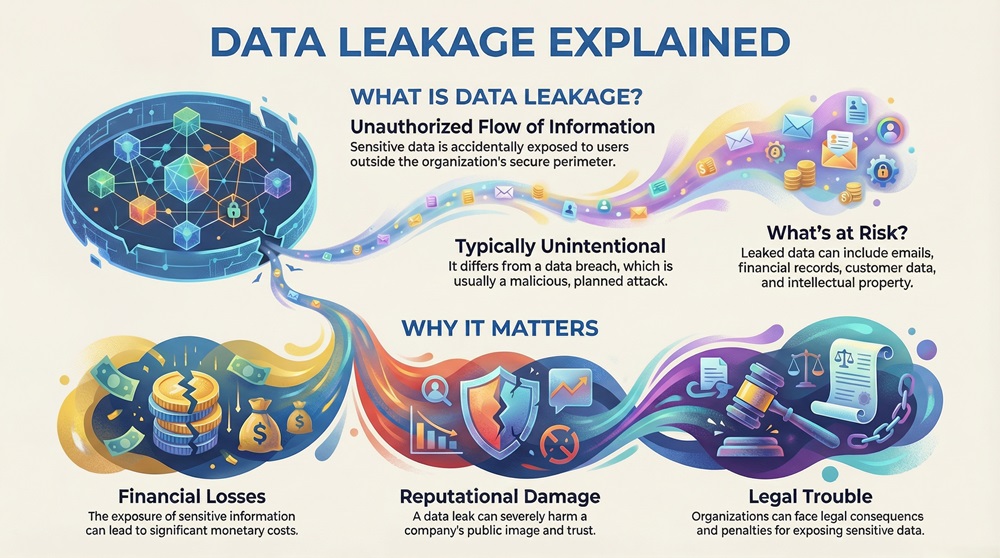
     

    Data Leakage Infographic


    In simple words, data leakage implies that your secret or important information has fallen into the wrong hands. It is important to note that data leakage is usually an unintentional event. This is different from a data breach, which is often a malicious attack.


    Secure Sensitive Data with Cato


    Data Leakage Versus Data Breach

    Many people get confused between a data leakage and a data breach. Let us now understand the basic difference.


    FeatureData LeakageData Breach
    DefinitionThe unauthorized flow of sensitive data from inside an organization to an external destination, usually due to error or poor controls.An intentional security violation where an unauthorized party gains access to or steals sensitive data from an organization's systems.
    Primary CauseInternal, unintentional actions or system flaws. The major driver is human error or misconfiguration.External, malicious actions (e.g., hacking, malware) or deliberate internal theft (malicious insider).
    IntentNon-malicious or accidental. The person or system exposing the data did not intend to harm the organization.Malicious or Hostile. The goal is typically to exploit, steal, or disrupt the business.
    Typical MechanismMisdirected email; lost USB drive or laptop; data left in an unsecured cloud bucket; misplaced physical documents; unencrypted network traffic.Phishing/spear-phishing attacks; brute-force attacks; exploiting zero-day vulnerabilities; injecting malware (ransomware/spyware); compromised user credentials.
    Data StatusData is usually exposed and transmitted to an unintended, but often benign, recipient or location (e.g., an employee's personal email).Data is accessed and exfiltrated (stolen) by a hostile, typically criminal, third party.
    DetectionCan be detected by Data Loss Prevention (DLP) systems that monitor data in transit, or by auditing cloud permissions and file logs.Often detected after the fact by credit monitoring agencies, customer complaints, or specialized Security Information and Event Management (SIEM) tools.
    Remediation FocusPreventive measures like tightening DLP policies, improving access control, enforcing encryption, and extensive employee training.Reactive measures like system patch management, incident response, forensic investigation, and notifying affected parties.
    ExampleAn employee posts a client spreadsheet to a public, unprotected file-sharing service by mistake.A hacker exploits a vulnerability in the company's server software and steals all customer credit card numbers.


    Data leakage is mainly due to carelessness or system flaws. On the other hand, a data breach primarily involves a criminal or hostile act. Both, however, lead to the same result: your sensitive data is lost.


    Also Read: What is Credential Stuffing? Detection and Prevention


    What Causes Data Leakage?

    The main reason behind data leakage is often human error. However, a lack of proper systems and controls also plays a major role. We can divide the causes of data leakage into two primary categories: Internal Factors and External Factors.


    1. Internal Factors Leading to Data Leakage

    Data leakage primarily involves actions taken by people who already have access to the information. These are known as insider threats.


    • Employee Error: This is the most common cause. An employee may simply make a mistake. For instance, they might send a confidential document to the wrong recipient via email. They might also print a sensitive report and leave it on a public printer. Simply put, human error is a significant factor in data leakage.
    • Poorly Secured Devices: Employees often use personal devices (laptops, phones) for work. If these devices are lost, or if they lack proper security measures, like encryption, data leakage can easily happen.
    • Insider Misconduct: Sometimes, an employee with authorized access intentionally tries to steal or expose sensitive data. This might happen just before they leave the company. This intentional act, however, is a very serious form of data leakage.
    • Weak Access Control: If too many employees have access to information they do not need, the risk of data leakage increases. This is why following the principle of least privilege is essential.


    2. External Factors Affecting Data Leakage

    While less common than internal factors, external factors also contribute to data leakage.


    • Lack of Encryption: When data is transmitted over networks or stored on mobile devices without strong encryption, it is highly sensitive. If a device is lost or a transmission is intercepted, the lack of encryption makes data leakage quite easy.
    • Vulnerable Cloud Services: Many companies store sensitive data in the cloud. If these cloud services are not configured correctly, or if they have security loopholes, they can cause data leakage.
    • Malware: Certain types of malicious software, such as spyware or Trojans, can secretly collect and send data from a user's computer to an external, unauthorized party. This also results in data leakage.


    Types of Data Leakage

    We can categorize data leakage based on how the information is being transmitted or exposed. Understanding these types helps in finding the right security solutions.


    1. Network-Based Data Leakage

    This type of data leakage happens when sensitive data travels outside the company network.


    • Email: This is a major source of data leakage. Employees can accidentally or intentionally attach a confidential file to an email and send it outside. Data leakage through email is one of the most common instances.
    • Web Uploads: Employees may use cloud storage services or public websites to upload sensitive data. If the service is not authorized or secure, this results in data leakage.
    • Instant Messaging: Using corporate messaging platforms or unauthorized chat apps can cause data leakage if sensitive information is shared there.


    2. Storage-Based Data Leakage

    This involves the physical or electronic storage of data leaving the secure environment.


    • Removable Media: Devices like USB drives and external hard drives are common sources of data leakage. An employee can easily copy a massive amount of data onto a small USB stick and take it away. Data leakage happens when this storage device is lost or compromised.
    • Physical Documents: Even in the digital age, printed documents can cause data leakage. If someone leaves confidential printouts in a public place, or throws them away without shredding, this also constitutes data leakage.


    3. Endpoint-Based Data Leakage

    This is about the loss of data directly from endpoints, such as desktop computers, laptops, and mobile phones.


    • Lost or Stolen Devices: A lost company laptop or a stolen phone contains data. If the device lacks encryption and remote wipe capabilities, this is a clear case of data leakage. Data leakage from endpoints is a constant threat.
    • Screen Captures: An employee can simply take a screenshot of sensitive information on their screen and then send that image externally.


    Also Read: What is an Intrusion Prevention System (IPS)?


    Data Leakage in Machine Learning (ML)

    Data leakage is not just an IT security issue. It is also a critical problem in the world of machine learning. Data leakage in ML means that information from the training data (the data used to build the model) is included in a way that artificially improves the model's performance.


    This is a subtle, but highly important form of data leakage.


    Understanding Data Leakage in ML

    The goal of a machine learning model is to predict new, unseen data accurately. When data leakage happens, the model essentially cheats. It performs very well on the test data (the data used to check the model) because it has seen the answers indirectly.


    Data leakage in ML can lead to a model that looks excellent during testing but fails completely when deployed in the real world. This is a big problem for businesses relying on accurate predictions.


    Two Major Types of Data Leakage in ML


    1. Target Leakage

    Target leakage occurs when the training data includes information that is not available in a real-world setting at the time you want to make a prediction. However, this information is strongly related to the target variable (what you want to predict).


    Example: Suppose you build a model to predict if a customer will default on a loan. If your training data includes a column called "post-default collection fees," this is a clear case of data leakage. Why? Because, in the real world, you only know the collection fees after the default has happened. Including this data in training makes the model too good because it already has a signal of the outcome.


    2. Train-Test Contamination

    Train-test contamination is another form of data leakage. This happens when data from the test set (the data the model has not seen) accidentally influences the training process.


    • Incorrect Data Splitting: If you preprocess the entire dataset (like scaling or imputing missing values) before you split it into training and testing sets, this causes data leakage. The data in the training set now uses information from the test set's distribution.
    • Feature Engineering: If a feature is created using the entire dataset, it can introduce data leakage.


    To avoid data leakage in ML, you must treat your test set as completely separate. You should only apply transformations that were learned only from the training data.


    Also Read: What is Web Application Firewall? | WAF Explained


    How to Prevent Data Leakage?

    Since data leakage poses a severe risk, organizations must take proactive steps. Preventing data leakage requires a combination of strong technology, clear policies, and regular employee training.


    1. Implement Data Loss Prevention (DLP)

    A DLP system is a set of tools and processes designed to prevent data leakage. DLP systems work by:


    • Identifying Sensitive Data: DLP first finds out where your sensitive data is located. It looks for things like credit card numbers or social security numbers.
    • Monitoring Data in Motion: The system monitors emails, network traffic, and cloud uploads. If it sees sensitive data leaving the network, it can block the transmission.
    • Controlling Data at Rest: It checks the security of data stored on servers and computers. Data leakage is often prevented by encryption.


    Data Loss Prevention is primarily a technological solution to data leakage.


    2. Strengthen Access Controls

    Controlling access minimizes the risk of data leakage. Organizations must strictly follow the Principle of Least Privilege (PoLP).


    • Role-Based Access Control (RBAC): You should only grant employees the necessary access to perform their job. Limiting access is a simple but highly effective way to prevent data leakage.
    • Regular Audits: Regularly check who has access to what data. This helps identify and fix any unauthorized access rights, thereby reducing the chances of data leakage.


    3. Educate Employees on Data Leakage Risks

    Since human error is a major cause, training employees is essential for preventing data leakage.


    • Mandatory Training: All employees must receive training on data security policies and the risks of data leakage.
    • Phishing Simulation: Simulate attacks to teach employees how to spot phishing attempts. Phishing can trick employees into exposing credentials, which leads to data leakage.


    4. Use Encryption

    Encryption makes data unusable even if it falls into the wrong hands.


    • Data at Rest: Encrypting all sensitive data stored on laptops, servers, and in the cloud protects against data leakage if a device is stolen.
    • Data in Motion: Use secure protocols, such as HTTPS and SFTP, for data transmission. This prevents eavesdropping and protects against network-based data leakage.


    5. Prevent Data Leakage in Machine Learning

    Preventing data leakage in ML requires a careful approach to data handling.


    • Split Data First: Always split your data into training and test sets before performing any feature engineering or data preprocessing.
    • Feature Review: Carefully review every feature you use in your model. Ask yourself: "Will this information be available at the time of prediction in the real world?" If the answer is no, then that feature may cause data leakage.


    Conclusion

    Data leakage is a constant threat in the interconnected digital world. It is clear that every organization must take a serious stance on this issue. Understanding what data leakage is and what causes it is the first step toward building a strong defense.


    Data leakage is mainly due to human mistakes or system vulnerabilities. We can reduce these risks by implementing strong measures like DLP systems and effective employee training. By adopting a security-first mindset, you protect your organization's most valuable assets. You maintain customer trust. You also ensure your business stays compliant with data protection laws.


    We are committed to helping you understand and implement these robust security strategies. 


    Contact us today to learn more about our data protection services and how we can help you prevent data leakage within your organization. We focus on providing solutions that secure your data and build a safer digital future for your business.
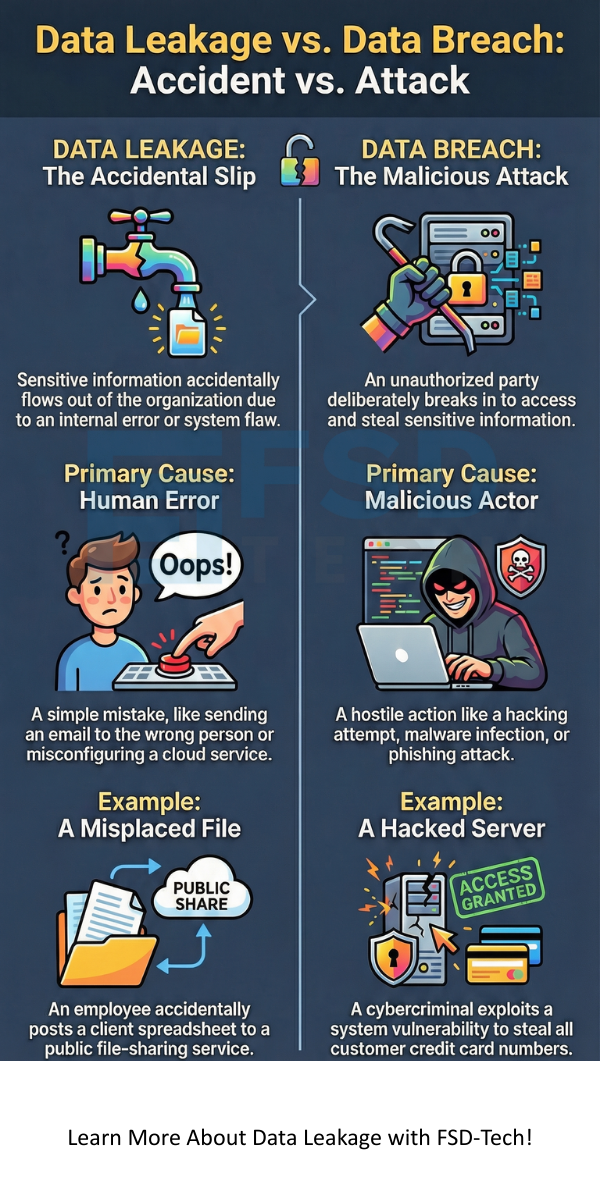
     

    Data Leakage Vs Data Breach


    Key Takeaways

    • Data leakage is the unauthorized flow of sensitive data from inside to outside an organization.
    • The primary cause of data leakage is human error, which accounts for a large percentage of incidents.
    • Insider threats, poor security controls, and a lack of encryption are other major causes of data leakage.
    • Data Loss Prevention (DLP) systems are the main technological defense used to identify, monitor, and prevent data leakage.
    • Encryption protects against data leakage by making lost or intercepted data unusable.
    • In machine learning, data leakage happens when the test results are influenced by the training data, leading to a flawed model.
    • Employee training is a critical, ongoing measure to prevent data leakage caused by accidental mistakes.


    Frequently Asked Questions (FAQs) on Data Leakage

    What is the primary difference between data leakage and data loss?

    Data leakage involves the unauthorized exposure or transmission of sensitive data outside a secure perimeter. This often means the data exists in two places: inside and outside. Data loss, on the other hand, means the data is destroyed or permanently inaccessible. While both are security incidents, data leakage is about exposure, and data loss is about destruction.


    Does data leakage only happen via email?

    No. Data leakage can happen in many ways. While email is a very common method, it also occurs through web uploads, lost or stolen USB drives, physical printouts, instant messaging, and even misconfigured cloud storage services. Data leakage occurs anytime sensitive data leaves the authorized environment.


    What is an insider threat in the context of data leakage?

    An insider threat is a security risk that comes from within the organization. This includes current or former employees, contractors, or business associates. An insider might cause data leakage accidentally through a mistake or intentionally to cause harm or steal information.


    What is the most important step to prevent data leakage?

    The most important step is a combination of DLP implementation and employee education. Technology, like DLP, can block accidental transmissions. However, since human error causes most data leakage, training employees to recognize risks and follow security protocols is absolutely crucial.


    Why is data leakage a problem in machine learning?

    Data leakage in machine learning leads to overly optimistic model performance during testing. The model appears highly accurate but will fail in the real world. This happens because the model unknowingly uses information that would not be available at the time of real prediction. Data leakage in ML creates a misleadingly good model.

    What Is Data Leakage? Causes, Prevention & ML Risks

    About The Author

    Surbhi Suhane

    Surbhi Suhane is an experienced digital marketing and content specialist with deep expertise in Getting Things Done (GTD) methodology and process automation. Adept at optimizing workflows and leveraging automation tools to enhance productivity and deliver impactful results in content creation and SEO optimization.

    Like This Story?

    Share it with friends!

    Subscribe to our newsletter!

    Atera

    (48)

    Cato Networks

    (109)

    ClickUp

    (61)

    FishOS

    (7)

    Miradore

    (21)

    PointGuard AI

    (9)

    Vembu

    (22)

    Xcitium

    (33)

    ZETA HRMS

    (63)

    Workflow Automation(2)

    Workforce Automation(1)

    AI Project Management(1)

    HR Data Automation(1)

    RMM(1)

    IT Workflow Automation(1)

    IT security(2)

    GCC compliance(3)

    Payroll Integration(2)

    IT support automation(2)

    procurement automation(1)

    lost device management(1)

    IT Management(5)

    IoT Security(2)

    Cato XOps(2)

    IT compliance(4)

    Workflow Management(1)

    Task Automation(1)

    OpenStack automation(1)

    AI-powered cloud ops(1)

    Kubernetes lifecycle management(2)

    SMB Security(8)

    Data Security(1)

    MDR (Managed Detection & Response)(4)

    MSP Automation(2)

    Atera Integrations(2)

    XDR Security(2)

    SMB Cyber Protection(1)

    Ransomware Defense(3)

    HR Tech Solutions(1)

    Zero Trust Network Access(3)

    Zero Trust Security(2)

    Endpoint Management(1)

    SaaS Security(1)

    Payroll Automation(5)

    IT Monitoring(2)

    Xcitium EDR SOC(15)

    Ransomware Protection GCC(1)

    M&A IT Integration(1)

    Network Consolidation UAE(1)

    MSSP for SMBs(1)

    Ransomware Protection(3)

    Managed EDR FSD-Tech(1)

    SMB Cybersecurity GCC(1)

    Antivirus vs EDR(1)

    FSD-Tech MSSP(25)

    Cybersecurity GCC(12)

    Endpoint Security(1)

    Endpoint Protection(1)

    Data Breach Costs(1)

    SMB Cybersecurity(8)

    Managed Security Services(2)

    Xcitium EDR(30)

    Zero Dwell Containment(31)

    Hybrid Backup(1)

    Cloud Backup(1)

    Backup & Recovery(1)

    pointguard ai(4)

    disaster recovery myths(1)

    backup myths(1)

    vembu(9)

    SMB data protection(9)

    Vembu BDR Suite(19)

    Disaster Recovery(4)

    GCCBusiness(1)

    DataProtection(1)

    Secure Access Service Edge(4)

    GCC HR software(14)

    Miradore EMM(15)

    Cato SASE(7)

    Cloud Security(8)

    Talent Development(1)

    AI Compliance(2)

    AI Governance(4)

    AI Risk Management(1)

    AI Security(2)

    AI Cybersecurity(12)

    GCC business security(1)

    GCC network integration(1)

    compliance automation(3)

    GCC cybersecurity(2)

    education security(1)

    Miradore EMM Premium+(5)

    BYOD security Dubai(8)

    App management UAE(1)

    MiddleEast(1)

    HealthcareSecurity(1)

    Team Collaboration(1)

    IT automation(9)

    Zscaler(1)

    SD-WAN(6)

    HR Integration(4)

    Cloud Networking(3)

    device management(9)

    VPN(1)

    ZeroTrust(2)

    RemoteWork(1)

    MPLS(1)

    Project Management(9)

    HR automation(14)

    share your thoughts

    Unified Threat Management (UTM)

    Unified Threat Management (UTM): Key Security Functions

    🕓 December 18, 2025

    Data leakage

    What Is Data Leakage? Causes, Prevention & ML Risks

    🕓 December 18, 2025

    Whaling Attack

    What Is a Whaling Attack? How It Works & Prevention

    🕓 December 17, 2025

    Decoded(25)

    Cyber Security(110)

    BCP / DR(22)

    Zeta HRMS(62)

    SASE(21)

    Automation(61)

    Next Gen IT-Infra(109)

    Monitoring & Management(69)

    ITSM(22)

    HRMS(21)

    Automation(24)