.webp&w=3840&q=75)
How ClickUp Enables Outcome-Based Project Management (Not Just Task Tracking)
🕓 February 15, 2026

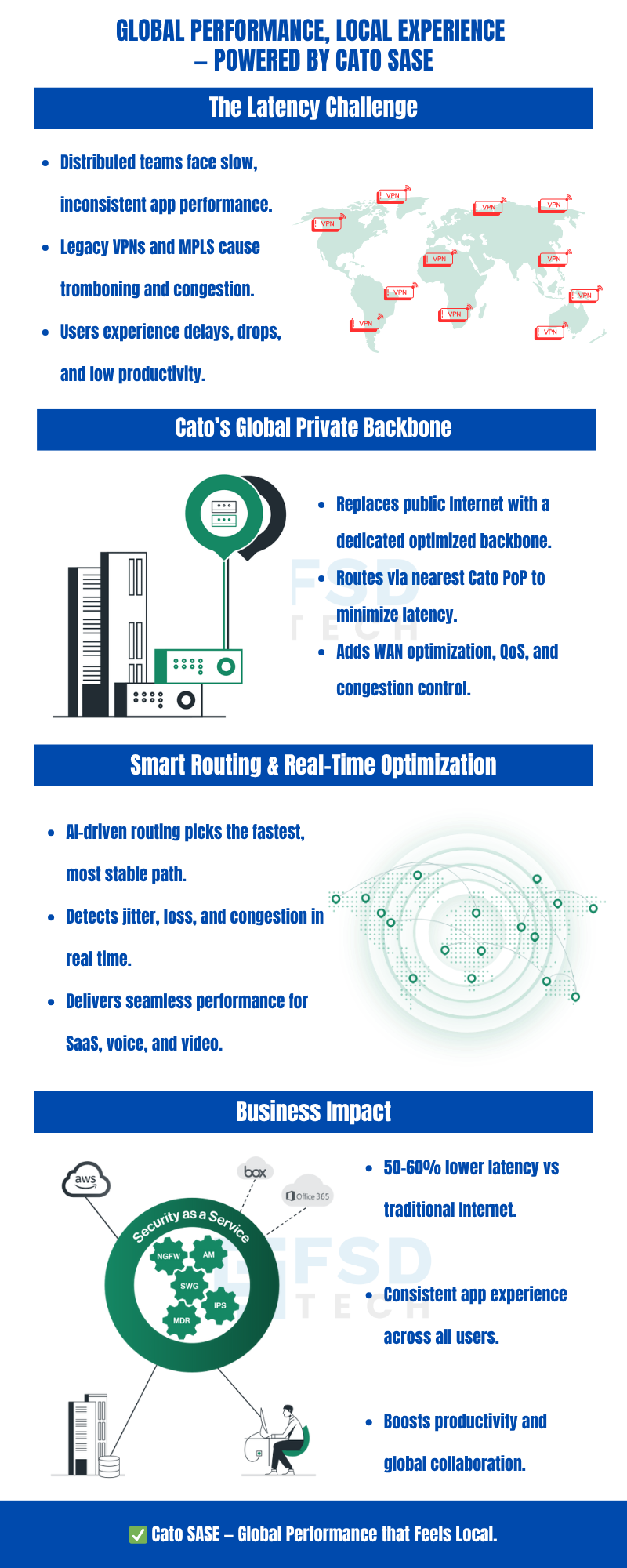
Reducing Network Latency and Enhancing User Experience Globally with Cato SASE is the secret sauce for modern businesses that can't afford to wait for a spinning loading icon. Picture this: your team in Dubai is trying to collaborate on a massive file with a colleague in London, but the lag is so bad they might as well be sending mail by sea. It’s frustrating, right? We’ve all been there, staring at a frozen video call while a deal hangs in the balance.
In my experience, the "old way" of connecting offices just doesn't cut it anymore. Whether you are using the public internet or expensive, rigid MPLS lines, the result is often the same: sluggish apps and unhappy employees. But what if you could bypass the traffic jams of the internet entirely? That is where Cato SASE enters the picture, especially for firms in the GCC looking to bridge the gap between local operations and global reach.
Network latency refers to the time data takes to travel from point A to point B. It is basically the "lag" you feel. For global teams, high latency means your Salesforce dashboard takes forever to load or your Microsoft 365 docs won't sync. To be honest, in a world that moves this fast, a two-second delay is a lifetime.
Traditional setups struggle because they weren't built for the cloud. MPLS is steady but stays stuck in one lane and costs a fortune.
The public internet is like a busy highway with no speed limits—it is unpredictable and full of "potholes" like packet loss. Here is the thing: if your network is slow, your business is slow. Are you tired of hearing your team complain about "the system being down" when it's actually just a slow connection?
Network latency is the time it takes for data to travel from source to destination across a network. In practical terms, it’s the delay users experience when accessing cloud applications, loading files, or participating in real-time communications. Even small increases in latency can accumulate, leading to sluggish application responses, degraded VoIP/video quality, and user frustration.
For distributed enterprises, latency isn’t just a technical metric—it’s a direct driver of user satisfaction and productivity. High latency can:
In global organizations, these effects are amplified by geographic distance and the unpredictability of the public internet, especially for users in regions like the GCC, where cross-border connectivity can be inconsistent.
These limitations create a gap between user expectations and what legacy networks can deliver, especially as organizations move to cloud-first models and distributed workforces.
Also Read: Platforms, Countries, and Origin of Connection: Advanced Device Criteria in Cato Firewall
How does it actually work under the hood? Cato uses something called application-aware routing. It is smart enough to know that a Zoom call is more important than a background software update. It gives the Zoom call the "fast lane" while letting the update wait a few seconds.
Quality of Service (QoS) is just a fancy way of saying "making sure the important stuff works first." Cato SASE monitors the network in real-time. If one path gets crowded, it automatically shifts your traffic to a clearer one. You don't have to do a thing. It just works.
Many security tools slow you down because they check your data over and over at different stops. Cato uses a "single-pass" engine. It checks for security and handles the routing all at once. This means you get top-tier protection without the "security tax" of a slower connection.
| Feature | Public Internet | Cato Private Backbone |
|---|---|---|
| Latency | High and unpredictable | Consistently low |
| Packet Loss | Frequent | Minimal |
| Security | Added on (Extra lag) | Built-in (No lag) |
| Reliability | Best effort | Enterprise grade |
Cato SASE redefines enterprise connectivity with a global private backbone—a managed network of high-capacity Points of Presence (PoPs) strategically located in major business hubs. This backbone provides:
By routing traffic over its private backbone, Cato SASE bypasses the unpredictability of the public internet, ensuring that data takes the most efficient, reliable path between users, sites, and cloud resources.
A global law firm with offices in Dubai, London, and Singapore previously struggled with slow document access and unreliable video calls. After deploying Cato SASE, latency between sites dropped significantly, and video call quality remained consistent—even during peak hours. Independent testing and customer deployments have shown Cato’s backbone can reduce latency, jitter, and packet loss compared to public internet routing.
Also Read: Device-Aware WAN Firewall Policies in Cato SASE
| Feature | Public Internet | Cato Private Backbone |
|---|---|---|
| Latency | Variable, often high | Predictable, consistently low |
| Packet Loss | Common, especially cross-region | Minimal, managed |
| Security | Requires separate tools | Integrated, end-to-end |
| Management | Fragmented, complex | Centralized, unified |
Cato SASE employs intelligent, real-time routing to optimize every data flow. The platform continuously evaluates network conditions and selects the optimal path for each application, ensuring business-critical traffic receives priority bandwidth and minimal latency. Application-aware routing distinguishes between traffic types, prioritizing latency-sensitive workloads like video conferencing and SaaS over less critical data transfers.
Continuous monitoring of network health, application performance, and user experience enables Cato SASE to dynamically adapt to changing conditions. If a link becomes congested or degrades, traffic is instantly rerouted via the optimal path—without manual intervention. This real-time adaptability is crucial for maintaining consistent QoS for remote users, branch offices, and cloud workloads.
A retail chain with distributed stores across the GCC leveraged Cato’s application-aware routing to prioritize POS and inventory systems, ensuring real-time updates and zero downtime during sales events. Video calls and SaaS tools remained responsive, even during high-traffic periods, thanks to dynamic bandwidth allocation and low-latency backbone connectivity.
Traditional security appliances often introduce latency by chaining multiple inspection engines, each adding processing delay. Cato SASE’s single-pass architecture processes all security and networking functions in one operation, eliminating redundant packet handling and maintaining high throughput—even with full TLS decryption and advanced threat prevention.
Cato’s platform is engineered for multi-Gbps throughput per PoP, supporting thousands of users and devices without bottlenecks. Enterprises can enable comprehensive security—IPS, anti-malware, DLP, SWG—without sacrificing speed or reliability, ensuring that security never comes at the expense of user experience.
Cato SASE provides a centralized management console for policy configuration, visibility, and troubleshooting across the entire network. IT teams benefit from:
As organizations expand into new markets or adopt hybrid work, Cato’s cloud-native architecture scales effortlessly. New sites, users, or applications can be onboarded in minutes, with consistent security and performance policies enforced everywhere. This unified approach reduces operational overhead and the risk of misconfiguration, supporting business agility and growth.
Enterprises in the GCC face unique challenges—regulatory compliance, data residency, and diverse connectivity landscapes. FSD Tech acts as the regional enabler for Cato SASE, bridging global innovation with local execution. This partnership provides:
By partnering with FSD Tech, GCC organizations can confidently adopt Cato SASE, benefiting from world-class technology and local expertise. This ensures not only technical excellence but also alignment with business and regulatory priorities, supporting secure and compliant digital transformation.
Also Read: Using Device Conditions in Cato Internet Firewall Rules for Granular Access Control
1. Assess Current Network Performance: Measure latency, packet loss, and application response times across all sites.
2. Identify Critical Applications: Prioritize workloads most sensitive to latency and downtime.
3. Plan Migration: Collaborate with FSD Tech to design a phased rollout, starting with high-impact locations or user groups.
4. Configure Application-Aware Policies: Use Cato’s management console to define bandwidth and routing priorities.
5. Monitor and Optimize: Leverage real-time analytics to track improvements and fine-tune policies as needed.
Future-ready architecture for distributed enterprises: Cato SASE’s purpose-built platform outpaces fragmented or legacy SASE solutions, supporting the demands of modern, cloud-first, and hybrid work environments.
Ready to deliver consistent low-latency experiences across your global and GCC networks?
Schedule a no-obligation call now
Cato SASE minimizes latency by routing traffic over its private global backbone, which connects enterprise sites and cloud resources through managed, high-capacity PoPs. Intelligent path selection avoids congested public internet routes, reducing the number of hops and ensuring more consistent, low-latency performance for users worldwide.
Yes, Cato SASE directly peers with major cloud providers and uses application-aware routing to ensure optimal paths and bandwidth for cloud workloads. This results in faster file uploads, lower response times, and improved reliability for SaaS applications, benefiting both remote and office-based users.
Cato’s single-pass architecture processes all security and networking functions in one operation, eliminating the performance bottlenecks associated with chaining multiple appliances. This allows for full TLS decryption, advanced threat prevention, and policy enforcement at multi-Gbps speeds, ensuring robust security without sacrificing user experience.
FSD Tech acts as the regional enabler for Cato SASE in the GCC, providing local expertise, deployment, and support. This ensures that organizations meet regional compliance requirements, benefit from tailored solutions, and receive rapid, hands-on assistance throughout their SASE journey.
Absolutely. Cato SASE’s cloud-native, unified platform delivers consistent performance and security for all users, regardless of location. Whether employees are working from corporate offices, branch sites, or remotely, they benefit from the same optimized connectivity and protection.
Cato SASE uses application-aware routing and dynamic bandwidth allocation to prioritize business-critical workloads. The platform identifies and classifies traffic in real time, ensuring that essential applications like VoIP, video conferencing, and POS systems receive priority over less critical data transfers.
Cato’s private backbone offers predictable, low-latency connectivity at a fraction of the cost and complexity of MPLS. It provides global reach, integrated security, and cloud-native scalability, making it more adaptable to modern enterprise needs, especially for organizations with distributed teams and cloud-centric strategies.
Through FSD Tech’s local expertise, Cato SASE deployments in the GCC are tailored to meet regional data residency and compliance mandates. FSD Tech ensures that network and security policies align with local regulations, providing peace of mind for organizations operating in sensitive or highly regulated sectors.
Yes, Cato SASE can be deployed alongside or as a replacement for existing WAN and SD-WAN solutions. The migration can be phased, allowing organizations to transition critical sites or applications first, while maintaining interoperability with legacy infrastructure during the process.
Organizations typically see significant reductions in latency (often 40–50% or more), improved application responsiveness, and more reliable collaboration tools. Real-world deployments have reported up to a 13x decrease in latency, jitter, and packet loss compared to public internet routing.
Cato’s global backbone is built with multiple, geographically distributed PoPs and redundant links. If a PoP or path becomes unavailable, traffic is automatically rerouted through the next best path, ensuring continuous connectivity and minimal disruption for users.
Cato SASE offers a centralized management console with real-time and historical analytics on network health, application performance, user activity, and security events. IT teams can set up alerts, generate reports, and quickly troubleshoot issues across all sites and users.
Thanks to its cloud-native architecture, new sites and users can typically be onboarded in minutes. FSD Tech provides hands-on assistance for GCC deployments, ensuring rapid, compliant, and seamless expansion as business needs evolve.
Cato SASE is built as a unified, cloud-native platform from the ground up, avoiding the integration and management challenges of patchwork or legacy SASE architectures. This ensures consistent performance, security, and scalability as organizations adopt new technologies and expand globally.
Cato SASE’s dynamic bandwidth allocation and real-time path optimization ensure that latency-sensitive workloads—such as video conferencing, VoIP, and real-time collaboration—maintain high performance, even during periods of peak network demand.
GCC enterprises benefit from the combination of Cato’s global, future-ready SASE platform and FSD Tech’s regional expertise. This partnership ensures rapid deployment, compliance with local regulations, and tailored support, empowering organizations to deliver superior user experiences while meeting business and regulatory objectives.

Anas is an Expert in Network and Security Infrastructure, With over seven years of industry experience, holding certifications Including CCIE- Enterprise, PCNSE, Cato SASE Expert, and Atera Certified Master. Anas provides his valuable insights and expertise to readers.
Share it with friends!




.webp&w=3840&q=75)



.webp&w=3840&q=75)
share your thoughts