HomeNext Gen IT-InfraMonitoring & ManagementCyber SecurityBCP / DRAutomationDecoded
Next Gen IT-Infra
Cato’s SASE Supports Cybersecurity Skills Development

How Cato’s SASE Supports Cybersecurity Skills Development

🕓 April 8, 2025

How SASE Supports the Security Needs of SMBs

How SASE Supports the Security Needs of SMBs

🕓 February 9, 2025

Attack Surface Reduction with Cato’s SASE

Attack Surface Reduction with Cato’s SASE

🕓 February 10, 2025

SASE for Digital Transformation in UAE

SASE for Digital Transformation in UAE

🕓 February 8, 2025

Monitoring & Management
Understanding Atera’s SLA Management

Understanding Atera’s SLA Management

🕓 February 7, 2025

Cost-Performance Ratio: Finding the Right Balance in IT Management Networks

Cost-Performance Ratio: Finding the Right Balance in IT Management Networks

🕓 June 16, 2025

Customizing Atera with APIs

Customizing Atera with APIs

🕓 March 3, 2025

Power Up Your IT Team’s Strategy with Atera’s Communication Tools

Power Up Your IT Team’s Strategy with Atera’s Communication Tools

🕓 February 8, 2025

Cyber Security
Illustration of the Cato Cloud architecture showing its role in delivering SASE for secure, optimized global connectivity.

Understanding the Cato Cloud and Its Role in SASE

🕓 January 29, 2025

Isometric illustration of professionals managing network performance, bandwidth analytics, and cloud-based optimization around the Cato Networks platform, symbolizing bandwidth control and QoS visibility.

Mastering Bandwidth Control and QoS in Cato Networks

🕓 July 26, 2025

Global network backbone powering Cato SASE solution for secure, high-performance connectivity across regions.

Global Backbone: The Engine Powering Cato’s SASE Solution

🕓 January 30, 2025

Illustration of team analyzing application traffic and usage insights on a large laptop screen using Cato’s dashboard, surrounded by network and cloud icons.

Cato Networks Application Visibility | Monitoring & Control

🕓 July 27, 2025

BCP / DR
Illustration showing diverse business and IT professionals collaborating with cloud, backup, and security icons, representing Vembu use cases for SMBs, MSPs, and IT teams.

Who Uses Vembu? Real-World Use Cases for SMBs, MSPs & IT Teams

🕓 July 12, 2025

Graphic showcasing Vembu’s all-in-one backup and disaster recovery platform with icons for cloud, data protection, and business continuity for IT teams and SMBs.

What Is Vembu? A Deep Dive Into the All in One Backup & Disaster Recovery Platform

🕓 July 6, 2025

Illustration showing Vembu backup and disaster recovery system with cloud storage, server racks, analytics dashboard, and IT professionals managing data.

The Rising Cost of Data Loss: Why Backup Is No Longer Optional?

🕓 August 14, 2025

3D isometric illustration of cloud backup and data recovery infrastructure with laptop, data center stack, and digital business icons — FSD Tech

RPO & RTO: The Heart of Business Continuity

🕓 August 15, 2025

Automation
Cross-Functional Collaboration with ClickUp

Fostering Cross-Functional Collaboration with ClickUp for Multi-Departmental Projects

🕓 February 11, 2025

ClickUp Project Reporting

Revolutionizing Enterprise Reporting with ClickUp’s Advanced Analytics and Dashboards

🕓 June 16, 2025

ClickUp’s Design Collaboration and Asset Management Tools

Empowering Creative Teams with ClickUp’s Design Collaboration and Asset Management Tools

🕓 February 26, 2025

ClickUp Communication and Collaboration Tools

ClickUp Communication and Collaboration Tools: Empowering Remote Teams

🕓 March 12, 2025

Decoded
Multi-Factor Authentication (MFA)

Multi-Factor Authentication (MFA): All You Need to Know

🕓 December 7, 2025

L3 Switch

What Is an L3 Switch? L2 vs L3 & Why You Need Layer 3?

🕓 December 8, 2025

IPSec

IPSec Explained: Protocols, Modes, IKE & VPN Security

🕓 December 3, 2025

 Datagram Transport Layer Security (DTLS)

What is Datagram Transport Layer Security (DTLS)? How it works?

🕓 December 4, 2025

    Subscribe to our newsletter!

    About Us

    Follow Us

    Copyright © 2024 | Powered by 

    Atera

    (56)

    Cato Networks

    (129)

    ClickUp

    (78)

    FishOS

    (7)

    Miradore

    (21)

    PointGuard AI

    (9)

    Vembu

    (22)

    Xcitium

    (33)

    ZETA HRMS

    (79)

    Table of Contents

    What is Managed Detection and Response (MDR)?

    Surbhi Suhane
    March 9, 2026
    Comments
    Managed Detection and Response (MDR)

    Managed detection and response is a service that handles your security feeds to find potential threats or active breaches. It helps you fix these issues before they turn into a nightmare for your business. Most big security names have an MDR offer. For example, Cato does this, and so do many specialized partners.


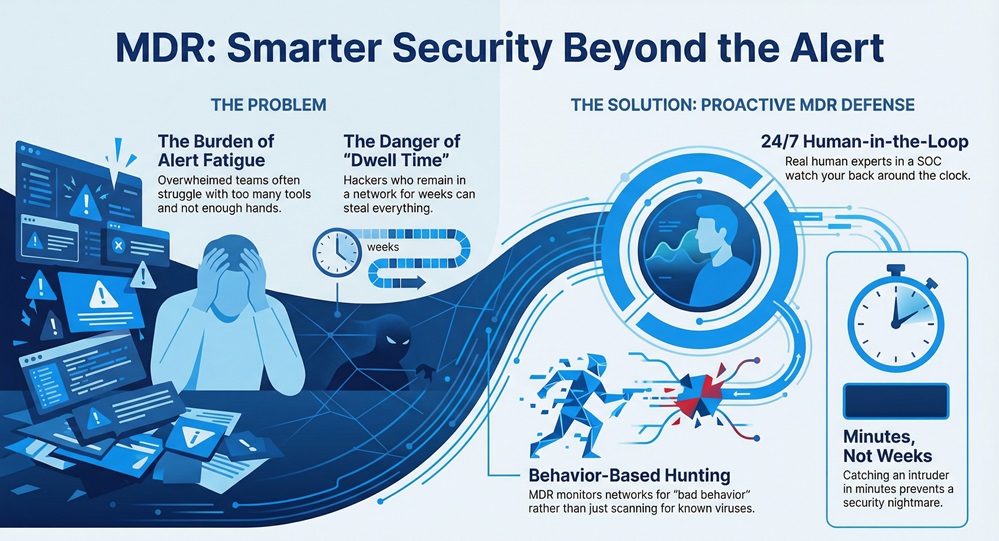
    But why do you actually need it? To be honest, we have all been there—staring at a screen full of alerts and wondering which one is a real fire. Most teams are tired. They have too many tools and not enough hands. That is where MDR steps in. It combines smart software with real human experts who watch your back 24/7.


    In this guide, we will look at how this service works. We will also see how it fits into a SASE platform and why having a human in the loop makes all the difference.


    What is MDR and Why Does It Matter?

    At its heart, managed detection and response (MDR) is about speed. Think of it as a high-tech security guard for your digital office. It does not just watch the cameras; it runs toward the noise to stop the intruder.


    Managed detection and response


    Many people confuse it with standard antivirus. However, it is much more than that. While basic software looks for known "bad files," MDR looks for "bad behavior." It monitors your network, your cloud, and your remote workers.


    Gate Started with Cato MDR


    The Core Goal of MDR

    The main goal is to reduce "dwell time." This is the time a hacker spends inside your network before you catch them. If a hacker stays in for weeks, they steal everything. If you catch them in minutes, you win. Thus, we can say that MDR is your best bet for keeping dwell time low.


    Does your current team have the time to hunt for hidden threats every single day? Most don't. That is why offloading this work to a dedicated Security Operations Center (SOC) is a smart move.


    How Managed Detection and Response Protects Your Business

    When you use managed detection and response, you are buying expertise. You get a team that knows exactly what a real attack looks like. They use Artificial Intelligence (AI) and Machine Learning (ML) to sort through millions of data points.


    24x7 Monitoring

    Threats do not take the weekend off. Hackers often strike on holidays or at 3 AM. A good MDR service monitors your environment every single minute. This constant eye on the ball ensures that a small glitch does not turn into a total shutdown.


    Human Threat Verification

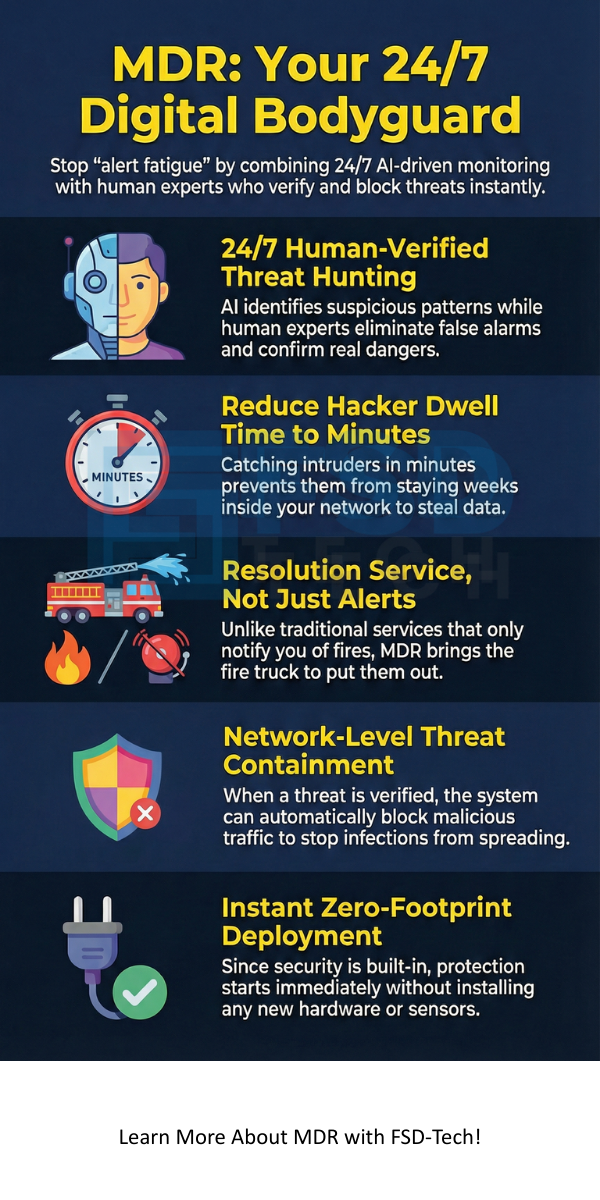
    Here is the thing: AI is great, but it can be wrong. It might flag a legitimate software update as a virus. In a Cato MDR setup, the SOC team inspects these "suspicious" flows. They close cases that are just noise. This means you only get a call when the threat is real. Don't you prefer a quiet inbox over one filled with false alarms?


    Also Read: What is Managed SD-WAN? All You Need to Know


    Why Cato MDR is Different?

    Most managed detection and response services require you to install a lot of new hardware. You have to put "sensors" everywhere. It takes months to set up. But Cato MDR is built-in to the Cato SASE platform.


    Zero-Footprint Data Collection

    Since Cato already runs your network, it already sees your data. You do not need to install anything new. Once you get the license, the SOC team starts working. It's like flipping a light switch. You get instant visibility into your sites, VPNs, and cloud environments.


    Automated Threat Hunting

    We use ML to mine your network for weird patterns. We look at:


    • Where is the data going (Geolocation)?
    • What app is sending it?
    • Is the destination IP dangerous?
    • How often is this happening?


    By checking these boxes, the system finds infected endpoints that traditional tools might miss.


    The Key Benefits of Managed Detection and Response

    If you are looking to improve your security posture, MDR offers several big wins. We've seen companies transform their safety levels just by adding this layer.


    • Network-Level Containment: If we find a verified threat, we don't just send an email. We can block the traffic at the network level. This stops the "infection" from spreading to other computers.
    • Guided Remediation: We don't just say, "You have a problem." We tell you exactly how to fix it. Our SOC team stays on the line to help you through the steps.
    • Big Data Analytics: All your metadata is stored in a massive repository. This allows us to look back in time to see how an attack started.


    Monthly Reporting and Tracking

    Transparency is key. Each month, you get a custom report. It shows your risk levels, which endpoints were at risk, and how we saved the day. It is a great way to show your boss that the investment is working.


    Also Read: Infrastructure Monitoring: Your Guide to a Healthy Tech Stack


    How the Managed Detection and Response Process Works

    You might wonder what happens behind the scenes. To be honest, it is a very structured dance between computers and people.


    1. Collection: The system gathers data from every corner of your network.
    2. Detection: AI looks for anomalies.
    3. Investigation: A human expert looks at the "red flags."
    4. Alerting: You get a verified alert with a clear plan.
    5. Containment: The threat is blocked.
    6. Review: We check your setup to make sure it doesn't happen again.


    As we have already discussed, this cycle happens every single day. It removes the burden from your IT staff so they can focus on growing your business.


    Comparing MDR to Traditional Security

    In this section, we will discuss why old methods are failing. In contrast to MDR, older tools like Managed Security Service Providers (MSSP) often just pass the alerts to you. They are like a "forwarding service."

    MDR is more like a "resolution service." While an MSSP tells you that your house is on fire, an MDR team brings the fire truck and helps you put it out. This shift from "watching" to "doing" is what modern businesses need.


    FeatureTraditional MSSPCato MDR
    ResponseOnly AlertsAlerts + Containment
    SetupComplex / Extra HWInstant / No HW
    FocusLogs and EventsNetwork Behavior
    Human ElementLimited24/7 SOC Experts


    Is Managed Detection and Response Right for You?

    You might think your company is too small for this. However, hackers actually love small businesses because their security is often weaker. Whether you have 50 employees or 5,000, managed detection and response scales with you.


    If you struggle with "alert fatigue" or don't have a 24/7 security team, then the answer is yes. It's a way to get "enterprise-grade" safety without hiring ten expensive security engineers.


    Conclusion

    To sum up, managed detection and response is no longer a luxury. It is a necessity in a world where cyberattacks are constant. By combining smart AI with a dedicated SOC team, you can finally sleep at night. You'll know that if something goes wrong, someone is already fixing it.


    At Cato, we value your peace of mind above all else. We are committed to keeping your network clean and your data safe. Our focus is always on the client, ensuring you have the best tools to succeed without the fear of a breach.


    MDR infographic


    Ready to see how we can protect your network? Let's chat about your security needs today.


    Talk to a SOC Expert


    Key Takeaways

    • MDR stands for Managed Detection and Response. It is a service that finds and stops threats.
    • Speed is the goal. It reduces the time a hacker can stay in your system.
    • Humans are essential. AI finds the patterns, but people verify the danger.
    • Cato MDR is built-in. There is no need for extra software or hardware if you use Cato SASE.
    • Containment matters. Blocking a threat is better than just reporting it.


    Frequently Asked Questions

    What is the difference between EDR and MDR?

    EDR (Endpoint Detection and Response) is a tool for your computers. MDR is a service that might use EDR tools but covers your whole network and includes human experts.


    Does MDR replace my IT team?

    No, it helps them! It takes the boring, scary work of watching logs off their plate. This lets them focus on high-value projects.


    How fast is the response?

    With Cato, monitoring is 24x7. Verification happens daily, and critical threats are alerted and contained almost instantly.


    Can I see what the SOC sees?

    Yes! You get a full dashboard and monthly reports that show every investigation.

     What is Managed Detection and Response (MDR)?

    About The Author

    Surbhi Suhane

    Surbhi Suhane is an experienced digital marketing and content specialist with deep expertise in Getting Things Done (GTD) methodology and process automation. Adept at optimizing workflows and leveraging automation tools to enhance productivity and deliver impactful results in content creation and SEO optimization.

    TRY OUR PRODUCTS

    Like This Story?

    Share it with friends!

    Subscribe to our newsletter!

    FishOSCato SASEVembuXcitiumZeta HRMSAtera
    Isometric illustration of a centralized performance platform connected to analytics dashboards and team members, representing goal alignment, measurable outcomes, risk visibility, and strategic project tracking within ClickUp.

    How ClickUp Enables Outcome-Based Project Management (Not Just Task Tracking)

    🕓 February 15, 2026
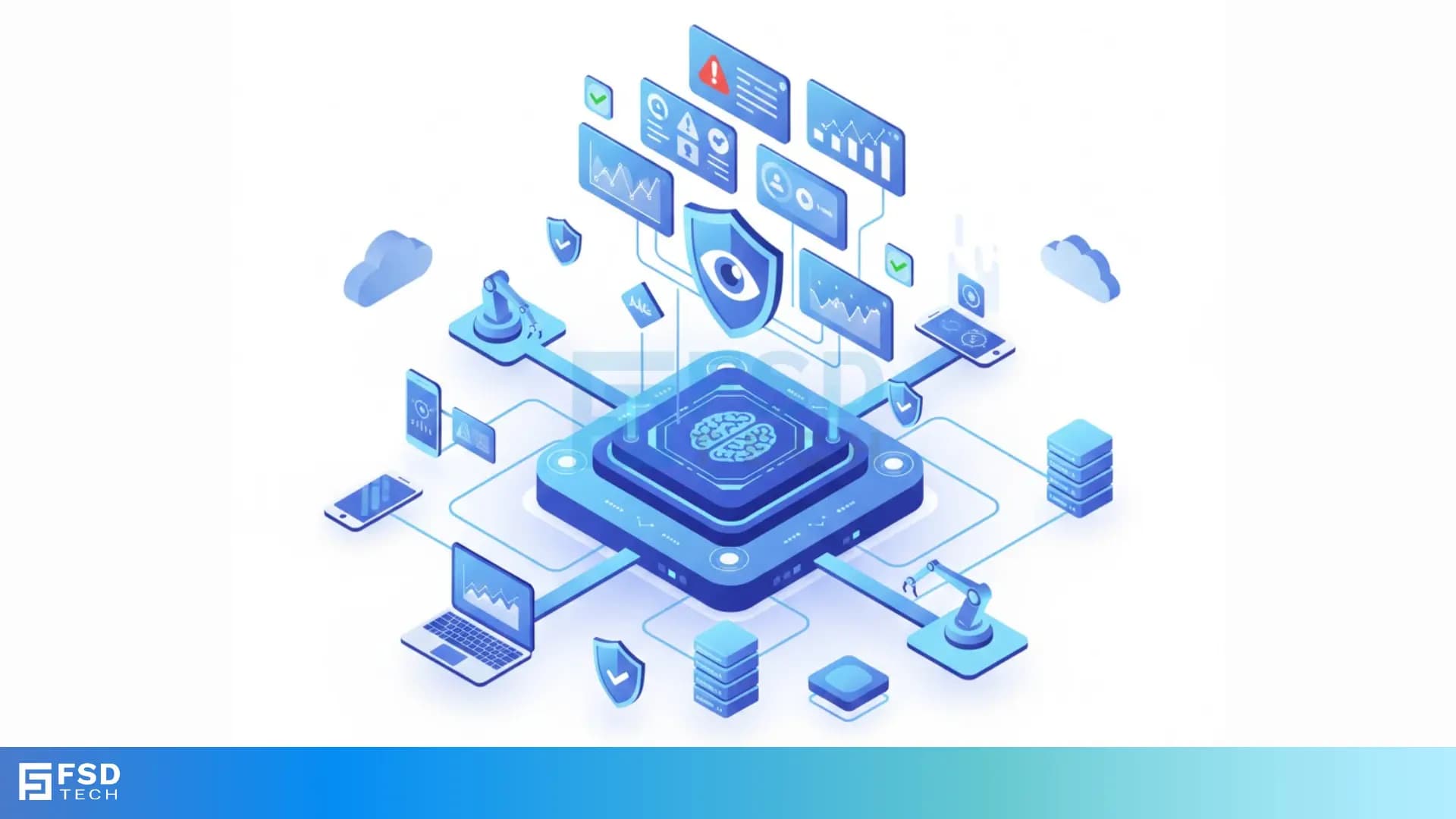
    Isometric illustration of a centralized executive dashboard platform connected to analytics panels, performance charts, security indicators, and strategic milestones, representing real-time business visibility and decision control within ClickUp.

    Executive Visibility in ClickUp – How CXOs Gain Real-Time Control Without Micromanaging

    🕓 February 13, 2026

    Cato SASE Architecture

    Inside Cato’s SASE Architecture: A Blueprint for Modern Security

    🕓 January 26, 2025

    Workflow Automation(8)

    Workforce Automation(1)

    AI Project Management(1)

    HR Data Automation(1)

    RMM(2)

    IT Workflow Automation(1)

    IT security(2)

    GCC compliance(4)

    Payroll Integration(2)

    IT support automation(3)

    procurement automation(1)

    lost device management(1)

    IT Management(5)

    IoT Security(2)

    Cato XOps(1)

    IT compliance(4)

    Workflow Management(1)

    Task Automation(1)

    Kubernetes lifecycle management(2)

    AI-powered cloud ops(1)

    OpenStack automation(1)

    SMB Security(8)

    Data Security(1)

    MDR (Managed Detection & Response)(3)

    MSP Automation(3)

    Atera Integrations(2)

    XDR Security(2)

    Threat Detection & Response(1)

    Ransomware Defense(3)

    SMB Cyber Protection(1)

    HR Tech Solutions(1)

    Zero Trust Network Access(3)

    Post-Quantum Cryptography(1)

    Quantum Threat UAE & GCC(1)

    Quantum Security(1)

    Cloud IDE Security(1)

    Zero Trust Security(2)

    Endpoint Management(1)

    SaaS Security(2)

    Payroll Automation(5)

    IT Monitoring(2)

    Xcitium EDR SOC(15)

    Ransomware Protection GCC(1)

    M&A IT Integration(1)

    Network Consolidation UAE(1)

    MSSP for SMBs(1)

    Antivirus vs EDR(1)

    Managed EDR FSD-Tech(1)

    Ransomware Protection(3)

    SMB Cybersecurity GCC(1)

    FSD-Tech MSSP(25)

    Endpoint Security(1)

    Cybersecurity GCC(13)

    Data Breach Costs(1)

    Endpoint Protection(1)

    SMB Cybersecurity(8)

    Xcitium EDR(30)

    Zero Dwell Containment(31)

    Managed Security Services(2)

    Cloud Backup(1)

    Hybrid Backup(1)

    Backup & Recovery(1)

    pointguard ai(4)

    vembu(9)

    SMB data protection(9)

    backup myths(1)

    disaster recovery myths(1)

    Disaster Recovery(4)

    Vembu BDR Suite(19)

    DataProtection(1)

    GCCBusiness(1)

    Secure Access Service Edge(4)

    GCC IT Solutions(1)

    Unified Network Management(1)

    GCC HR software(20)

    open banking(1)

    financial cybersecurity(2)

    CC compliance(1)

    Miradore EMM(15)

    Government Security(1)

    Cato SASE(9)

    GCC Education(1)

    Cloud Security(9)

    Hybrid Learning(1)

    Talent Development(1)

    AI Governance(4)

    AI Cybersecurity(13)

    AI Compliance(2)

    AI Security(2)

    AI Risk Management(1)

    Secure Remote Access(1)

    GCC business security(1)

    GCC network integration(1)

    compliance automation(5)

    education security(1)

    GCC cybersecurity(3)

    App management UAE(1)

    BYOD security Dubai(8)

    Miradore EMM Premium+(5)

    HealthcareSecurity(1)

    share your thoughts

    Managed Detection and Response (MDR)

    What is Managed Detection and Response (MDR)?

    🕓 March 9, 2026

    Database Fingerprinting

    Database Fingerprinting: Secure Your Data Assets

    🕓 March 7, 2026

    Threat Actors

    Threat Actors: Who is Behind Your Cyber Security Risks?

    🕓 March 7, 2026

    Decoded(145)

    Cyber Security(126)

    BCP / DR(22)

    Zeta HRMS(78)

    SASE(21)

    Automation(78)

    Next Gen IT-Infra(126)

    Monitoring & Management(77)

    ITSM(22)

    HRMS(21)

    Automation(24)