.webp&w=3840&q=75)
How ClickUp Enables Outcome-Based Project Management (Not Just Task Tracking)
🕓 February 15, 2026
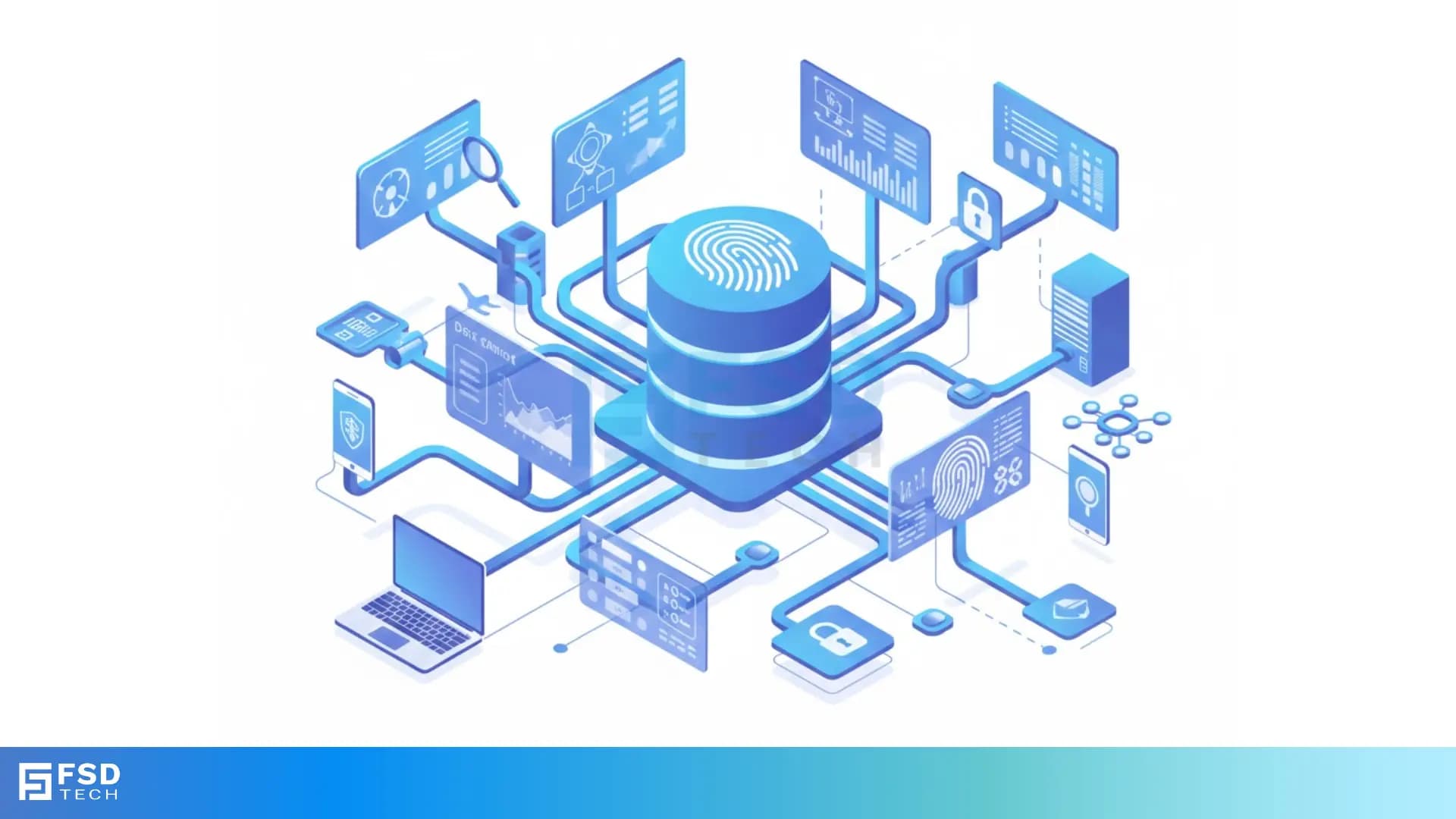
Database fingerprinting serves as a silent guardian for your most sensitive information in an era where data is the new gold. Have you ever wondered how companies know exactly who leaked a private list of customers? It isn't magic. It's a sophisticated method of embedding unique, invisible marks into a dataset. Unlike a standard watermark that looks the same on every copy, a fingerprint is unique to the person receiving the data.
Think of it this way. If I give a copy of a book to five friends, and one friend leaks it, how do I know who did it? If I slightly change one word in each friend's copy—a word only they have—I can trace the leak back to the source. This is the heart of traitor tracing. To be honest, most businesses focus so much on "keeping people out" that they forget to track what happens when the data is "given out" to partners or employees.
In this guide, we'll explore how this technology works, why it differs from watermarking, and how it keeps your relational databases safe.
At its core, database fingerprinting is the process of hiding unique identifying information within a relational database. We do this to identify the source of unauthorized data redistribution. If a "traitor" (an authorized user who leaks data) shares your dataset, the fingerprint stays attached to that data. When you find the leaked file, you can "read" the fingerprint and identify exactly which user it was assigned to.
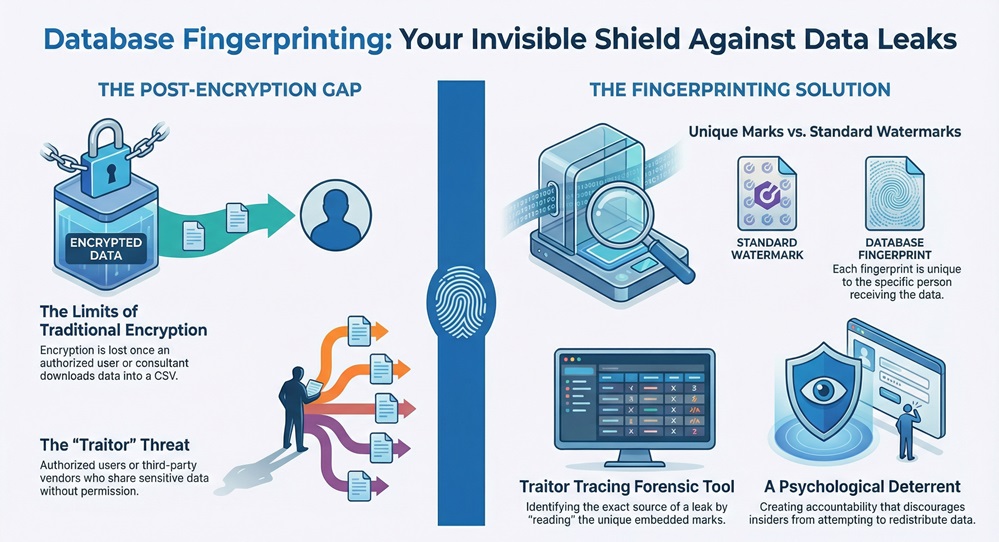
Here’s the thing: data is easy to copy. Traditional encryption helps while the data is sitting on your server. But what happens after a consultant downloads a CSV file? Encryption is gone. That's where fingerprinting steps in. It provides a permanent link between the data and the recipient.
Why should you care? Because data breaches aren't always caused by hackers in hoodies. Often, it’s an insider or a third-party vendor. By using database fingerprinting, you create a psychological deterrent and a forensic tool all in one.
People often confuse these two terms. While they share a similar DNA, their purpose is quite different.
In my view, watermarking is for protection, but fingerprinting is for accountability. If we have a hundred employees, we want a hundred different versions of the dataset. This way, if a leak happens, there is no "he-said, she-said." The data itself tells the story.
Also Read: What is the Shared Responsibility Model and Why Does it Matter?
You might be asking, "Doesn't changing data ruin the database?" That's a great question. The goal of database fingerprinting is to make changes that are "transparent." This means the changes are so small that they don't affect the results of your queries or your data analysis.
The Bit-Level Manipulation
Most fingerprinting algorithms target "numeric" or "categorical" data. Imagine a column representing the price of an item. If an item costs $10.00, the algorithm might change it to $10.0001 for User A and $9.9999 for User B.
To a human or a computer program, this difference is negligible. However, to a forensic algorithm, this is a clear signature. We use the "least significant bits" (LSB) of a value to hide our mark. This ensures the data remains useful while carrying a hidden message.
Identifying the Target Rows and Columns
We don't fingerprint every single cell. That would be too much "noise." Instead, we use a secret key to select specific rows and columns. This makes it incredibly hard for a leaker to find and remove the marks.
If a leaker doesn't know which rows are marked, they can't delete them without destroying the value of the entire dataset. We call this "robustness." A good fingerprint should survive even if the leaker deletes 30% of the rows or adds "noise" to the data.
We can see the power of fingerprinting in large-scale government systems. For instance, the National Automated Fingerprint Identification System (NAFIS) in India handles millions of biometric records. While NAFIS focuses on physical fingerprints to identify criminals, the concept of a unique digital identifier is the same.
In business, we see database fingerprinting used in:
Have you ever thought about how much sensitive data leaves your company via email every day? Without a fingerprint, that data is effectively "lost" the moment it hits an outbox.
Also Read: What is Managed SD-WAN? All You Need to Know
It’s not all sunshine and rainbows. Leakers are smart. They try to "wash" the data to remove fingerprints. There are three main types of attacks we fight against:
To combat this, we use "collusion-secure codes." These are mathematical structures that make it impossible for a small group of people to hide their tracks, even if they work together.
To make database fingerprinting effective, it must meet several criteria:
As we have already discussed, the secret key is the most important part. If you lose the key, you lose the ability to prove who leaked the data. Thus, key management is a top priority for any security team.
If we want to protect a relational database, we usually follow these steps:
This might sound complex, but many modern Data Loss Prevention (DLP) tools now automate this process. You don't need to be a mathematician to use it, but you do need to understand the logic behind it.
Lately, we’ve seen a shift toward using AI to make fingerprints even harder to find. Machine learning can help identify which parts of a database are "stable" and which are "volatile." By embedding marks in stable areas, we ensure the fingerprint stays intact even if the data is processed or cleaned.
On the other hand, leakers also use AI to try and "de-fingerprint" datasets. It's a constant cat-and-mouse game. This is why staying updated on the latest research is so vital for technical leads.
In my experience, the best security is the one people don't see. Database fingerprinting provides that invisible layer of accountability that traditional firewalls simply cannot offer. It transforms your data from a static asset into a traceable one.
We've all been there—worrying about where our data goes once it leaves our sight. By implementing these forensic techniques, you take back control. You aren't just protecting rows and columns; you're protecting your company's reputation and its future.
At our core, we believe that security should be simple, effective, and human-centric. We focus on building tools that empower you to share data confidently without the fear of "what if." If you're ready to secure your databases and ensure your intellectual property stays yours, we're here to help you every step of the way.
Generally, no. The fingerprinting happens when the data is "exported" or "shared," not during every single read/write operation on your production server.
No. Because the fingerprint is embedded in the values of the data itself (like changing 10.0 to 10.0001), moving the data from a SQL database to an Excel sheet won't remove the mark.
Yes, as long as you disclose your data protection policies to your employees and partners. In fact, for many industries, it helps meet compliance standards for data security.
It depends on the algorithm, but usually, a few hundred rows are enough to identify a user with high confidence.

Surbhi Suhane is an experienced digital marketing and content specialist with deep expertise in Getting Things Done (GTD) methodology and process automation. Adept at optimizing workflows and leveraging automation tools to enhance productivity and deliver impactful results in content creation and SEO optimization.
Share it with friends!




.webp&w=3840&q=75)

share your thoughts