HomeNext Gen IT-InfraMonitoring & ManagementCyber SecurityBCP / DRAutomationDecoded
Next Gen IT-Infra
Cato’s SASE Supports Cybersecurity Skills Development

How Cato’s SASE Supports Cybersecurity Skills Development

🕓 April 8, 2025

How SASE Supports the Security Needs of SMBs

How SASE Supports the Security Needs of SMBs

🕓 February 9, 2025

Attack Surface Reduction with Cato’s SASE

Attack Surface Reduction with Cato’s SASE

🕓 February 10, 2025

SASE for Digital Transformation in UAE

SASE for Digital Transformation in UAE

🕓 February 8, 2025

Monitoring & Management
Understanding Atera’s SLA Management

Understanding Atera’s SLA Management

🕓 February 7, 2025

Cost-Performance Ratio: Finding the Right Balance in IT Management Networks

Cost-Performance Ratio: Finding the Right Balance in IT Management Networks

🕓 June 16, 2025

Customizing Atera with APIs

Customizing Atera with APIs

🕓 March 3, 2025

Power Up Your IT Team’s Strategy with Atera’s Communication Tools

Power Up Your IT Team’s Strategy with Atera’s Communication Tools

🕓 February 8, 2025

Cyber Security
Visual guide showing Cato CMA interface for configuring Internet and WAN firewall rules, enabling threat protection, and monitoring security events in real time for UAE IT teams.

Enforcing Firewall and Threat Protection Policies in Cato

🕓 July 25, 2025

Isometric illustration of professionals managing network performance, bandwidth analytics, and cloud-based optimization around the Cato Networks platform, symbolizing bandwidth control and QoS visibility.

Mastering Bandwidth Control and QoS in Cato Networks

🕓 July 26, 2025

Illustration of the Cato Cloud architecture showing its role in delivering SASE for secure, optimized global connectivity.

Understanding the Cato Cloud and Its Role in SASE

🕓 January 29, 2025

Global network backbone powering Cato SASE solution for secure, high-performance connectivity across regions.

Global Backbone: The Engine Powering Cato’s SASE Solution

🕓 January 30, 2025

BCP / DR
Illustration showing diverse business and IT professionals collaborating with cloud, backup, and security icons, representing Vembu use cases for SMBs, MSPs, and IT teams.

Who Uses Vembu? Real-World Use Cases for SMBs, MSPs & IT Teams

🕓 July 12, 2025

Graphic showcasing Vembu’s all-in-one backup and disaster recovery platform with icons for cloud, data protection, and business continuity for IT teams and SMBs.

What Is Vembu? A Deep Dive Into the All in One Backup & Disaster Recovery Platform

🕓 July 6, 2025

Illustration showing Vembu backup and disaster recovery system with cloud storage, server racks, analytics dashboard, and IT professionals managing data.

The Rising Cost of Data Loss: Why Backup Is No Longer Optional?

🕓 August 14, 2025

3D isometric illustration of cloud backup and data recovery infrastructure with laptop, data center stack, and digital business icons — FSD Tech

RPO & RTO: The Heart of Business Continuity

🕓 August 15, 2025

Automation
Cross-Functional Collaboration with ClickUp

Fostering Cross-Functional Collaboration with ClickUp for Multi-Departmental Projects

🕓 February 11, 2025

ClickUp Project Reporting

Revolutionizing Enterprise Reporting with ClickUp’s Advanced Analytics and Dashboards

🕓 June 16, 2025

ClickUp’s Design Collaboration and Asset Management Tools

Empowering Creative Teams with ClickUp’s Design Collaboration and Asset Management Tools

🕓 February 26, 2025

ClickUp Communication and Collaboration Tools

ClickUp Communication and Collaboration Tools: Empowering Remote Teams

🕓 March 12, 2025

Decoded
Multi-Factor Authentication (MFA)

Multi-Factor Authentication (MFA): All You Need to Know

🕓 December 7, 2025

L3 Switch

What Is an L3 Switch? L2 vs L3 & Why You Need Layer 3?

🕓 December 8, 2025

IPSec

IPSec Explained: Protocols, Modes, IKE & VPN Security

🕓 December 3, 2025

 Datagram Transport Layer Security (DTLS)

What is Datagram Transport Layer Security (DTLS)? How it works?

🕓 December 4, 2025

    Subscribe to our newsletter!

    About Us

    Follow Us

    Copyright © 2024 | Powered by 

    Cato SASE Architecture

    Inside Cato’s SASE Architecture: A Blueprint for Modern Security

    🕓 January 26, 2025

    Enterprise Data Security and Privacy with ClickUp

    Ensuring Enterprise Data Security and Privacy with ClickUp

    🕓 February 9, 2025

    DDoS protection SASE

    DDoS Protection and Cato’s Defence Mechanisms

    🕓 February 11, 2025

    Table of Contents

    What is Hash Function? Data Integrity and Security

    Surbhi Suhane
    January 20, 2026
    Comments
    Hash Function

    You rely on security and speed every day when you interact with digital systems, from logging into your email to using a mobile payment app. But have you ever wondered how these systems protect your sensitive data, like your hash function password, while ensuring quick access? The secret weapon is often the hash function algorithm.


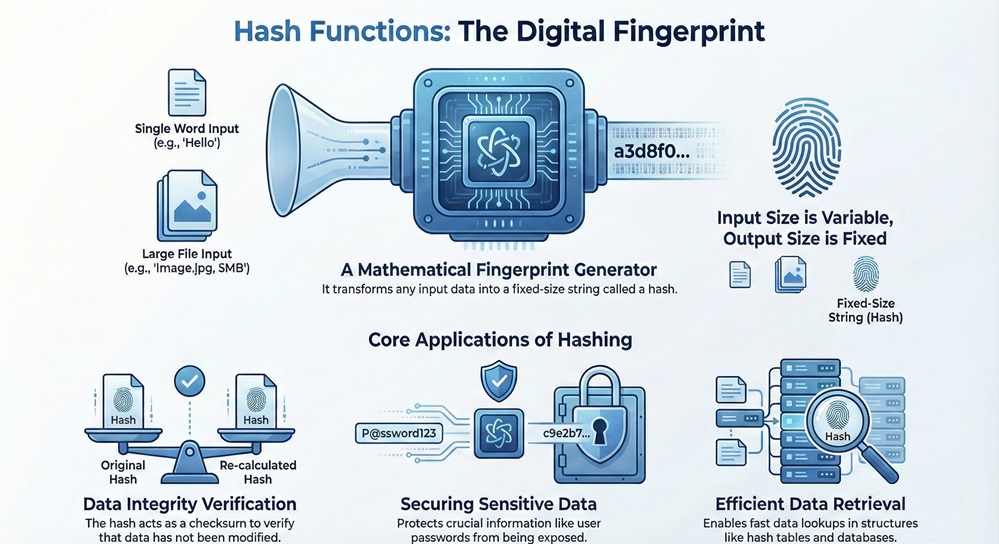
    A hash function is nothing but a mathematical algorithm that acts as a digital fingerprint generator. It takes any input data—which we call a "message" or "key"—and transforms it into a fixed-size string of characters, known as a hash value or message digest. This process, called hashing, is one of the most fundamental concepts in computer science and network security.


    Why should you care about this technical process? Because the integrity and security of your data depend on it. This content will walk you through the core concepts, show how hash function works, and help you understand why certain hash function types are essential for modern digital life.


    What is a hash function?

    A hash function definition is simple: it is a deterministic function that maps input data of arbitrary size to an output of a fixed size. The input can be a single number, a long text file, or even an entire database. No matter the size of the input, the resulting hash, or digest, always maintains the exact same length.
     

    hash function


    This process serves as a highly efficient tool for several key purposes:


    • Data Integrity: A hash value acts as a checksum to verify that data has not been modified.
    • Security: Hashing secures sensitive data like hash function password entries.
    • Efficiency: It facilitates fast data retrieval in data structures like hash tables, which are vital for a system like hash function in dbms.


    Secure with Hashing Now


    The Uniqueness of the Hash Value

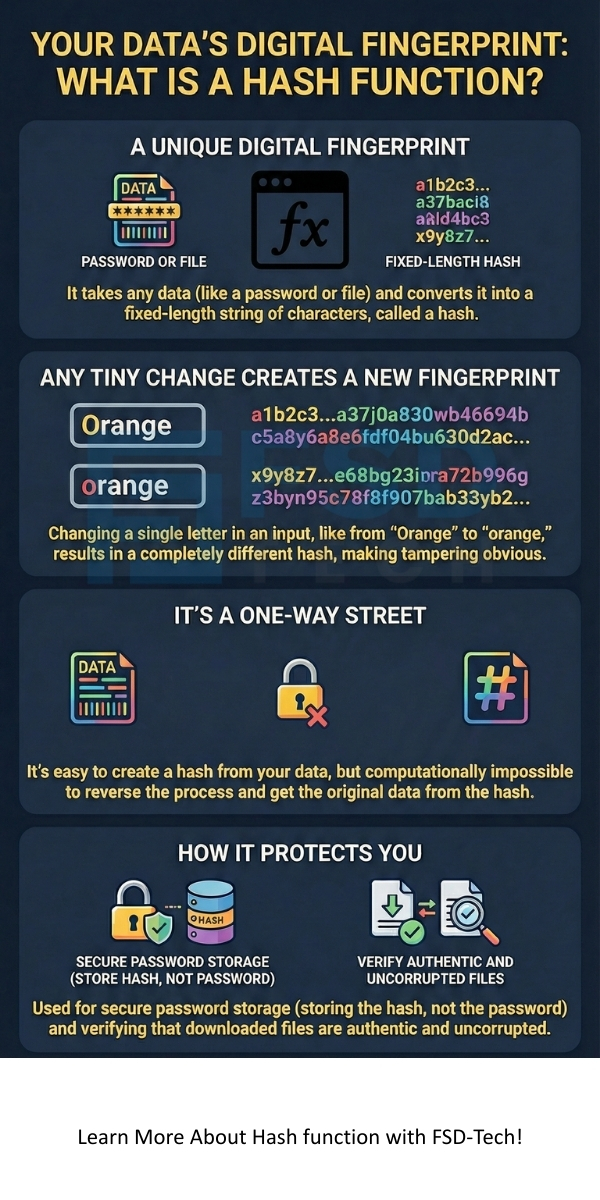
    The resulting hash value for a specific input is always the same. If you run the word "Orange" through a hash function algorithm like SHA-256 today, you will get the identical output a year from now.


    However, if you change even a single comma or a single letter in the input—for example, changing "Orange" to "orange"—the resulting hash value will change completely. This critical feature is called the Avalanche Effect. This effect ensures that a tiny modification in a large document immediately results in a drastically different digital fingerprint, making any tampering immediately obvious.


    How Hash Function Works: The Key Steps

    Understanding how hash function works requires focusing on its one-way nature. It is easy to compute a hash from an input, but it is computationally infeasible to reverse the process and get the original input from the hash value. This makes the hash function algorithm a one-way function.


    The general process of calculating a hash value involves these steps:


    1. Input Standardization: The hash function algorithm first converts the input—which might be a text file, a hash function python string, or a hash function excel cell—into a binary format.
    2. Input Segmentation: The algorithm typically divides this binary input into fixed-size blocks. For example, the SHA-256 algorithm processes data in 512-bit blocks.
    3. Iterative Processing: The algorithm processes these blocks sequentially. It takes the first block and the algorithm's initial internal state to produce an intermediate hash. Then, it mixes this intermediate hash with the second block to create the next hash, and so on.
    4. Final Digest: After processing all blocks, the last intermediate hash becomes the final hash value or message digest. This digest has a fixed length, regardless of the original input's size.


    This sequential, block-by-block mixing of data is what creates the strong interdependency where a single change affects the entire final hash.


    Also Read: Quantum Cryptography - QKD, Security & Future Guide


    Essential Hash Function Properties

    A good hash function needs specific qualities to be reliable, especially for applications like hash function security. These hash function properties ensure the hash value is useful and the process is trustworthy.


    Deterministic

    A hash function is deterministic, meaning the exact same input always generates the exact same output. This is a primary feature, as consistent output allows systems to verify data integrity and compare passwords effectively.


    • Example: Running the string "hello" through the SHA-256 hash function algorithm on any computer, at any time, will always produce the same 64-character hash: 2cf24dba5fb0a30e26e83b2ac5b9e29e1b161e5c1fa7425e73043362938798c1.


    Fixed-Size Output

    No matter the input's size, the resulting hash always has a predetermined, fixed length. For example, a 1-character text, a 100-page document, or a 2 GB video file, when run through SHA-256, will all produce a hash that is exactly 256 bits long (or 64 hexadecimal characters). This ensures consistency and makes data management more efficient.


    Pre-Image Resistance (One-Way)

    This property means that given the output (hash value), it is computationally infeasible to figure out the original input (pre-image). This is crucial for securing a hash function password. If an attacker steals the stored hash, they cannot easily reverse it to get your original password.


    • Now, the question arises: Why is it only "infeasible" and not "impossible"? Because the number of possible inputs is infinite, but the number of possible hash outputs is finite. This leads to the next property.


    Collision Resistance

    Collision resistance implies it is computationally very difficult to find two different inputs that produce the same hash value. This is called a hash collision. While mathematically possible, strong algorithms are designed to make finding a collision take an impossible amount of time and computing power. This property is paramount for ensuring hash function security and data authenticity.


    Speed of Computation

    The algorithm must generate the hash quickly, especially for non-cryptographic purposes like in a hash function in dbms or for file indexing. Fast computation ensures that data retrieval remains efficient, which is the whole point of using a hash table in the first place.


    Hash Function Types and Their Security Applications

    Hash function types fall into two main categories: non-cryptographic and cryptographic. Both types use the basic principles of hashing but prioritize different properties.


    1. Non-Cryptographic Hash Functions

    These functions prioritize speed and good distribution over absolute collision resistance. They are commonly used for data indexing and error checking.


    • Application: A hash function in dbms uses these for quick lookup. For hash function excel applications, a simple modulo function may be enough to distribute data into buckets for fast access.
    • Method: Simple methods like the Division Method (using the modulo operator) or the Multiplication Method are often employed.


    2. Cryptographic Hash Functions

    Cryptographic functions meet a stricter set of security requirements, including strong collision and pre-image resistance. They are vital for hash function in network security.


    • It is important to note that many older algorithms are no longer considered secure due to advances in computing power and cryptanalysis.


    Also Read: What is Sandboxing in CyberSecurity? How It Works?


    Key Cryptographic Algorithms

    The Secure Hash Algorithm (SHA) family represents the modern standard for hash function security.


    • MD5 (Message Digest Algorithm 5): Once widely used, MD5 is now deprecated for security purposes because researchers found ways to generate collisions easily. It remains useful only for non-security-critical applications like simple checksums for file verification.
    • SHA-1 (Secure Hash Algorithm 1): This algorithm provided a stronger 160-bit hash compared to MD5's 128-bit hash. However, like MD5, it is now considered insecure due to practical collision attacks and is no longer recommended for applications requiring strong security.
    • SHA-2 Family (SHA-256, SHA-512): The SHA-2 family is currently the industry standard. SHA-256 and SHA-512 offer robust security with outputs of 256 bits and 512 bits, respectively. This larger output size makes collision and pre-image attacks computationally impossible with current technology.
      • Now, the question arises: Which hash function is the most secure? For current general use, SHA-256 is the most widely recommended and adopted for security-critical functions.
    • SHA-3 (Keccak): Adopted as the latest NIST standard, SHA-3 uses a different internal structure called a "sponge construction," which offers enhanced security and flexibility. It serves as a strong alternative to SHA-2, offering resistance to attack types that may threaten the older structure.


    Hash Function in Action?

    The use of a hash function is much more widespread than you may realize.


    Hash Function Password Storage

    The system never stores your actual password in its database. Instead, it stores the hash of your password. When you log in, the system runs your entered password through the same hash function algorithm and compares the resulting hash to the one stored in the database.


    • If the hashes match, the login succeeds.
    • If they do not match, the login fails.


    This method ensures that even if an attacker hacks the system and steals the database of hashes, they cannot use the hashes to log in or easily reverse them to get your original hash function password. This is a core component of hash function security.


    Data Integrity and Verification

    When you download a file, the source website often publishes a hash value alongside it. After the download is complete, you can run the file on your local machine through the same hash function algorithm to generate a local hash.


    • If your local hash matches the published hash, it indicates the file is authentic and has not suffered any corruption or malicious alteration during the download process.


    Hash Function in DBMS and Hash Tables

    In database management systems (hash function in dbms), hash functions create hash tables for incredibly fast data lookup. The hash function takes a data key (like a customer ID or a product name) and converts it into a small integer, which is used as an index to a specific location (or "bucket") in the database.


    This method allows the system to directly access the data's location without searching through every entry, significantly improving speed and efficiency. The goal here is uniform distribution of keys to minimize collisions and ensure quick access.


    Also Read: What is Edge Computing? How it Differs from Cloud Computing?


    Comparison Chart: Hash vs. Encryption

    While both hashing and encryption deal with data security, they serve fundamentally different purposes. It is important to know the distinctions.


    Basis for ComparisonHash Function (Hashing)Encryption
    Primary GoalData integrity and verification (One-Way)Data confidentiality and secrecy (Two-Way)
    Output SizeAlways a fixed length (e.g., 256 bits)Output size is often the same or larger than the input
    ReversibilityIrreversible (one-way function)Reversible (two-way function) using a secret key
    Key RequirementDoes not require a keyRequires an encryption key and a decryption key
    Best Used ForHash function password storage, data integrity, indexingSecuring data transmission (e.g., HTTPS, VPNs)


    Conclusion

    The humble hash function is one of the most critical, yet often unseen, components of modern computing. Whether speeding up data retrieval in a hash function in dbms, ensuring the integrity of a file, or protecting your hash function password with unbreakable digital fingerprints, the hash function algorithm plays a vital role. You gain efficiency, reliability, and hash function security by mastering the core properties like determinism, fixed output, and collision resistance.


    As a client, you need partners who understand the technical depth required to safeguard your digital assets. We focus on implementing and maintaining the most secure standards, such as SHA-256, across all systems. 


    Contact us today to learn how our expertise in robust network security architecture can ensure the complete integrity and safety of your most critical data.
     

    hash function infographic


    Key Takeaways on Hash Functions

    1. One-Way & Deterministic A hash function always produces the same fixed-size output (digest) for any given input, but it is computationally infeasible to reverse the process and recover the original input from the hash value.
    2. Avalanche Effect Even a tiny change in the input (a single bit) causes a dramatic and unpredictable change in the resulting hash value, ensuring that tampering or modification is immediately detectable.
    3. Collision Resistance Strong cryptographic hash functions are designed to make it extremely difficult to find two different inputs that produce the same hash value (a collision), providing robust protection against forgery and data manipulation.
    4. Essential for Password Security Passwords are never stored in plaintext; only their hash values are saved. When a user logs in, the system hashes the entered password and compares it to the stored hash—keeping credentials safe even if the database is breached.
    5. Core Building Block of Modern Security Hash functions power digital signatures, data integrity checks (e.g., file verification), blockchain, SSL/TLS certificates, message authentication codes (MACs), and secure data structures like hash tables in databases. SHA-256 remains the most widely trusted standard

    Frequently Asked Questions About the Hash Function Algorithm

    What is a Hash Collision in simple terms?

    A hash collision occurs when two completely different inputs produce the exact same hash value output. While mathematically inevitable in any fixed-size output system, a good hash function algorithm, like SHA-256, makes finding a collision extremely difficult to the point of being practically impossible.


    How does a hash function in network security work?

    In hash function in network security, the hash function creates a Message Authentication Code (MAC) or is used for digital signatures. The sender hashes the message and includes the hash. The receiver calculates a new hash upon receiving the message. If the two hashes match, it verifies both the sender's authenticity and that the message has not been altered during transmission.


    Is SHA-256 the most secure hash function?

    SHA-256 is currently the industry-recommended hash function for most security applications. It is part of the SHA-2 family. While newer algorithms like SHA-3 and BLAKE2/BLAKE3 offer different structures and performance advantages, SHA-256 remains an extremely robust and widely accepted standard for hash function security.

    What is Hash Function? Data Integrity and Security

    About The Author

    Surbhi Suhane

    Surbhi Suhane is an experienced digital marketing and content specialist with deep expertise in Getting Things Done (GTD) methodology and process automation. Adept at optimizing workflows and leveraging automation tools to enhance productivity and deliver impactful results in content creation and SEO optimization.

    Like This Story?

    Share it with friends!

    Subscribe to our newsletter!

    Atera

    (48)

    Cato Networks

    (116)

    ClickUp

    (70)

    FishOS

    (7)

    Miradore

    (21)

    PointGuard AI

    (9)

    Vembu

    (22)

    Xcitium

    (33)

    ZETA HRMS

    (73)

    Workflow Automation(8)

    Workforce Automation(1)

    AI Project Management(1)

    HR Data Automation(1)

    RMM(1)

    IT Workflow Automation(1)

    IT security(2)

    GCC compliance(4)

    Payroll Integration(2)

    IT support automation(3)

    procurement automation(1)

    lost device management(1)

    IT Management(5)

    IoT Security(2)

    Cato XOps(2)

    IT compliance(4)

    Task Automation(1)

    Workflow Management(1)

    AI-powered cloud ops(1)

    Kubernetes lifecycle management(2)

    OpenStack automation(1)

    SMB Security(8)

    Data Security(1)

    MDR (Managed Detection & Response)(4)

    Atera Integrations(2)

    MSP Automation(3)

    XDR Security(2)

    SMB Cyber Protection(1)

    Ransomware Defense(3)

    HR Tech Solutions(1)

    Zero Trust Network Access(3)

    Zero Trust Security(2)

    Endpoint Management(1)

    SaaS Security(1)

    Payroll Automation(5)

    IT Monitoring(2)

    Xcitium EDR SOC(15)

    Ransomware Protection GCC(1)

    Network Consolidation UAE(1)

    M&A IT Integration(1)

    MSSP for SMBs(1)

    Antivirus vs EDR(1)

    FSD-Tech MSSP(25)

    Ransomware Protection(3)

    Managed EDR FSD-Tech(1)

    SMB Cybersecurity GCC(1)

    Cybersecurity GCC(12)

    Endpoint Security(1)

    Endpoint Protection(1)

    Data Breach Costs(1)

    Xcitium EDR(30)

    Zero Dwell Containment(31)

    SMB Cybersecurity(8)

    Managed Security Services(2)

    Hybrid Backup(1)

    Cloud Backup(1)

    Backup & Recovery(1)

    pointguard ai(4)

    backup myths(1)

    vembu(9)

    SMB data protection(9)

    disaster recovery myths(1)

    Disaster Recovery(4)

    Vembu BDR Suite(19)

    GCCBusiness(1)

    DataProtection(1)

    Secure Access Service Edge(4)

    GCC HR software(16)

    Miradore EMM(15)

    Cato SASE(7)

    Cloud Security(8)

    Talent Development(1)

    AI Governance(4)

    AI Risk Management(1)

    AI Security(2)

    AI Cybersecurity(12)

    AI Compliance(2)

    GCC business security(1)

    GCC network integration(1)

    compliance automation(5)

    education security(1)

    GCC cybersecurity(2)

    BYOD security Dubai(8)

    App management UAE(1)

    Miradore EMM Premium+(5)

    MiddleEast(1)

    HealthcareSecurity(1)

    Team Collaboration(1)

    IT automation(12)

    Zscaler(1)

    SD-WAN(6)

    HR Integration(4)

    Cloud Networking(3)

    device management(9)

    VPN(1)

    RemoteWork(1)

    ZeroTrust(2)

    MPLS(1)

    Project Management(9)

    HR automation(16)

    share your thoughts

    Cloud access security broker

    What is Cloud Access Security Broker (CASB)?

    🕓 January 23, 2026

    Geofencing-technology

    What is Geofencing Technology? All You Need to Know

    🕓 January 23, 2026

    Advanced Persistent Threat (APT)

    What is Advanced Persistent Threat (APT)?

    🕓 January 22, 2026

    Decoded(80)

    Cyber Security(116)

    BCP / DR(22)

    Zeta HRMS(72)

    SASE(21)

    Automation(70)

    Next Gen IT-Infra(116)

    Monitoring & Management(69)

    ITSM(22)

    HRMS(21)

    Automation(24)