HomeNext Gen IT-InfraMonitoring & ManagementCyber SecurityBCP / DRAutomationDecoded
Next Gen IT-Infra
Cato’s SASE Supports Cybersecurity Skills Development

How Cato’s SASE Supports Cybersecurity Skills Development

🕓 April 8, 2025

How SASE Supports the Security Needs of SMBs

How SASE Supports the Security Needs of SMBs

🕓 February 9, 2025

Attack Surface Reduction with Cato’s SASE

Attack Surface Reduction with Cato’s SASE

🕓 February 10, 2025

SASE for Digital Transformation in UAE

SASE for Digital Transformation in UAE

🕓 February 8, 2025

Monitoring & Management
Understanding Atera’s SLA Management

Understanding Atera’s SLA Management

🕓 February 7, 2025

Cost-Performance Ratio: Finding the Right Balance in IT Management Networks

Cost-Performance Ratio: Finding the Right Balance in IT Management Networks

🕓 June 16, 2025

Customizing Atera with APIs

Customizing Atera with APIs

🕓 March 3, 2025

Power Up Your IT Team’s Strategy with Atera’s Communication Tools

Power Up Your IT Team’s Strategy with Atera’s Communication Tools

🕓 February 8, 2025

Cyber Security
Visual guide showing Cato CMA interface for configuring Internet and WAN firewall rules, enabling threat protection, and monitoring security events in real time for UAE IT teams.

Enforcing Firewall and Threat Protection Policies in Cato

🕓 July 25, 2025

Isometric illustration of professionals managing network performance, bandwidth analytics, and cloud-based optimization around the Cato Networks platform, symbolizing bandwidth control and QoS visibility.

Mastering Bandwidth Control and QoS in Cato Networks

🕓 July 26, 2025

Illustration of the Cato Cloud architecture showing its role in delivering SASE for secure, optimized global connectivity.

Understanding the Cato Cloud and Its Role in SASE

🕓 January 29, 2025

Global network backbone powering Cato SASE solution for secure, high-performance connectivity across regions.

Global Backbone: The Engine Powering Cato’s SASE Solution

🕓 January 30, 2025

BCP / DR
Illustration showing diverse business and IT professionals collaborating with cloud, backup, and security icons, representing Vembu use cases for SMBs, MSPs, and IT teams.

Who Uses Vembu? Real-World Use Cases for SMBs, MSPs & IT Teams

🕓 July 12, 2025

Graphic showcasing Vembu’s all-in-one backup and disaster recovery platform with icons for cloud, data protection, and business continuity for IT teams and SMBs.

What Is Vembu? A Deep Dive Into the All in One Backup & Disaster Recovery Platform

🕓 July 6, 2025

Illustration showing Vembu backup and disaster recovery system with cloud storage, server racks, analytics dashboard, and IT professionals managing data.

The Rising Cost of Data Loss: Why Backup Is No Longer Optional?

🕓 August 14, 2025

3D isometric illustration of cloud backup and data recovery infrastructure with laptop, data center stack, and digital business icons — FSD Tech

RPO & RTO: The Heart of Business Continuity

🕓 August 15, 2025

Automation
Cross-Functional Collaboration with ClickUp

Fostering Cross-Functional Collaboration with ClickUp for Multi-Departmental Projects

🕓 February 11, 2025

ClickUp Project Reporting

Revolutionizing Enterprise Reporting with ClickUp’s Advanced Analytics and Dashboards

🕓 June 16, 2025

ClickUp’s Design Collaboration and Asset Management Tools

Empowering Creative Teams with ClickUp’s Design Collaboration and Asset Management Tools

🕓 February 26, 2025

ClickUp Communication and Collaboration Tools

ClickUp Communication and Collaboration Tools: Empowering Remote Teams

🕓 March 12, 2025

Decoded
Multi-Factor Authentication (MFA)

Multi-Factor Authentication (MFA): All You Need to Know

🕓 December 7, 2025

L3 Switch

What Is an L3 Switch? L2 vs L3 & Why You Need Layer 3?

🕓 December 8, 2025

IPSec

IPSec Explained: Protocols, Modes, IKE & VPN Security

🕓 December 3, 2025

 Datagram Transport Layer Security (DTLS)

What is Datagram Transport Layer Security (DTLS)? How it works?

🕓 December 4, 2025

    Subscribe to our newsletter!

    About Us

    Follow Us

    Copyright © 2024 | Powered by 

    Cato SASE Architecture

    Inside Cato’s SASE Architecture: A Blueprint for Modern Security

    🕓 January 26, 2025

    Enterprise Data Security and Privacy with ClickUp

    Ensuring Enterprise Data Security and Privacy with ClickUp

    🕓 February 9, 2025

    DDoS protection SASE

    DDoS Protection and Cato’s Defence Mechanisms

    🕓 February 11, 2025

    Table of Contents

    What is Edge Computing? How it Differs from Cloud Computing?

    Surbhi Suhane
    December 24, 2025
    Comments
    Edge Computing

    The volume of data you manage from connected devices, like smart cameras or factory sensors, constantly increases. Managing all this data in a distant central cloud computing center creates problems. You encounter high latency, slow reaction times, and big bandwidth costs. You need a better way to process information quickly and locally.


    This is where edge computing comes in.


    Edge computing is a powerful, distributed information technology (IT) architecture. It moves processing power and data storage closer to the physical location where the data is created. This happens at the “edge” of your network.


    We will explore exactly what edge computing is, how it works, and why businesses worldwide are adopting this crucial technology to boost speed and efficiency.


    Meaning of Edge Computing 

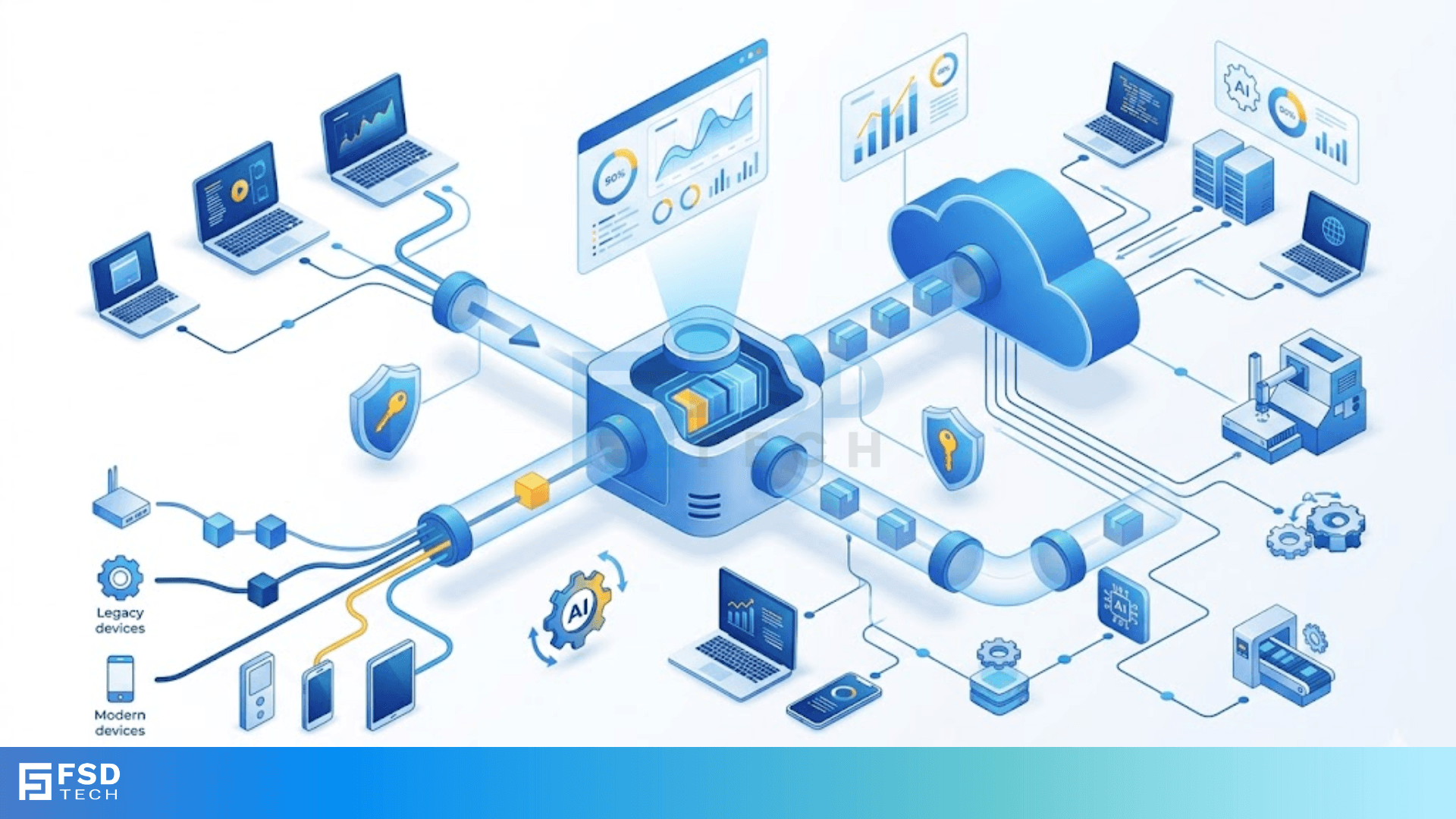
    Edge computing can be understood as a computing model. It brings computing resources, such as processing and storage, near the source of data generation. This means that instead of sending all raw data over long distances to a central data center or a large cloud server, you process the critical data right where you gather it.
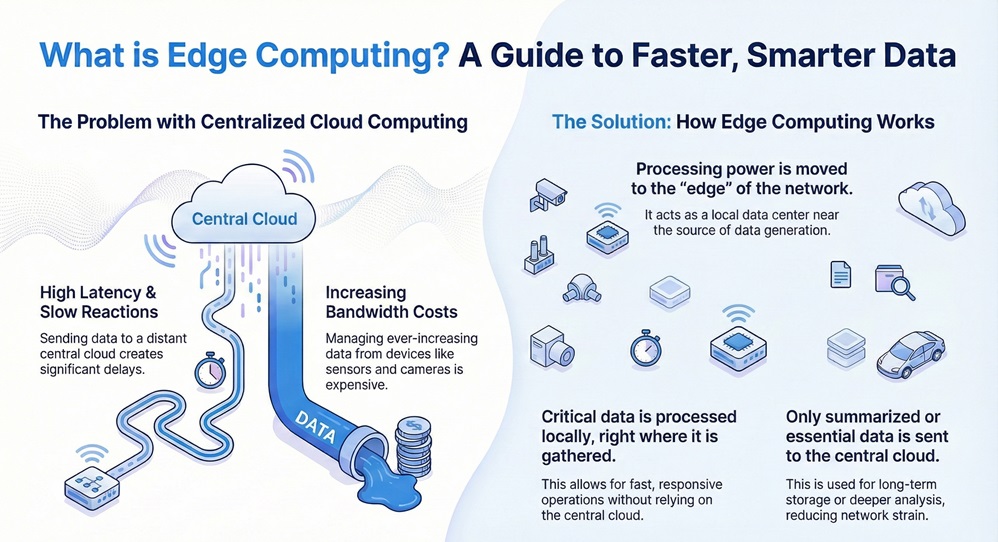
     

    Edge computing infographic


    What is Edge computing in simple terms?

    Simply put, edge computing is nothing but a local data center. It lives outside the traditional central facility. It acts as a necessary bridge between the data source and the central cloud.


    It is important to note that this technology prioritizes local data processing. Only summarized or critical data then travels to the central cloud for long-term storage or deeper analysis. This systematic process ensures that your operations remain fast and responsive.


    Deploy Edge Computing Now


    Fundamental Definition of Edge Computing

    The formal edge computing definition refers to the practice of processing data near the generating source, which is at the logical extremes, or edge, of a network.


    This implies that the network relies on a vast network of smaller, localized processing devices. These devices, known as edge computing devices, are responsible for collecting, processing, and analyzing data locally. The purpose pattern is to reduce the amount of data sent over the network. This reduction leads to lower latency and better service quality.


    In other words, edge computing technology helps you decentralize computing. This offers a major advantage over traditional, centralized models.


    Also Read: What is Vulnerability Assessment? Process & Tools


    Why Edge Computing?

    Now, the question arises, why edge computing is becoming a vital part of modern infrastructure. Edge computing provides solutions for several common business and operational problems.


    The causation pattern is Due to the massive growth of the Internet of Things (IoT) devices, the sheer volume of data overwhelms central networks. Edge computing provides the necessary framework to manage this data flow efficiently.


    Here are the primary reasons why edge computing is essential for your business:


    • Low Latency and Real-Time Performance: Edge computing signifies faster decision-making. Since the processing occurs locally, the time taken for data to travel to a server and back—known as latency—is significantly reduced. This enables real-time applications like autonomous vehicles and patient monitoring.
    • Reduced Bandwidth Costs: Edge computing only sends processed, filtered, or critical data to the cloud. This ensures that you reduce the total amount of data transferred. This reduction directly leads to lower bandwidth costs.
    • Enhanced Security: Keeping sensitive data local allows you to implement specific, physical security measures at the edge location. Also, it minimizes the exposure of raw data during transmission across the internet.
    • Increased Reliability: Edge computing solutions continue to operate even if the connection to the central cloud is temporarily lost. This provides a much-needed layer of operational continuity.
    • Scalability and Flexibility: The distributed nature of the edge computing architecture allows you to scale your processing power simply by adding more edge devices locally, without upgrading the entire central system.


    Edge Computing vs. Cloud Computing: A Quick Comparison

    Many people ask about edge computing vs cloud computing. While they both involve processing data, they work on the principle of different operational locations and goals. They are complementary, not competing, technologies.


    Basis for ComparisonEdge ComputingCloud Computing
    Primary LocationCloser to the data source (the "edge").Distant, centralized data centers.
    Data ProcessingLocalized, real-time processing of immediate data.Large-scale analysis, long-term storage, and global access.
    LatencyExtremely low (milliseconds).Higher (tens to hundreds of milliseconds).
    Bandwidth UseLow (only sends aggregated or critical data).High (requires high bandwidth for large data transfers).
    Typical Use CaseReal-time monitoring, industrial control, autonomous vehicles.Backup, big data analytics, global application hosting.
    FocusSpeed, immediacy, and operational continuity.Scalability, massive storage, and general computing power.


    While edge computing focuses on immediate action near the device, cloud computing deals with big-picture analysis and storage. They work together so as to provide a seamless data pipeline, where the edge handles the rapid local needs and the cloud handles the archival and deep learning tasks.


    Also Read: What Is Endpoint Detection & Response (EDR) in Cybersecurity?


    Edge Computing Architecture

    The edge computing architecture can be understood as a multi-layered structure. This structure allows data to flow efficiently from the source to the final storage location. It is based on three main elements:


    1. The Edge Layer

    The Edge Layer consists of the edge computing devices themselves. These devices are the physical hardware present at the data generation site.


    • Edge Computing Devices: These include sensors, industrial controllers, smart cameras, and gateways. They are responsible for data collection and initial, immediate processing.
    • Role:They perform simple tasks like data filtering, aggregation, and format conversion. This process minimizes the load on the rest of the network.


    2. The Fog Layer (Fog Computing vs Edge Computing)

    The Fog Layer acts as a bridge between the Edge and the Cloud. This is where the concept of fog computing vs edge computing becomes relevant.


    Fog computing refers to a distributed computing structure. It extends cloud processing capabilities down towards the local area network (LAN) level. It is distinct from edge computing in terms of location.


    • Edge Computing happens directly on the device (or extremely close to it).
    • Fog Computing takes place in a gateway or a small server near the edge devices, often serving multiple devices.


    The purpose is to provide more complex computing, storage, and networking services closer to the end devices than the central cloud.


    3. The Cloud/Core Layer

    The Cloud/Core Layer comprises the traditional, centralized data centers.


    • Role:It maintains a record of all aggregated data and provides the massive computing power required for long-term data analysis, deep learning, and organizational-wide reporting. This ensures that your company retains all necessary historical data for strategic planning.


    How edge computing works is based on this sequential flow. Data is born at the edge, aggregated in the fog, and stored/analyzed long-term in the cloud.


    Edge Computing in IoT: The Power of Local Processing

    Edge computing in IoT is one of the most significant applications of this technology. The Internet of Things (IoT) is nothing but a network of physical objects embedded with sensors, software, and other technologies. These devices collect and exchange data with other systems over the internet.


    The problem arises when an IoT system generates a massive, continuous data stream. For example, a wind farm with hundreds of turbines continuously generates operational data. Sending terabytes of this raw data to a distant cloud for immediate failure detection is inefficient.


    Edge computing in IoT solves this problem. The edge devices (i.e., the controllers inside the turbines) perform simple, real-time anomaly detection.


    • If the data is normal, the device simply sends a health summary.
    • If a critical anomaly occurs, the device immediately triggers an alarm and takes pre-programmed corrective action before ever connecting to the cloud.


    This allows for instant reaction times. This functionality is critical for industrial automation, smart cities, and especially for mobile edge computing applications.


    Also Read: Unified Threat Management (UTM): Key Security Functions


    Examples

    To understand the practical impact of edge computing, consider these specific examples:


    • Manufacturing and Industry 4.0: An industrial machine uses edge devices to monitor vibration and temperature. The edge device analyzes the data instantly to predict equipment failure. This enables predictive maintenance. It helps in scheduling repairs before a costly breakdown occurs.
    • Healthcare: Remote patient monitoring relies on wearable edge computing devices. These devices continuously analyze a patient's vital signs. If the heart rate exceeds a safe threshold, the edge device immediately sends an alert to the medical staff. This ensures rapid, life-saving intervention.
    • Autonomous Vehicles: Self-driving cars use dozens of sensors to process data about the road, pedestrians, and other cars. The car's local edge system determines in real time whether to brake or turn. This is because waiting for a response from the central cloud is simply too slow and dangerous.
    • Smart Retail: Retail stores deploy smart cameras at the edge. These cameras count customers and monitor inventory levels. They send only summarized metrics, like the current store occupancy rate, to the central cloud. This helps in managing staff levels efficiently.


    Benefits

    The advantages of implementing edge computing solutionsare numerous and significantly improve business operations.


    • Cost Reduction: By processing data locally, you reduce data transmission and storage costs.
    • Real-Time Insights: The localized analysis provides immediate operational insights.
    • Improved Compliance: It helps in keeping sensitive data within national or regional boundaries, thereby ensuring compliance with various data sovereignty laws.
    • New Revenue Streams: Edge computing platforms facilitate the creation of new services, such as high-speed, localized content delivery or advanced industrial automation services.


    How can edge computing be used to improve sustainability?

    Edge computing can be used to improve sustainability by making energy use more efficient. Smart grid systems rely on edge devices to monitor and regulate energy flow in real time. They ensure that power is distributed exactly where and when it is needed, which helps in reducing overall waste and optimizing the use of renewable energy sources.


    Also Read: What Is Spyware Software? Types, Signs & Removal Guide


    Choosing Edge Computing Solutions and Platforms

    Selecting the right edge computing solutions involves choosing the correct hardware and software.


    • Edge Computing Devices: These include industrial personal computers (IPCs), micro-servers, and powerful gateways. The choice depends on the complexity of the processing required. For example, a simple sensor requires minimal processing, while an industrial robot needs a robust micro-server.
    • Edge Computing Platforms: These are the software tools that allow you to deploy, manage, and monitor your applications across a distributed network of edge devices. They simplify the complex task of managing thousands of geographically dispersed devices. Such platforms ensure security, updates, and consistent performance across the entire network.


    Mobile Edge Computing (MEC) Meaning

    Mobile edge computing (MEC) meaning refers to the deployment of cloud-computing capabilities within the radio access network (RAN) close to mobile subscribers.


    MEC* aims at bringing IT and cloud-computing resources into the cellular base stations. This allows for extremely low-latency applications for mobile users.


    For example, streaming a live event in Virtual Reality (VR) to a mobile user requires incredibly fast data delivery. The MEC platform provides this necessary speed by hosting the content server directly within the local carrier network, closer to your phone.


    Therefore, MEC plays a vital role in enabling future technologies like 5G networks, autonomous driving, and advanced augmented reality (AR) experiences.


    Conclusion 

    Edge computing is a critical shift in how you manage the overwhelming flow of modern data. It signifies moving intelligence out of the centralized cloud and placing it at the network’s edge, where data is created. This fundamental change provides the necessary speed and responsiveness required for real-time applications, such as autonomous vehicles and predictive maintenance in factories. 


    By reducing latency and cutting bandwidth costs, edge computing plays a vital role in increasing your operational efficiency and security. We are here to help you integrate these powerful edge computing solutions so as to ensure your business remains fast, resilient, and ready for the future of connected technology. Contact us today to optimize your data flow.
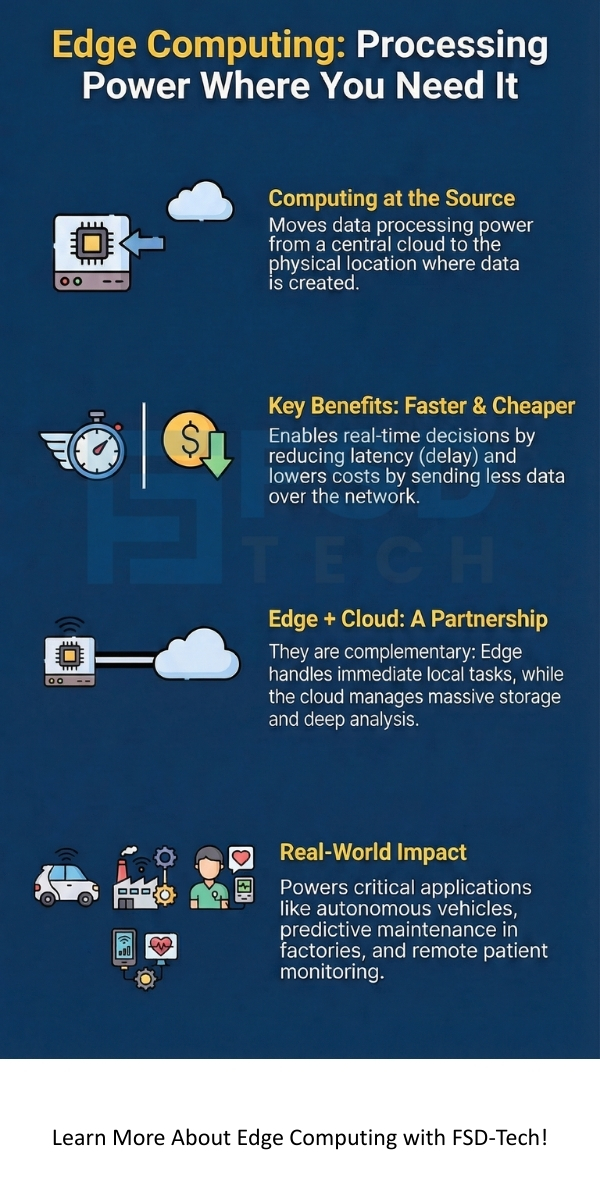
     

    Edge Computing


    Key Takeaways

    Based on our discussion, here are the crucial points you should keep in mind about edge computing:


    • Definition and Core Purpose: Edge computing is nothing but a distributed architecture. It moves processing power closer to where data originates (the edge of your network). The primary aim is to enable real-time applications and reduce reliance on the distant central cloud for immediate decisions.
    • Low Latency is Key: Why edge computing is vital is based on its capacity to provide extremely low latency. This is essential for critical, time-sensitive applications like autonomous systems and industrial control.
    • Complementary to Cloud: The relationship between edge computing vs cloud computing is symbiotic. The edge handles fast, local processing; the cloud deals with big data storage, deep analysis, and global management. They work together to form a complete data pipeline.
    • Driven by IoT Growth: The massive increase in sensors and connected devices makes edge computing in IoT a necessity. It prevents network congestion and provides real-time anomaly detection right at the device level.
    • The Architecture: The system comprises three layers: the Edge Layer (devices and sensors), the Fog Layer (gateways and aggregation points), and the Cloud/Core Layer (central data centers).
    • Practical Benefits: Implementing edge computing solutions offers key benefits. These include reduced operational costs (lower bandwidth), enhanced security, and improved operational continuity, especially in environments with unstable connectivity.
    • Mobile Applications: Mobile Edge Computing (MEC) meaning refers to bringing processing to the mobile network base stations. This facilitates next-generation, high-speed applications like 5G and AR/VR experiences for mobile users.


    Frequently Asked Questions (FAQs) About Edge Computing

    1. What is the difference between Mobile Edge Computing (MEC) and Fog Computing?

    Mobile Edge Computing (MEC) meaning implies that the edge server is positioned inside the mobile carrier's network, often at a base station. This focuses on improving the experience for mobile users. Fog computing, on the other hand, is a more general term for any intermediate layer of processing between the core cloud and the edge devices. MEC is a specific type of fog computing.


    2. Does Edge Computing replace Cloud Computing?

    No, edge computing vs cloud computing are complementary. Edge computing handles immediate, time-sensitive processing locally, while the cloud provides vast resources for long-term storage, deep analysis, and global data management.


    3. What is an edge gateway?

    An edge gateway is nothing but a buffer device. It acts as a central collection point for several local edge computing devices. The gateway performs pre-processing, translation of data formats, and secure transmission of the aggregated data up to the cloud or fog layers.


    4. What are some real-world edge computing examples in retail?

    In retail, a popular edge computing example is smart inventory tracking. Edge cameras monitor shelf stock and immediately alert staff when an item needs restocking. Another example is the use of local servers to process point-of-sale transactions so as to ensure rapid checkout, even if the main internet connection is slow.


    5. What is the role of an Edge Computing Platform?

    An edge computing platform provides the necessary software. It helps in centrally managing, deploying, and updating the applications running on all of your geographically distributed edge computing devices. This simplifies the complex management and maintenance of the entire system.

    What is Edge Computing? How it Differs from Cloud Computing?

    About The Author

    Surbhi Suhane

    Surbhi Suhane is an experienced digital marketing and content specialist with deep expertise in Getting Things Done (GTD) methodology and process automation. Adept at optimizing workflows and leveraging automation tools to enhance productivity and deliver impactful results in content creation and SEO optimization.

    Like This Story?

    Share it with friends!

    Subscribe to our newsletter!

    Atera

    (48)

    Cato Networks

    (111)

    ClickUp

    (63)

    FishOS

    (7)

    Miradore

    (21)

    PointGuard AI

    (9)

    Vembu

    (22)

    Xcitium

    (33)

    ZETA HRMS

    (66)

    Workflow Automation(4)

    Workforce Automation(1)

    AI Project Management(1)

    HR Data Automation(1)

    RMM(1)

    IT Workflow Automation(1)

    GCC compliance(4)

    IT security(2)

    Payroll Integration(2)

    IT support automation(2)

    procurement automation(1)

    lost device management(1)

    IT Management(5)

    IoT Security(2)

    Cato XOps(2)

    IT compliance(4)

    Task Automation(1)

    Workflow Management(1)

    OpenStack automation(1)

    AI-powered cloud ops(1)

    Kubernetes lifecycle management(2)

    SMB Security(8)

    Data Security(1)

    MDR (Managed Detection & Response)(4)

    MSP Automation(2)

    Atera Integrations(2)

    XDR Security(2)

    SMB Cyber Protection(1)

    Ransomware Defense(3)

    HR Tech Solutions(1)

    Zero Trust Network Access(3)

    Zero Trust Security(2)

    Endpoint Management(1)

    SaaS Security(1)

    Payroll Automation(5)

    IT Monitoring(2)

    Xcitium EDR SOC(15)

    Ransomware Protection GCC(1)

    M&A IT Integration(1)

    Network Consolidation UAE(1)

    MSSP for SMBs(1)

    Antivirus vs EDR(1)

    Managed EDR FSD-Tech(1)

    SMB Cybersecurity GCC(1)

    FSD-Tech MSSP(25)

    Ransomware Protection(3)

    Cybersecurity GCC(12)

    Endpoint Security(1)

    Data Breach Costs(1)

    Endpoint Protection(1)

    Managed Security Services(2)

    Xcitium EDR(30)

    SMB Cybersecurity(8)

    Zero Dwell Containment(31)

    Cloud Backup(1)

    Hybrid Backup(1)

    Backup & Recovery(1)

    pointguard ai(4)

    backup myths(1)

    vembu(9)

    disaster recovery myths(1)

    SMB data protection(9)

    Disaster Recovery(4)

    Vembu BDR Suite(19)

    GCCBusiness(1)

    DataProtection(1)

    Secure Access Service Edge(4)

    GCC HR software(14)

    Miradore EMM(15)

    Cato SASE(7)

    Cloud Security(8)

    Talent Development(1)

    AI Cybersecurity(12)

    AI Security(2)

    AI Risk Management(1)

    AI Governance(4)

    AI Compliance(2)

    GCC business security(1)

    GCC network integration(1)

    compliance automation(4)

    GCC cybersecurity(2)

    education security(1)

    App management UAE(1)

    Miradore EMM Premium+(5)

    BYOD security Dubai(8)

    HealthcareSecurity(1)

    MiddleEast(1)

    Team Collaboration(1)

    IT automation(9)

    Zscaler(1)

    SD-WAN(6)

    HR Integration(4)

    Cloud Networking(3)

    device management(9)

    RemoteWork(1)

    ZeroTrust(2)

    VPN(1)

    MPLS(1)

    Project Management(9)

    HR automation(16)

    share your thoughts

    Edge Computing

    What is Edge Computing? How it Differs from Cloud Computing?

    🕓 December 24, 2025

    Vulnerability Assessment

    What is Vulnerability Assessment? Process & Tools

    🕓 December 24, 2025

    Man-in-the-Middle (MITM)

    Man-in-the-Middle (MITM) Attack - Prevention Guide

    🕓 December 23, 2025

    Decoded(35)

    Cyber Security(112)

    BCP / DR(22)

    Zeta HRMS(65)

    SASE(21)

    Automation(63)

    Next Gen IT-Infra(111)

    Monitoring & Management(69)

    ITSM(22)

    HRMS(21)

    Automation(24)