Have you ever wondered how your smartphone instantly knows it's you just by glancing at your face or touching your screen? We are talking about something more powerful than a simple password. We are discussing biometric authentication. This technique takes a significant step beyond traditional security methods.
We will understand what biometric authentication is, why it plays a vital role in modern security, and how it is revolutionizing the way you access your digital life. You will see that this technology is not just for secret agents in movies.
Let us explore this essential biometric authentication method that uses your unique physical and behavioral traits to prove your identity.
What is Biometric Authentication?
Biometric authenticationcan be understood as a security and access control process. It confirms your identity based on your unique physical or behavioral characteristics.
This method refers to the process of verifying a person's identity using human traits. These traits are measurable and quantifiable. The biometric authentication means is to establish a user's identity before granting them access to a system, device, or physical area.
What does Biometric Authentication rely on?
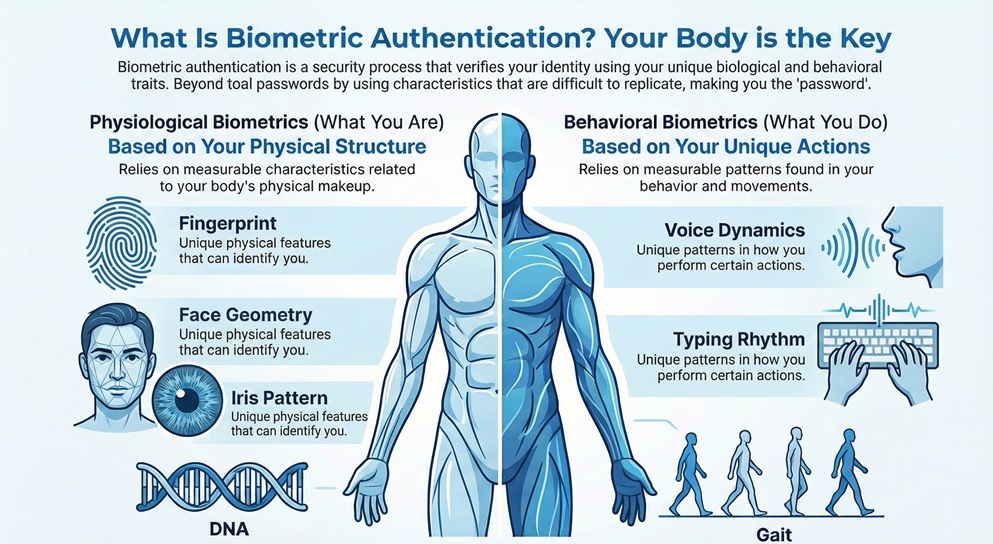
Biometric authentication relies on the fact that every person possesses distinct biological and behavioral features. These features are difficult to fake or replicate. This means that your body acts as a unique password.
Biometric authentication uses features that fall into two main categories:
Physiological Biometrics: These include characteristics related to your body's physical structure. Examples include your fingerprint, face geometry, iris pattern, and DNA.
Behavioral Biometrics: This refers to unique patterns in your actions. Examples include your voice dynamics, typing rhythm (keystroke dynamics), and gait (the way you walk).
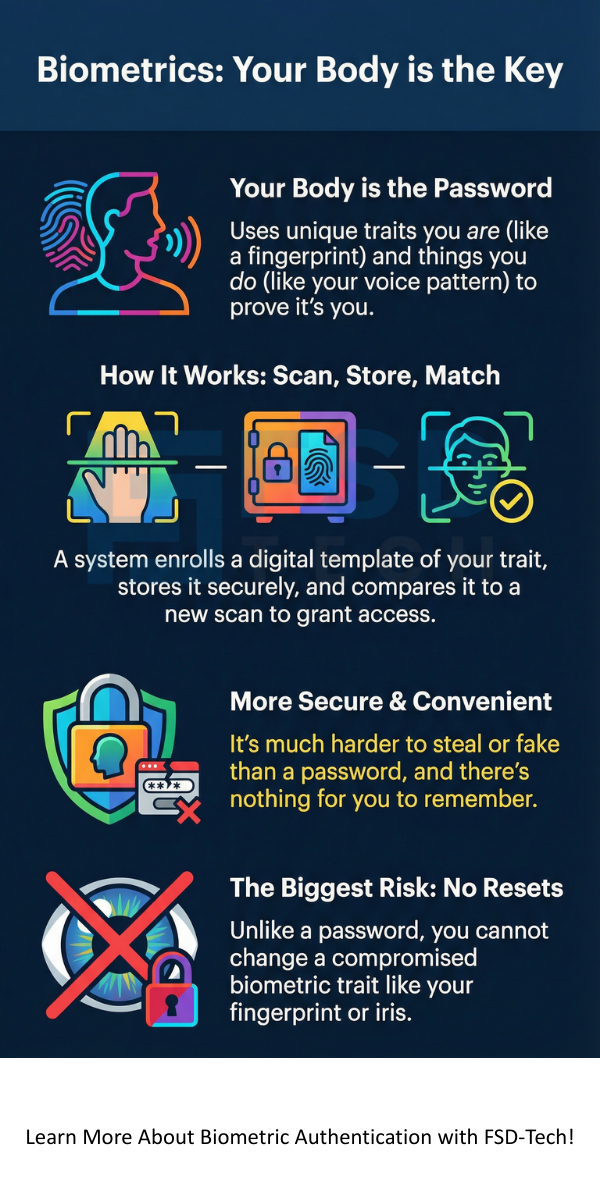
If you want to understand how does biometric authentication work, you must know that it involves three primary steps: enrollment, storage, and verification. The whole process plays a vital role in ensuring secure access.
1. Enrollment: Creating the Biometric Template
The first step is nothing but the enrollment process.
Data Capture: First, a sensor captures an image or recording of your specific biometric feature (e.g., your fingerprint scan or a voice recording).
Feature Extraction: Then, the system processes this raw data. It extracts the most distinguishing features. For a fingerprint, this involves mapping minutiae points (ridge endings and bifurcations).
Template Creation: Finally, the system converts these features into a mathematical representation or code. This code is called a biometric template. This template acts as a reference for future comparisons.
It is important to note that the system generally does not store the original image or recording. It stores only the template. This is because storing the template enhances security and privacy.
2. Storage: Securing the Template
The system stores the generated biometric template in a database or directly on the device. Next gen biometric authentication systems store templates in an encrypted, secure environment.
Security Focus: This processensures that even if a security breach happens, the attacker cannot reverse-engineer the template to recreate the original biometric data.
3. Verification: Proving Your Identity
When you try to log in or access something, the system performs the verification step. This step explains how biometric authentication works in real-time.
New Data Capture: The process starts with a sensor capturing a new sample of your biometric feature.
Comparison: The system then creates a new template from this sample. It compares this new template against the previously stored reference template.
Match Decision: If the two templates match closely enough—above a predetermined threshold—then the system authenticates you. It grants you access. If not, the system denies access.
Why biometrics is importantis mainly due to the weaknesses of traditional authentication methods. Biometric authentication offers many significant benefits of biometric authentication that make it superior to passwords or PINs.
Enhanced Security
Uniqueness: Your fingerprint or iris pattern is nothing but unique to you. This means that a malicious actor cannot easily guess or steal it. Therefore, biometric authentication is secure and reduces fraud risk.
Non-Repudiation: The systemensures that the person accessing the system is truly the authorized user. In this way, users cannot later deny their actions.
Improved User Experience
Convenience: Usersdo not require you to remember complex passwords. This helps in faster login times and reduces the need for password resets.
Speed: The authenticationperforms almost instantly. This facilitates a seamless and quick user experience.
Prevention of Theft and Sharing
Non-Transferable: Unlike a password, you cannot share a biometric trait. This prevents unauthorized sharing of access credentials.
Difficult to Forge: Replicating a live biometric feature requires advanced tools and efforts. This makes biometric data much safer than a simple four-digit PIN.
Biometric Authentication Methods: A Comparison
There are various biometric authentication methods used today. Each biometric authentication method has specific applications. The following table shows the key differences.
Comparison Chart: Common Biometric Authentication Methods
Let us now discuss the most common biometric authentication methods in detail.
1. Fingerprint Recognition
Fingerprint recognitionrefers to one of the oldest and most widely adopted biometric authentication techniques.
The Principle: Itworks on the principle of uniqueness in the patterns of friction ridges and valleys on your finger. The system identifies specific features called minutiae.
Application: You see it everywhere—from unlocking your personal smartphone to controlling access at a secure facility.
2. Facial Recognition
Facial recognition can be defined as a contactless biometric authentication method.
The Process: Itcaptures a 2D or 3D image of your face. The system thenmeasures and analyzes the relative positions of your facial features. Examples include the distance between your eyes or the shape of your cheekbones.
Challenges: While it is highly convenient, face recognition can struggle with poor lighting, changes in hairstyle, or when you wear a mask.
3. Iris Recognition
Iris recognition is nothing but an extremely accurate form of biometric identification.
The Feature: The systemfocuses on the unique, complex pattern of the iris, the colored part of the eye. The irisis protected internally. Therefore, it remains stable throughout a person's life.
Security Level: This methodprovides a very low False Acceptance Rate (FAR). This makes itsuitable for highly sensitive environments.
4. Voice Biometric Authentication
Voice biometric authenticationrefers to the method that uses the characteristics of your voice.
Two Components: This includes two aspects:
Acoustic Features: This focuses on the physical components of your voice, such as pitch, tone, and accent.
Behavioral Features: This focuses on how you speak, such as speed and pronunciation.
Application: Itis commonly used for biometric authentication for banking over the telephone. This enables you to access your account simply by speaking.
Advantages and Disadvantages of Biometric Authentication
While the benefits of biometric authentication are clear, you must also understand the drawbacks. No technology is perfect. Let us explore the advantages and disadvantages of biometric authentication.
Advantages of Biometric Authentication
High Assurance: The systemprovides a high level of confidence in identity verification.
Convenient Access: Iteliminates the need to carry physical tokens or memorize complex codes.
Reduced Fraud: Itminimizes fraud risk since it is difficult to steal or replicate personal biological traits.
Accountability: The systemensures greater individual accountability for actions taken within a system.
Disadvantage of Biometric Authentication
No Revocation: If a password gets compromised, then you can simply change it. However, you cannot change your finger or your iris. This means that a compromised biometric template is a permanent security issue.
Template Storage Risk: The securitydepends on how safely the templates are stored. Poor storagecan lead to serious privacy concerns.
False Readings: The systemmay encounter a False Acceptance Rate (FAR) or a False Rejection Rate (FRR). This can lead to either unauthorized access or legitimate users being locked out.
Cost: Setting up certain systems, especially Iris or retinal scanners, requires significant initial investment.
History of Biometric Authentication
The history of biometric authenticationindicates that the idea is quite old. It did not just start with the computer age.
Ancient Beginnings: As early as the 14th century, the Chinese used fingerprints to authenticate business documents and children.
19th Century Advancement: In the 1880s, Sir Francis Galtonformulated the first comprehensive classification of fingerprints. This workestablished the unique and permanent nature of fingerprints.
Modern Era: The 20th centurysaw the emergence of automated systems. The development of computerized image processing allowed for the digital capture and comparison of biometric data.
The future of biometric authentication is constantly evolving. Next gen biometric authenticationfocuses on combining multiple traits for superior security.
Multimodal Biometrics: This approachinvolves combining two or more distinct biometrics. For example, a system might require both your fingerprint and your face scan. Thissignificantly reduces the chance of error.
Continuous Authentication: This systemdoes not stop after the initial login. Itcontinuously monitors behavioral biometrics, such as typing patterns or mouse movements. Thisensures that the authenticated user remains the same throughout the entire session.
Conclusion
Biometric authenticationis changing how you interact with the digital world. It makes your banking, phone access, and even physical security faster and more reliable.
Are you ready to implement this robust layer of protection?
We provide the expertise to analyze your security needs and implement the most effective biometric authentication method for your specific requirements, thereby securing your valuable assets.
So, with the above discussion, we can say that biometric authenticationis not just a passing trend. It is the foundation of future digital security.
Definition: Biometric authenticationuses your unique body traits to verify your identity.
Mechanism: The processinvolves enrollment, secure template storage, and real-time verification.
Importance: Biometrics is importantbecause it offersenhanced security and convenience compared to traditional methods.
Methods: Common methodsinclude fingerprint, facial, iris, and voice biometric authentication.
Frequently Asked Questions (FAQs) About Biometrics
Q1: What is the primary difference between identification and verification in biometrics?
Identificationis nothing but a one-to-many comparison. The systemcompares your captured biometric against every template in the database to find a match.
Verificationis a one-to-one comparison. The systemcompares your captured biometric only against the template associated with the identity you claim.
Q2: Is biometric data considered personally identifiable information (PII)?
Yes. Biometric datais considered one of the most sensitive types of Personally Identifiable Information (PII). Therefore, companies must maintain strict regulations for its collection, storage, and processing.
Q3: How secure is voice biometric authentication?
Voice biometric authenticationprovides a good level of security. However, it can be affected by sound quality or attempts to mimic the voice. Therefore, advanced systems use liveness detection to spot pre-recorded audio.
About The Author
Surbhi Suhane
Surbhi Suhane is an experienced digital marketing and content specialist with deep expertise in Getting Things Done (GTD) methodology and process automation. Adept at optimizing workflows and leveraging automation tools to enhance productivity and deliver impactful results in content creation and SEO optimization.
.webp&w=3840&q=75)






.webp&w=3840&q=75)



share your thoughts