Anandhu holds a Master's degree in Computer Science and brings extensive expertise in Business Analysis and Project Management, delivering innovative solutions and driving success across diverse projects.
Like This Story?
Share it with friends!
Subscribe to our newsletter!
share your thoughts
Key Takeaways
Eliminate HR data silos for UAE enterprises: Zeta HRMS’s native multi-system architecture synchronizes employee, payroll, and project data across ERP, CRM, and payroll tools, reducing manual reconciliation and errors.
Automate project-to-payroll workflows: Seamless integration of time tracking, project costing, and payroll ensures accurate labor cost attribution and real-time financial reporting for multi-site and multi-company operations.
Enhance compliance and audit readiness: Automated approval workflows, document expiry tracking, and unified reporting help organizations meet GCC regulatory requirements and simplify audits.
Empower employees and managers: Self-service portals and real-time data updates propagate across connected systems, improving employee experience and reducing HR administrative overhead.
Support global and regional growth: Multi-currency, intercompany, and configurable data fields enable integration with international ERP systems and adaptation to local Middle East business rules.
Accelerate decision-making with unified analytics: Integrated dashboards and custom reports provide cross-system insights, supporting strategic planning and operational agility.
Why HR Integration Matters: The Cost of Data Silos
The Operational Impact of Disconnected Systems
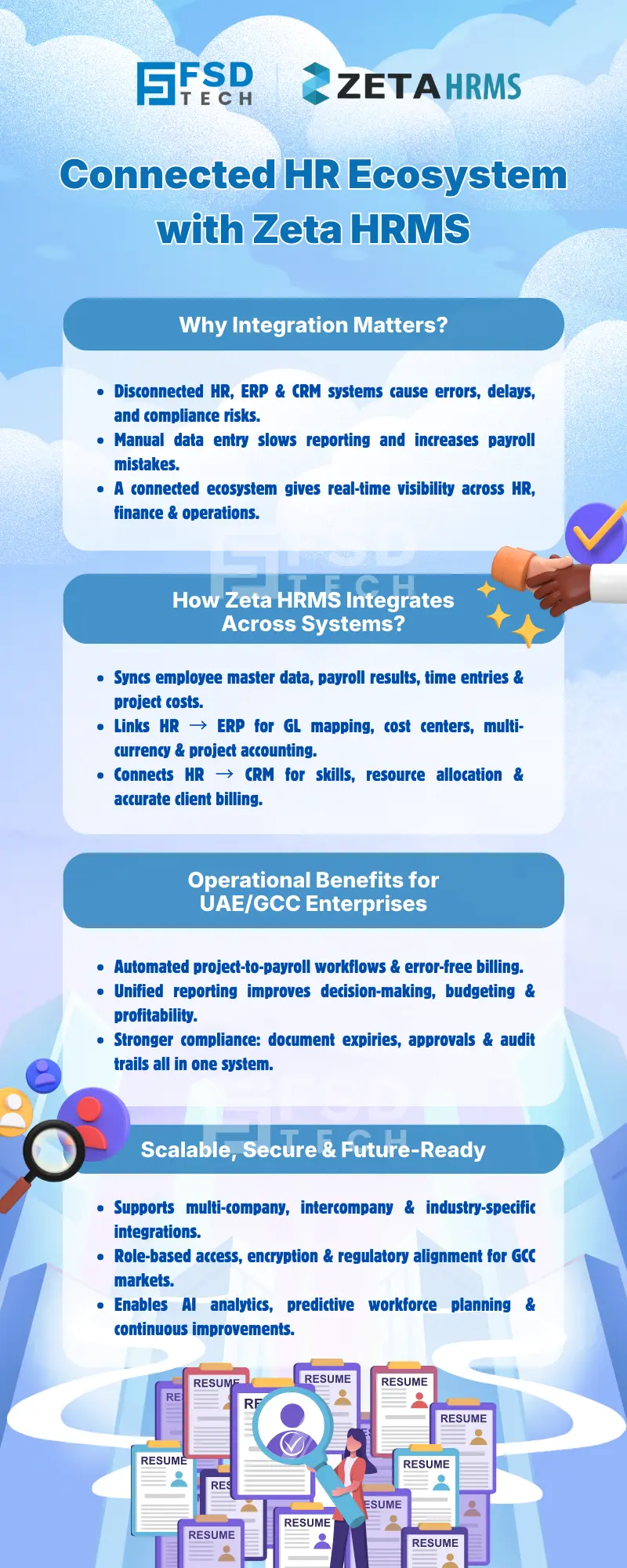
Disconnected HR, finance, and operations platforms create persistent inefficiencies:
Manual data entry and reconciliation: HR teams must re-enter employee data into multiple systems, increasing the risk of errors and delays.
Delayed reporting: Finance and operations teams struggle to produce timely, accurate reports when data is fragmented.
Compliance risks: Inconsistent employee records can result in missed certification renewals, payroll errors, or regulatory breaches—especially critical in regulated sectors like healthcare or construction.
For example, if an employee’s leave is approved in the HRMS but not reflected in the project management or payroll systems, it can lead to double-booking, inaccurate billing, and payroll discrepancies.
The Strategic Value of Connected HR Ecosystems
A connected HR ecosystem delivers:
Real-time visibility: Decision-makers can access up-to-date data on headcount, labor costs, project progress, and compliance status across the organization.
Improved resource allocation: Project managers assign the right people to the right work, factoring in skills, availability, and cost—all from a single source of truth.
Enhanced employee experience: Employees interact with one self-service portal, updating information that flows instantly to payroll, benefits, and project assignments.
This integration is especially valuable for UAE-based and multinational organizations operating across multiple business units, currencies, and regulatory environments.
Zeta HRMS Integration Architecture: Built for Connectivity
Native Multi-System Design Philosophy
Zeta HRMS is engineered for integration from the ground up:
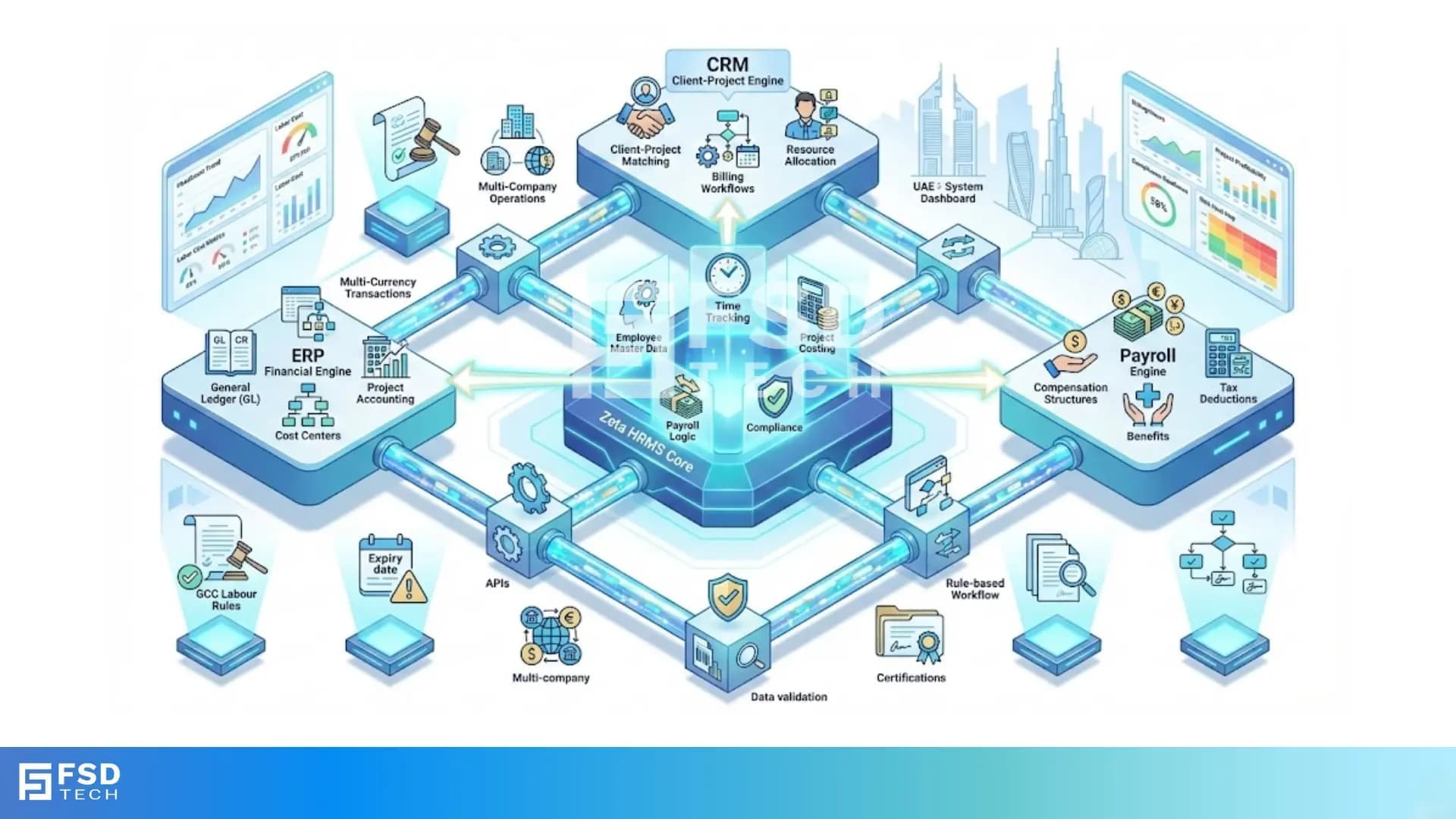
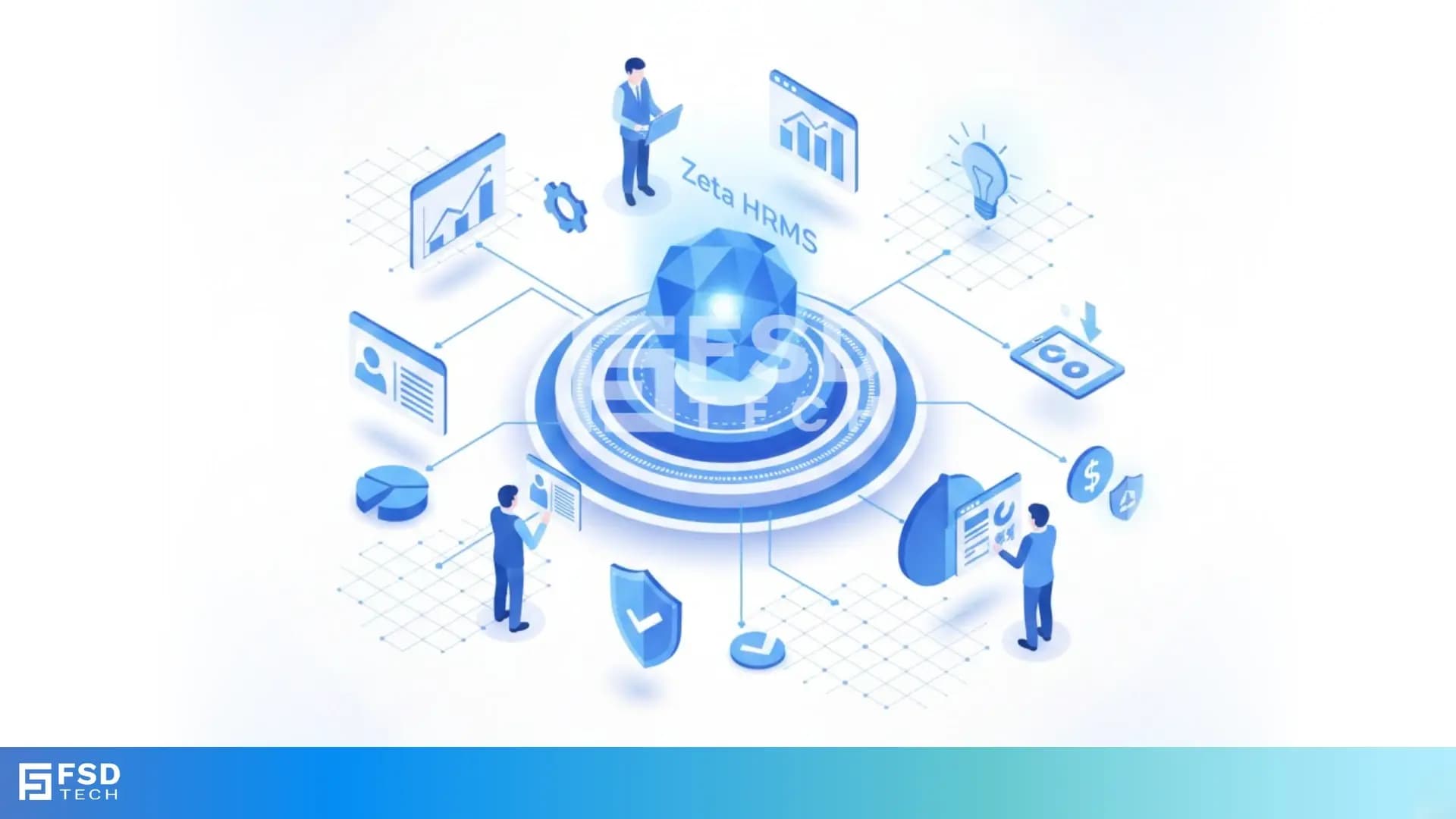
Core modules share data seamlessly: Employee master data, payroll, time tracking, and project management are interconnected, eliminating the need for third-party middleware.
Multi-company and intercompany capabilities: The platform supports complex organizational structures, allowing data to flow across subsidiaries and business units.
Rule-based configuration: Administrators can define how data moves between modules and external systems, supporting custom workflows and business logic.
This architecture positions Zeta HRMS as an integration-ready HRMS, not a standalone silo.
Key Integration Points in Zeta HRMS
Employee master data synchronization: Ensures consistent employee records across HRMS, ERP, CRM, and payroll systems.
Payroll to accounting data flows: Automates the transfer of payroll results, deductions, and benefits to financial ledgers.
Project costs to financial reporting: Links project time entries and labor costs directly to ERP project accounting.
Time and attendance to billing systems: Feeds attendance and job entries into client billing and resource utilization reports.
Zeta HRMS’s unlimited custom fields and document management (with expiry alerts) further enable integration with compliance, DMS, and industry-specific platforms.
Integrating Zeta HRMS with ERP Systems
Financial Data Synchronization
Zeta HRMS’s integration with ERP platforms (such as SAP, Oracle, or regional ERP solutions) enables:
GL code and cost center mapping: Every HR transaction can be tagged with the correct general ledger and cost center, ensuring accurate financial reporting.
Employee cost attribution: Labor costs are automatically allocated to projects, departments, or business units, supporting granular profitability analysis.
Multi-currency support: Compensation, benefits, and expenses can be managed in local and corporate currencies, streamlining global operations.
This level of integration is vital for organizations with multi-entity, multi-currency structures common in the Middle East and global markets.
Procurement and Resource Planning
Project resource allocation: HR data on skills, certifications, and availability feeds into ERP resource planning, optimizing project staffing.
Vendor management for benefits: Integration with ERP procurement modules streamlines benefits administration and vendor payments.
Asset tracking: Employee assignments can trigger asset allocation and tracking in the ERP, improving control over company resources.
Real-World Scenario: Construction Company Integration
A UAE-based construction firm integrated Zeta HRMS with its ERP to manage labor costs across multiple job sites:
Field workers log hours against specific projects and phases in Zeta HRMS.
The system calculates loaded labor costs (including benefits and overhead) and pushes these to the ERP’s project ledgers.
Project managers and finance teams access real-time reports on labor costs versus budget, enabling early intervention and accurate bid preparation.
Connecting Zeta HRMS with CRM Platforms
Skills and Competency Integration
Certification synchronization: Employee certifications and skills tracked in Zeta HRMS are shared with CRM systems, ensuring only qualified staff are assigned to client projects.
Resource availability: Real-time updates on employee status and availability support accurate client engagement planning.
Collaboration on skill development: HR and project managers maintain up-to-date skills databases, supporting workforce planning and client delivery.
Project and Client Assignment Workflows
Project assignments: Employees are matched to client projects based on skills, certifications, and availability.
Time tracking for client billing: Time entries in Zeta HRMS feed directly into CRM and accounting systems, automating client invoicing.
A consulting firm uses Zeta HRMS integrated with its CRM:
Consultants log time against client projects in Zeta HRMS.
This data updates client invoices in the accounting system and CRM account records.
Account managers and finance teams have real-time visibility into project progress, billable hours, and revenue recognition.
Payroll Integration: Creating Financial Accuracy
Time-to-Pay Data Flow
Attendance tracking: Biometric or digital attendance data flows directly into payroll calculations.
Leave management: Approved leave requests in the HRMS automatically adjust payroll and benefits.
Benefits administration: Compensation and benefits data are synchronized across payroll and accounting systems.
Project Time Allocation to Payroll
Project hours to payroll entries: Time logged against projects is converted into payroll entries, supporting accurate compensation and cost allocation.
Billable vs. non-billable categorization: The system distinguishes between billable and internal hours, supporting client billing and internal cost control.
Accounting integration: Payroll results are posted to the correct GL accounts and cost centers in the ERP.
Compliance and Audit Trail Benefits
Automated tax calculations: Integrated data ensures accurate tax withholding and compliance with local regulations.
Audit-ready documentation: All transactions are tracked with approval workflows and audit trails.
Regulatory reporting: Unified data simplifies statutory reporting for labor, tax, and benefits compliance.
Implementation Best Practices for HRMS Integration
Data Mapping and Field Alignment
Identify integration touchpoints: Map out which data fields need to sync between HRMS, ERP, CRM, and payroll.
Custom field configuration: Use Zeta HRMS’s unlimited custom fields to capture all required integration data.
Data validation: Implement rules to ensure data accuracy and consistency across systems.
Workflow Design for Cross-System Processes
Multi-level approval cycles: Configure workflows that span HR, finance, and operations platforms.
Exception handling: Set up notifications and error management for integration failures.
Testing scenarios: Rigorously test data flows before going live to prevent disruptions.
Change Management and User Adoption
Training: Equip HR, finance, and IT teams with the knowledge to use integrated workflows.
Stakeholder communication: Clearly articulate the benefits and changes to all affected users.
Feedback loops: Monitor adoption and gather feedback to refine processes post-implementation.
Technical Considerations for Integration Success
Security and Access Control Across Systems
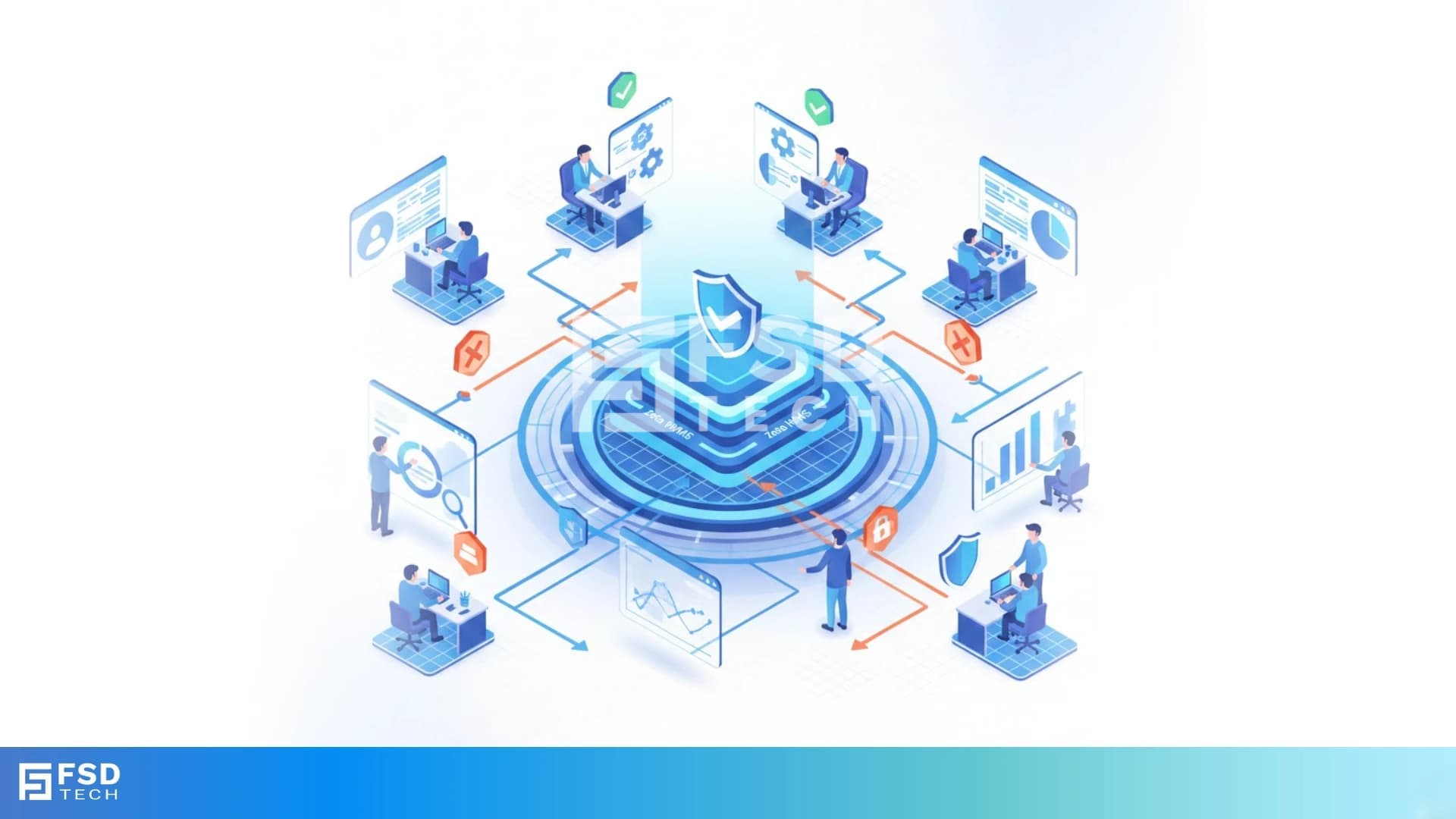
Role-based permissions: Define user roles and data access levels across integrated platforms.
Data encryption: Ensure data is encrypted both in transit and at rest.
Regulatory compliance: Align integration with data protection laws relevant to the UAE and international operations.
Scalability and Performance Optimization
Data volume management: Design integrations to handle increased data as your organization grows.
API rate limiting and batch processing: Optimize data transfer to prevent system overloads.
Monitoring: Continuously track integration health and performance metrics.
Maintaining Integration Over Time
Version management: Monitor for updates in connected systems and test integrations accordingly.
Documentation: Maintain detailed integration documentation for troubleshooting and onboarding.
Continuous improvement: Regularly review integration performance and adapt as business needs evolve.
Measuring Integration Success: KPIs and Outcomes
Manual data entry reduction: Track decreases in time spent on duplicate data entry.
Error rate in payroll and reporting: Monitor reductions in payroll discrepancies and financial reporting errors.
Reporting turnaround time: Measure how quickly integrated data can be turned into actionable reports.
Decision-making quality: Assess improvements in project profitability, resource allocation, and compliance.
Employee self-service adoption: Evaluate usage rates and satisfaction with self-service capabilities.
The Future of Connected HR Systems
The HR technology landscape is moving rapidly toward hyper-connected ecosystems. Key trends include:
AI-driven analytics: Integrated data sets enable advanced analytics for workforce planning, predictive scheduling, and talent management.
Real-time collaboration: Cloud-based integrations support distributed teams and mobile-first operations.
Continuous compliance: Automated monitoring of certifications, labor laws, and benefits ensures ongoing regulatory alignment.
Zeta HRMS, implemented by FSD Tech, is positioned as a benchmark HRMS for UAE and global enterprises—offering the integration flexibility, automation, and analytics required for the next generation of connected HR ecosystems.
What types of systems can Zeta HRMS integrate with?
Zeta HRMS is designed to integrate with ERP systems (for financial and operational data), CRM platforms (for client and project management), payroll solutions, and project management tools. Its flexible architecture, including unlimited custom fields and rule-based workflows, allows it to connect with virtually any business system that requires employee, time, or cost data.
How does Zeta HRMS ensure data accuracy when syncing with other systems?
Data accuracy is maintained through multi-level approval workflows, rule-based validation, and real-time updates via employee self-service. Audit trails track all changes, and the platform’s native integration between payroll, time tracking, and project management minimizes manual data entry and the risk of errors.
Can Zeta HRMS integrate with our existing payroll provider?
Yes. Zeta HRMS can function as your primary payroll system or integrate with external payroll providers. It shares employee master data, attendance, leave balances, and compensation details, and supports mapping of unlimited salary components to match your provider’s requirements.
How long does it typically take to implement Zeta HRMS integration with our ERP?
Implementation timelines vary based on complexity, data volume, and integration scope. Simple integrations may take 4–6 weeks, while more comprehensive projects (covering project costing, multi-company operations, and complex workflows) can take 3–4 months. FSD Tech provides structured implementation support, including data mapping, workflow configuration, testing, and training.
What happens if one of our integrated systems gets updated or changed?
Zeta HRMS’s rule-based and modular architecture allows integration parameters to be reconfigured as external systems evolve. New data fields can be added without restructuring your HR database. Best practice includes testing integration points after updates and maintaining documentation for quick troubleshooting.
How does integration affect data security and access control?
Zeta HRMS supports robust role-based access control, letting you define which users and systems can access specific data. Data encryption (in transit and at rest) and document expiry tracking help maintain compliance and security across integrated platforms.
Can we integrate Zeta HRMS if we operate in multiple countries with different currencies?
Absolutely. Zeta HRMS offers multi-currency support down to the benefit level and supports multi-company, intercompany operations. This makes it ideal for organizations with international or GCC-wide operations, ensuring accurate compensation, compliance, and consolidated reporting.
What are the main benefits of integrating Zeta HRMS with ERP and CRM systems?
Key benefits include real-time data synchronization, reduced manual entry, improved reporting accuracy, streamlined payroll and project costing, enhanced compliance, and better resource allocation. Integration enables a unified view of workforce, financial, and client data for strategic decision-making.
How does Zeta HRMS handle project-to-payroll data flow?
The platform links project management modules with payroll, automatically converting project hours into payroll calculations and cost metrics. This ensures seamless flow from time tracking to financial reporting, eliminating manual data transfer and reducing errors.
What approval workflows does Zeta HRMS support for integration?
Zeta HRMS enables multi-level and parallel approval cycles for requests, job entries, and project reports. These workflows can sync with ERP approval hierarchies, ensuring proper authorization and audit trails across systems.
How does Zeta HRMS support compliance and audit requirements?
Automated workflows, document management with expiry alerts, and unified reporting help organizations meet regulatory requirements. All transactions are logged with audit trails, simplifying compliance for labor, tax, and benefits regulations.
Can Zeta HRMS be customized for industry-specific integration needs?
Yes. The platform’s unlimited custom fields, rule-based workflows, and document management capabilities allow tailoring for industry-specific requirements—such as credential tracking in healthcare, multi-location labor costing in retail, or project profitability in construction.
What role does FSD Tech play in Zeta HRMS integration projects?
FSD Tech provides end-to-end implementation, integration, and support services for Zeta HRMS. Their regional expertise ensures that integrations are tailored for UAE and GCC compliance, business practices, and operational needs, maximizing value for local and multinational organizations.
How does Zeta HRMS support employee self-service across integrated systems?
The Employee Self-Service (ESS) module lets employees update personal data, request leave, and view payroll details. These updates propagate in real-time to connected ERP, CRM, and benefits systems, ensuring consistency and reducing HR workload.
What KPIs should we track to measure integration success?
Recommended KPIs include reduction in manual data entry, error rates in payroll and reporting, reporting turnaround time, quality of decision-making, and employee adoption of self-service features. These metrics help quantify the impact of integration on efficiency and business outcomes.
Is Zeta HRMS suitable for cloud and on-premise integration scenarios?
Yes. Zeta HRMS supports both cloud and on-premise deployments, offering flexible integration options to fit your IT infrastructure and security requirements. FSD Tech can advise on the optimal integration approach for your environment.
.webp&w=3840&q=75)

.webp&w=3840&q=75)

.webp&w=3840&q=75)
share your thoughts