HomeNext Gen IT-InfraMonitoring & ManagementCyber SecurityBCP / DRAutomationDecoded
Next Gen IT-Infra
Cato’s SASE Supports Cybersecurity Skills Development

How Cato’s SASE Supports Cybersecurity Skills Development

🕓 April 8, 2025

How SASE Supports the Security Needs of SMBs

How SASE Supports the Security Needs of SMBs

🕓 February 9, 2025

Attack Surface Reduction with Cato’s SASE

Attack Surface Reduction with Cato’s SASE

🕓 February 10, 2025

SASE for Digital Transformation in UAE

SASE for Digital Transformation in UAE

🕓 February 8, 2025

Monitoring & Management
Understanding Atera’s SLA Management

Understanding Atera’s SLA Management

🕓 February 7, 2025

Cost-Performance Ratio: Finding the Right Balance in IT Management Networks

Cost-Performance Ratio: Finding the Right Balance in IT Management Networks

🕓 June 16, 2025

Customizing Atera with APIs

Customizing Atera with APIs

🕓 March 3, 2025

Power Up Your IT Team’s Strategy with Atera’s Communication Tools

Power Up Your IT Team’s Strategy with Atera’s Communication Tools

🕓 February 8, 2025

Cyber Security
Illustration of the Cato Cloud architecture showing its role in delivering SASE for secure, optimized global connectivity.

Understanding the Cato Cloud and Its Role in SASE

🕓 January 29, 2025

Isometric illustration of professionals managing network performance, bandwidth analytics, and cloud-based optimization around the Cato Networks platform, symbolizing bandwidth control and QoS visibility.

Mastering Bandwidth Control and QoS in Cato Networks

🕓 July 26, 2025

Global network backbone powering Cato SASE solution for secure, high-performance connectivity across regions.

Global Backbone: The Engine Powering Cato’s SASE Solution

🕓 January 30, 2025

Illustration of team analyzing application traffic and usage insights on a large laptop screen using Cato’s dashboard, surrounded by network and cloud icons.

Cato Networks Application Visibility | Monitoring & Control

🕓 July 27, 2025

BCP / DR
Illustration showing diverse business and IT professionals collaborating with cloud, backup, and security icons, representing Vembu use cases for SMBs, MSPs, and IT teams.

Who Uses Vembu? Real-World Use Cases for SMBs, MSPs & IT Teams

🕓 July 12, 2025

Graphic showcasing Vembu’s all-in-one backup and disaster recovery platform with icons for cloud, data protection, and business continuity for IT teams and SMBs.

What Is Vembu? A Deep Dive Into the All in One Backup & Disaster Recovery Platform

🕓 July 6, 2025

Illustration showing Vembu backup and disaster recovery system with cloud storage, server racks, analytics dashboard, and IT professionals managing data.

The Rising Cost of Data Loss: Why Backup Is No Longer Optional?

🕓 August 14, 2025

3D isometric illustration of cloud backup and data recovery infrastructure with laptop, data center stack, and digital business icons — FSD Tech

RPO & RTO: The Heart of Business Continuity

🕓 August 15, 2025

Automation
Cross-Functional Collaboration with ClickUp

Fostering Cross-Functional Collaboration with ClickUp for Multi-Departmental Projects

🕓 February 11, 2025

ClickUp Project Reporting

Revolutionizing Enterprise Reporting with ClickUp’s Advanced Analytics and Dashboards

🕓 June 16, 2025

ClickUp’s Design Collaboration and Asset Management Tools

Empowering Creative Teams with ClickUp’s Design Collaboration and Asset Management Tools

🕓 February 26, 2025

ClickUp Communication and Collaboration Tools

ClickUp Communication and Collaboration Tools: Empowering Remote Teams

🕓 March 12, 2025

Decoded
Multi-Factor Authentication (MFA)

Multi-Factor Authentication (MFA): All You Need to Know

🕓 December 7, 2025

L3 Switch

What Is an L3 Switch? L2 vs L3 & Why You Need Layer 3?

🕓 December 8, 2025

IPSec

IPSec Explained: Protocols, Modes, IKE & VPN Security

🕓 December 3, 2025

 Datagram Transport Layer Security (DTLS)

What is Datagram Transport Layer Security (DTLS)? How it works?

🕓 December 4, 2025

    Subscribe to our newsletter!

    About Us

    Follow Us

    Copyright © 2024 | Powered by 

    Atera

    (55)

    Cato Networks

    (121)

    ClickUp

    (76)

    FishOS

    (7)

    Miradore

    (21)

    PointGuard AI

    (9)

    Vembu

    (22)

    Xcitium

    (33)

    ZETA HRMS

    (79)

    Table of Contents

    SIEM vs SOAR Comparison: 5 Key Differences

    Surbhi Suhane
    February 17, 2026
    Comments
    SIEM vs SOAR

    Security teams today face a massive flood of digital noise. If you've ever worked in a Security Operations Center (SOC), you know the feeling of drowning in alerts. It's like trying to hear a whisper in a crowded stadium. This is exactly where the debate of SIEM vs SOAR begins.


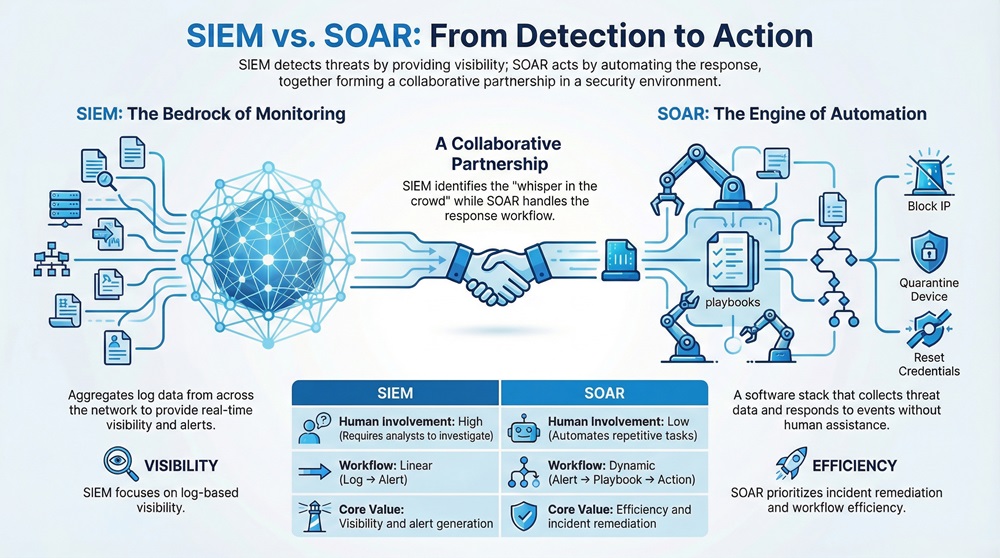
    SIEM (Security Information and Event Management) is a software solution that aggregates log data from across your network to provide real-time analysis and security alerts. SOAR (Security Orchestration, Automation, and Response) is a stack of compatible software programs that allow an organization to collect data about security threats and respond to low-level security events without human assistance.


    Security Information and Event Management


    To be honest, many people think these two tools are rivals. In my experience, that’s a misconception. They aren't competing for the same job; they're more like a detective and a rapid-response team working the same case. But which one does your business actually need right now?


    Comparison Chart: SIEM Vs SOAR

    Basis for ComparisonSIEMSOAR
    Primary FunctionData collection and log managementThreat response and workflow automation
    Core ValueVisibility and alert generationEfficiency and incident remediation
    Input SourceDiverse logs (firewalls, servers, apps)SIEM alerts and external threat intel
    Human InvolvementHigh (requires analysts to investigate)Low (automates repetitive tasks)
    Data HandlingIngests massive volumes of raw dataFocuses on actionable intelligence
    WorkflowLinear (Log → Alert)Dynamic (Alert → Playbook → Action)


    Optimize Your Security Now

    What is SIEM?

    SIEM is the bedrock of modern security monitoring. It acts as a central repository for every digital footprint in your company. It gathers logs from your antivirus, your cloud servers, and even your employee logins.


    SIEM technology supports threat detection, compliance, and security incident management. It looks for patterns. For instance, if someone tries to log in from New York and then two minutes later from Tokyo, the SIEM flags it.


    How SIEM Operates?

    The system works by using "correlation rules." You tell the system: "If X and Y happen together, tell me." It’s fantastic for compliance because it keeps a perfect record of everything. However, the downside is "alert fatigue." If your rules are too sensitive, your team gets thousands of notifications a day. How can a human possibly check them all?


    Also Read: What is a Wide Area Network (WAN)? Architecture & Types Explained


    What is SOAR?

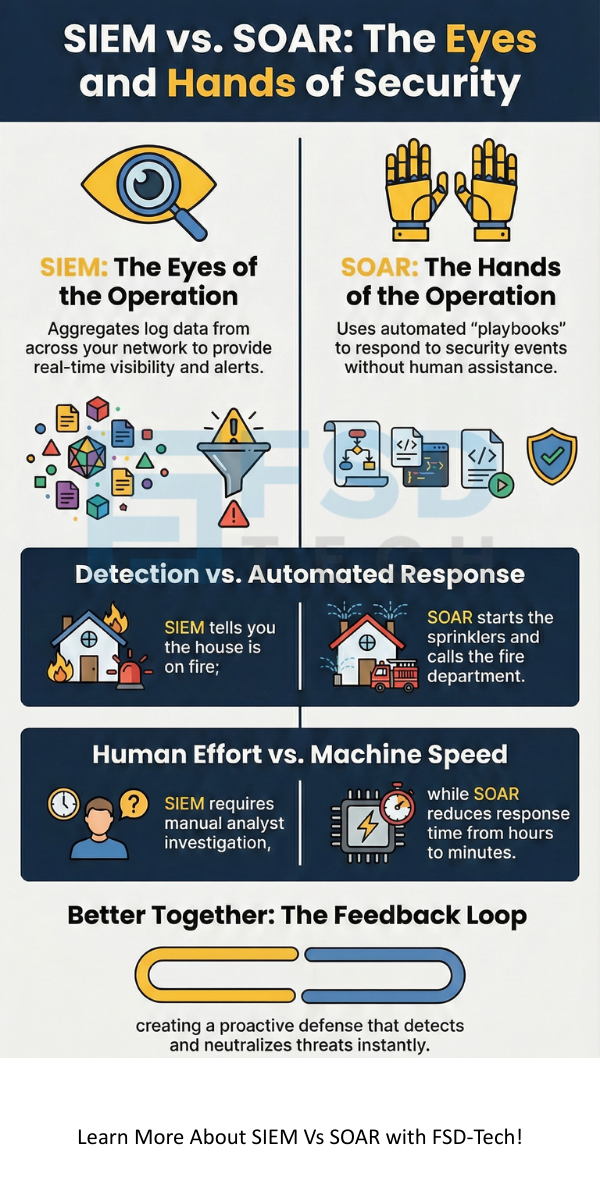
    If SIEM is the eyes of your operation, SOAR is the hands. It takes the "What now?" out of the equation. SOAR platforms take the alerts generated by your SIEM (or other tools) and run them through a "playbook."


    A playbook is essentially a digital "if-then" chart. For example, if an alert says a user's laptop has malware, the SOAR tool can automatically isolate that laptop from the network, scan the file, and email the IT manager—all in seconds.


    The Power of Automation

    The magic of SOAR lies in its ability to integrate with other tools. It uses APIs to "talk" to your firewall, your email server, and your endpoint protection. In my time consulting for mid-sized firms, I've seen SOAR reduce the time to contain a threat from hours down to literal minutes.


    Key Differences Between SIEM and SOAR

    The points given below explains the difference between SIEM vs SOAR in detail:


    1. SIEM focuses on ingestion and detection, whereas SOAR focuses on orchestration and response. While the SIEM tells you that the house is on fire, the SOAR starts the sprinklers and calls the fire department.
    2. SIEM requires a human analyst to look at an alert and decide what to do. Conversely, SOAR uses pre-defined playbooks to execute actions automatically, significantly reducing the "Mean Time to Respond" (MTTR).
    3. SIEM collects raw data from almost any source. On the other hand, SOAR primarily ingests alerts from security tools and enriches them with threat intelligence from external sources.
    4. SIEM is often a requirement for regulatory compliance (like HIPAA or PCI-DSS) because of its log storage. SOAR is rarely a compliance requirement but is an operational necessity for overwhelmed teams.
    5. SIEM creates a "big picture" view of the network's health. In contrast, SOAR creates a streamlined "action view" that moves a ticket from open to closed without manual clicking.


    Also Read: What is Bandwidth? | Types, Working, and Network Capacity Explained


    Why You Need Both?

    One may wonder: "If SOAR is so smart, do I even need SIEM?" Here's the thing—SOAR needs a feed to work. Without a SIEM, your SOAR doesn't know what's happening across your entire infrastructure. It would be like having a world-class surgeon but no diagnostic equipment.


    The Feedback Loop

    In a mature security setup, these two tools form a loop. The SIEM detects a suspicious login. It sends that alert to the SOAR. The SOAR checks the user’s location and realizes it’s a breach. It then tells the SIEM to look for other logs from that same IP address across the whole network.


    The combination of these technologies allows for a "proactive" rather than "reactive" stance. Isn't it better to stop a hacker at the door rather than cleaning up after they've left?


    Advantages and Disadvantages


    Advantages of SIEM

    • Centralized Visibility: You can see your entire network in one dashboard.
    • Compliance Power: It generates the reports auditors love to see.
    • Historical Data: You can search through months of logs to find out exactly when a breach started.


    Disadvantages of SIEM

    • Noise: It can produce too many false positives.
    • Cost: Storing massive amounts of log data can get expensive quickly.
    • Skill Gap: You need smart people to write and maintain the correlation rules.


    Advantages of SOAR

    • Speed: It handles the "boring" work instantly.
    • Consistency: A playbook never forgets a step, unlike a tired analyst at 3 AM.
    • Integration: It glues all your different security products together into one ecosystem.

    Disadvantages of SOAR

    • Complexity: Building effective playbooks takes time and deep process knowledge.
    • Dependency: It relies on the quality of the alerts it receives. If the "input" is bad, the "output" is useless.


    Conclusion

    At the end of the day, the SIEM vs SOAR debate comes down to your team's maturity. If you don't know what's happening on your network, get a SIEM. If you know exactly what's happening but you're too busy to fix it all, you need a SOAR.


    In my experience, the most successful companies are the ones that stop looking for a "magic bullet" and start building a layered defense. Your security team deserves tools that make their lives easier, not harder. We are committed to helping you find that balance, ensuring your data stays safe while your team stays sane.


    Talk to a Security Expert


    SIEM vs SOAR


    Key Takeaways

    • SIEM is your "Data Hub" for detection and compliance.
    • SOAR is your "Action Hub" for response and automation.
    • SIEM vs SOAR is not an "either-or" choice for large enterprises; they work best as a pair.
    • SOAR significantly reduces alert fatigue by filtering out the noise.
    • Small businesses might start with a managed SIEM, while growing firms add SOAR to scale their security team's impact.


    FAQs on SIEM Vs SOAR

    Can SOAR replace SIEM?

    Not really. While some SOAR tools are adding log features, they aren't designed to hold the massive amounts of historical data that a SIEM manages. You’d be losing your "memory" if you switched entirely.


    How much does SOAR cost compared to SIEM?

    It varies. SIEM is usually priced by data volume (GB/day), while SOAR is often priced by the number of "actions" or "users." Generally, SOAR is seen as an investment to save money on hiring more analysts.


    Is SOAR hard to set up?

    Yes, it can be. You need to have your security processes documented before you can automate them. If your current process is messy, automating it just makes the mess happen faster!

    SIEM vs SOAR Comparison: 5 Key Differences

    About The Author

    Surbhi Suhane

    Surbhi Suhane is an experienced digital marketing and content specialist with deep expertise in Getting Things Done (GTD) methodology and process automation. Adept at optimizing workflows and leveraging automation tools to enhance productivity and deliver impactful results in content creation and SEO optimization.

    Like This Story?

    Share it with friends!

    Subscribe to our newsletter!

    Isometric illustration of a centralized performance platform connected to analytics dashboards and team members, representing goal alignment, measurable outcomes, risk visibility, and strategic project tracking within ClickUp.

    How ClickUp Enables Outcome-Based Project Management (Not Just Task Tracking)

    🕓 February 15, 2026
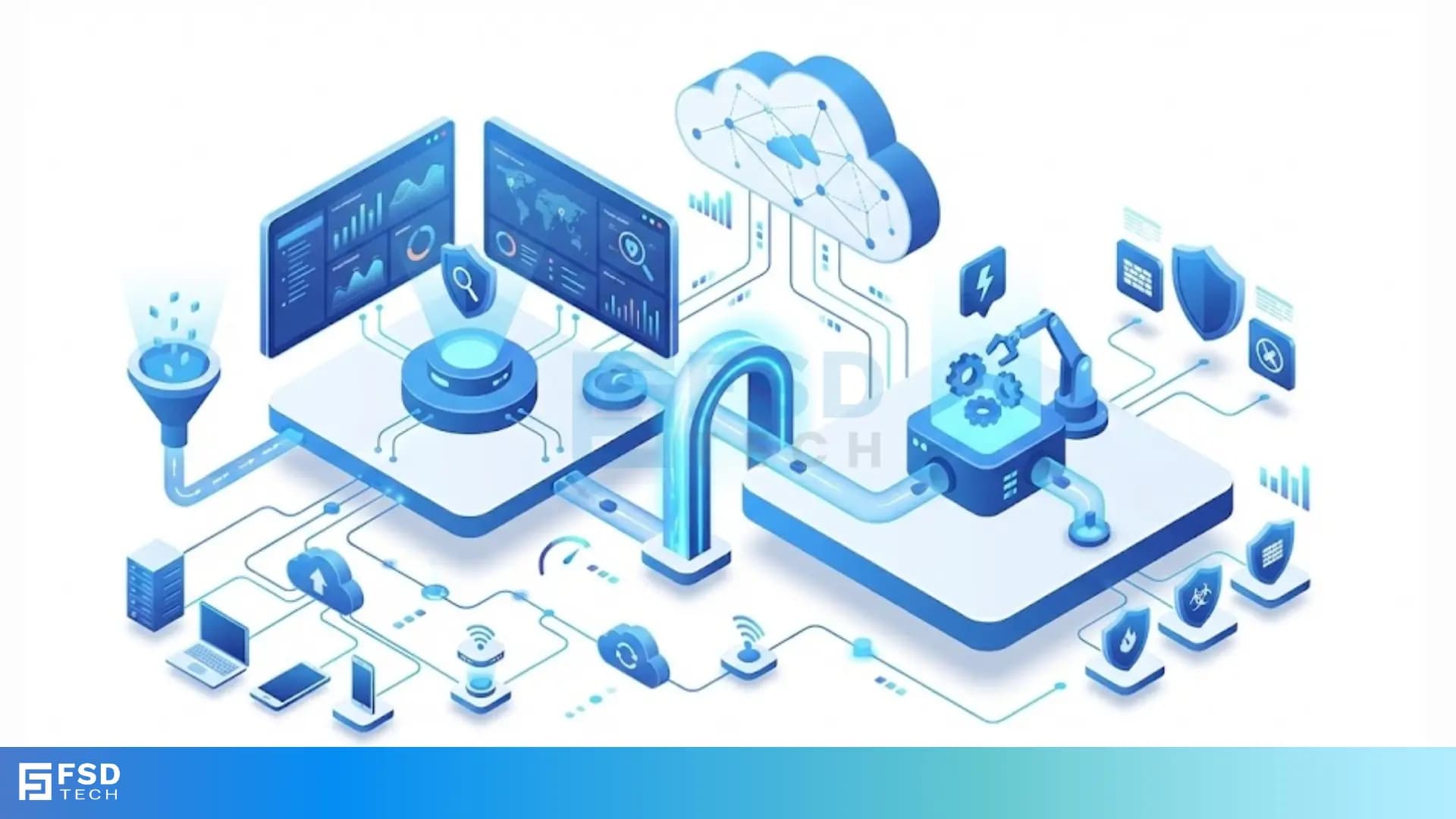
    Isometric illustration of a centralized executive dashboard platform connected to analytics panels, performance charts, security indicators, and strategic milestones, representing real-time business visibility and decision control within ClickUp.

    Executive Visibility in ClickUp – How CXOs Gain Real-Time Control Without Micromanaging

    🕓 February 13, 2026

    Cato SASE Architecture

    Inside Cato’s SASE Architecture: A Blueprint for Modern Security

    🕓 January 26, 2025

    Workflow Automation(8)

    Workforce Automation(1)

    AI Project Management(1)

    HR Data Automation(1)

    RMM(1)

    IT Workflow Automation(1)

    GCC compliance(4)

    IT security(2)

    Payroll Integration(2)

    IT support automation(3)

    procurement automation(1)

    lost device management(1)

    IT Management(5)

    IoT Security(2)

    Cato XOps(2)

    IT compliance(4)

    Task Automation(1)

    Workflow Management(1)

    AI-powered cloud ops(1)

    Kubernetes lifecycle management(2)

    OpenStack automation(1)

    SMB Security(8)

    Data Security(1)

    MDR (Managed Detection & Response)(4)

    Atera Integrations(2)

    MSP Automation(3)

    XDR Security(2)

    Ransomware Defense(3)

    SMB Cyber Protection(1)

    HR Tech Solutions(1)

    Zero Trust Network Access(3)

    Zero Trust Security(2)

    Endpoint Management(1)

    SaaS Security(1)

    Payroll Automation(5)

    IT Monitoring(2)

    Xcitium EDR SOC(15)

    Ransomware Protection GCC(1)

    M&A IT Integration(1)

    Network Consolidation UAE(1)

    MSSP for SMBs(1)

    Ransomware Protection(3)

    SMB Cybersecurity GCC(1)

    Antivirus vs EDR(1)

    Managed EDR FSD-Tech(1)

    FSD-Tech MSSP(25)

    Cybersecurity GCC(12)

    Endpoint Security(1)

    Endpoint Protection(1)

    Data Breach Costs(1)

    Zero Dwell Containment(31)

    SMB Cybersecurity(8)

    Xcitium EDR(30)

    Managed Security Services(2)

    Cloud Backup(1)

    Hybrid Backup(1)

    Backup & Recovery(1)

    pointguard ai(4)

    backup myths(1)

    vembu(9)

    disaster recovery myths(1)

    SMB data protection(9)

    Vembu BDR Suite(19)

    Disaster Recovery(4)

    GCCBusiness(1)

    DataProtection(1)

    Secure Access Service Edge(4)

    GCC HR software(20)

    Miradore EMM(15)

    Cato SASE(7)

    Hybrid Learning(1)

    Cloud Security(9)

    GCC Education(1)

    Talent Development(1)

    AI Risk Management(1)

    AI Compliance(2)

    AI Governance(4)

    AI Cybersecurity(12)

    AI Security(2)

    Secure Remote Access(1)

    GCC business security(1)

    GCC network integration(1)

    compliance automation(5)

    GCC cybersecurity(3)

    education security(1)

    BYOD security Dubai(8)

    Miradore EMM Premium+(5)

    App management UAE(1)

    MiddleEast(1)

    HealthcareSecurity(1)

    Team Collaboration(1)

    IT automation(12)

    Zscaler(1)

    SD-WAN(7)

    HR Integration(4)

    Cloud Networking(4)

    device management(9)

    VPN(1)

    ZeroTrust(2)

    RemoteWork(1)

    share your thoughts

    Breach and Attack Simulation

    7 Ways Breach and Attack Simulation Secures Your Data

    🕓 February 17, 2026

    SIEM vs SOAR

    SIEM vs SOAR Comparison: 5 Key Differences

    🕓 February 17, 2026

    pci compliance

    Is Your Business PCI Compliant? A 12-Step Roadmap

    🕓 February 16, 2026

    Decoded(115)

    Cyber Security(118)

    BCP / DR(22)

    Zeta HRMS(78)

    SASE(21)

    Automation(76)

    Next Gen IT-Infra(118)

    Monitoring & Management(76)

    ITSM(22)

    HRMS(21)

    Automation(24)