.webp&w=3840&q=75)
How ClickUp Enables Outcome-Based Project Management (Not Just Task Tracking)
🕓 February 15, 2026
In many organizations, strategy lives in boardrooms, execution happens in silos, and reporting is stitched together manually at the end of the month. Leadership sets ambitious goals, teams stay busy delivering tasks, and managers struggle to explain how daily work actually connects to business outcomes.
This disconnect is not caused by lack of effort or talent. It is caused by fragmented systems. Strategy tools don’t talk to execution platforms, and reporting depends on manual updates that are outdated the moment they’re created.
To operate at scale, organizations need a single platform where strategy, execution, and reporting are continuously connected.
ClickUp enables organizations to close this gap by unifying strategic planning, day-to-day execution, and real-time reporting in one operational system. In this blog, we explore how enterprises can use ClickUp to create end-to-end alignment-from high-level goals to measurable results.
Most organizations start the year with clear objectives. But as months pass, priorities shift, teams react to urgent requests, and strategy slowly loses visibility.
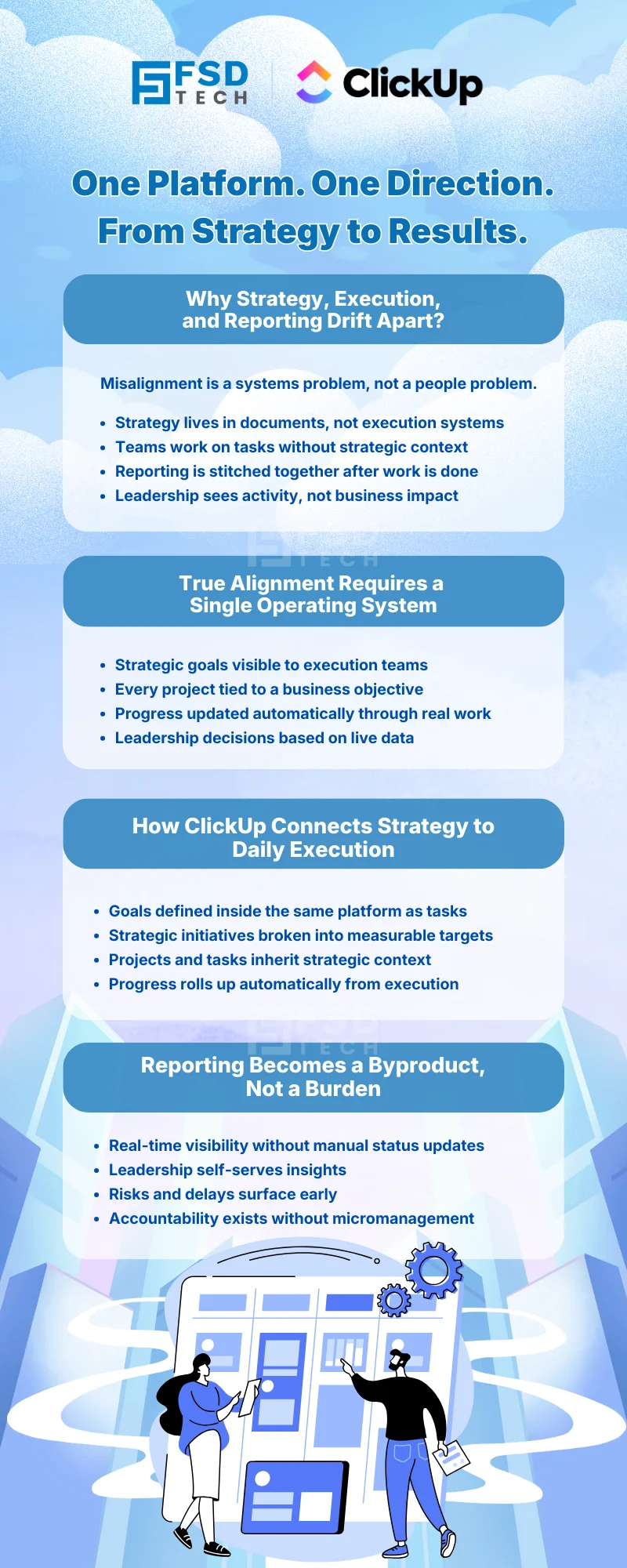
Common reasons for this drift include:
When strategy is disconnected from execution, teams may be productive-but not effective.
Bridging strategy, execution, and reporting requires more than dashboards. True alignment means:
ClickUp enables this alignment by making goals, work, and insights part of the same system-not separate layers.
Alignment begins with where strategy is defined.
In ClickUp, organizations can define strategic priorities directly within the platform instead of external documents or slide decks. This ensures strategy is not abstract-it is operational.
Teams can:
When strategy lives inside the same system as execution, it stays visible throughout the lifecycle of work.
A common failure point is translating high-level strategy into actionable work.
ClickUp solves this by allowing:
This ensures that every team member understands how their work contributes to broader objectives-without additional explanation or meetings.
As initiatives grow, maintaining visibility becomes harder. Leaders often lose sight of progress once execution moves across departments.
ClickUp maintains visibility by:
Visibility is no longer dependent on manual reporting-it is built into execution itself.
Most strategic initiatives span multiple teams. Without a shared system, alignment breaks down quickly.
ClickUp enables cross-functional alignment by:
Everyone works toward the same outcomes, even if execution happens in different Spaces or workflows.
Traditional reporting is time-consuming and often inaccurate.
ClickUp changes this by using live execution data as the foundation for reporting. As work progresses, reports update automatically.
Leadership can track:
Reporting becomes a byproduct of work-not an additional task.
One of the biggest productivity drains is preparing status updates.
With ClickUp:
This reduces meeting overhead while increasing transparency.
Dashboards play a critical role in bridging strategy and execution-but only when powered by accurate data.
ClickUp dashboards can be designed to:
Because dashboards pull directly from live tasks and goals, leaders always see the current state of execution.
Strategy is not static. Market conditions change, priorities evolve, and execution plans must adapt.
ClickUp supports agile decision-making by:
This ensures organizations stay responsive without losing alignment.
When strategy, execution, and reporting are connected, accountability becomes clear.
ClickUp enables accountability by:
Leaders gain confidence in execution without needing to monitor individual tasks closely.
As organizations grow, maintaining alignment becomes harder-but also more critical.
ClickUp enables scalable alignment by:
Alignment does not need to be rebuilt with every new initiative.
To maximize impact:
Consistency is the key to sustained alignment.
Organizations don’t fail due to lack of strategy or effort. They fail because strategy, execution, and reporting drift apart over time.
By using ClickUp as a unified platform, enterprises can:
With ClickUp, strategy is no longer something teams hear about quarterly-it becomes something they execute on daily.
Want to connect strategy, execution, and reporting inside one ClickUp workspace → Book a 30-minute ClickUp alignment session with our experts.
ClickUp links goals directly to projects and tasks, ensuring daily work aligns with strategic objectives.
Yes. Real-time dashboards and goal views provide continuous visibility into execution and outcomes.
Absolutely. ClickUp supports multi-team initiatives with shared ownership, dependencies, and reporting.
Reports pull directly from live task data, eliminating manual updates and inconsistencies.
Yes. ClickUp allows priorities and goals to be updated while execution data adjusts automatically.

Nhaif is an AI Automation Engineer & Business Analyst focused on ClickUp, AI, Automation, and Workflow Optimization. He helps businesses shift from scattered processes to streamlined, data-driven operations. With hands-on expertise, he simplifies complex tools into clear, easy-to-apply solutions.
Share it with friends!

.webp&w=3840&q=75)
share your thoughts