HomeNext Gen IT-InfraMonitoring & ManagementCyber SecurityBCP / DRAutomationDecoded
Next Gen IT-Infra
Cato’s SASE Supports Cybersecurity Skills Development

How Cato’s SASE Supports Cybersecurity Skills Development

🕓 April 8, 2025

How SASE Supports the Security Needs of SMBs

How SASE Supports the Security Needs of SMBs

🕓 February 9, 2025

Attack Surface Reduction with Cato’s SASE

Attack Surface Reduction with Cato’s SASE

🕓 February 10, 2025

SASE for Digital Transformation in UAE

SASE for Digital Transformation in UAE

🕓 February 8, 2025

Monitoring & Management
Understanding Atera’s SLA Management

Understanding Atera’s SLA Management

🕓 February 7, 2025

Cost-Performance Ratio: Finding the Right Balance in IT Management Networks

Cost-Performance Ratio: Finding the Right Balance in IT Management Networks

🕓 June 16, 2025

Customizing Atera with APIs

Customizing Atera with APIs

🕓 March 3, 2025

Power Up Your IT Team’s Strategy with Atera’s Communication Tools

Power Up Your IT Team’s Strategy with Atera’s Communication Tools

🕓 February 8, 2025

Cyber Security
Illustration of the Cato Cloud architecture showing its role in delivering SASE for secure, optimized global connectivity.

Understanding the Cato Cloud and Its Role in SASE

🕓 January 29, 2025

Isometric illustration of professionals managing network performance, bandwidth analytics, and cloud-based optimization around the Cato Networks platform, symbolizing bandwidth control and QoS visibility.

Mastering Bandwidth Control and QoS in Cato Networks

🕓 July 26, 2025

Global network backbone powering Cato SASE solution for secure, high-performance connectivity across regions.

Global Backbone: The Engine Powering Cato’s SASE Solution

🕓 January 30, 2025

Illustration of team analyzing application traffic and usage insights on a large laptop screen using Cato’s dashboard, surrounded by network and cloud icons.

Cato Networks Application Visibility | Monitoring & Control

🕓 July 27, 2025

BCP / DR
Illustration showing diverse business and IT professionals collaborating with cloud, backup, and security icons, representing Vembu use cases for SMBs, MSPs, and IT teams.

Who Uses Vembu? Real-World Use Cases for SMBs, MSPs & IT Teams

🕓 July 12, 2025

Graphic showcasing Vembu’s all-in-one backup and disaster recovery platform with icons for cloud, data protection, and business continuity for IT teams and SMBs.

What Is Vembu? A Deep Dive Into the All in One Backup & Disaster Recovery Platform

🕓 July 6, 2025

Illustration showing Vembu backup and disaster recovery system with cloud storage, server racks, analytics dashboard, and IT professionals managing data.

The Rising Cost of Data Loss: Why Backup Is No Longer Optional?

🕓 August 14, 2025

3D isometric illustration of cloud backup and data recovery infrastructure with laptop, data center stack, and digital business icons — FSD Tech

RPO & RTO: The Heart of Business Continuity

🕓 August 15, 2025

Automation
Cross-Functional Collaboration with ClickUp

Fostering Cross-Functional Collaboration with ClickUp for Multi-Departmental Projects

🕓 February 11, 2025

ClickUp Project Reporting

Revolutionizing Enterprise Reporting with ClickUp’s Advanced Analytics and Dashboards

🕓 June 16, 2025

ClickUp’s Design Collaboration and Asset Management Tools

Empowering Creative Teams with ClickUp’s Design Collaboration and Asset Management Tools

🕓 February 26, 2025

ClickUp Communication and Collaboration Tools

ClickUp Communication and Collaboration Tools: Empowering Remote Teams

🕓 March 12, 2025

Decoded
Multi-Factor Authentication (MFA)

Multi-Factor Authentication (MFA): All You Need to Know

🕓 December 7, 2025

L3 Switch

What Is an L3 Switch? L2 vs L3 & Why You Need Layer 3?

🕓 December 8, 2025

IPSec

IPSec Explained: Protocols, Modes, IKE & VPN Security

🕓 December 3, 2025

 Datagram Transport Layer Security (DTLS)

What is Datagram Transport Layer Security (DTLS)? How it works?

🕓 December 4, 2025

    Subscribe to our newsletter!

    About Us

    Follow Us

    Copyright © 2024 | Powered by 

    Atera

    (55)

    Cato Networks

    (121)

    ClickUp

    (76)

    FishOS

    (7)

    Miradore

    (21)

    PointGuard AI

    (9)

    Vembu

    (22)

    Xcitium

    (33)

    ZETA HRMS

    (79)

    Table of Contents

    Is Your Business PCI Compliant? A 12-Step Roadmap

    Surbhi Suhane
    February 16, 2026
    Comments
    pci compliance

    PCI compliance is something you've probably heard of if you've ever processed a credit card payment. But let’s be honest, for most business owners, it feels like a massive wall of technical jargon and red tape. Have you ever wondered why some companies seem to handle data breaches with grace while others face millions in fines? The secret usually lies in how they handle their PCI compliance standards.


    Here is the thing: PCI compliance isn't just a "nice to have" badge for your website. It is a rigorous security standard designed to protect the very lifeblood of your business—your customers' payment data. To be honest, in my experience, many people wait until an audit or a breach to take this seriously. By then, it’s usually too late.


    What exactly goes into staying compliant? Is it just about having a strong password, or is there more to the story? Let’s break down what PCI compliance actually means for you and your team.


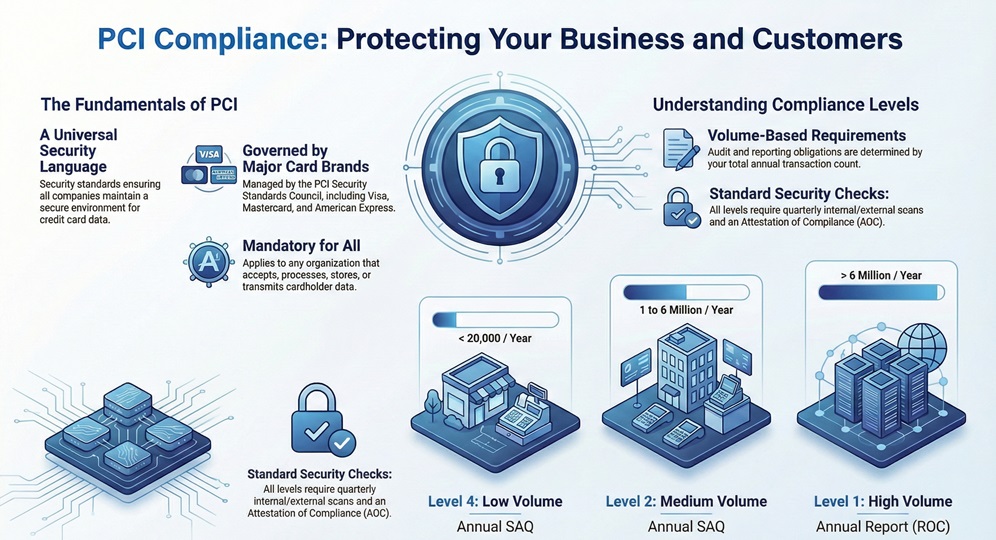
    Comparison Chart: PCI Levels

    Basis for ComparisonLevel 1Level 2Level 3Level 4
    Transaction VolumeOver 6 Million/Year1 to 6 Million/Year20,000 to 1 Million/YearLess than 20,000/Year
    Audit RequirementAnnual Report (ROC)Annual SAQAnnual SAQAnnual SAQ
    Internal ScanRequired QuarterlyRequired QuarterlyRequired QuarterlyRequired Quarterly
    External ScanASV RequiredASV RequiredASV RequiredASV Required
    AttestationAOC RequiredAOC RequiredAOC RequiredAOC Required


    Definition of PCI Compliance

    Definition: PCI compliance is a set of security standards formed to ensure that all companies that accept, process, store, or transmit credit card information maintain a secure environment. It is governed by the Payment Card Industry Security Standards Council (PCI SSC), an independent body created by major card brands like Visa, Mastercard, and American Express.


    PCI compliance


    You can think of PCI compliance as a universal language for payment security. It ensures that whether a customer buys a coffee in London or a laptop in New York, their data is handled with the same level of care. PCI compliance applies to any organization, regardless of size or number of transactions, that touches cardholder data (CHD).


    Verify your PCI status


    Why PCI Compliance Matters?

    Now, you might ask, "Why should I care about PCI compliance if I'm a small business?" In my experience, the cost of non-compliance far outweighs the investment in security. When you maintain PCI compliance, you aren't just checking a box for the bank; you're building a wall around your reputation.


    Data breaches are incredibly expensive. Between legal fees, forensic investigations, and the inevitable loss of customer trust, a single leak can end a business. PCI compliance provides a proven roadmap to prevent these disasters. Furthermore, card brands can levy heavy fines against banks that work with non-compliant merchants, and those costs are always passed down to you.


    The 12 Requirements of PCI DSS

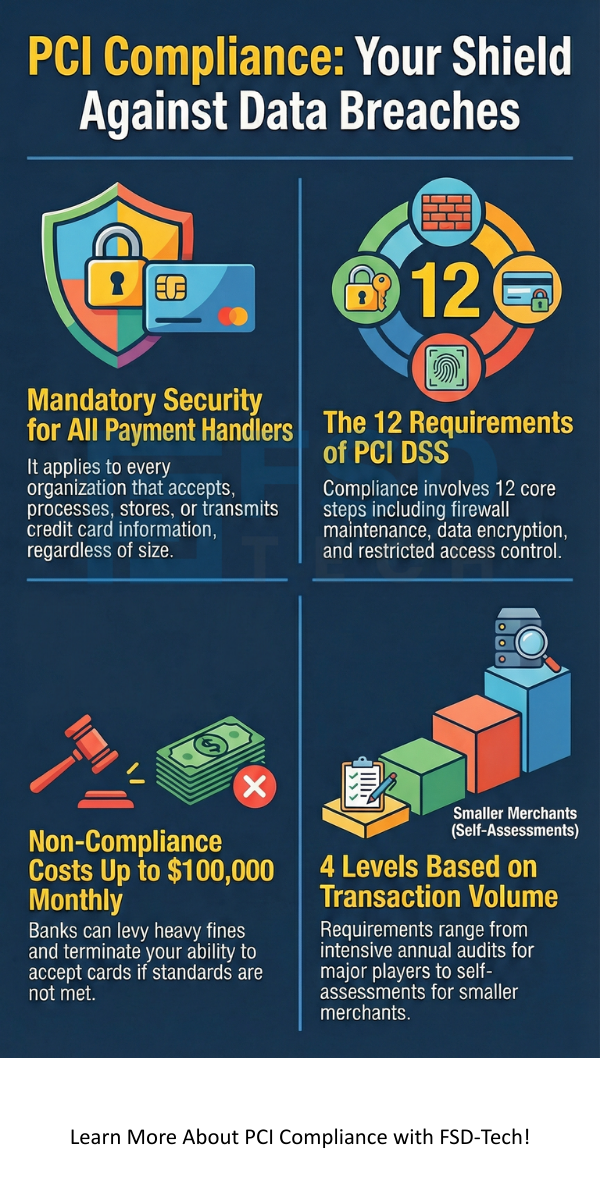
    To achieve PCI compliance, you must adhere to the Payment Card Industry Data Security Standard (PCI DSS). These are broken down into six main goals and 12 specific requirements.


    Build and Maintain a Secure Network

    1. Install and maintain a firewall configuration: Firewalls are your first line of defense. You must configure them to protect cardholder data and review your rules regularly.
    2. Do not use vendor-supplied defaults: Hackers love default passwords like "admin" or "1234." PCI compliance requires you to change all system passwords and security parameters before moving a system into production.


    Protect Cardholder Data

    1. Protect stored cardholder data: You should only store data if it's absolutely necessary. If you do store it, use encryption, truncation, or masking.
    2. Encrypt transmission of cardholder data: When data moves across open, public networks (like the internet), it must be encrypted. Have you checked if your site uses the latest TLS protocols?


    Maintain a Vulnerability Management Program

    1. Use and regularly update anti-virus software: You need to protect all systems commonly affected by malware. It isn't enough to just have the software; it must be kept current.
    2. Develop and maintain secure systems and applications: This involves installing security patches as soon as they are released. PCI compliance expects you to stay ahead of known vulnerabilities.


    Implement Strong Access Control Measures

    1. Restrict access to cardholder data by business need to know: Not every employee needs to see credit card numbers. Access should be granted only to those who need it for their job.
    2. Assign a unique ID to each person with computer access: This ensures accountability. If something goes wrong, you need to know exactly who was logged in.
    3. Restrict physical access to cardholder data: This means locking server rooms and securing paper records. PCI compliance isn't just about digital files; it’s about physical security too.


    Regularly Monitor and Test Networks

    1. Track and monitor all access to network resources and cardholder data: You must keep logs of all activity. These logs are vital for identifying the cause of a breach after it happens.
    2. Regularly test security systems and processes: Run quarterly vulnerability scans and annual penetration tests. This helps you find the cracks before a hacker does.


    Maintain an Information Security Policy

    1. Maintain a policy that addresses information security: You need a formal document that outlines security expectations for all personnel.


    Also Read: Authentication Authorization and Accounting (AAA)

    Understanding PCI Compliance Levels

    PCI compliance isn't a one-size-fits-all approach. The "levels" are determined by your transaction volume over a 12-month period.


    Level 1 is for the big players—merchants processing over 6 million transactions annually. These businesses must undergo an annual on-site assessment by a Qualified Security Assessor (QSA).


    Levels 2, 3, and 4 generally involve smaller volumes. Instead of a full on-site audit, these merchants usually complete a Self-Assessment Questionnaire (SAQ). However, don't let the word "self-assessment" fool you. You are still legally obligated to be truthful and ensure your systems meet the PCI compliance requirements.


    Common Challenges in Achieving Compliance

    Let’s be honest: reaching PCI compliance is hard work. In my experience, the biggest hurdle is "scope creep." This happens when your cardholder data environment (CDE) expands because you’ve added new software or hardware without segmenting your network.


    Another challenge is documentation. Many businesses do the work but fail to keep the records. If you can't prove you ran a scan six months ago, as far as an auditor is concerned, it never happened. Maintaining PCI compliance requires a disciplined approach to record-keeping.


    Also Read: What is Cloud Access Security Broker (CASB)?


    Best Practices for Maintaining Security

    To keep your PCI compliance status healthy, you should move from "compliance as an event" to "compliance as a habit." Here are a few tips:


    • Segment your network: Keep your payment systems separate from your office Wi-Fi. This reduces the number of systems that need to be audited.
    • Minimize data storage: If you don't need it, don't store it. This is the simplest way to lower your risk.
    • Train your staff: Human error is a leading cause of breaches. Regularly educate your team on phishing and password security.
    • Work with compliant partners: Ensure your hosting provider and payment gateway are also PCI compliance certified.


    Conclusion

    At the end of the day, PCI compliance is about one thing: integrity. It shows your customers that you value their privacy and their hard-earned money. Here at our firm, we believe that security should never be an afterthought. 


    We focus on helping clients navigate these complex waters with ease, ensuring that your data stays safe so you can focus on growing your business. Staying compliant is a journey, not a destination. Are you ready to take the next step in securing your future?


    Secure your payments now. Speak with a specialist.


    PCI compliance


    Key Takeaways

    • PCI compliance is mandatory for any business handling credit card data, regardless of size.
    • The PCI DSS consists of 12 core requirements focused on network security, data protection, and monitoring.
    • Your compliance level (1-4) is based on your annual transaction volume.
    • Regular vulnerability scans and penetration tests are essential for maintaining a secure environment.
    • Non-compliance can lead to massive fines, legal issues, and a permanent loss of customer trust.


    Frequently Asked Questions on PCI Compliance

    1. Does PCI compliance apply to me if I only use PayPal?

    Yes. Even if you use a third-party processor like PayPal or Stripe, you are still responsible for ensuring that the way you integrate those services is secure. You still have a small amount of PCI compliance paperwork to handle (usually SAQ A).


    2. What happens if I fail to maintain PCI compliance?

    If you are found non-compliant, you could face monthly fines ranging from $5,000 to $100,000. Additionally, your bank might terminate your ability to accept credit cards entirely.


    3. How often do I need to renew my PCI compliance?

    You must validate your PCI compliance annually. However, certain requirements, like network scanning, must be performed every quarter.


    4. Is PCI compliance the law?

    Technically, it is not a federal law in the United States, but it is a contractual requirement by the card brands. However, some states (like Nevada and Washington) have incorporated PCI DSS into their state laws.

    Is Your Business PCI Compliant? A 12-Step Roadmap

    About The Author

    Surbhi Suhane

    Surbhi Suhane is an experienced digital marketing and content specialist with deep expertise in Getting Things Done (GTD) methodology and process automation. Adept at optimizing workflows and leveraging automation tools to enhance productivity and deliver impactful results in content creation and SEO optimization.

    Like This Story?

    Share it with friends!

    Subscribe to our newsletter!

    Isometric illustration of a centralized performance platform connected to analytics dashboards and team members, representing goal alignment, measurable outcomes, risk visibility, and strategic project tracking within ClickUp.

    How ClickUp Enables Outcome-Based Project Management (Not Just Task Tracking)

    🕓 February 15, 2026
    Isometric illustration of a centralized executive dashboard platform connected to analytics panels, performance charts, security indicators, and strategic milestones, representing real-time business visibility and decision control within ClickUp.

    Executive Visibility in ClickUp – How CXOs Gain Real-Time Control Without Micromanaging

    🕓 February 13, 2026

    Cato SASE Architecture

    Inside Cato’s SASE Architecture: A Blueprint for Modern Security

    🕓 January 26, 2025

    Workflow Automation(8)

    Workforce Automation(1)

    AI Project Management(1)

    HR Data Automation(1)

    RMM(1)

    IT Workflow Automation(1)

    GCC compliance(4)

    IT security(2)

    Payroll Integration(2)

    IT support automation(3)

    procurement automation(1)

    lost device management(1)

    IT Management(5)

    IoT Security(2)

    Cato XOps(2)

    IT compliance(4)

    Task Automation(1)

    Workflow Management(1)

    AI-powered cloud ops(1)

    Kubernetes lifecycle management(2)

    OpenStack automation(1)

    SMB Security(8)

    Data Security(1)

    MDR (Managed Detection & Response)(4)

    Atera Integrations(2)

    MSP Automation(3)

    XDR Security(2)

    Ransomware Defense(3)

    SMB Cyber Protection(1)

    HR Tech Solutions(1)

    Zero Trust Network Access(3)

    Zero Trust Security(2)

    Endpoint Management(1)

    SaaS Security(1)

    Payroll Automation(5)

    IT Monitoring(2)

    Xcitium EDR SOC(15)

    Ransomware Protection GCC(1)

    M&A IT Integration(1)

    Network Consolidation UAE(1)

    MSSP for SMBs(1)

    Ransomware Protection(3)

    SMB Cybersecurity GCC(1)

    Antivirus vs EDR(1)

    Managed EDR FSD-Tech(1)

    FSD-Tech MSSP(25)

    Cybersecurity GCC(12)

    Endpoint Security(1)

    Endpoint Protection(1)

    Data Breach Costs(1)

    Zero Dwell Containment(31)

    SMB Cybersecurity(8)

    Xcitium EDR(30)

    Managed Security Services(2)

    Cloud Backup(1)

    Hybrid Backup(1)

    Backup & Recovery(1)

    pointguard ai(4)

    backup myths(1)

    vembu(9)

    disaster recovery myths(1)

    SMB data protection(9)

    Vembu BDR Suite(19)

    Disaster Recovery(4)

    GCCBusiness(1)

    DataProtection(1)

    Secure Access Service Edge(4)

    GCC HR software(20)

    Miradore EMM(15)

    Cato SASE(7)

    Hybrid Learning(1)

    Cloud Security(9)

    GCC Education(1)

    Talent Development(1)

    AI Risk Management(1)

    AI Compliance(2)

    AI Governance(4)

    AI Cybersecurity(12)

    AI Security(2)

    Secure Remote Access(1)

    GCC business security(1)

    GCC network integration(1)

    compliance automation(5)

    GCC cybersecurity(3)

    education security(1)

    BYOD security Dubai(8)

    Miradore EMM Premium+(5)

    App management UAE(1)

    MiddleEast(1)

    HealthcareSecurity(1)

    Team Collaboration(1)

    IT automation(12)

    Zscaler(1)

    SD-WAN(7)

    HR Integration(4)

    Cloud Networking(4)

    device management(9)

    VPN(1)

    ZeroTrust(2)

    RemoteWork(1)

    share your thoughts

    pci compliance

    Is Your Business PCI Compliant? A 12-Step Roadmap

    🕓 February 16, 2026

    File Integrity Monitoring (FIM)

    What is File Integrity Monitoring (FIM)? Security Guide

    🕓 February 16, 2026

    Unicast

    What is Unicast? Definition, Working & WAN Role

    🕓 February 14, 2026

    Decoded(113)

    Cyber Security(118)

    BCP / DR(22)

    Zeta HRMS(78)

    SASE(21)

    Automation(76)

    Next Gen IT-Infra(118)

    Monitoring & Management(76)

    ITSM(22)

    HRMS(21)

    Automation(24)