HomeNext Gen IT-InfraMonitoring & ManagementCyber SecurityBCP / DRAutomationDecoded
Next Gen IT-Infra
Cato’s SASE Supports Cybersecurity Skills Development

How Cato’s SASE Supports Cybersecurity Skills Development

🕓 April 8, 2025

How SASE Supports the Security Needs of SMBs

How SASE Supports the Security Needs of SMBs

🕓 February 9, 2025

Attack Surface Reduction with Cato’s SASE

Attack Surface Reduction with Cato’s SASE

🕓 February 10, 2025

SASE for Digital Transformation in UAE

SASE for Digital Transformation in UAE

🕓 February 8, 2025

Monitoring & Management
Understanding Atera’s SLA Management

Understanding Atera’s SLA Management

🕓 February 7, 2025

Cost-Performance Ratio: Finding the Right Balance in IT Management Networks

Cost-Performance Ratio: Finding the Right Balance in IT Management Networks

🕓 June 16, 2025

Customizing Atera with APIs

Customizing Atera with APIs

🕓 March 3, 2025

Power Up Your IT Team’s Strategy with Atera’s Communication Tools

Power Up Your IT Team’s Strategy with Atera’s Communication Tools

🕓 February 8, 2025

Cyber Security
Illustration of the Cato Cloud architecture showing its role in delivering SASE for secure, optimized global connectivity.

Understanding the Cato Cloud and Its Role in SASE

🕓 January 29, 2025

Isometric illustration of professionals managing network performance, bandwidth analytics, and cloud-based optimization around the Cato Networks platform, symbolizing bandwidth control and QoS visibility.

Mastering Bandwidth Control and QoS in Cato Networks

🕓 July 26, 2025

Global network backbone powering Cato SASE solution for secure, high-performance connectivity across regions.

Global Backbone: The Engine Powering Cato’s SASE Solution

🕓 January 30, 2025

Illustration of team analyzing application traffic and usage insights on a large laptop screen using Cato’s dashboard, surrounded by network and cloud icons.

Cato Networks Application Visibility | Monitoring & Control

🕓 July 27, 2025

BCP / DR
Illustration showing diverse business and IT professionals collaborating with cloud, backup, and security icons, representing Vembu use cases for SMBs, MSPs, and IT teams.

Who Uses Vembu? Real-World Use Cases for SMBs, MSPs & IT Teams

🕓 July 12, 2025

Graphic showcasing Vembu’s all-in-one backup and disaster recovery platform with icons for cloud, data protection, and business continuity for IT teams and SMBs.

What Is Vembu? A Deep Dive Into the All in One Backup & Disaster Recovery Platform

🕓 July 6, 2025

Illustration showing Vembu backup and disaster recovery system with cloud storage, server racks, analytics dashboard, and IT professionals managing data.

The Rising Cost of Data Loss: Why Backup Is No Longer Optional?

🕓 August 14, 2025

3D isometric illustration of cloud backup and data recovery infrastructure with laptop, data center stack, and digital business icons — FSD Tech

RPO & RTO: The Heart of Business Continuity

🕓 August 15, 2025

Automation
Cross-Functional Collaboration with ClickUp

Fostering Cross-Functional Collaboration with ClickUp for Multi-Departmental Projects

🕓 February 11, 2025

ClickUp Project Reporting

Revolutionizing Enterprise Reporting with ClickUp’s Advanced Analytics and Dashboards

🕓 June 16, 2025

ClickUp’s Design Collaboration and Asset Management Tools

Empowering Creative Teams with ClickUp’s Design Collaboration and Asset Management Tools

🕓 February 26, 2025

ClickUp Communication and Collaboration Tools

ClickUp Communication and Collaboration Tools: Empowering Remote Teams

🕓 March 12, 2025

Decoded
Multi-Factor Authentication (MFA)

Multi-Factor Authentication (MFA): All You Need to Know

🕓 December 7, 2025

L3 Switch

What Is an L3 Switch? L2 vs L3 & Why You Need Layer 3?

🕓 December 8, 2025

IPSec

IPSec Explained: Protocols, Modes, IKE & VPN Security

🕓 December 3, 2025

 Datagram Transport Layer Security (DTLS)

What is Datagram Transport Layer Security (DTLS)? How it works?

🕓 December 4, 2025

    Subscribe to our newsletter!

    About Us

    Follow Us

    Copyright © 2024 | Powered by 

    Atera

    (55)

    Cato Networks

    (121)

    ClickUp

    (76)

    FishOS

    (7)

    Miradore

    (21)

    PointGuard AI

    (9)

    Vembu

    (22)

    Xcitium

    (33)

    ZETA HRMS

    (79)

    Table of Contents

    7 Ways Breach and Attack Simulation Secures Your Data

    Surbhi Suhane
    February 17, 2026
    Comments
    Breach and Attack Simulation

    Breach and Attack Simulation is a smart way for companies to test their digital defenses by mimicking the moves of real hackers. Have you ever wondered if your expensive firewall actually works when a real threat hits? Many leaders feel safe because they bought the best tools, but they don't know if those tools are set up right. This is where BAS comes in. It acts like a persistent, friendly intruder that pokes at your doors and windows 24/7.


    To be honest, the old way of checking security is failing. We used to rely on a "pen test" once a year. But a year is a lifetime in tech. If a hacker finds a new hole the day after your test, you’re in trouble. BAS changes the game by making testing constant. It helps you see your network through the eyes of an attacker without actually causing any damage.


    Let's chat about why this matters. We’ve all been there—staring at a dashboard full of alerts, not knowing which one is a real fire. BAS helps clear that noise. In this guide, we'll look at how these tools work, the different styles of testing, and why your team might need to start using them today.


    What is Breach and Attack Simulation?

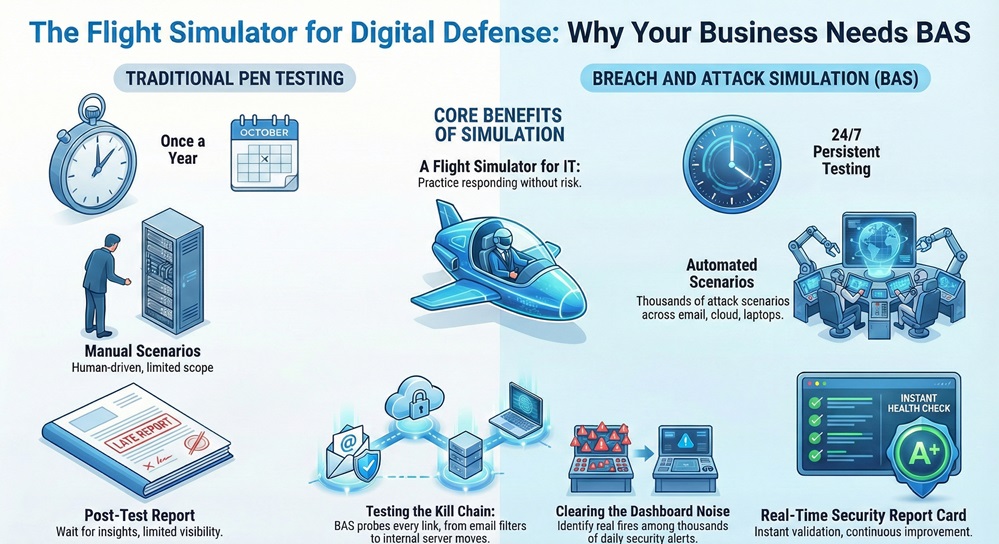
    The term Breach and Attack Simulation, or BAS, refers to a software tool that automates the testing of your security posture. Think of it as a flight simulator for your IT team. Pilots use simulators to practice crashes without dying; IT teams use BAS to practice cyberattacks without losing data.


    Breach and Attack Simulation


    In my view, the biggest win here is automation. Humans are slow and they get tired. Software doesn't. A BAS platform can run thousands of attack scenarios across your emails, cloud, and laptops every single hour. It looks for "pathways" that a criminal might take to steal your "crown jewels"—your customer data or money.


    Find your security gaps


    Why do we need BAS?

    You might ask, "Don't I already have an antivirus?" Yes, but attackers don't just walk through the front door anymore. They use complex steps called the "kill chain." BAS tests every link in that chain. It checks if your email filter catches a fake virus. It checks if your server blocks a fake "lateral move." It gives you a report card on your security health in real-time.


    The Three Main Approaches to BAS

    Not all simulation tools work the same way. According to industry experts, we can break them down into three main styles. Each has its own perks, and choosing the right one depends on what you want to protect.


    1. The Endpoint Agent Method

    In this style, we install small pieces of software (agents) on your computers. These agents talk to each other. They pretend to "infect" one machine and try to jump to another. Since they are controlled, they don't hurt your files. This is great for seeing if your internal office security is tight.


    2. The Traffic-Based Approach

    Here, the tool sends malicious-looking data packets across your network. It doesn't install anything. It just watches to see if your "guards" (like firewalls) stop the bad data. It’s like a car manufacturer crash-testing a vehicle to see if the airbags deploy.


    3. The Playbook Method

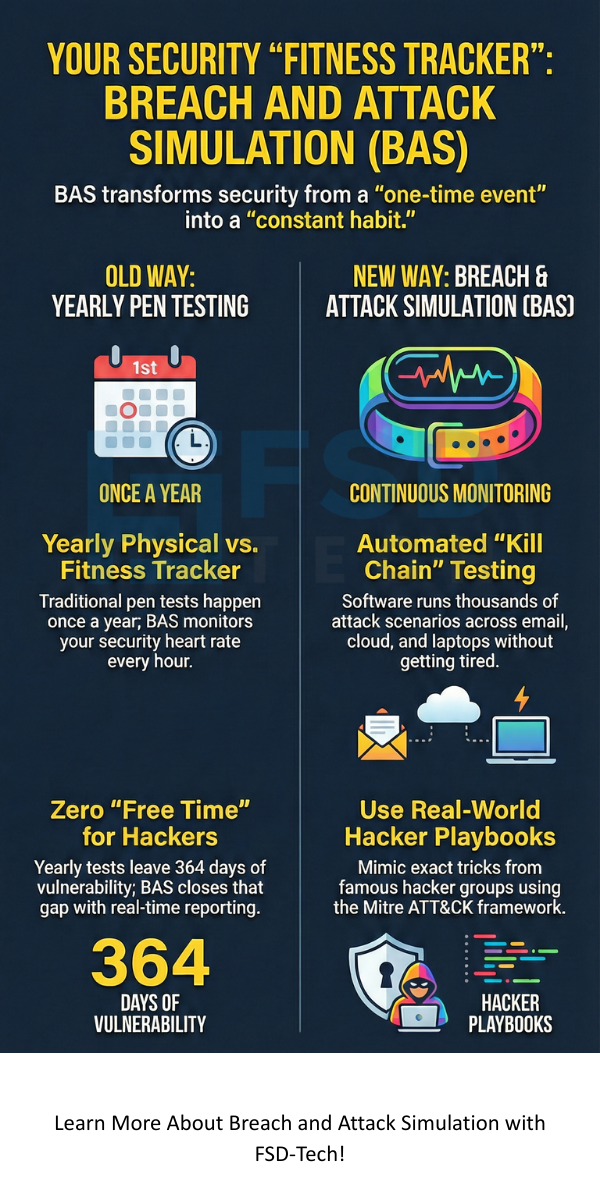
    This is my favorite because it’s so practical. The software uses a library of "plays" based on real-world groups like the Mitre ATT&CK framework. It tries the exact same tricks that famous hacker groups use. If a new ransomware comes out on Monday, a good BAS tool has a simulation for it by Tuesday.


    How BAS Differs from Traditional Pentesting

    One must note that BAS is not a replacement for human experts, but it is a massive upgrade in speed. Let's compare the two so you can see the difference.


    Penetration Testing (The Old Way):

    • When: Once or twice a year.
    • Who: Expensive outside consultants.
    • Result: A 100-page PDF that is out of date by the time you read it.
    • Feel: Like a yearly physical exam at the doctor.


    Breach and Attack Simulation (The New Way):

    • When: Every day, or even every hour.
    • Who: Your own internal team using software.
    • Result: Live dashboards and instant alerts.
    • Feel: Like wearing a fitness tracker that monitors your heart rate 24/7.


    Here’s the thing: hackers don't wait for your scheduled test. They are always scanning. If you only test once a year, you are giving them 364 days of "free time" to find a way in. BAS closes that gap. It turns security from a "one-time event" into a "constant habit."


    Why Your Security Team Will Love BAS

    If you talk to any security analyst, they'll tell you they're overwhelmed. There are too many tools and too many alerts. How does Breach and Attack Simulation help them?


    First, it validates their work. Imagine setting up a new security rule. How do you know it works? Usually, you just hope for the best. With BAS, you can hit a button and "attack" your new rule. If it catches the attack, you know you did a good job.


    Second, it helps with "alert fatigue." We've all seen those screens flashing red. BAS helps you figure out which alerts matter. If the simulation shows that an attacker can't actually get to your data, that alert becomes a lower priority. It helps the team focus on the real holes.


    Finally, it’s about the budget. When the boss asks, "Why are we spending $50k on this software?" you can show them a BAS report. It proves the software is actually stopping attacks. It turns "I think we're safe" into "I know we're safe."


    Key Steps to Start Your BAS Journey

    Ready to try it? You don't have to turn everything on at once. We recommend a "crawl, walk, run" approach.


    1. Pick your targets: Start with your most important data. Is it your customer list? Your bank info? Start the simulation there.
    2. Run a baseline: See how you score today. Don't be embarrassed if the score is low. That's why you're doing this!
    3. Fix and re-test: Use the BAS report to fix one or two holes. Then, run the simulation again. Did the score go up? Great!
    4. Automate: Once you're comfortable, set the tests to run every night while you sleep.


    Common Challenges (The Honest Truth)

    I want to be real with you—BAS isn't a magic wand. There are a few things to watch out for. Sometimes, simulations can trigger actual alarms in your office. Your IT team might get a "heart attack" thinking a real breach is happening!


    This is why communication is key. Everyone needs to know when the "friendly" attacks are running. Also, BAS only tests what it knows. It can't predict a totally new, "never-seen-before" attack. You still need smart humans to think about the "what ifs."


    Is BAS Right for Your Business?

    You might think, "We're a small company, we don't need this." But hackers love small businesses because they often have weaker locks. If you have customer data or rely on your website to make money, you are a target.


    In my view, Breach and Attack Simulation is becoming a "must-have" rather than a "nice-to-have." As the world gets more digital, the risk grows. Can you really afford to wait six months to find out your firewall has a hole in it?


    Conclusion

    At the end of the day, security is about peace of mind. You want to go home at night knowing your business is safe. Breach and Attack Simulation gives you that certainty. It takes the guesswork out of cyber defense. Instead of hoping your tools work, you get to see them in action every single day.


    We believe that every company deserves a strong defense. Our team is dedicated to helping you find the right tools to stay one step ahead of the bad guys. Your security is our focus, and we're here to make sure your digital doors stay locked tight. Let's build a safer future together!


    Ready to see your security gaps before hackers do? Contact our experts today for a free BAS strategy session and harden your defenses!


    Breach and Attack Simulation


    Key Takeaways

    • Continuous Testing: BAS provides 24/7 security checking, unlike yearly pen tests.
    • Automation: It uses software to run thousands of attacks without human effort.
    • Real-World Tactics: Tools use playbooks from real hacker groups (like Mitre ATT&CK).
    • Proof of Value: It helps teams prove that their security tools are actually working.
    • Faster Fixes: By finding gaps instantly, you can patch them before a real criminal finds them.


    Frequently Asked Questions

    Does BAS replace my antivirus? 

    No. Think of your antivirus as the lock on the door. BAS is the guy who comes by to check if the lock is actually latched and if the door frame is solid. You need both.


    Will BAS slow down my computers? 

    Modern BAS tools are very "light." They are designed to run in the background without bothering your employees. You usually won't even know it's there.


    Is it hard to set up? 

    Most "out of the box" BAS tools are fairly simple. You can usually get your first scan running in a few hours. However, getting the most out of it takes a bit of time to learn the reports.


    How much does it cost?

    The price varies based on the size of your company. While it's an extra cost, most firms find it saves money by preventing a massive data breach, which could cost millions.

    7 Ways Breach and Attack Simulation Secures Your Data

    About The Author

    Surbhi Suhane

    Surbhi Suhane is an experienced digital marketing and content specialist with deep expertise in Getting Things Done (GTD) methodology and process automation. Adept at optimizing workflows and leveraging automation tools to enhance productivity and deliver impactful results in content creation and SEO optimization.

    Like This Story?

    Share it with friends!

    Subscribe to our newsletter!

    Isometric illustration of a centralized performance platform connected to analytics dashboards and team members, representing goal alignment, measurable outcomes, risk visibility, and strategic project tracking within ClickUp.

    How ClickUp Enables Outcome-Based Project Management (Not Just Task Tracking)

    🕓 February 15, 2026
    Isometric illustration of a centralized executive dashboard platform connected to analytics panels, performance charts, security indicators, and strategic milestones, representing real-time business visibility and decision control within ClickUp.

    Executive Visibility in ClickUp – How CXOs Gain Real-Time Control Without Micromanaging

    🕓 February 13, 2026

    Cato SASE Architecture

    Inside Cato’s SASE Architecture: A Blueprint for Modern Security

    🕓 January 26, 2025

    Decoded(115)

    Cyber Security(118)

    BCP / DR(22)

    Zeta HRMS(78)

    SASE(21)

    Automation(76)

    Next Gen IT-Infra(118)

    Monitoring & Management(76)

    ITSM(22)

    HRMS(21)

    Automation(24)

    Workflow Automation(8)

    Workforce Automation(1)

    AI Project Management(1)

    HR Data Automation(1)

    RMM(1)

    IT Workflow Automation(1)

    GCC compliance(4)

    IT security(2)

    Payroll Integration(2)

    IT support automation(3)

    procurement automation(1)

    lost device management(1)

    IT Management(5)

    IoT Security(2)

    Cato XOps(2)

    IT compliance(4)

    Task Automation(1)

    Workflow Management(1)

    AI-powered cloud ops(1)

    Kubernetes lifecycle management(2)

    OpenStack automation(1)

    SMB Security(8)

    Data Security(1)

    MDR (Managed Detection & Response)(4)

    Atera Integrations(2)

    MSP Automation(3)

    XDR Security(2)

    Ransomware Defense(3)

    SMB Cyber Protection(1)

    HR Tech Solutions(1)

    Zero Trust Network Access(3)

    Zero Trust Security(2)

    Endpoint Management(1)

    SaaS Security(1)

    Payroll Automation(5)

    IT Monitoring(2)

    Xcitium EDR SOC(15)

    Ransomware Protection GCC(1)

    M&A IT Integration(1)

    Network Consolidation UAE(1)

    MSSP for SMBs(1)

    Ransomware Protection(3)

    SMB Cybersecurity GCC(1)

    Antivirus vs EDR(1)

    Managed EDR FSD-Tech(1)

    FSD-Tech MSSP(25)

    Cybersecurity GCC(12)

    Endpoint Security(1)

    Endpoint Protection(1)

    Data Breach Costs(1)

    Zero Dwell Containment(31)

    SMB Cybersecurity(8)

    Xcitium EDR(30)

    Managed Security Services(2)

    Cloud Backup(1)

    Hybrid Backup(1)

    Backup & Recovery(1)

    pointguard ai(4)

    backup myths(1)

    vembu(9)

    disaster recovery myths(1)

    SMB data protection(9)

    Vembu BDR Suite(19)

    Disaster Recovery(4)

    GCCBusiness(1)

    DataProtection(1)

    Secure Access Service Edge(4)

    GCC HR software(20)

    Miradore EMM(15)

    Cato SASE(7)

    Hybrid Learning(1)

    Cloud Security(9)

    GCC Education(1)

    Talent Development(1)

    AI Risk Management(1)

    AI Compliance(2)

    AI Governance(4)

    AI Cybersecurity(12)

    AI Security(2)

    Secure Remote Access(1)

    GCC business security(1)

    GCC network integration(1)

    compliance automation(5)

    GCC cybersecurity(3)

    education security(1)

    BYOD security Dubai(8)

    Miradore EMM Premium+(5)

    App management UAE(1)

    MiddleEast(1)

    HealthcareSecurity(1)

    Team Collaboration(1)

    IT automation(12)

    Zscaler(1)

    SD-WAN(7)

    HR Integration(4)

    Cloud Networking(4)

    device management(9)

    VPN(1)

    ZeroTrust(2)

    RemoteWork(1)

    share your thoughts

    Breach and Attack Simulation

    7 Ways Breach and Attack Simulation Secures Your Data

    🕓 February 17, 2026

    SIEM vs SOAR

    SIEM vs SOAR Comparison: 5 Key Differences

    🕓 February 17, 2026

    pci compliance

    Is Your Business PCI Compliant? A 12-Step Roadmap

    🕓 February 16, 2026