HomeNext Gen IT-InfraMonitoring & ManagementCyber SecurityBCP / DRAutomationDecoded
Next Gen IT-Infra
Cato’s SASE Supports Cybersecurity Skills Development

How Cato’s SASE Supports Cybersecurity Skills Development

🕓 April 8, 2025

How SASE Supports the Security Needs of SMBs

How SASE Supports the Security Needs of SMBs

🕓 February 9, 2025

Attack Surface Reduction with Cato’s SASE

Attack Surface Reduction with Cato’s SASE

🕓 February 10, 2025

SASE for Digital Transformation in UAE

SASE for Digital Transformation in UAE

🕓 February 8, 2025

Monitoring & Management
Understanding Atera’s SLA Management

Understanding Atera’s SLA Management

🕓 February 7, 2025

Cost-Performance Ratio: Finding the Right Balance in IT Management Networks

Cost-Performance Ratio: Finding the Right Balance in IT Management Networks

🕓 June 16, 2025

Customizing Atera with APIs

Customizing Atera with APIs

🕓 March 3, 2025

Power Up Your IT Team’s Strategy with Atera’s Communication Tools

Power Up Your IT Team’s Strategy with Atera’s Communication Tools

🕓 February 8, 2025

Cyber Security
Illustration of the Cato Cloud architecture showing its role in delivering SASE for secure, optimized global connectivity.

Understanding the Cato Cloud and Its Role in SASE

🕓 January 29, 2025

Isometric illustration of professionals managing network performance, bandwidth analytics, and cloud-based optimization around the Cato Networks platform, symbolizing bandwidth control and QoS visibility.

Mastering Bandwidth Control and QoS in Cato Networks

🕓 July 26, 2025

Global network backbone powering Cato SASE solution for secure, high-performance connectivity across regions.

Global Backbone: The Engine Powering Cato’s SASE Solution

🕓 January 30, 2025

Illustration of team analyzing application traffic and usage insights on a large laptop screen using Cato’s dashboard, surrounded by network and cloud icons.

Cato Networks Application Visibility | Monitoring & Control

🕓 July 27, 2025

BCP / DR
Illustration showing diverse business and IT professionals collaborating with cloud, backup, and security icons, representing Vembu use cases for SMBs, MSPs, and IT teams.

Who Uses Vembu? Real-World Use Cases for SMBs, MSPs & IT Teams

🕓 July 12, 2025

Graphic showcasing Vembu’s all-in-one backup and disaster recovery platform with icons for cloud, data protection, and business continuity for IT teams and SMBs.

What Is Vembu? A Deep Dive Into the All in One Backup & Disaster Recovery Platform

🕓 July 6, 2025

Illustration showing Vembu backup and disaster recovery system with cloud storage, server racks, analytics dashboard, and IT professionals managing data.

The Rising Cost of Data Loss: Why Backup Is No Longer Optional?

🕓 August 14, 2025

3D isometric illustration of cloud backup and data recovery infrastructure with laptop, data center stack, and digital business icons — FSD Tech

RPO & RTO: The Heart of Business Continuity

🕓 August 15, 2025

Automation
Cross-Functional Collaboration with ClickUp

Fostering Cross-Functional Collaboration with ClickUp for Multi-Departmental Projects

🕓 February 11, 2025

ClickUp Project Reporting

Revolutionizing Enterprise Reporting with ClickUp’s Advanced Analytics and Dashboards

🕓 June 16, 2025

ClickUp’s Design Collaboration and Asset Management Tools

Empowering Creative Teams with ClickUp’s Design Collaboration and Asset Management Tools

🕓 February 26, 2025

ClickUp Communication and Collaboration Tools

ClickUp Communication and Collaboration Tools: Empowering Remote Teams

🕓 March 12, 2025

Decoded
Multi-Factor Authentication (MFA)

Multi-Factor Authentication (MFA): All You Need to Know

🕓 December 7, 2025

L3 Switch

What Is an L3 Switch? L2 vs L3 & Why You Need Layer 3?

🕓 December 8, 2025

IPSec

IPSec Explained: Protocols, Modes, IKE & VPN Security

🕓 December 3, 2025

 Datagram Transport Layer Security (DTLS)

What is Datagram Transport Layer Security (DTLS)? How it works?

🕓 December 4, 2025

    Subscribe to our newsletter!

    About Us

    Follow Us

    Copyright © 2024 | Powered by 

    Cato SASE Architecture

    Inside Cato’s SASE Architecture: A Blueprint for Modern Security

    🕓 January 26, 2025

    Enterprise Data Security and Privacy with ClickUp

    Ensuring Enterprise Data Security and Privacy with ClickUp

    🕓 February 9, 2025

    DDoS protection SASE

    DDoS Protection and Cato’s Defence Mechanisms

    🕓 February 11, 2025

    Table of Contents

    Authentication Authorization and Accounting (AAA)

    Surbhi Suhane
    February 7, 2026
    Comments
    Authentication Authorization and Accounting (AAA)

    Network security relies on a strong framework to manage user access and track activity. You need a way to verify who a person is and what they can do once they enter your system. This is where Authentication Authorization and Accounting (AAA) becomes essential. The AAA framework provides a modular way to handle these three distinct security functions.


    How do you ensure that only the right people access your sensitive data? How do you keep a record of what happens on your network for billing or auditing? Authentication Authorization and Accounting (AAA) answers these questions by creating a structured environment for network security.


    In this guide, you will learn how Authentication Authorization and Accounting (AAA) works. We will look at each component and see how they interact to protect your digital assets. Let us start by defining what this framework actually means for your business.


    What is Authentication Authorization and Accounting (AAA)?

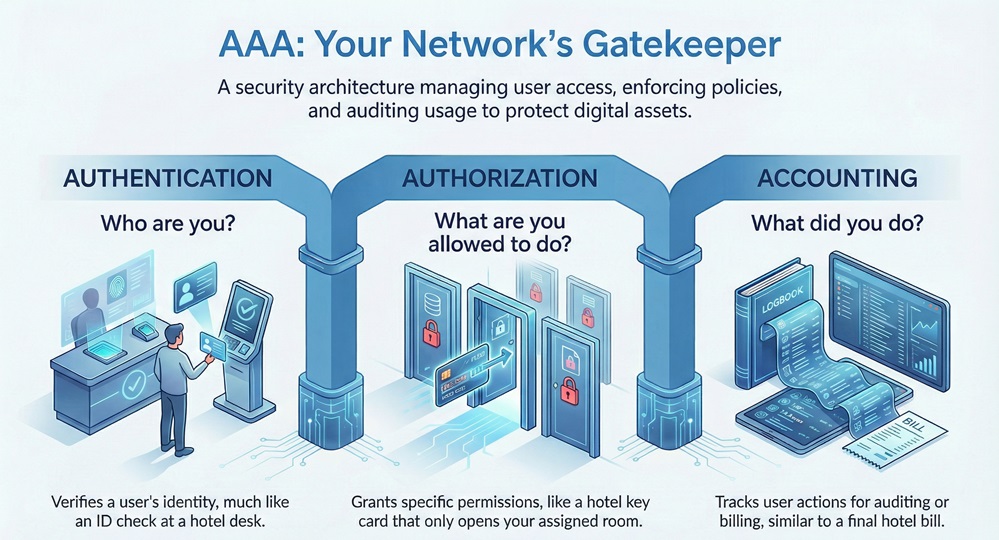
    Authentication Authorization and Accounting (AAA) refers to a security architecture used to manage user access, enforce policies, and audit usage. It acts as the gatekeeper for your network. Authentication Authorization and Accounting (AAA) ensures that every user is identified, granted specific rights, and held accountable for their actions.
     

    Authentication Authorization and Accounting (AAA)


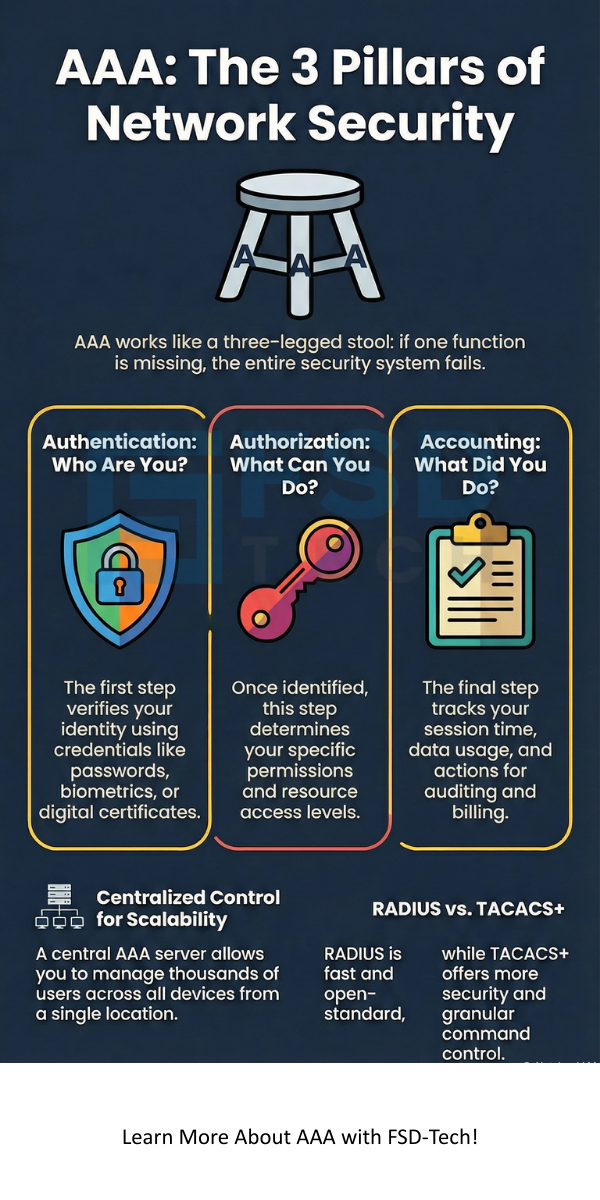
    Authentication Authorization and Accounting (AAA) can be understood as a three-legged stool. If one leg is missing, the security of the entire system falls apart. Organizations use this framework to centralize administration. Instead of managing users on every single device, you use a central AAA server.


    To understand this better, think about a hotel. Authentication is your ID check at the front desk. Authorization is the key card that only opens your room. Accounting is the final bill that lists all your charges.


    Learn More About AAA


    The Core Components of AAA

    Authentication Authorization and Accounting (AAA) splits security tasks into three logical steps. Each step plays a vital role in maintaining a secure network environment.

    1. Authentication

    Authentication is the first step in the process. It is the method of verifying the identity of a user or device. When you log into a computer, you provide a username and password. The system checks these credentials against a database.


    If the credentials match, the system identifies you as a valid user. Authentication Authorization and Accounting (AAA) supports various methods like digital certificates, biometrics, and one-time passwords.


    2. Authorization

    Authorization happens after you successfully authenticate. It determines what resources you can access and what operations you can perform. Just because you are allowed into the building does not mean you can enter the server room.


    Authentication Authorization and Accounting (AAA) uses policies to define your rights. These rights might include access to specific files, the ability to run certain commands, or time-of-day restrictions.


    3. Accounting

    Accounting is the final piece of the puzzle. It involves collecting and reporting data about user activity. Authentication Authorization and Accounting (AAA) tracks when you log in, when you log out, and what data you transferred.


    This data is crucial for billing, capacity planning, and security auditing. If a security breach occurs, accounting logs help you trace the steps of the intruder.


    Also Read: What is the Principle of Least Privilege (PoLP)? Guide & Benefits


    Comparison of Authentication Authorization and Accounting (AAA) Elements

    The following table provides a quick look at the differences between the three components.


    Basis for ComparisonAuthenticationAuthorizationAccounting
    Main GoalVerifying identityGranting permissionsTracking activity
    TimingHappens firstHappens after authenticationHappens during and after session
    Information UsedPasswords, tokens, IDsRoles, groups, policiesTimestamps, data usage, logs
    Typical QuestionWho are you?What can you do?What did you do?
    OutcomeAccess granted or deniedLevel of access definedLog entry created


    How Authentication Authorization and Accounting (AAA) Works

    Authentication Authorization and Accounting (AAA) follows a specific sequence of events to protect a resource. Let us discuss the typical workflow when a user attempts to connect to a network.


    1. Request: You attempt to connect to a network access server (NAS) or a VPN.
    2. Authentication: The NAS asks for your credentials. It sends these to the central AAA server.
    3. Validation: The server checks your credentials. If they are correct, it sends an "Accept" message back to the NAS.
    4. Authorization: The server also sends a list of your permissions. This tells the NAS what you are allowed to do.
    5. Accounting: Once your session starts, the NAS sends a "Start" record to the server. When you disconnect, it sends a "Stop" record.


    Also Read: What is SD-WAN Architecture? Benefits and Working


    Common AAA Protocols

    To implement Authentication Authorization and Accounting (AAA), you need protocols that allow devices to talk to the server. The two most common protocols are RADIUS and TACACS+.


    RADIUS (Remote Authentication Dial-In User Service)

    RADIUS is an open-standard protocol. It is mainly used for network access. RADIUS combines authentication and authorization into a single exchange. It encrypts only the password during transmission. Because it uses UDP, it is generally faster but less reliable in complex environments.


    TACACS+ (Terminal Access Controller Access-Control System Plus)

    TACACS+ is a Cisco-proprietary protocol, though it is widely supported. It separates authentication, authorization, and accounting into distinct processes. TACACS+ encrypts the entire body of the packet. It uses TCP, which ensures reliable delivery of data. Many admins prefer TACACS+ for device administration because it allows for granular command authorization.


    Why Do You Need Authentication Authorization and Accounting (AAA)?

    Authentication Authorization and Accounting (AAA) provides several benefits for modern businesses. As networks grow, manual management becomes impossible.


    Centralized Management

    Authentication Authorization and Accounting (AAA) allows you to manage all user accounts in one place. If an employee leaves the company, you disable their account on the AAA server. They immediately lose access to all network devices. Without this, you would have to log into every switch and router to delete their user profile.


    Scalability

    The framework scales easily. Whether you have ten users or ten thousand, the process remains the same. You can add more AAA servers to handle the load and provide redundancy.


    Enhanced Security

    By using Authentication Authorization and Accounting (AAA), you enforce a consistent security policy. You can require strong passwords or multi-factor authentication (MFA) across the board. The accounting logs provide a clear trail for compliance and forensics.


    Accurate Auditing

    Accounting helps you understand how your resources are used. You can see which users consume the most bandwidth or which devices are accessed most frequently. This data helps in making informed decisions about infrastructure upgrades.


    Implementing AAA in Your Network

    Setting up Authentication Authorization and Accounting (AAA) requires careful planning. You must decide which protocol fits your needs and which server software to use.


    Choosing a Server

    You can use dedicated software like Cisco Identity Services Engine (ISE) or FreeRADIUS. Some organizations use Active Directory (AD) as the backend database for their AAA server. This integration ensures that network access matches company-wide user credentials.


    Defining Policies

    Authentication Authorization and Accounting (AAA) is only as good as the policies you create. You should follow the principle of least privilege. This means giving users the minimum level of access they need to perform their jobs.


    Monitoring and Logs

    Simply collecting logs is not enough. You must regularly review your accounting data. Look for failed login attempts or unusual activity patterns. High numbers of failed authentications might indicate a brute-force attack.


    Also Read: What is SQL Injection (SQLi) Attack? Examples & Prevention


    The Role of AAA in Modern Cybersecurity

    Authentication Authorization and Accounting (AAA) is the foundation of a Zero Trust architecture. In a Zero Trust model, you never trust anyone by default. Every user must be verified and authorized for every session.


    Authentication Authorization and Accounting (AAA) facilitates this by providing a continuous loop of identity verification and activity tracking. As cloud services and remote work become standard, the "perimeter" of the network disappears. Your security must follow the user, and that is exactly what this framework does.


    Key Differences Between Protocols

    Now, the question arises: should you use RADIUS or TACACS+? Let us explore the technical distinctions.


    • Encryption: TACACS+ encrypts the whole packet. RADIUS only encrypts the password.
    • Separation of Functions: TACACS+ separates AAA functions. RADIUS combines authentication and authorization.
    • Transport Protocol: TACACS+ uses TCP (Port 49). RADIUS uses UDP (Ports 1812 and 1813).
    • Command Authorization: TACACS+ is better for controlling which commands an admin can run on a router.


    Common Challenges with AAA

    While Authentication Authorization and Accounting (AAA) is powerful, it is not without challenges.


    1. Single Point of Failure: If your AAA server goes down, no one can log in. To prevent this, always deploy primary and secondary servers.
    2. Latency: If the server is geographically far from the user, login times might increase.
    3. Complexity: Configuring granular authorization levels for different user groups takes time and expertise.

    Conclusion

    Authentication Authorization and Accounting (AAA) is more than just a technical requirement. It is a strategic approach to identity management and data protection. By separating identity, permission, and tracking, you create a robust defense against unauthorized access.


    Our team focuses on building secure foundations for every client. We believe that clarity in security leads to better business outcomes. When you know exactly who is on your network and what they are doing, you can operate with confidence. Authentication Authorization and Accounting (AAA) provides that peace of mind.


    Protecting your network starts with knowing your users. Use Authentication Authorization and Accounting (AAA) to build a system that is both secure and easy to manage. If you value transparency and control, this framework is the right choice for your organization.


    Book a Call with Our Network Experts
     

    Authentication Authorization and Accounting (AAA) infographic


    Key Takeaways

    • Authentication verifies the identity of the user.
    • Authorization manages the permissions and access levels.
    • Accounting tracks and logs all user activity for auditing.
    • RADIUS and TACACS+ are the primary protocols used for implementation.
    • Centralization is the biggest advantage of using a dedicated AAA server.
    • Zero Trust models rely heavily on the AAA framework to maintain security.
    • Redundancy is vital to ensure that the AAA server does not become a single point of failure.


    Frequently Asked Questions about AAA

    What is the difference between Authentication and Authorization?

    Authentication checks who you are. Authorization determines what you can do. You must be authenticated before the system can authorize your actions.


    Is AAA only for large companies?

    No. Even small businesses benefit from centralized access control. It reduces the risk of orphaned accounts and simplifies management.


    Can I use AAA for Wi-Fi security?

    Yes. WPA2-Enterprise and WPA3-Enterprise use RADIUS for Authentication Authorization and Accounting (AAA) to verify individual user credentials instead of a shared password.


    What happens if the AAA server is unreachable?

    Most network devices have a "fallback" configuration. You can set a local username and password that only works if the server is offline.


    Does AAA support Multi-Factor Authentication (MFA)?

    Yes. Many modern AAA servers can integrate with MFA providers to add an extra layer of security during the authentication phase.

    Authentication Authorization and Accounting (AAA)

    About The Author

    Surbhi Suhane

    Surbhi Suhane is an experienced digital marketing and content specialist with deep expertise in Getting Things Done (GTD) methodology and process automation. Adept at optimizing workflows and leveraging automation tools to enhance productivity and deliver impactful results in content creation and SEO optimization.

    Like This Story?

    Share it with friends!

    Subscribe to our newsletter!

    Atera

    (52)

    Cato Networks

    (121)

    ClickUp

    (70)

    FishOS

    (7)

    Miradore

    (21)

    PointGuard AI

    (9)

    Vembu

    (22)

    Xcitium

    (33)

    ZETA HRMS

    (79)

    Workflow Automation(8)

    Workforce Automation(1)

    AI Project Management(1)

    HR Data Automation(1)

    RMM(1)

    IT Workflow Automation(1)

    IT security(2)

    GCC compliance(4)

    Payroll Integration(2)

    IT support automation(3)

    procurement automation(1)

    lost device management(1)

    IT Management(5)

    IoT Security(2)

    Cato XOps(2)

    IT compliance(4)

    Workflow Management(1)

    Task Automation(1)

    Kubernetes lifecycle management(2)

    OpenStack automation(1)

    AI-powered cloud ops(1)

    SMB Security(8)

    Data Security(1)

    MDR (Managed Detection & Response)(4)

    MSP Automation(3)

    Atera Integrations(2)

    XDR Security(2)

    SMB Cyber Protection(1)

    Ransomware Defense(3)

    HR Tech Solutions(1)

    Zero Trust Network Access(3)

    Zero Trust Security(2)

    Endpoint Management(1)

    SaaS Security(1)

    Payroll Automation(5)

    IT Monitoring(2)

    Xcitium EDR SOC(15)

    Ransomware Protection GCC(1)

    Network Consolidation UAE(1)

    M&A IT Integration(1)

    MSSP for SMBs(1)

    SMB Cybersecurity GCC(1)

    Antivirus vs EDR(1)

    FSD-Tech MSSP(25)

    Ransomware Protection(3)

    Managed EDR FSD-Tech(1)

    Cybersecurity GCC(12)

    Endpoint Security(1)

    Endpoint Protection(1)

    Data Breach Costs(1)

    SMB Cybersecurity(8)

    Zero Dwell Containment(31)

    Xcitium EDR(30)

    Managed Security Services(2)

    Cloud Backup(1)

    Hybrid Backup(1)

    Backup & Recovery(1)

    pointguard ai(4)

    backup myths(1)

    disaster recovery myths(1)

    SMB data protection(9)

    vembu(9)

    Vembu BDR Suite(19)

    Disaster Recovery(4)

    GCCBusiness(1)

    DataProtection(1)

    Secure Access Service Edge(4)

    GCC HR software(20)

    Miradore EMM(15)

    Cato SASE(7)

    Cloud Security(8)

    Talent Development(1)

    AI Security(2)

    AI Cybersecurity(12)

    AI Governance(4)

    AI Risk Management(1)

    AI Compliance(2)

    GCC business security(1)

    GCC network integration(1)

    compliance automation(5)

    education security(1)

    GCC cybersecurity(2)

    BYOD security Dubai(8)

    App management UAE(1)

    Miradore EMM Premium+(5)

    MiddleEast(1)

    HealthcareSecurity(1)

    Team Collaboration(1)

    IT automation(12)

    Zscaler(1)

    SD-WAN(7)

    HR Integration(4)

    Cloud Networking(4)

    device management(9)

    RemoteWork(1)

    VPN(1)

    ZeroTrust(2)

    MPLS(1)

    Project Management(9)

    HR automation(16)

    share your thoughts

    Authentication Authorization and Accounting (AAA)

    Authentication Authorization and Accounting (AAA)

    🕓 February 7, 2026

    Metropolitan Area Network (MAN)

    Metropolitan Area Network (MAN) - Meaning & Examples

    🕓 February 6, 2026

    Load Balancer in Networking

    What is Load Balancer and How it Works?

    🕓 February 6, 2026

    Decoded(100)

    Cyber Security(118)

    BCP / DR(22)

    Zeta HRMS(78)

    SASE(21)

    Automation(70)

    Next Gen IT-Infra(118)

    Monitoring & Management(73)

    ITSM(22)

    HRMS(21)

    Automation(24)