.webp&w=3840&q=75)
How ClickUp Enables Outcome-Based Project Management (Not Just Task Tracking)
🕓 February 15, 2026
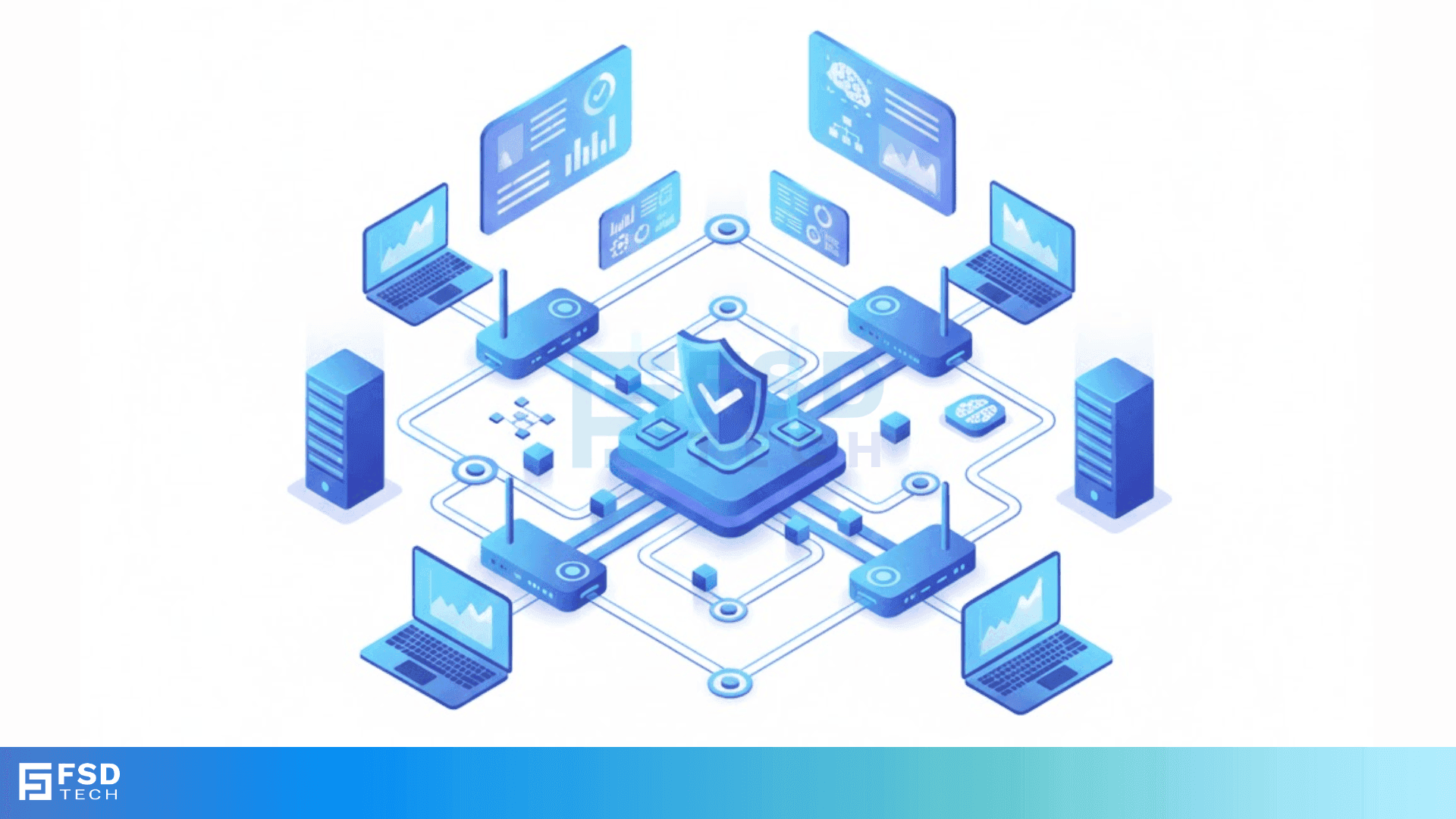
Managed SD-WAN is the smarter way to run your business network without the headache of managing every single wire and router yourself. Think of it as hiring a professional chauffeur for your data. You still decide where you're going, but someone else handles the traffic, the directions, and the car maintenance.
In today's fast-paced world, we've all been there—staring at a spinning loading wheel during a vital Zoom call. It's frustrating, right? Standard networks often struggle to keep up with cloud apps like Microsoft 365 or Salesforce. That is where a managed service comes in to save the day. It takes the power of Software-Defined Wide Area Networking and puts it in the hands of experts.
But what does this actually look like for your daily operations? And why are so many companies moving away from the "do it yourself" (DIY) model? Let's break down the mystery of this networking shift.
Managed SD-WAN refers to a service where a third-party provider handles the design, setup, and daily runs of your wide area network. Instead of your IT team spending weeks configuring hardware at every branch office, the provider does the heavy lifting. They use software to create a "virtual" layer over your existing internet connections.
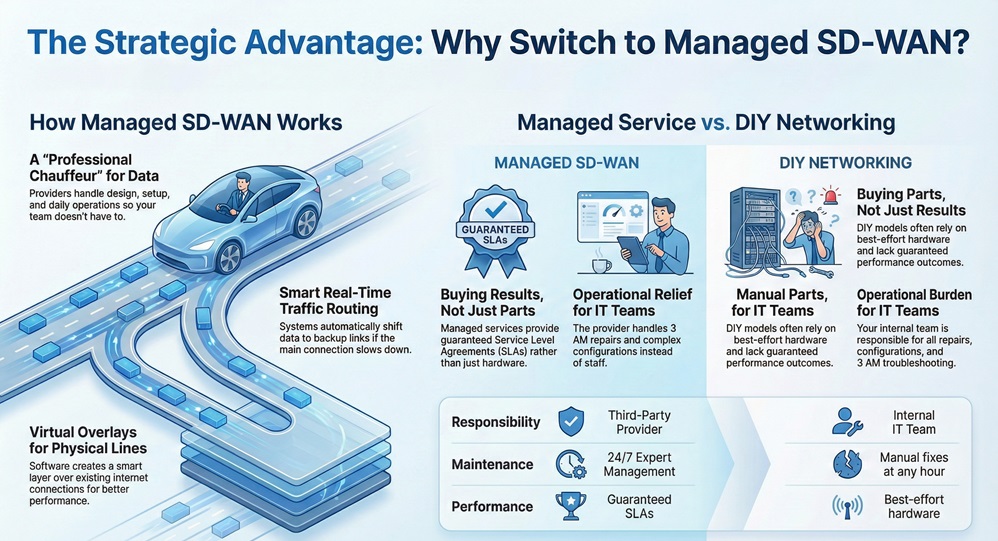
This virtual layer is smart. It watches your traffic in real-time. If your main fiber line gets slow, the system automatically shifts your important data to a backup link. You don't have to lift a finger. Does that sound like a relief? For most busy IT managers, it absolutely is.
Here is the thing: you can build your own network. Many large firms do. However, a DIY approach requires a lot of highly skilled staff. You have to buy the gear, install the software, and fix it when it breaks at 3 AM.
With a managed solution, you're essentially buying a result, not just a box of parts. The provider gives you a Service Level Agreement (SLA). This is a promise that your network will stay up and perform at a certain speed. If it doesn't, they're on the hook to fix it.
In my view, the biggest reason to switch is focus. Your IT team should be working on projects that grow your business. They shouldn't be stuck troubleshooting a router in a different time zone. Here’s why this model is winning:
Also Read: The Weakest Link: How Supply Chain Cybersecurity Gaps Put SMBs at Risk
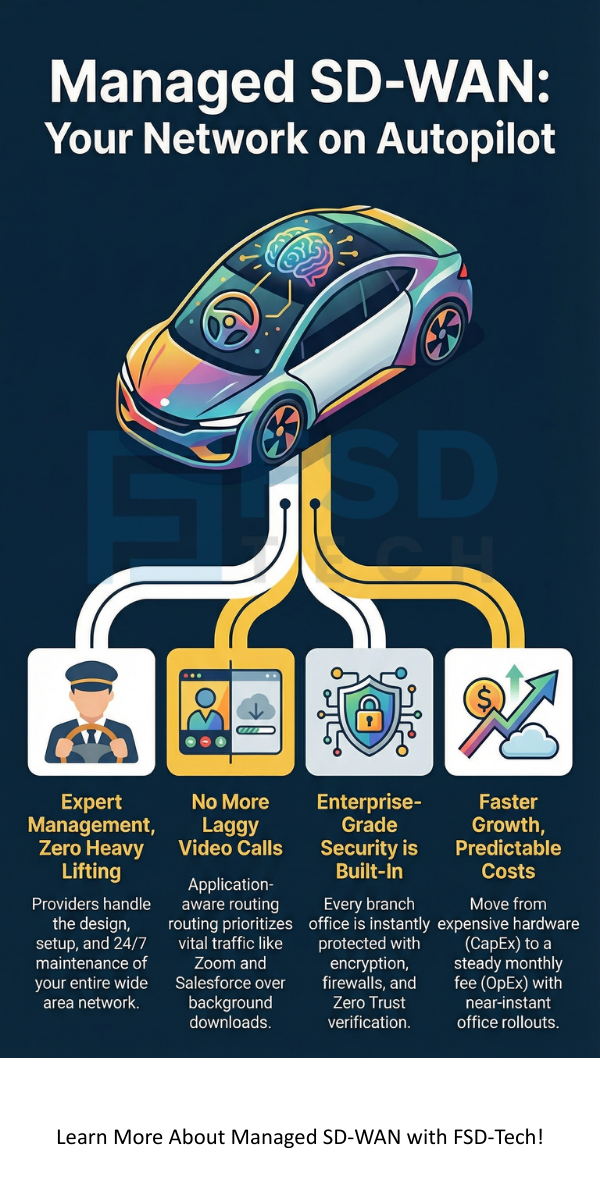
Have you noticed how some apps just feel "laggy"? That's usually due to poor routing. A managed service uses application-aware routing. It recognizes that a video call is more important than a background file download.
It prioritizes the video packets so your meeting stays crystal clear. Meanwhile, the file download can wait a few extra seconds on a cheaper internet link. This intelligent steering makes your whole team more productive.
A managed SD-WAN architecture isn't just one piece of hardware. It is a symphony of software and gear working together.
The Orchestrator
This is the "brain." It lives in the cloud and tells every device on your network how to behave. If you want to change a security rule, you do it here once. The Orchestrator then pushes that change to every office instantly.
Edge Devices
These are the physical or virtual boxes at your locations. They sit at the "edge" of your network. They're the ones doing the actual work of looking at data packets and deciding which path is best.
The Controller
The controller manages the flow. It keeps track of which links are healthy and which ones are "jittery." It ensures the instructions from the brain are actually being followed on the ground.
For years, Multiprotocol Label Switching (MPLS) was the king of networking. It was reliable but very expensive. It’s also quite rigid. Changing an MPLS setup can take months.
Managed SD-WAN is the modern answer. It can use MPLS, but it also uses cheap broadband and even 5G. It blends them together into one big pipe. You get the reliability of the expensive lines with the speed and low cost of the public internet. It’s the best of both worlds.
Also Read: When the Threat Wears Your Company Badge: Understanding & Preventing Insider Threats
This is a question we hear a lot. To be honest, a network is only as good as its security. Most managed SD-WAN services now include "Secure Access Service Edge" (SASE) features.
This means you get:
Instead of buying a separate firewall for every office, the security is baked right into the service.
At the end of the day, your network should be a tool that helps you win, not a hurdle that holds you back. We believe in creating connections that just work. Our focus is always on your success and making sure your team stays connected, no matter where they are. We treat your business like our own because we know that when your data flows, your business grows.
Ready to stop worrying about your connection? You deserve a network that’s as fast and agile as your business goals.
Contact our experts today for a free network audit.
Not at all. You usually get a dashboard. You can see everything that's happening. You just don't have to do the "grunt work" of fixing it. Think of it as having a co-pilot.
Actually, it's quite smooth. Most providers can layer the new system over your old one. You don't have to "rip and replace" everything on day one.
Yes. In fact, smaller teams often benefit the most. Since they don't have 50 network engineers on staff, the managed provider becomes their instant expert team.

Surbhi Suhane is an experienced digital marketing and content specialist with deep expertise in Getting Things Done (GTD) methodology and process automation. Adept at optimizing workflows and leveraging automation tools to enhance productivity and deliver impactful results in content creation and SEO optimization.
Share it with friends!




.webp&w=3840&q=75)

share your thoughts