HomeNext Gen IT-InfraMonitoring & ManagementCyber SecurityBCP / DRAutomationDecoded
Next Gen IT-Infra
Cato’s SASE Supports Cybersecurity Skills Development

How Cato’s SASE Supports Cybersecurity Skills Development

🕓 April 8, 2025

How SASE Supports the Security Needs of SMBs

How SASE Supports the Security Needs of SMBs

🕓 February 9, 2025

Attack Surface Reduction with Cato’s SASE

Attack Surface Reduction with Cato’s SASE

🕓 February 10, 2025

SASE for Digital Transformation in UAE

SASE for Digital Transformation in UAE

🕓 February 8, 2025

Monitoring & Management
Understanding Atera’s SLA Management

Understanding Atera’s SLA Management

🕓 February 7, 2025

Cost-Performance Ratio: Finding the Right Balance in IT Management Networks

Cost-Performance Ratio: Finding the Right Balance in IT Management Networks

🕓 June 16, 2025

Customizing Atera with APIs

Customizing Atera with APIs

🕓 March 3, 2025

Power Up Your IT Team’s Strategy with Atera’s Communication Tools

Power Up Your IT Team’s Strategy with Atera’s Communication Tools

🕓 February 8, 2025

Cyber Security
Illustration of the Cato Cloud architecture showing its role in delivering SASE for secure, optimized global connectivity.

Understanding the Cato Cloud and Its Role in SASE

🕓 January 29, 2025

Isometric illustration of professionals managing network performance, bandwidth analytics, and cloud-based optimization around the Cato Networks platform, symbolizing bandwidth control and QoS visibility.

Mastering Bandwidth Control and QoS in Cato Networks

🕓 July 26, 2025

Global network backbone powering Cato SASE solution for secure, high-performance connectivity across regions.

Global Backbone: The Engine Powering Cato’s SASE Solution

🕓 January 30, 2025

Illustration of team analyzing application traffic and usage insights on a large laptop screen using Cato’s dashboard, surrounded by network and cloud icons.

Cato Networks Application Visibility | Monitoring & Control

🕓 July 27, 2025

BCP / DR
Illustration showing diverse business and IT professionals collaborating with cloud, backup, and security icons, representing Vembu use cases for SMBs, MSPs, and IT teams.

Who Uses Vembu? Real-World Use Cases for SMBs, MSPs & IT Teams

🕓 July 12, 2025

Graphic showcasing Vembu’s all-in-one backup and disaster recovery platform with icons for cloud, data protection, and business continuity for IT teams and SMBs.

What Is Vembu? A Deep Dive Into the All in One Backup & Disaster Recovery Platform

🕓 July 6, 2025

Illustration showing Vembu backup and disaster recovery system with cloud storage, server racks, analytics dashboard, and IT professionals managing data.

The Rising Cost of Data Loss: Why Backup Is No Longer Optional?

🕓 August 14, 2025

3D isometric illustration of cloud backup and data recovery infrastructure with laptop, data center stack, and digital business icons — FSD Tech

RPO & RTO: The Heart of Business Continuity

🕓 August 15, 2025

Automation
Cross-Functional Collaboration with ClickUp

Fostering Cross-Functional Collaboration with ClickUp for Multi-Departmental Projects

🕓 February 11, 2025

ClickUp Project Reporting

Revolutionizing Enterprise Reporting with ClickUp’s Advanced Analytics and Dashboards

🕓 June 16, 2025

ClickUp’s Design Collaboration and Asset Management Tools

Empowering Creative Teams with ClickUp’s Design Collaboration and Asset Management Tools

🕓 February 26, 2025

ClickUp Communication and Collaboration Tools

ClickUp Communication and Collaboration Tools: Empowering Remote Teams

🕓 March 12, 2025

Decoded
Multi-Factor Authentication (MFA)

Multi-Factor Authentication (MFA): All You Need to Know

🕓 December 7, 2025

L3 Switch

What Is an L3 Switch? L2 vs L3 & Why You Need Layer 3?

🕓 December 8, 2025

IPSec

IPSec Explained: Protocols, Modes, IKE & VPN Security

🕓 December 3, 2025

 Datagram Transport Layer Security (DTLS)

What is Datagram Transport Layer Security (DTLS)? How it works?

🕓 December 4, 2025

    Subscribe to our newsletter!

    About Us

    Follow Us

    Copyright © 2024 | Powered by 

    Atera

    (55)

    Cato Networks

    (121)

    ClickUp

    (78)

    FishOS

    (7)

    Miradore

    (21)

    PointGuard AI

    (9)

    Vembu

    (22)

    Xcitium

    (33)

    ZETA HRMS

    (79)

    Table of Contents

    From Chaos to Clarity: Designing an Operating Model Inside ClickUp

    NHAIF NOUSHAD
    February 19, 2026
    Comments
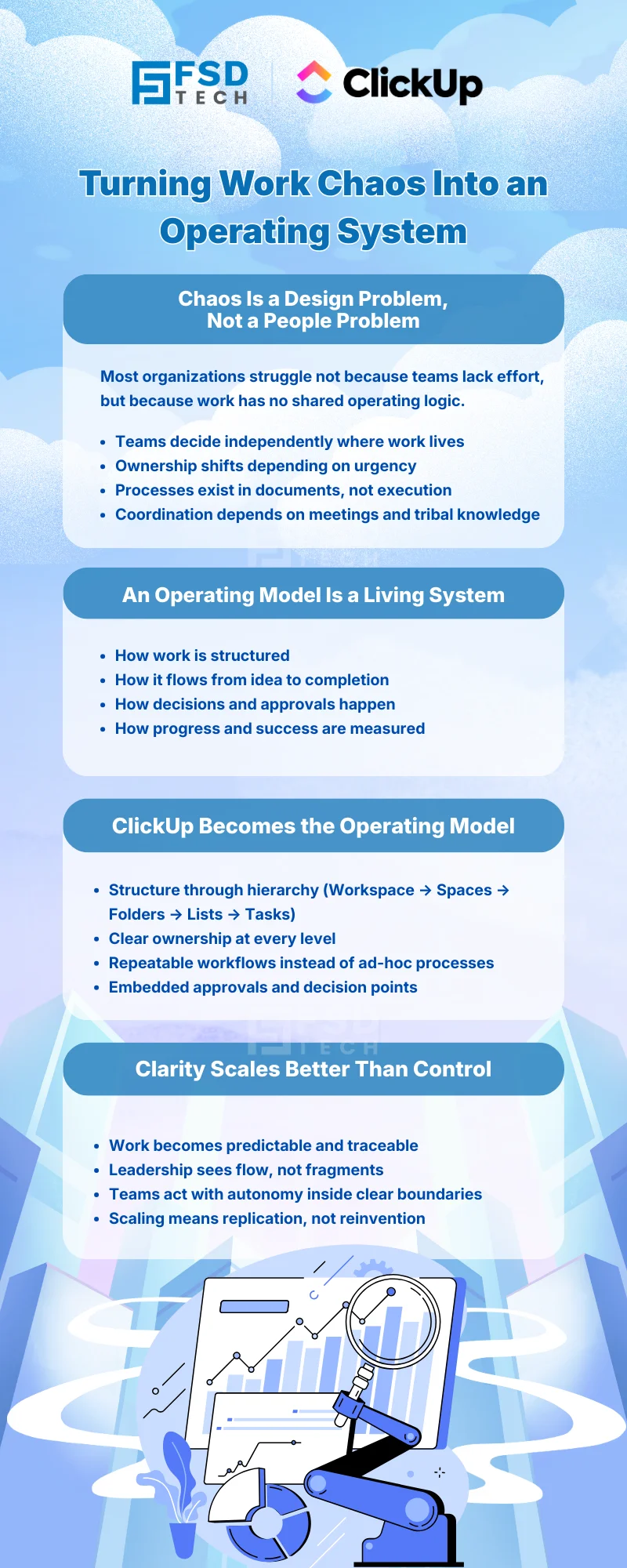
    Infographic titled “Turning Work Chaos Into an Operating System,” explaining how ClickUp structures workflows through hierarchy, ownership, approvals, and repeatable processes to transform fragmented work into a scalable operating model with predictable execution and leadership visibility, branded by FSD Tech and ClickUp.

    As organizations grow, work becomes harder to coordinate-not because teams lack effort, but because there is no shared operating model. Each department defines work differently, priorities shift constantly, and execution depends heavily on tribal knowledge rather than structure.
     

    The result is familiar: confusion around ownership, duplicated efforts, slow decision-making, and leaders who struggle to understand how work actually flows through the organization.

    An operating model is what brings order to this chaos. It defines how work moves, who owns what, how decisions are made, and how success is measured.


    ClickUp enables organizations to design and run a clear, scalable operating model directly inside the system where work happens. In this blog, we explore how enterprises can move from fragmented execution to structured clarity by building their operating model in ClickUp.


    Why Most Organizations Operate Without a Clear Model

    Many organizations have org charts, policies, and KPIs-but lack a defined way of operating day to day.

    Common symptoms include:

    • Teams unsure where work should live
    • Inconsistent ownership and accountability
    • Processes that exist only in documents
    • Heavy reliance on meetings for coordination
    • Execution that varies widely across departments

    Without a shared operating model, work becomes reactive. Teams respond to urgency instead of priorities, and leadership spends time resolving confusion instead of driving outcomes.


    What an Operating Model Really Is

    An operating model is not a document-it’s a system.

    A strong operating model defines:

    • How work is structured
    • How work flows from idea to completion
    • How decisions and approvals happen
    • How teams collaborate across functions
    • How progress and success are measured

    When embedded inside ClickUp, the operating model becomes living and enforceable-not theoretical.


    Why ClickUp Is Ideal for Operating Model Design

    Traditional operating models fail because they live outside execution tools.

    ClickUp succeeds because it:

    • Combines structure and flexibility
    • Connects strategy, execution, and reporting
    • Makes workflows visible and repeatable
    • Enforces clarity without micromanagement

    Instead of asking teams to “follow the model,” ClickUp becomes the model.


    Defining the Structural Backbone of Work

    Every operating model starts with structure.

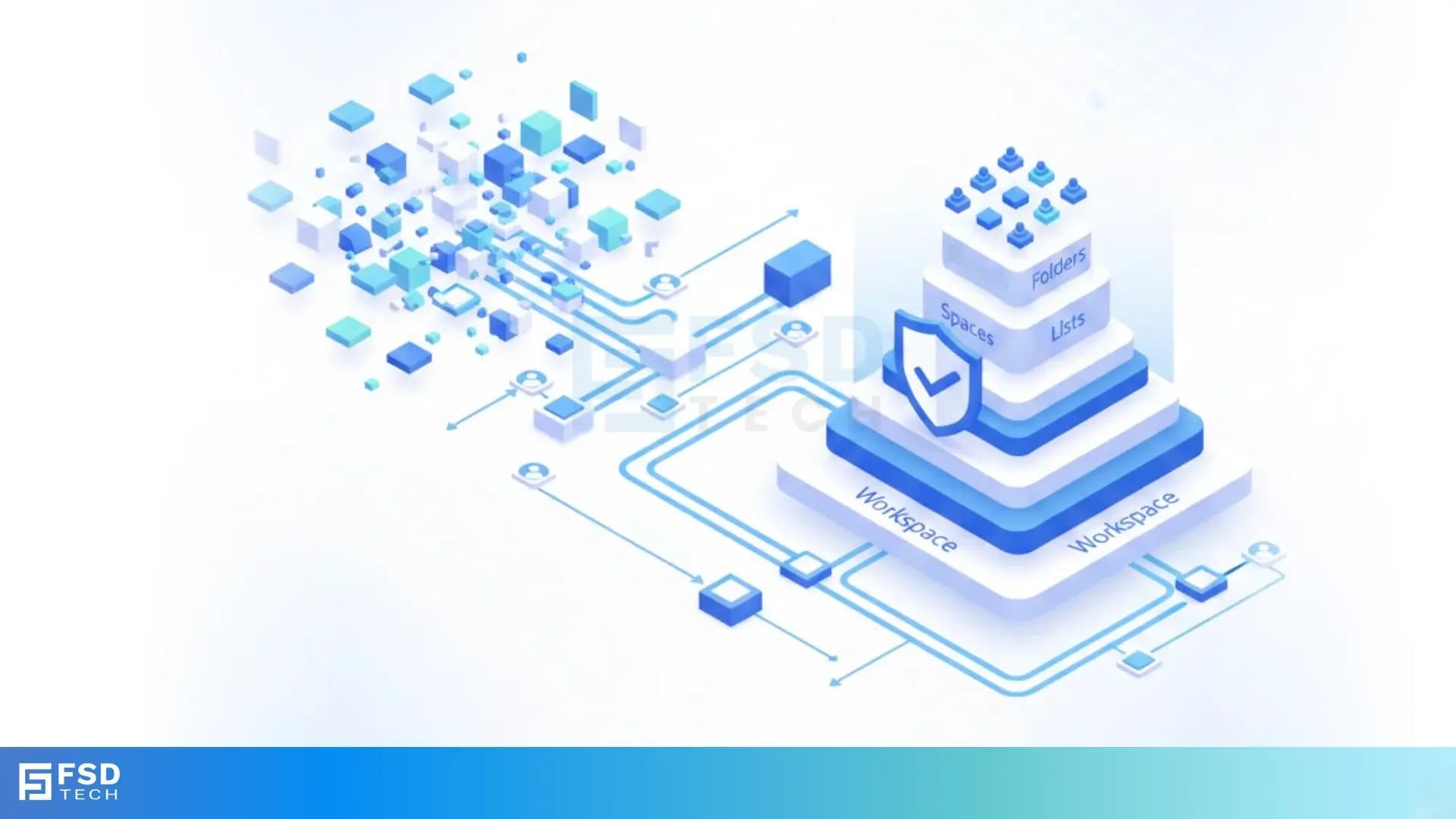
    In ClickUp, structure is defined through hierarchy:

    • Workspace as the organization
    • Spaces as business units or functions
    • Folders as programs or workflow categories
    • Lists as projects or recurring processes
    • Tasks as execution units

    This hierarchy ensures everyone knows:

    • Where work belongs
    • How it rolls up
    • Who owns it

    Structure creates predictability, which is the foundation of clarity.


    Establishing Clear Ownership and Accountability

    Chaos often comes from unclear ownership.

    ClickUp enforces accountability by:

    • Assigning owners at task, project, and initiative levels
    • Making ownership visible to all stakeholders
    • Preventing work from “floating” without responsibility

    When ownership is clear, decisions are faster and execution is more reliable.


    Designing How Work Flows End to End

    An operating model must define how work moves-not just where it lives.

    ClickUp enables teams to:

    • Define consistent status flows
    • Map stages from intake to completion
    • Identify review and approval points
    • Visualize progress in real time

    Instead of each team inventing its own process, workflows become repeatable and scalable.


    Embedding Decision-Making Into Execution

    Decision-making is a critical part of any operating model.

    In ClickUp, decisions are embedded into work by:

    • Defining approval stages within workflows
    • Assigning decision owners clearly
    • Capturing context and rationale in tasks
    • Maintaining an audit trail automatically

    This reduces dependency on email threads and undocumented verbal approvals.


    Making Priorities Explicit, Not Assumed

    One of the biggest causes of execution chaos is unclear prioritization.

    ClickUp brings priority clarity by:

    • Allowing explicit priority levels
    • Linking work to strategic initiatives
    • Making trade-offs visible
    • Showing workload and capacity constraints

    Teams no longer guess what matters most-the operating model makes it explicit.


    Aligning Cross-Functional Teams Around the Same Model

    Most work today is cross-functional, but operating models are often siloed.

    ClickUp enables cross-team alignment by:

    • Connecting work across Spaces
    • Sharing common workflow logic
    • Making dependencies visible
    • Ensuring all teams follow the same execution principles

    Different teams may execute differently-but they operate within the same model.


    Turning the Operating Model Into a System of Record

    An operating model only works if it’s trusted.

    ClickUp becomes the system of record by:

    • Centralizing all work and context
    • Reflecting real execution data
    • Eliminating parallel tracking systems
    • Providing real-time visibility to leadership

    When ClickUp is the source of truth, clarity replaces debate.


    Enabling Leadership Oversight Without Interference

    Leaders need visibility into the operating model-but not involvement in every detail.

    ClickUp allows leadership to:

    • Monitor execution at a high level
    • Identify risks and bottlenecks early
    • Understand how work flows across teams
    • Intervene strategically, not tactically

    This preserves autonomy while maintaining control.


    Scaling the Operating Model as the Organization Grows

    Operating models often break during growth.

    ClickUp supports scale by:

    • Using templates for new teams or initiatives
    • Replicating proven workflows easily
    • Maintaining consistent reporting structures
    • Allowing controlled evolution of processes

    The model grows with the organization-without being rebuilt.


    Avoiding Common Operating Model Pitfalls

    Effective operating models avoid these mistakes:

    • Over-engineering processes
    • Forcing identical workflows on all teams
    • Leaving execution outside the system
    • Treating the model as static

    ClickUp’s flexibility ensures the model evolves while maintaining clarity.


    Best Practices for Designing an Operating Model in ClickUp

    To succeed:

    • Design structure before automations
    • Involve leaders and team owners early
    • Document standards inside ClickUp
    • Review and refine the model quarterly
    • Treat ClickUp as the operational backbone

    Consistency builds confidence. Confidence drives adoption.


    Final Thoughts: Clarity Is a Competitive Advantage

    Organizations don’t fail due to lack of talent. They fail due to lack of clarity.

    By designing an operating model inside ClickUp, enterprises can:

    • Eliminate execution chaos
    • Improve ownership and accountability
    • Align teams without micromanagement
    • Scale operations predictably
    • Turn strategy into repeatable execution

    ClickUp transforms operating models from abstract frameworks into lived, daily reality.


    Stop managing work through disconnected processes→ Reserve your 30-minute ClickUp implementation strategy call.


    Infographic titled “Turning Work Chaos Into an Operating System,” explaining how ClickUp structures workflows through hierarchy, ownership, approvals, and repeatable processes to transform fragmented work into a scalable operating model with predictable execution and leadership visibility, branded by FSD Tech and ClickUp.


    FAQs

    What is an operating model in ClickUp?

    It is the structured way work is organized, executed, governed, and measured inside ClickUp across the organization.


    Why should the operating model live inside ClickUp?

    Because ClickUp is where execution happens, embedding the model ensures consistency, adoption, and real-time visibility.


    Can different teams still work differently?

    Yes. ClickUp allows flexibility within a shared structural and governance framework.


    How does an operating model improve execution?

    It removes ambiguity around ownership, flow, and priorities—allowing teams to focus on delivery.


    Is this approach suitable for large enterprises?

    Absolutely. ClickUp’s hierarchy and scalability make it ideal for enterprise-grade operating models.

    From Chaos to Clarity: Designing an Operating Model Inside ClickUp

    About The Author

    NHAIF NOUSHAD

    Nhaif is an AI Automation Engineer & Business Analyst focused on ClickUp, AI, Automation, and Workflow Optimization. He helps businesses shift from scattered processes to streamlined, data-driven operations. With hands-on expertise, he simplifies complex tools into clear, easy-to-apply solutions.

    TRY OUR PRODUCTS

    Like This Story?

    Share it with friends!

    Subscribe to our newsletter!

    FishOSCato SASEVembuXcitiumZeta HRMSAtera
    Isometric illustration of a centralized performance platform connected to analytics dashboards and team members, representing goal alignment, measurable outcomes, risk visibility, and strategic project tracking within ClickUp.

    How ClickUp Enables Outcome-Based Project Management (Not Just Task Tracking)

    🕓 February 15, 2026
    Isometric illustration of a centralized executive dashboard platform connected to analytics panels, performance charts, security indicators, and strategic milestones, representing real-time business visibility and decision control within ClickUp.

    Executive Visibility in ClickUp – How CXOs Gain Real-Time Control Without Micromanaging

    🕓 February 13, 2026

    Cato SASE Architecture

    Inside Cato’s SASE Architecture: A Blueprint for Modern Security

    🕓 January 26, 2025

    Workflow Automation(8)

    Workforce Automation(1)

    AI Project Management(1)

    HR Data Automation(1)

    RMM(1)

    IT Workflow Automation(1)

    IT security(2)

    GCC compliance(4)

    Payroll Integration(2)

    IT support automation(3)

    procurement automation(1)

    lost device management(1)

    IT Management(5)

    IoT Security(2)

    Cato XOps(2)

    IT compliance(4)

    Task Automation(1)

    Workflow Management(1)

    OpenStack automation(1)

    Kubernetes lifecycle management(2)

    AI-powered cloud ops(1)

    SMB Security(8)

    Data Security(1)

    MDR (Managed Detection & Response)(4)

    MSP Automation(3)

    Atera Integrations(2)

    XDR Security(2)

    Ransomware Defense(3)

    SMB Cyber Protection(1)

    HR Tech Solutions(1)

    Zero Trust Network Access(3)

    Zero Trust Security(2)

    Endpoint Management(1)

    SaaS Security(1)

    Payroll Automation(5)

    IT Monitoring(2)

    Xcitium EDR SOC(15)

    Ransomware Protection GCC(1)

    Network Consolidation UAE(1)

    M&A IT Integration(1)

    MSSP for SMBs(1)

    Managed EDR FSD-Tech(1)

    Ransomware Protection(3)

    Antivirus vs EDR(1)

    SMB Cybersecurity GCC(1)

    FSD-Tech MSSP(25)

    Endpoint Security(1)

    Cybersecurity GCC(12)

    Endpoint Protection(1)

    Data Breach Costs(1)

    Managed Security Services(2)

    Zero Dwell Containment(31)

    Xcitium EDR(30)

    SMB Cybersecurity(8)

    Cloud Backup(1)

    Hybrid Backup(1)

    Backup & Recovery(1)

    pointguard ai(4)

    vembu(9)

    backup myths(1)

    SMB data protection(9)

    disaster recovery myths(1)

    Disaster Recovery(4)

    Vembu BDR Suite(19)

    DataProtection(1)

    GCCBusiness(1)

    GCC IT Solutions(1)

    Secure Access Service Edge(4)

    Unified Network Management(1)

    GCC HR software(20)

    CC compliance(1)

    open banking(1)

    financial cybersecurity(2)

    Miradore EMM(15)

    Government Security(1)

    Cato SASE(8)

    Hybrid Learning(1)

    Cloud Security(9)

    GCC Education(1)

    Talent Development(1)

    AI Compliance(2)

    AI Risk Management(1)

    AI Security(2)

    AI Governance(4)

    AI Cybersecurity(12)

    Secure Remote Access(1)

    GCC business security(1)

    GCC network integration(1)

    compliance automation(5)

    GCC cybersecurity(3)

    education security(1)

    BYOD security Dubai(8)

    Miradore EMM Premium+(5)

    App management UAE(1)

    MiddleEast(1)

    HealthcareSecurity(1)

    Team Collaboration(1)

    IT automation(12)

    Zscaler(1)

    SD-WAN(7)

    share your thoughts

    Infographic titled “Turning Work Chaos Into an Operating System,” explaining how ClickUp structures workflows through hierarchy, ownership, approvals, and repeatable processes to transform fragmented work into a scalable operating model with predictable execution and leadership visibility, branded by FSD Tech and ClickUp.

    From Chaos to Clarity: Designing an Operating Model Inside ClickUp

    🕓 February 19, 2026

    Isometric illustration of a centralized enterprise operations platform linking strategic planning, analytics dashboards, teams, and execution workflows, representing unified strategy alignment, real-time reporting, and coordinated business operations inside ClickUp.

    Using ClickUp to Bridge Strategy, Execution, and Reporting in One Platform

    🕓 February 17, 2026

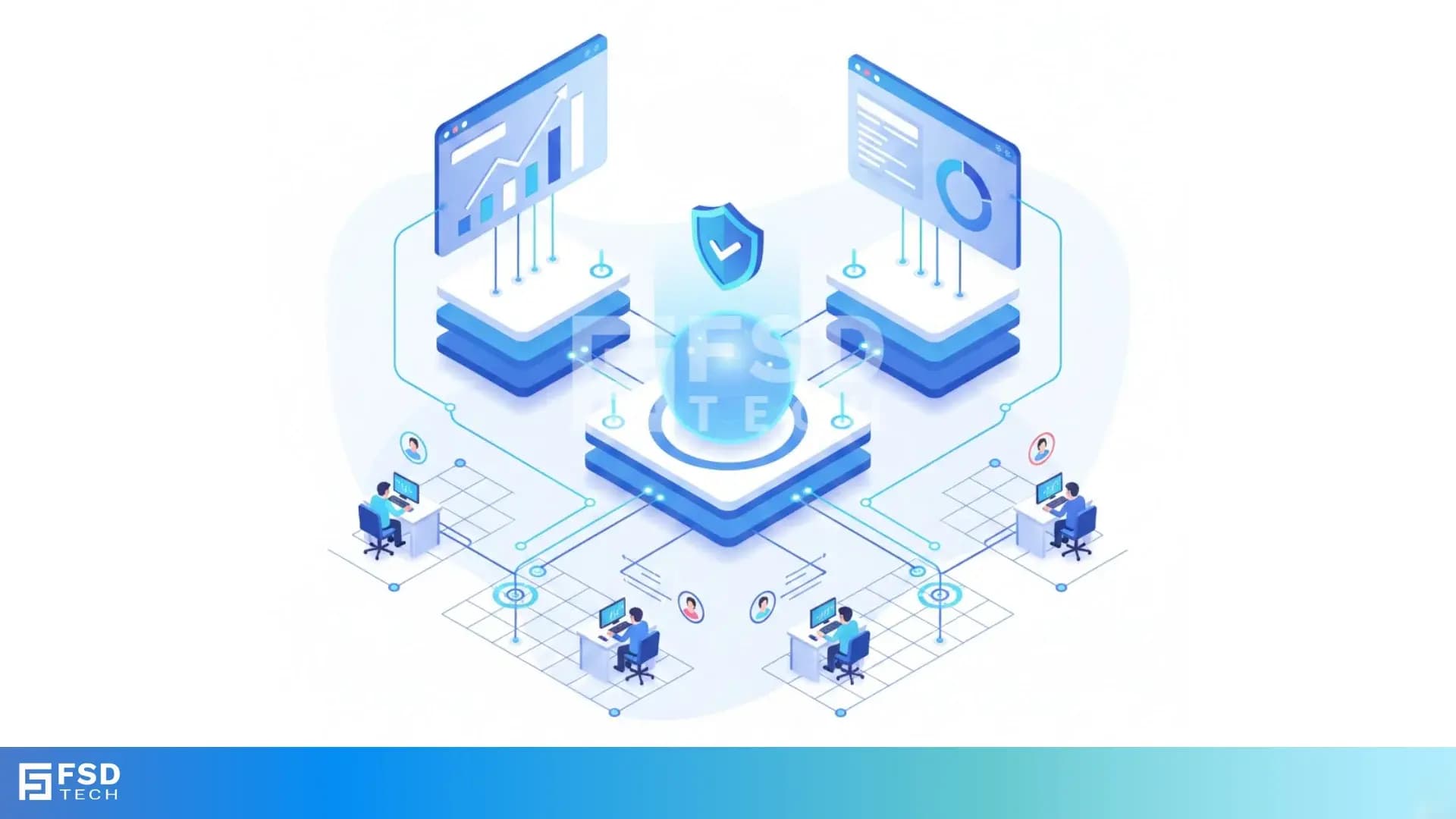
    Isometric illustration of a centralized enterprise platform connecting multiple structured workspaces, dashboards, and data layers, representing standardized workflows, shared governance, and coordinated operations across departments.

    Standardizing Workflows Across Business Units Using ClickUp Spaces and Hierarchies

    🕓 February 16, 2026

    Decoded(119)

    Cyber Security(118)

    BCP / DR(22)

    Zeta HRMS(78)

    SASE(21)

    Automation(78)

    Next Gen IT-Infra(118)

    Monitoring & Management(76)

    ITSM(22)

    HRMS(21)

    Automation(24)