HomeNext Gen IT-InfraMonitoring & ManagementCyber SecurityBCP / DRAutomationDecoded
Next Gen IT-Infra
Cato’s SASE Supports Cybersecurity Skills Development

How Cato’s SASE Supports Cybersecurity Skills Development

🕓 April 8, 2025

How SASE Supports the Security Needs of SMBs

How SASE Supports the Security Needs of SMBs

🕓 February 9, 2025

Attack Surface Reduction with Cato’s SASE

Attack Surface Reduction with Cato’s SASE

🕓 February 10, 2025

SASE for Digital Transformation in UAE

SASE for Digital Transformation in UAE

🕓 February 8, 2025

Monitoring & Management
Understanding Atera’s SLA Management

Understanding Atera’s SLA Management

🕓 February 7, 2025

Cost-Performance Ratio: Finding the Right Balance in IT Management Networks

Cost-Performance Ratio: Finding the Right Balance in IT Management Networks

🕓 June 16, 2025

Customizing Atera with APIs

Customizing Atera with APIs

🕓 March 3, 2025

Power Up Your IT Team’s Strategy with Atera’s Communication Tools

Power Up Your IT Team’s Strategy with Atera’s Communication Tools

🕓 February 8, 2025

Cyber Security
Illustration of the Cato Cloud architecture showing its role in delivering SASE for secure, optimized global connectivity.

Understanding the Cato Cloud and Its Role in SASE

🕓 January 29, 2025

Isometric illustration of professionals managing network performance, bandwidth analytics, and cloud-based optimization around the Cato Networks platform, symbolizing bandwidth control and QoS visibility.

Mastering Bandwidth Control and QoS in Cato Networks

🕓 July 26, 2025

Global network backbone powering Cato SASE solution for secure, high-performance connectivity across regions.

Global Backbone: The Engine Powering Cato’s SASE Solution

🕓 January 30, 2025

Illustration of team analyzing application traffic and usage insights on a large laptop screen using Cato’s dashboard, surrounded by network and cloud icons.

Cato Networks Application Visibility | Monitoring & Control

🕓 July 27, 2025

BCP / DR
Illustration showing diverse business and IT professionals collaborating with cloud, backup, and security icons, representing Vembu use cases for SMBs, MSPs, and IT teams.

Who Uses Vembu? Real-World Use Cases for SMBs, MSPs & IT Teams

🕓 July 12, 2025

Graphic showcasing Vembu’s all-in-one backup and disaster recovery platform with icons for cloud, data protection, and business continuity for IT teams and SMBs.

What Is Vembu? A Deep Dive Into the All in One Backup & Disaster Recovery Platform

🕓 July 6, 2025

Illustration showing Vembu backup and disaster recovery system with cloud storage, server racks, analytics dashboard, and IT professionals managing data.

The Rising Cost of Data Loss: Why Backup Is No Longer Optional?

🕓 August 14, 2025

3D isometric illustration of cloud backup and data recovery infrastructure with laptop, data center stack, and digital business icons — FSD Tech

RPO & RTO: The Heart of Business Continuity

🕓 August 15, 2025

Automation
Cross-Functional Collaboration with ClickUp

Fostering Cross-Functional Collaboration with ClickUp for Multi-Departmental Projects

🕓 February 11, 2025

ClickUp Project Reporting

Revolutionizing Enterprise Reporting with ClickUp’s Advanced Analytics and Dashboards

🕓 June 16, 2025

ClickUp’s Design Collaboration and Asset Management Tools

Empowering Creative Teams with ClickUp’s Design Collaboration and Asset Management Tools

🕓 February 26, 2025

ClickUp Communication and Collaboration Tools

ClickUp Communication and Collaboration Tools: Empowering Remote Teams

🕓 March 12, 2025

Decoded
Multi-Factor Authentication (MFA)

Multi-Factor Authentication (MFA): All You Need to Know

🕓 December 7, 2025

L3 Switch

What Is an L3 Switch? L2 vs L3 & Why You Need Layer 3?

🕓 December 8, 2025

IPSec

IPSec Explained: Protocols, Modes, IKE & VPN Security

🕓 December 3, 2025

 Datagram Transport Layer Security (DTLS)

What is Datagram Transport Layer Security (DTLS)? How it works?

🕓 December 4, 2025

    Subscribe to our newsletter!

    About Us

    Follow Us

    Copyright © 2024 | Powered by 

    Atera

    (55)

    Cato Networks

    (124)

    ClickUp

    (78)

    FishOS

    (7)

    Miradore

    (21)

    PointGuard AI

    (9)

    Vembu

    (22)

    Xcitium

    (33)

    ZETA HRMS

    (79)

    Table of Contents

    What is Identity Governance and Administration (IGA)?

    Surbhi Suhane
    February 24, 2026
    Comments
    Identity Governance

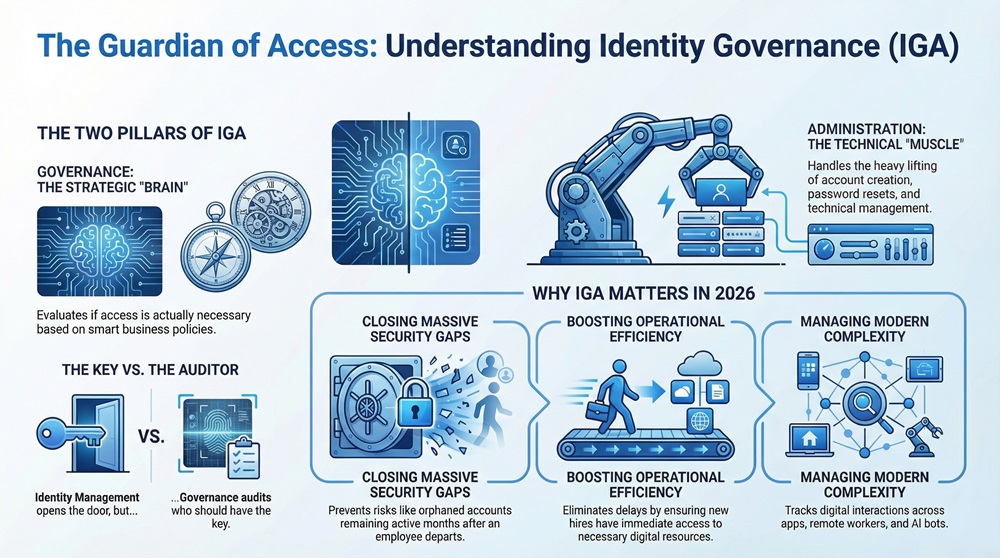
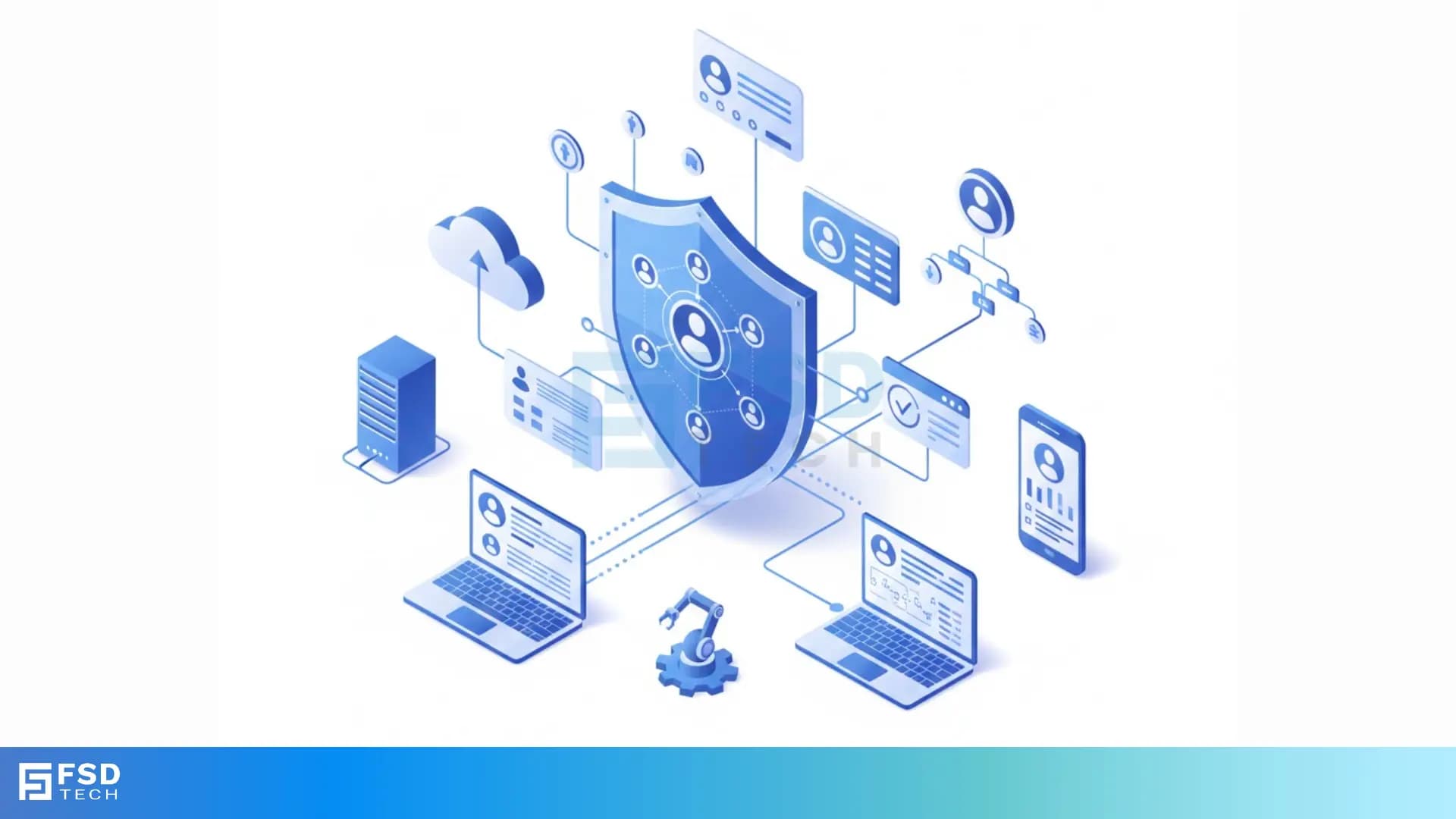
    Identity governance is the strategic framework that ensures the right people have the right access to the right resources for the right reasons. To be honest, we've all been there: a new hire starts, but they can't log into their email for three days. Or worse, an employee leaves the company, yet their account stays active for months. These aren't just IT headaches; they're massive security gaps.


    In my experience, many leaders confuse simple logins with true oversight. Think of it this way: if Identity Management is the key that opens the door, then identity governance is the auditor who checks if you should even have a key in the first place. It provides the "who, what, where, and why" of every digital interaction in your network.


    As we move through 2026, the digital world is getting crowded. With more apps, remote workers, and even AI bots joining our teams, how do we keep track of it all? Let's explore how this framework keeps your data safe while making life easier for your team.


    What is Identity Governance and Administration?

    When we talk about this topic, you'll often hear the acronym IGA. This stands for Identity Governance and Administration. It's a fancy way of saying we're combining technical tools with smart business policies.


    Identity Governance


    The "Administration" part handles the heavy lifting, like creating accounts or resetting passwords. The "Governance" part is the brain. It asks: "Does this person actually need access to the payroll folder?"


    Secure My Network


    The Core Components of IGA

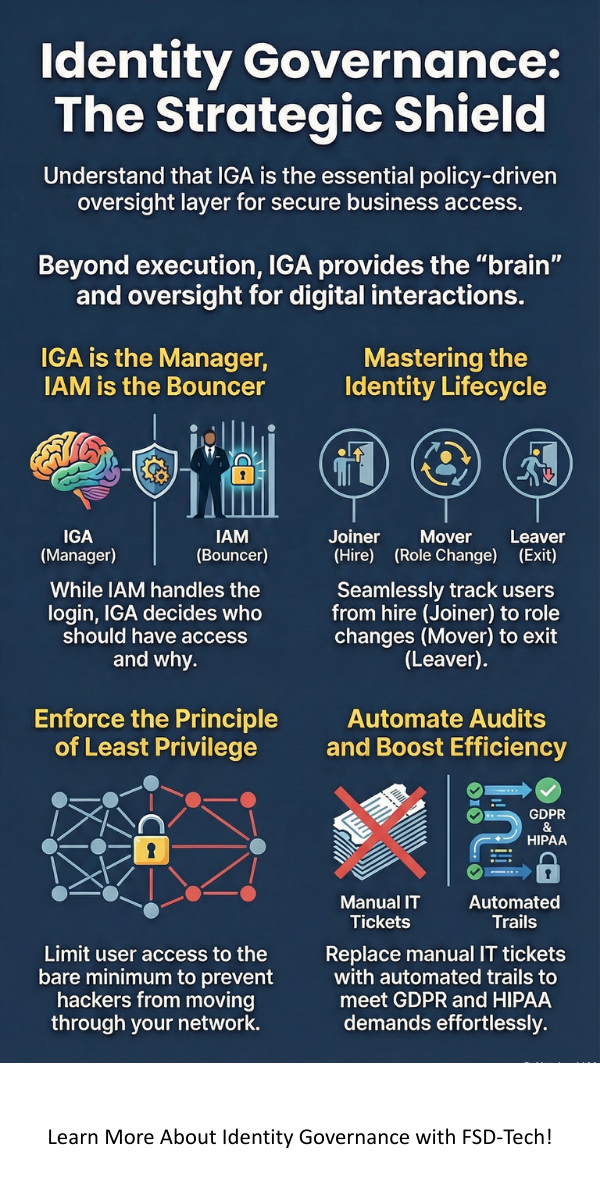
    • Identity Lifecycle Management: This tracks a user from the moment they're hired (Joiner) to when they change roles (Mover) and finally when they leave (Leaver).
    • Access Certifications: These are regular check-ups where managers confirm their team still needs certain permissions.
    • Policy Enforcement: This sets the rules, like ensuring no one can both request and approve their own payments.


    Have you ever wondered why some companies seem to pass audits effortlessly while others scramble? It's usually because they have a solid identity governance strategy in place.


    Why Identity Governance Matters More Than Ever?

    In the past, we relied on a strong "perimeter." We thought if the office walls were secure, the data was safe. Fast-forward to today, and that perimeter is gone. We're working from coffee shops, using personal phones, and connecting to a dozen different cloud services.


    Reducing the Risk of Breaches

    Most cyberattacks today don't "hack" in; they log in. Hackers use stolen credentials to walk right through the front door. Identity governance limits this risk by enforcing the "Principle of Least Privilege." This means users only get the bare minimum access they need to do their jobs. If a hacker steals a junior designer's password, they shouldn't be able to access the company's financial servers.


    Meeting Compliance Demands

    Whether it's GDPR, HIPAA, or SOX, regulators are getting tougher. They don't just want to know that your data is safe; they want proof. IGA solutions provide a clear audit trail. You can show exactly who approved a specific permission and when it was last reviewed.


    Boosting IT Efficiency

    Let’s be real: IT teams are tired of manual tickets. By automating the identity governance process, you remove the "middleman." New hires get their tools on day one automatically. This doesn't just save time—it stops human error from creating "orphan accounts" that attackers love to exploit.


    Also Read: What is the Principle of Least Privilege (PoLP)? Guide & Benefits


    How Identity Governance Differs from IAM?

    It's common to hear people use Identity Governance and IAM (Identity and Access Management) interchangeably. To be honest, they're related, but they aren't the same.


    FeatureIdentity Management (IAM)Identity Governance (IGA)
    Primary FocusExecution and SpeedPolicy and Oversight
    Core TaskLogging people in (SSO/MFA)Deciding who should be logged in
    GoalUser ProductivityRisk Mitigation & Compliance
    ProcessTransactional (Add/Remove)Strategic (Review/Certify)


    Best Practices for Implementing Identity Governance

    Starting an IGA program can feel like climbing a mountain. Roughly 40% of companies struggle because they try to do everything at once. In my view, the best approach is a slow and steady one.


    1. Clean Your Data First

    You can't govern what you don't understand. Before you buy expensive software, look at your current user list. Are there "ghost" accounts for people who left years ago? Clean up your active directory so your identity governance tools have a fresh start.


    2. Focus on High-Risk Areas

    Don't worry about every single app on day one. Start with the ones that hold your "crown jewels"—things like customer data or financial records.


    3. Involve Business Leaders

    This isn't just an IT project. Who knows better than a Sales Manager if a salesperson needs access to a specific CRM folder? Identity governance works best when the people who manage the workers also manage the permissions.


    4. Use Automation Wisely

    We've all seen automation go wrong. Start by automating simple things, like removing access the moment an HR system marks an employee as "terminated." This is a quick win for security.


    Also Read: Security Automation: How to Protect Your Data Without the Burnout


    The Future of Identity Governance in 2026

    We're seeing a massive shift toward "Identity-First Security." This means identity is now the new perimeter. We're also seeing the rise of "Non-Human Identities"—think of the AI agents and bots that now perform tasks for us. How do we govern them?


    Modern identity governance platforms are starting to use AI to spot weird behavior. If a user suddenly requests access to fifty folders they've never used before, the system can flag it instantly. It's about being proactive rather than waiting for an audit to find a problem.


    “Identity is the foundation of Zero Trust. Without knowing exactly who is on your network and why, you're just hoping for the best.”

    Conclusion

    At its heart, identity governance is about trust. It's about knowing that your digital house is in order and that your team has exactly what they need to succeed—nothing more, nothing less. By focusing on smart policies and clear oversight, you aren't just ticking a compliance box. You're building a foundation that allows your business to grow safely in a messy digital world.


    Our company believes that security should empower people, not slow them down. We're dedicated to helping you find that perfect balance between airtight protection and seamless productivity. Your security is our focus, and we're here to guide you every step of the way.


    Identity Governance

    Talk to an Expert

    Key Takeaways

    • Identity governance provides the oversight and policy layer for user access.
    • It helps companies stay compliant with laws like GDPR and HIPAA.
    • The framework reduces security risks by enforcing "least privilege."
    • Automation within IGA saves IT teams hundreds of hours each year.
    • It differs from IAM by focusing on the "why" and "should" of access, not just the "how."


    Frequently Asked Questions

    What is an "orphan account" in identity governance?

    An orphan account is a login that no longer has an owner, usually because an employee left the company. These are dangerous because they are often unmonitored and provide an easy entry point for hackers.


    Does my small business need identity governance?

    Yes! While you might not need a complex software suite, the principles of identity governance—like reviewing access every six months—are vital for any business that handles customer data.


    Is identity governance the same as SoD?

    No, but it enforces it. SoD (Segregation of Duties) is a policy that prevents conflicts of interest. Identity governance is the system that makes sure those policies are actually followed.


    What is Identity Governance and Administration (IGA)?

    About The Author

    Surbhi Suhane

    Surbhi Suhane is an experienced digital marketing and content specialist with deep expertise in Getting Things Done (GTD) methodology and process automation. Adept at optimizing workflows and leveraging automation tools to enhance productivity and deliver impactful results in content creation and SEO optimization.

    TRY OUR PRODUCTS

    Like This Story?

    Share it with friends!

    Subscribe to our newsletter!

    FishOSCato SASEVembuXcitiumZeta HRMSAtera
    Isometric illustration of a centralized performance platform connected to analytics dashboards and team members, representing goal alignment, measurable outcomes, risk visibility, and strategic project tracking within ClickUp.

    How ClickUp Enables Outcome-Based Project Management (Not Just Task Tracking)

    🕓 February 15, 2026
    Isometric illustration of a centralized executive dashboard platform connected to analytics panels, performance charts, security indicators, and strategic milestones, representing real-time business visibility and decision control within ClickUp.

    Executive Visibility in ClickUp – How CXOs Gain Real-Time Control Without Micromanaging

    🕓 February 13, 2026

    Cato SASE Architecture

    Inside Cato’s SASE Architecture: A Blueprint for Modern Security

    🕓 January 26, 2025

    Workflow Automation(8)

    Workforce Automation(1)

    AI Project Management(1)

    HR Data Automation(1)

    RMM(1)

    IT Workflow Automation(1)

    IT security(2)

    GCC compliance(4)

    Payroll Integration(2)

    IT support automation(3)

    procurement automation(1)

    lost device management(1)

    IT Management(5)

    IoT Security(2)

    Cato XOps(2)

    IT compliance(4)

    Workflow Management(1)

    Task Automation(1)

    AI-powered cloud ops(1)

    Kubernetes lifecycle management(2)

    OpenStack automation(1)

    SMB Security(8)

    Data Security(1)

    MDR (Managed Detection & Response)(4)

    MSP Automation(3)

    Atera Integrations(2)

    Threat Detection & Response(1)

    XDR Security(2)

    Ransomware Defense(3)

    SMB Cyber Protection(1)

    HR Tech Solutions(1)

    Zero Trust Network Access(3)

    Zero Trust Security(2)

    Endpoint Management(1)

    SaaS Security(1)

    Payroll Automation(5)

    IT Monitoring(2)

    Xcitium EDR SOC(15)

    Ransomware Protection GCC(1)

    M&A IT Integration(1)

    Network Consolidation UAE(1)

    MSSP for SMBs(1)

    Managed EDR FSD-Tech(1)

    SMB Cybersecurity GCC(1)

    Ransomware Protection(3)

    FSD-Tech MSSP(25)

    Antivirus vs EDR(1)

    Cybersecurity GCC(12)

    Endpoint Security(1)

    Data Breach Costs(1)

    Endpoint Protection(1)

    Xcitium EDR(30)

    SMB Cybersecurity(8)

    Managed Security Services(2)

    Zero Dwell Containment(31)

    Cloud Backup(1)

    Hybrid Backup(1)

    Backup & Recovery(1)

    pointguard ai(4)

    SMB data protection(9)

    backup myths(1)

    disaster recovery myths(1)

    vembu(9)

    Disaster Recovery(4)

    Vembu BDR Suite(19)

    DataProtection(1)

    GCCBusiness(1)

    Secure Access Service Edge(4)

    Unified Network Management(1)

    GCC IT Solutions(1)

    GCC HR software(20)

    open banking(1)

    financial cybersecurity(2)

    CC compliance(1)

    Miradore EMM(15)

    Cato SASE(8)

    Government Security(1)

    Hybrid Learning(1)

    Cloud Security(9)

    GCC Education(1)

    Talent Development(1)

    AI Governance(4)

    AI Cybersecurity(13)

    AI Risk Management(1)

    AI Security(2)

    AI Compliance(2)

    Secure Remote Access(1)

    GCC business security(1)

    GCC network integration(1)

    compliance automation(5)

    education security(1)

    GCC cybersecurity(3)

    BYOD security Dubai(8)

    App management UAE(1)

    Miradore EMM Premium+(5)

    HealthcareSecurity(1)

    MiddleEast(1)

    Team Collaboration(1)

    IT automation(12)

    Zscaler(1)

    share your thoughts

    Runtime Application Self Protection (RASP) Security

    What is Runtime Application Self Protection (RASP) Security?

    🕓 February 24, 2026

    Identity Governance

    What is Identity Governance and Administration (IGA)?

    🕓 February 24, 2026

    DNS over HTTPS (DoH)

    What is DNS over HTTPS (DoH)? A Guide to Better Online Privacy

    🕓 February 23, 2026

    Decoded(127)

    Cyber Security(121)

    BCP / DR(22)

    Zeta HRMS(78)

    SASE(21)

    Automation(78)

    Next Gen IT-Infra(121)

    Monitoring & Management(76)

    ITSM(22)

    HRMS(21)

    Automation(24)