HomeNext Gen IT-InfraMonitoring & ManagementCyber SecurityBCP / DRAutomationDecoded
Next Gen IT-Infra
Cato’s SASE Supports Cybersecurity Skills Development

How Cato’s SASE Supports Cybersecurity Skills Development

🕓 April 8, 2025

How SASE Supports the Security Needs of SMBs

How SASE Supports the Security Needs of SMBs

🕓 February 9, 2025

Attack Surface Reduction with Cato’s SASE

Attack Surface Reduction with Cato’s SASE

🕓 February 10, 2025

SASE for Digital Transformation in UAE

SASE for Digital Transformation in UAE

🕓 February 8, 2025

Monitoring & Management
Understanding Atera’s SLA Management

Understanding Atera’s SLA Management

🕓 February 7, 2025

Cost-Performance Ratio: Finding the Right Balance in IT Management Networks

Cost-Performance Ratio: Finding the Right Balance in IT Management Networks

🕓 June 16, 2025

Customizing Atera with APIs

Customizing Atera with APIs

🕓 March 3, 2025

Power Up Your IT Team’s Strategy with Atera’s Communication Tools

Power Up Your IT Team’s Strategy with Atera’s Communication Tools

🕓 February 8, 2025

Cyber Security
Illustration of the Cato Cloud architecture showing its role in delivering SASE for secure, optimized global connectivity.

Understanding the Cato Cloud and Its Role in SASE

🕓 January 29, 2025

Isometric illustration of professionals managing network performance, bandwidth analytics, and cloud-based optimization around the Cato Networks platform, symbolizing bandwidth control and QoS visibility.

Mastering Bandwidth Control and QoS in Cato Networks

🕓 July 26, 2025

Global network backbone powering Cato SASE solution for secure, high-performance connectivity across regions.

Global Backbone: The Engine Powering Cato’s SASE Solution

🕓 January 30, 2025

Illustration of team analyzing application traffic and usage insights on a large laptop screen using Cato’s dashboard, surrounded by network and cloud icons.

Cato Networks Application Visibility | Monitoring & Control

🕓 July 27, 2025

BCP / DR
Illustration showing diverse business and IT professionals collaborating with cloud, backup, and security icons, representing Vembu use cases for SMBs, MSPs, and IT teams.

Who Uses Vembu? Real-World Use Cases for SMBs, MSPs & IT Teams

🕓 July 12, 2025

Graphic showcasing Vembu’s all-in-one backup and disaster recovery platform with icons for cloud, data protection, and business continuity for IT teams and SMBs.

What Is Vembu? A Deep Dive Into the All in One Backup & Disaster Recovery Platform

🕓 July 6, 2025

Illustration showing Vembu backup and disaster recovery system with cloud storage, server racks, analytics dashboard, and IT professionals managing data.

The Rising Cost of Data Loss: Why Backup Is No Longer Optional?

🕓 August 14, 2025

3D isometric illustration of cloud backup and data recovery infrastructure with laptop, data center stack, and digital business icons — FSD Tech

RPO & RTO: The Heart of Business Continuity

🕓 August 15, 2025

Automation
Cross-Functional Collaboration with ClickUp

Fostering Cross-Functional Collaboration with ClickUp for Multi-Departmental Projects

🕓 February 11, 2025

ClickUp Project Reporting

Revolutionizing Enterprise Reporting with ClickUp’s Advanced Analytics and Dashboards

🕓 June 16, 2025

ClickUp’s Design Collaboration and Asset Management Tools

Empowering Creative Teams with ClickUp’s Design Collaboration and Asset Management Tools

🕓 February 26, 2025

ClickUp Communication and Collaboration Tools

ClickUp Communication and Collaboration Tools: Empowering Remote Teams

🕓 March 12, 2025

Decoded
Multi-Factor Authentication (MFA)

Multi-Factor Authentication (MFA): All You Need to Know

🕓 December 7, 2025

L3 Switch

What Is an L3 Switch? L2 vs L3 & Why You Need Layer 3?

🕓 December 8, 2025

IPSec

IPSec Explained: Protocols, Modes, IKE & VPN Security

🕓 December 3, 2025

 Datagram Transport Layer Security (DTLS)

What is Datagram Transport Layer Security (DTLS)? How it works?

🕓 December 4, 2025

    Subscribe to our newsletter!

    About Us

    Follow Us

    Copyright © 2024 | Powered by 

    Cato SASE Architecture

    Inside Cato’s SASE Architecture: A Blueprint for Modern Security

    🕓 January 26, 2025

    Enterprise Data Security and Privacy with ClickUp

    Ensuring Enterprise Data Security and Privacy with ClickUp

    🕓 February 9, 2025

    DDoS protection SASE

    DDoS Protection and Cato’s Defence Mechanisms

    🕓 February 11, 2025

    Table of Contents

    What is the Principle of Least Privilege (PoLP)? Guide & Benefits

    Surbhi Suhane
    February 5, 2026
    Comments
    Principle of Least Privilege (PoLP)

    Have you ever wondered why a regular employee can access the entire company server? In many cases, users have more power than they actually need to do their jobs. This creates a massive security gap. When you give everyone keys to every door, one lost key can lead to a total disaster. How do we stop this? The answer lies in a core security concept.


    The concept of least privilege serves as a foundation for modern digital safety. It ensures that users only get the specific access they need. But what exactly does this look like in a real-world setting? Let us explore how this strategy protects your data and your business.


    What is Least Privilege in Cybersecurity?

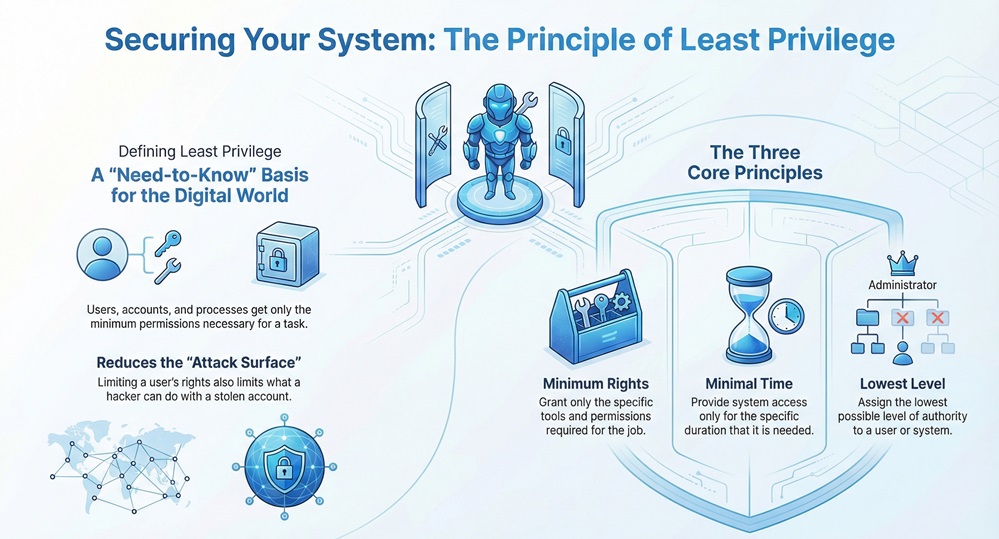
    In simple terms, it is a security rule that limits access rights for users, accounts, and computing processes. You only provide the minimum permissions necessary to perform a task. If a person only needs to read a file, they should not have the right to edit or delete it.
     

    Least Privilege in Cybersecurity


    It is the practice of restricting access to the bare minimum. This applies to humans, but it also applies to applications, systems, and devices. Think of it as a "need-to-know" basis for the digital world.


    Request a Comprehensive Access Audit


    Defining Least Privilege Principles

    Least privilege principles focus on reducing the attack surface. When you limit what a user can do, you limit what a hacker can do if they steal that user's login.


    • Minimum Rights: Give only the tools required for the job.
    • Minimal Time: Provide access only for the duration needed.
    • Lowest Level: Assign the lowest level of authority possible.


    What Does Least Privilege Mean in Access Control?

    It means your system must verify every request. It does not trust a user just because they are inside the network. Access control systems use this rule to decide who can see, change, or move data.


    Least privilege access control works by creating strict boundaries. For example, a marketing manager does not need access to the payroll database. By blocking that path, the system stays secure.


    Also Read: What Is Zero Touch Provisioning (ZTP)? All You Need to Know


    Least Privilege vs. Excessive Privilege

    To understand why least privilege security matters, we must compare it to the alternative. Many older systems use "all-or-nothing" access. This is dangerous.


    Basis for ComparisonLeast Privilege AccessExcessive Privilege Access
    Access LevelMinimum required for tasksFull access to many systems
    Security RiskLow (contained)High (widespread)
    User ScopeSpecific and restrictedBroad and open
    ManagementRequires regular auditsOften ignored or "set and forget"
    Impact of BreachLimited to one areaPotential for total system takeover


    Why You Need Least Privilege Access

    Least privilege access is not just a suggestion; it is a necessity. Data breaches are expensive and common. Most attacks involve someone using a stolen account to move through a network.


    Stopping Lateral Movement

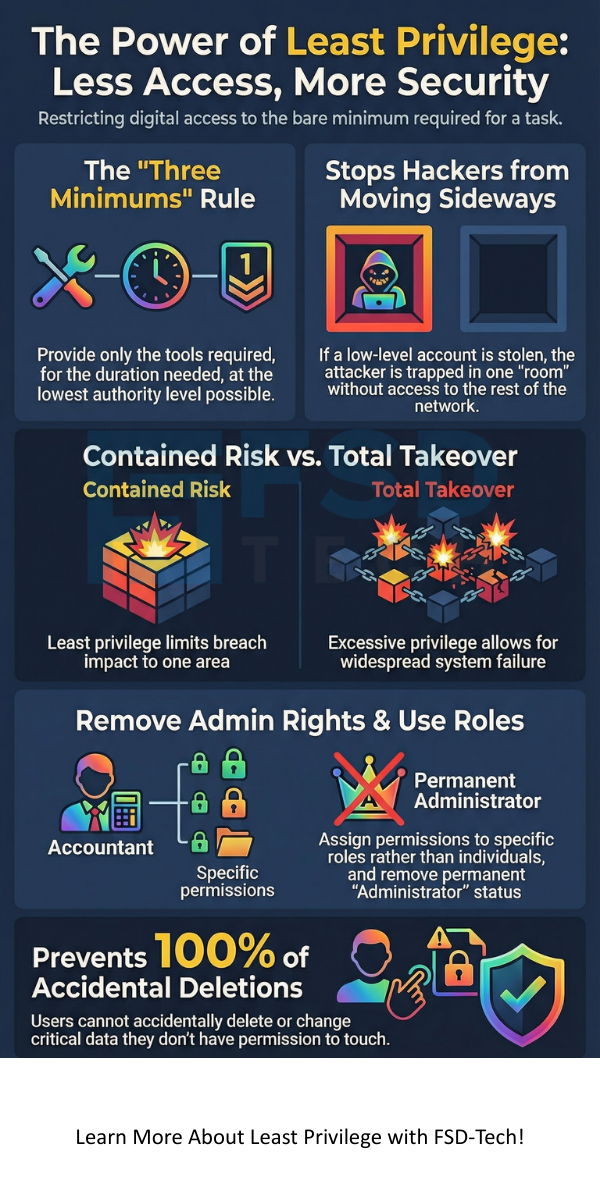
    Least privilege security prevents hackers from moving sideways through your system. If a hacker enters through a low-level account, they find themselves stuck in a small "room" with no exit. They cannot reach your sensitive files because the account they stole does not have those rights.


    Reducing Human Error

    Least privilege access control protects you from mistakes. Even the best employees make errors. Someone might accidentally delete a database or change a setting. If they do not have the permission to do those things, the mistake never happens.


    Meeting Compliance Standards

    Many regulations like HIPAA or GDPR require you to protect data. They often mandate that you limit access. Using least privilege principles helps you pass audits and avoid heavy fines.


    Also Read: What is Credential Stuffing? Detection and Prevention


    How Least Privilege Works in Practice

    It involves a few technical steps. It is not a one-time setup. It is a continuous process of checking and adjusting.


    Step 1: Identify Critical Assets

    The concept of least privilege starts with knowing what you own. You must list your databases, servers, and sensitive files. You cannot protect what you do not see.


    Step 2: Categorize Users and Roles

    Least privilege access relies on "Role-Based Access Control" (RBAC). Instead of giving permissions to a person, you give them to a role. For example, a "Developer" role gets access to the code, while an "Accountant" role gets access to invoices.


    Step 3: Remove Admin Rights

    Most users do not need to be administrators on their laptops. Removing these rights prevents them from installing unauthorized software or malware.


    Step 4: Use Just-in-Time (JIT) Access

    Least privilege security can be temporary. JIT access gives a user high-level rights only when they need them. Once the task is done, the system automatically removes those rights. This leaves no "always-on" doors for hackers to find.


    Common Challenges in Implementation

    Least privilege access control sounds easy, but it takes work. You might face some pushback from your team.


    1. Workflow Disruptions: If you lock things down too tight, people cannot work. You must find a balance between safety and speed.
    2. Privilege Creep: This happens when an employee changes roles but keeps their old permissions. Over time, they gain too much power.
    3. Complexity: Managing thousands of users and their specific needs is a big task. You need the right tools to handle it.


    Also Read: Brute Force Attack in Cybersecurity - How it Works?


    Benefits of the Concept of Least Privilege

    The concept of least privilege offers more than just security. It improves the way your whole IT department functions.


    • Better Productivity: Systems run better when only authorized apps are running.
    • Easier Troubleshooting: When something breaks, you have a shorter list of people who could have caused the change.
    • Faster Recovery: If an infection happens, it stays in one spot. You can clean it up without wiping your whole network.


    Conclusion

    By adopting least privilege principles, you create a resilient environment that respects your data. Security is not just about building higher walls. It is about making sure that if someone gets over the wall, they find nothing of value.


    At our core, we believe that your safety is our priority. We focus on providing solutions that protect your assets while keeping your team productive. Your trust is our most valuable asset, and we work every day to earn it through smart, simple, and effective security strategies.


    "Don't give hackers an open door. Let us help you build a Zero Trust environment today. Contact Our Security Team
     

    Least Privilege


    Key Takeaways

    • Least privilege access reduces the damage from cyberattacks by limiting what any single user can reach.
    • The concept of least privilege applies to users, applications, and automated systems.
    • Implementing least privilege security involves removing administrative rights and using role-based access.
    • What is least privilege? It is your best defense against both external hackers and internal mistakes.
    • Regular audits are necessary to prevent "privilege creep" where users collect too many permissions over time.


    Frequently Asked Questions on Least Privilege

    What is the principle of least privilege in simple terms?

    It is the practice of giving people exactly what they need to do their job and nothing more. It is like giving a hotel guest a key that only opens their room, not the manager's office.


    Why is least privilege important for remote work?

    Remote workers often use unsecured Wi-Fi. If their device is compromised, least privilege access ensures the hacker cannot reach the corporate core.


    Does least privilege apply to software?

    Yes. Least privilege principles dictate that an application should only run with the permissions it needs. A calculator app should not have access to your contacts or location.


    How do I start using least privilege?

    Start by auditing your current users. See who has "Administrator" status and ask if they really need it. Most of the time, they do not.

    What is the Principle of Least Privilege (PoLP)? Guide & Benefits

    About The Author

    Surbhi Suhane

    Surbhi Suhane is an experienced digital marketing and content specialist with deep expertise in Getting Things Done (GTD) methodology and process automation. Adept at optimizing workflows and leveraging automation tools to enhance productivity and deliver impactful results in content creation and SEO optimization.

    Like This Story?

    Share it with friends!

    Subscribe to our newsletter!

    Atera

    (51)

    Cato Networks

    (121)

    ClickUp

    (70)

    FishOS

    (7)

    Miradore

    (21)

    PointGuard AI

    (9)

    Vembu

    (22)

    Xcitium

    (33)

    ZETA HRMS

    (79)

    Workflow Automation(8)

    Workforce Automation(1)

    AI Project Management(1)

    HR Data Automation(1)

    RMM(1)

    IT Workflow Automation(1)

    GCC compliance(4)

    IT security(2)

    Payroll Integration(2)

    IT support automation(3)

    procurement automation(1)

    lost device management(1)

    IT Management(5)

    IoT Security(2)

    Cato XOps(2)

    IT compliance(4)

    Task Automation(1)

    Workflow Management(1)

    Kubernetes lifecycle management(2)

    AI-powered cloud ops(1)

    OpenStack automation(1)

    SMB Security(8)

    Data Security(1)

    MDR (Managed Detection & Response)(4)

    MSP Automation(3)

    Atera Integrations(2)

    XDR Security(2)

    SMB Cyber Protection(1)

    Ransomware Defense(3)

    HR Tech Solutions(1)

    Zero Trust Network Access(3)

    Zero Trust Security(2)

    Endpoint Management(1)

    SaaS Security(1)

    Payroll Automation(5)

    IT Monitoring(2)

    Xcitium EDR SOC(15)

    Ransomware Protection GCC(1)

    Network Consolidation UAE(1)

    M&A IT Integration(1)

    MSSP for SMBs(1)

    SMB Cybersecurity GCC(1)

    Antivirus vs EDR(1)

    Ransomware Protection(3)

    FSD-Tech MSSP(25)

    Managed EDR FSD-Tech(1)

    Cybersecurity GCC(12)

    Endpoint Security(1)

    Endpoint Protection(1)

    Data Breach Costs(1)

    SMB Cybersecurity(8)

    Zero Dwell Containment(31)

    Xcitium EDR(30)

    Managed Security Services(2)

    Cloud Backup(1)

    Hybrid Backup(1)

    Backup & Recovery(1)

    pointguard ai(4)

    backup myths(1)

    disaster recovery myths(1)

    SMB data protection(9)

    vembu(9)

    Vembu BDR Suite(19)

    Disaster Recovery(4)

    GCCBusiness(1)

    DataProtection(1)

    Secure Access Service Edge(4)

    GCC HR software(20)

    Miradore EMM(15)

    Cato SASE(7)

    Cloud Security(8)

    Talent Development(1)

    AI Security(2)

    AI Cybersecurity(12)

    AI Governance(4)

    AI Risk Management(1)

    AI Compliance(2)

    GCC business security(1)

    GCC network integration(1)

    compliance automation(5)

    education security(1)

    GCC cybersecurity(2)

    BYOD security Dubai(8)

    App management UAE(1)

    Miradore EMM Premium+(5)

    MiddleEast(1)

    HealthcareSecurity(1)

    Team Collaboration(1)

    IT automation(12)

    Zscaler(1)

    SD-WAN(6)

    HR Integration(4)

    Cloud Networking(4)

    device management(9)

    RemoteWork(1)

    VPN(1)

    ZeroTrust(2)

    MPLS(1)

    Project Management(9)

    HR automation(16)

    share your thoughts

    Principle of Least Privilege (PoLP)

    What is the Principle of Least Privilege (PoLP)? Guide & Benefits

    🕓 February 5, 2026

    Symmetric Encryption

    What is Symmetric Encryption? Process and Algorithms

    🕓 February 5, 2026

    Digital Twin Technology

    What is a Digital Twin? Technology, Examples & Benefits

    🕓 February 4, 2026

    Decoded(97)

    Cyber Security(118)

    BCP / DR(22)

    Zeta HRMS(78)

    SASE(21)

    Automation(70)

    Next Gen IT-Infra(118)

    Monitoring & Management(72)

    ITSM(22)

    HRMS(21)

    Automation(24)