HomeNext Gen IT-InfraMonitoring & ManagementCyber SecurityBCP / DRAutomationDecoded
Next Gen IT-Infra
Cato’s SASE Supports Cybersecurity Skills Development

How Cato’s SASE Supports Cybersecurity Skills Development

🕓 April 8, 2025

How SASE Supports the Security Needs of SMBs

How SASE Supports the Security Needs of SMBs

🕓 February 9, 2025

Attack Surface Reduction with Cato’s SASE

Attack Surface Reduction with Cato’s SASE

🕓 February 10, 2025

SASE for Digital Transformation in UAE

SASE for Digital Transformation in UAE

🕓 February 8, 2025

Monitoring & Management
Understanding Atera’s SLA Management

Understanding Atera’s SLA Management

🕓 February 7, 2025

Cost-Performance Ratio: Finding the Right Balance in IT Management Networks

Cost-Performance Ratio: Finding the Right Balance in IT Management Networks

🕓 June 16, 2025

Customizing Atera with APIs

Customizing Atera with APIs

🕓 March 3, 2025

Power Up Your IT Team’s Strategy with Atera’s Communication Tools

Power Up Your IT Team’s Strategy with Atera’s Communication Tools

🕓 February 8, 2025

Cyber Security
Illustration of the Cato Cloud architecture showing its role in delivering SASE for secure, optimized global connectivity.

Understanding the Cato Cloud and Its Role in SASE

🕓 January 29, 2025

Isometric illustration of professionals managing network performance, bandwidth analytics, and cloud-based optimization around the Cato Networks platform, symbolizing bandwidth control and QoS visibility.

Mastering Bandwidth Control and QoS in Cato Networks

🕓 July 26, 2025

Global network backbone powering Cato SASE solution for secure, high-performance connectivity across regions.

Global Backbone: The Engine Powering Cato’s SASE Solution

🕓 January 30, 2025

Illustration of team analyzing application traffic and usage insights on a large laptop screen using Cato’s dashboard, surrounded by network and cloud icons.

Cato Networks Application Visibility | Monitoring & Control

🕓 July 27, 2025

BCP / DR
Illustration showing diverse business and IT professionals collaborating with cloud, backup, and security icons, representing Vembu use cases for SMBs, MSPs, and IT teams.

Who Uses Vembu? Real-World Use Cases for SMBs, MSPs & IT Teams

🕓 July 12, 2025

Graphic showcasing Vembu’s all-in-one backup and disaster recovery platform with icons for cloud, data protection, and business continuity for IT teams and SMBs.

What Is Vembu? A Deep Dive Into the All in One Backup & Disaster Recovery Platform

🕓 July 6, 2025

Illustration showing Vembu backup and disaster recovery system with cloud storage, server racks, analytics dashboard, and IT professionals managing data.

The Rising Cost of Data Loss: Why Backup Is No Longer Optional?

🕓 August 14, 2025

3D isometric illustration of cloud backup and data recovery infrastructure with laptop, data center stack, and digital business icons — FSD Tech

RPO & RTO: The Heart of Business Continuity

🕓 August 15, 2025

Automation
Cross-Functional Collaboration with ClickUp

Fostering Cross-Functional Collaboration with ClickUp for Multi-Departmental Projects

🕓 February 11, 2025

ClickUp Project Reporting

Revolutionizing Enterprise Reporting with ClickUp’s Advanced Analytics and Dashboards

🕓 June 16, 2025

ClickUp’s Design Collaboration and Asset Management Tools

Empowering Creative Teams with ClickUp’s Design Collaboration and Asset Management Tools

🕓 February 26, 2025

ClickUp Communication and Collaboration Tools

ClickUp Communication and Collaboration Tools: Empowering Remote Teams

🕓 March 12, 2025

Decoded
Multi-Factor Authentication (MFA)

Multi-Factor Authentication (MFA): All You Need to Know

🕓 December 7, 2025

L3 Switch

What Is an L3 Switch? L2 vs L3 & Why You Need Layer 3?

🕓 December 8, 2025

IPSec

IPSec Explained: Protocols, Modes, IKE & VPN Security

🕓 December 3, 2025

 Datagram Transport Layer Security (DTLS)

What is Datagram Transport Layer Security (DTLS)? How it works?

🕓 December 4, 2025

    Subscribe to our newsletter!

    About Us

    Follow Us

    Copyright © 2024 | Powered by 

    Cato SASE Architecture

    Inside Cato’s SASE Architecture: A Blueprint for Modern Security

    🕓 January 26, 2025

    Enterprise Data Security and Privacy with ClickUp

    Ensuring Enterprise Data Security and Privacy with ClickUp

    🕓 February 9, 2025

    DDoS protection SASE

    DDoS Protection and Cato’s Defence Mechanisms

    🕓 February 11, 2025

    Table of Contents

    What is Symmetric Encryption? Process and Algorithms

    Surbhi Suhane
    February 5, 2026
    Comments
    Symmetric Encryption

    Have you ever wondered how your private messages stay private? In the world of digital safety, symmetric encryption plays a vital role. It is a fundamental method used to protect data. But how does it really work, and why should you care about it? Let's explore this essential tool.


    What is Symmetric Encryption?

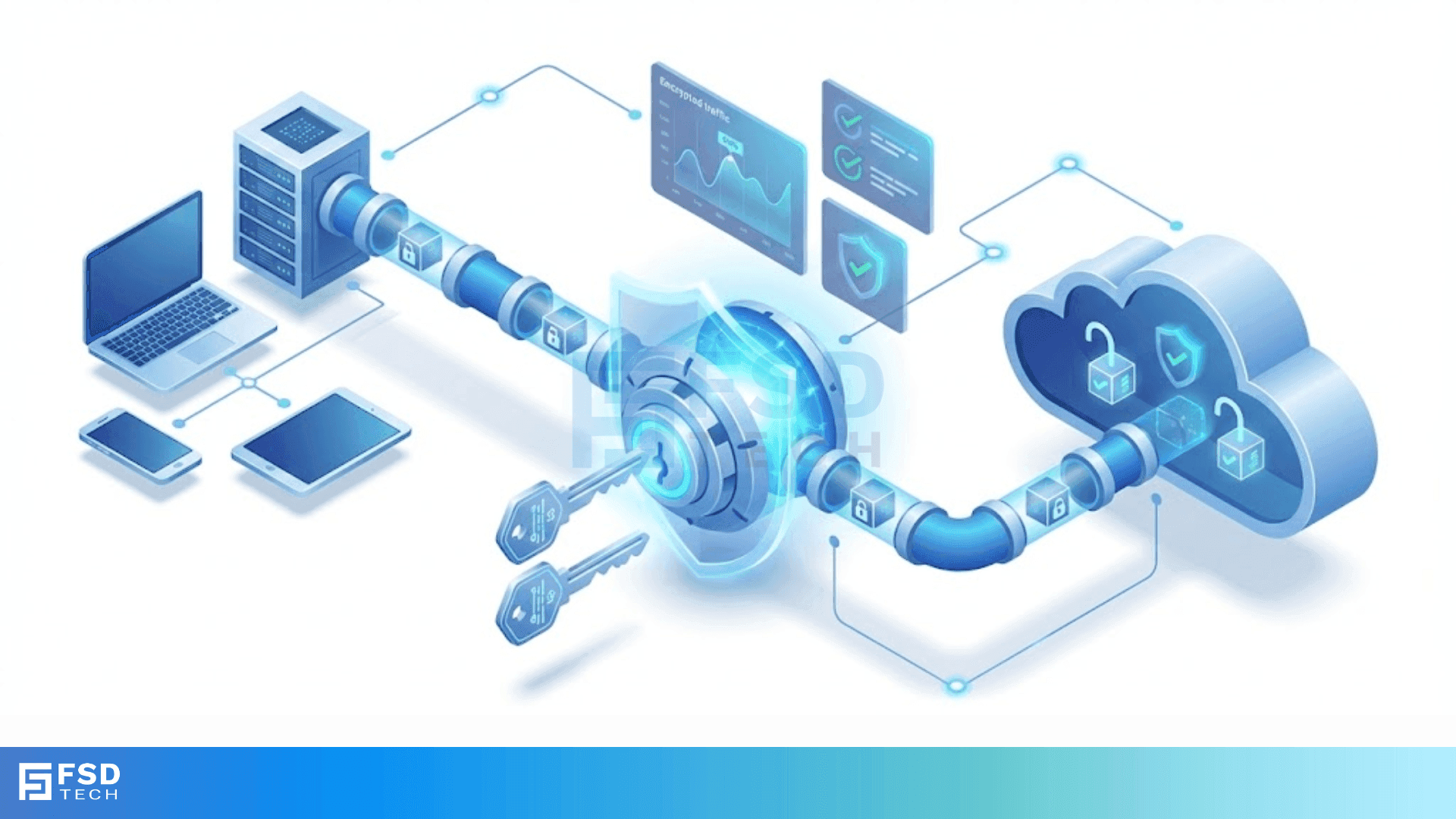
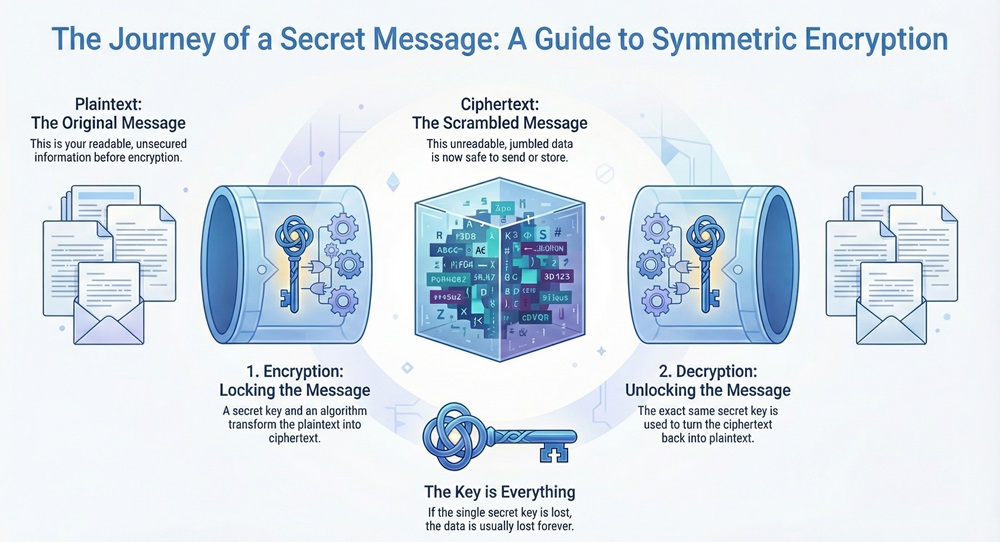
    Symmetric encryption can be understood as a type of cryptography where only one secret key is used. This single key handles both symmetric encryption and decryption tasks. This means the sender and the receiver must share the same "password" or key before they can communicate safely.
     

    Symmetric Encryption


    It is one of the oldest and most reliable methods in information security. In simple terms, it works like a physical lock and key. You use one key to lock a box. You must give that same key to your friend so they can open it. If anyone else finds the box, they cannot see what is inside without that specific key.


    Consult with our Encryption Specialists


    Basic Concepts of Cryptography

    To understand symmetric encryption in information security, we must look at a few basic terms:


    • Plaintext: This is the original message you want to send. It is readable by anyone.
    • Ciphertext: This is the scrambled version of your message. It looks like random gibberish.
    • Encryption Algorithm: This is the mathematical formula or set of rules used to turn plaintext into ciphertext.
    • Secret Key: This is the piece of information that controls the algorithm.


    How Symmetric Encryption and Decryption Work

    Symmetric encryption and decryption follow a very specific path. This process ensures that data remains confidential while it travels across a network.


    The Encryption Step

    First, the sender takes the plaintext message. They choose a specific symmetric encryption algorithm. Then, they apply the secret key to that algorithm. The result is ciphertext. This scrambled data is now ready to be sent over the internet or stored on a disk.


    The Decryption Step

    Next, the receiver gets the ciphertext. To read the message, they must use the exact same secret key. The receiver applies this key to the inverse of the algorithm. This turns the ciphertext back into the original plaintext.


    What happens if the key is lost? If the key is lost, the data usually cannot be recovered. This is why key management is so important.


    Also Read: What is Decryption and Encryption in Modern Data Security?


    Types of Symmetric Encryption Algorithms

    Symmetric encryption algorithm types are usually divided into two main categories. These are stream ciphers and block ciphers.


    1. Block Ciphers

    A block cipher breaks the data into fixed-size chunks. These chunks are called blocks. A common block size is 128 bits. The algorithm processes each block one by one.


    • AES (Advanced Encryption Standard): This is the most popular choice today. It is used by governments and banks.
    • DES (Data Encryption Standard): This is an older standard. It is no longer considered secure for modern needs.
    • 3DES (Triple DES): This applies the DES algorithm three times to each block to increase security.


    2. Stream Ciphers

    A stream cipher encrypts data one bit or one byte at a time. It does not wait for a full block of data to be ready. This makes it very fast.


    • RC4: This was used in older Wi-Fi security. However, it now has known weaknesses.
    • ChaCha20: This is a modern and very fast stream cipher used in many mobile apps.


    Symmetric vs Asymmetric Encryption

    When discussing information security, we often compare symmetric methods to asymmetric ones. Asymmetric encryption uses two different keys: a public key and a private key.

    Let us look at a comparison to see the differences clearly.


    Basis for ComparisonSymmetric EncryptionAsymmetric Encryption
    Number of KeysSingle secret keyTwo keys (Public and Private)
    SpeedVery fastSlower due to complex math
    Resource UsageLow CPU and memory needsHigh CPU and memory needs
    Key ExchangeKey must be shared securelyNo need to share private keys
    Primary UseBulk data encryptionSecure key exchange and signatures
    Data SizeGood for large filesGood for small data bits


    What is Not a Symmetric Encryption Algorithm?

    It is easy to get confused by different security terms. Many people ask, "what is not a symmetric encryption algorithm?" Understanding the exceptions helps clarify the definition.


    Public Key Algorithms (Asymmetric)

    Algorithms like RSA (Rivest-Shamir-Adleman) and Diffie-Hellman are not symmetric. They rely on the relationship between two different keys. If an algorithm requires a "public key" to work, it is not symmetric.


    Hashing Algorithms

    Hashing is also not encryption. While encryption is a two-way street (you can lock and unlock it), hashing is a one-way street. MD5 and SHA-256 are examples of hashing. You cannot "decrypt" a hash to get the original data back. Therefore, a hash is not a symmetric encryption algorithm.


    Also Read: What is BIOS Security? Features & Protection


    The Role of Symmetric Encryption in Information Security

    Symmetric encryption in information security provides three main things: confidentiality, integrity, and speed.


    Ensuring Confidentiality

    The primary goal is to keep secrets. By using a strong symmetric encryption decryption process, organizations ensure that hackers cannot read stolen data. Even if a database is leaked, the information remains useless without the key.


    Maintaining High Performance

    Why don't we use asymmetric encryption for everything? The answer is speed. Asymmetric math is very heavy. It would slow down your internet connection if every single packet used it. Symmetric encryption and decryption are much lighter. This allows for real-time video streaming and fast file transfers.


    Secure Storage

    Most modern hard drives use symmetric methods to protect "data at rest." When you set a password on your laptop, the system often uses AES to lock your files. This is a classic example of symmetric encryption decryption in daily life.


    Common Challenges and Limitations

    No system is perfect. Symmetric encryption faces one major hurdle: the "Key Distribution Problem."


    The Key Distribution Problem

    If you and I want to talk privately, I need to give you my secret key. But how do I send it to you? If I send it through an email, a hacker could steal it. If they have the key, the encryption is useless.


    Scalability Issues

    In a large network, the number of keys grows very fast. If 100 people want to talk to each other privately, they need thousands of individual keys. Managing these keys becomes a nightmare for IT departments.


    Symmetric Encryption Decryption Standards

    To keep data safe, we must use verified standards. Using "custom" or "home-made" encryption is a bad idea.


    1. Advanced Encryption Standard (AES)

    AES is the gold standard for symmetric encryption algorithm use. It was chosen by the National Institute of Standards and Technology (NIST) after a long competition. It supports key lengths of 128, 192, and 256 bits.


    2. Blowfish and Twofish

    These are alternative block ciphers. They were designed to be fast and are not owned by any single company. They are often used in password managers and open-source software.


    Also Read: Cloud Encryption Gateway (CEG): Keep Keys, Secure Data


    Practical Steps for Implementation

    How do developers use symmetric encryption in information security? They follow a standard workflow.


    1. Select an Algorithm: Most choose AES-256 for maximum safety.
    2. Generate a Random Key: The key must be truly random. It should not be a simple word found in a dictionary.
    3. Use an Initialization Vector (IV): An IV ensures that the same message encrypted twice looks different both times. This prevents pattern recognition.
    4. Secure the Key: The key is stored in a "Key Vault" or a hardware security module (HSM).
    5. Perform Symmetric Encryption and Decryption: The data is processed as needed for the application.


    Conclusion

    Symmetric encryption is the backbone of modern digital privacy. It allows us to send huge amounts of data safely across the globe. By using a single secret key, it balances high-level security with incredible speed. While key management remains a challenge, combining this method with other tools creates a solid defense.


    At FSD-tech we believe that understanding your security is the first step toward staying safe. We focus on providing clear, expert guidance to help you navigate the digital world. Your data is your most valuable asset, and we are committed to helping you protect it. Whether you are building an app or securing a business, we are here to support your journey with proven expertise and a client-first approach.


    Don't leave your data to chance. Let’s build a robust encryption strategy together. Contact Our Team Today
     

    Symmetric encryption


    Key Takeaways

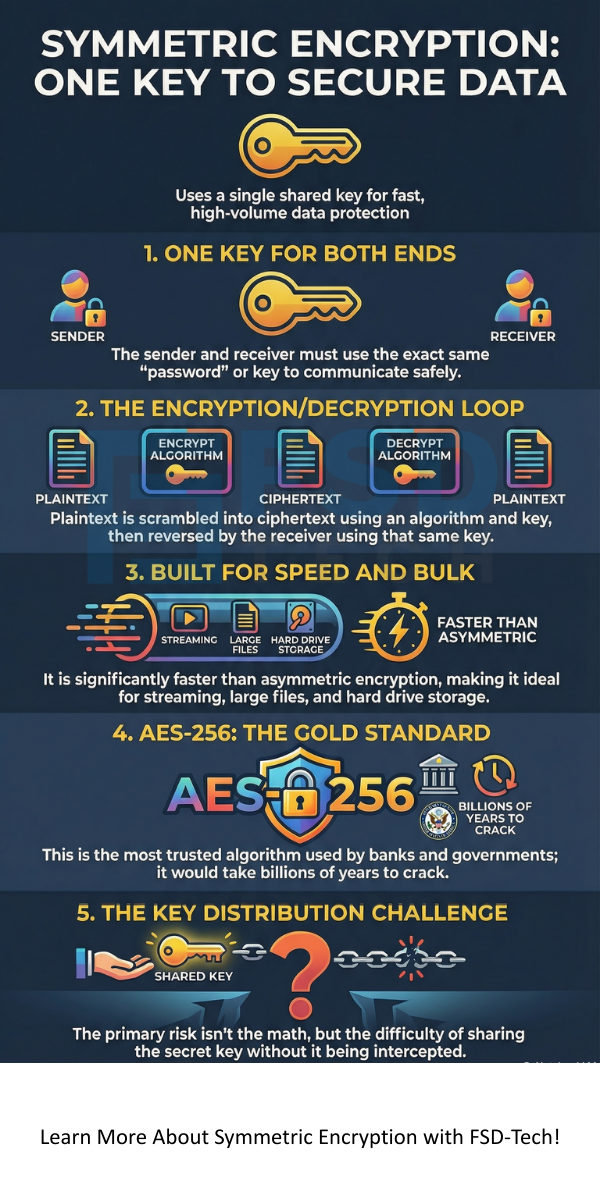
    • Symmetric encryption uses a single secret key for both locking and unlocking data.
    • The symmetric encryption and decryption process is highly efficient and fast.
    • AES is the most widely used and trusted symmetric encryption algorithm today.
    • Symmetric encryption in information security is the primary method for protecting bulk data and hard drives.
    • The biggest challenge is sharing the secret key without it being intercepted by others.
    • Items like RSA or hashing functions are what is not a symmetric encryption algorithm.


    Frequently Asked Questions (FAQs)

    What is the main advantage of symmetric encryption?

    The main advantage is speed. It can process large amounts of data very quickly with very little power. This makes it perfect for mobile devices and high-speed servers.


    Is symmetric encryption less secure than asymmetric?

    No, it is not "less secure." In fact, a 256-bit symmetric key is mathematically stronger than a 2048-bit asymmetric key. The main risk is how the key is shared, not the strength of the math itself.


    Can symmetric encryption be cracked?

    Modern algorithms like AES-256 are currently impossible to "brute-force" with today's computers. It would take billions of years to try every possible key. Most hacks happen because someone stole the key, not because they broke the algorithm.


    What is a common example of symmetric encryption?

    Your home Wi-Fi (WPA2 or WPA3) uses symmetric encryption. Both your router and your phone use the same "Wi-Fi Password" as a key to protect your data.


    How are keys shared safely?

    In modern systems, we often use asymmetric encryption to send a symmetric key. This combines the security of asymmetric methods with the speed of symmetric ones.


    What is Symmetric Encryption? Process and Algorithms

    About The Author

    Surbhi Suhane

    Surbhi Suhane is an experienced digital marketing and content specialist with deep expertise in Getting Things Done (GTD) methodology and process automation. Adept at optimizing workflows and leveraging automation tools to enhance productivity and deliver impactful results in content creation and SEO optimization.

    Like This Story?

    Share it with friends!

    Subscribe to our newsletter!

    Atera

    (51)

    Cato Networks

    (121)

    ClickUp

    (70)

    FishOS

    (7)

    Miradore

    (21)

    PointGuard AI

    (9)

    Vembu

    (22)

    Xcitium

    (33)

    ZETA HRMS

    (79)

    Workflow Automation(8)

    Workforce Automation(1)

    AI Project Management(1)

    HR Data Automation(1)

    RMM(1)

    IT Workflow Automation(1)

    GCC compliance(4)

    IT security(2)

    Payroll Integration(2)

    IT support automation(3)

    procurement automation(1)

    lost device management(1)

    IT Management(5)

    IoT Security(2)

    Cato XOps(2)

    IT compliance(4)

    Task Automation(1)

    Workflow Management(1)

    Kubernetes lifecycle management(2)

    AI-powered cloud ops(1)

    OpenStack automation(1)

    SMB Security(8)

    Data Security(1)

    MDR (Managed Detection & Response)(4)

    MSP Automation(3)

    Atera Integrations(2)

    XDR Security(2)

    SMB Cyber Protection(1)

    Ransomware Defense(3)

    HR Tech Solutions(1)

    Zero Trust Network Access(3)

    Zero Trust Security(2)

    Endpoint Management(1)

    SaaS Security(1)

    Payroll Automation(5)

    IT Monitoring(2)

    Xcitium EDR SOC(15)

    Ransomware Protection GCC(1)

    Network Consolidation UAE(1)

    M&A IT Integration(1)

    MSSP for SMBs(1)

    SMB Cybersecurity GCC(1)

    Antivirus vs EDR(1)

    Ransomware Protection(3)

    FSD-Tech MSSP(25)

    Managed EDR FSD-Tech(1)

    Cybersecurity GCC(12)

    Endpoint Security(1)

    Endpoint Protection(1)

    Data Breach Costs(1)

    SMB Cybersecurity(8)

    Zero Dwell Containment(31)

    Xcitium EDR(30)

    Managed Security Services(2)

    Cloud Backup(1)

    Hybrid Backup(1)

    Backup & Recovery(1)

    pointguard ai(4)

    backup myths(1)

    disaster recovery myths(1)

    SMB data protection(9)

    vembu(9)

    Vembu BDR Suite(19)

    Disaster Recovery(4)

    GCCBusiness(1)

    DataProtection(1)

    Secure Access Service Edge(4)

    GCC HR software(20)

    Miradore EMM(15)

    Cato SASE(7)

    Cloud Security(8)

    Talent Development(1)

    AI Security(2)

    AI Cybersecurity(12)

    AI Governance(4)

    AI Risk Management(1)

    AI Compliance(2)

    GCC business security(1)

    GCC network integration(1)

    compliance automation(5)

    education security(1)

    GCC cybersecurity(2)

    BYOD security Dubai(8)

    App management UAE(1)

    Miradore EMM Premium+(5)

    MiddleEast(1)

    HealthcareSecurity(1)

    Team Collaboration(1)

    IT automation(12)

    Zscaler(1)

    SD-WAN(6)

    HR Integration(4)

    Cloud Networking(4)

    device management(9)

    RemoteWork(1)

    VPN(1)

    ZeroTrust(2)

    MPLS(1)

    Project Management(9)

    HR automation(16)

    share your thoughts

    Principle of Least Privilege (PoLP)

    What is the Principle of Least Privilege (PoLP)? Guide & Benefits

    🕓 February 5, 2026

    Symmetric Encryption

    What is Symmetric Encryption? Process and Algorithms

    🕓 February 5, 2026

    Digital Twin Technology

    What is a Digital Twin? Technology, Examples & Benefits

    🕓 February 4, 2026

    Decoded(97)

    Cyber Security(118)

    BCP / DR(22)

    Zeta HRMS(78)

    SASE(21)

    Automation(70)

    Next Gen IT-Infra(118)

    Monitoring & Management(72)

    ITSM(22)

    HRMS(21)

    Automation(24)