HomeNext Gen IT-InfraMonitoring & ManagementCyber SecurityBCP / DRAutomationDecoded
Next Gen IT-Infra
Cato’s SASE Supports Cybersecurity Skills Development

How Cato’s SASE Supports Cybersecurity Skills Development

🕓 April 8, 2025

How SASE Supports the Security Needs of SMBs

How SASE Supports the Security Needs of SMBs

🕓 February 9, 2025

Attack Surface Reduction with Cato’s SASE

Attack Surface Reduction with Cato’s SASE

🕓 February 10, 2025

SASE for Digital Transformation in UAE

SASE for Digital Transformation in UAE

🕓 February 8, 2025

Monitoring & Management
Understanding Atera’s SLA Management

Understanding Atera’s SLA Management

🕓 February 7, 2025

Cost-Performance Ratio: Finding the Right Balance in IT Management Networks

Cost-Performance Ratio: Finding the Right Balance in IT Management Networks

🕓 June 16, 2025

Customizing Atera with APIs

Customizing Atera with APIs

🕓 March 3, 2025

Power Up Your IT Team’s Strategy with Atera’s Communication Tools

Power Up Your IT Team’s Strategy with Atera’s Communication Tools

🕓 February 8, 2025

Cyber Security
Illustration of the Cato Cloud architecture showing its role in delivering SASE for secure, optimized global connectivity.

Understanding the Cato Cloud and Its Role in SASE

🕓 January 29, 2025

Isometric illustration of professionals managing network performance, bandwidth analytics, and cloud-based optimization around the Cato Networks platform, symbolizing bandwidth control and QoS visibility.

Mastering Bandwidth Control and QoS in Cato Networks

🕓 July 26, 2025

Global network backbone powering Cato SASE solution for secure, high-performance connectivity across regions.

Global Backbone: The Engine Powering Cato’s SASE Solution

🕓 January 30, 2025

Illustration of team analyzing application traffic and usage insights on a large laptop screen using Cato’s dashboard, surrounded by network and cloud icons.

Cato Networks Application Visibility | Monitoring & Control

🕓 July 27, 2025

BCP / DR
Illustration showing diverse business and IT professionals collaborating with cloud, backup, and security icons, representing Vembu use cases for SMBs, MSPs, and IT teams.

Who Uses Vembu? Real-World Use Cases for SMBs, MSPs & IT Teams

🕓 July 12, 2025

Graphic showcasing Vembu’s all-in-one backup and disaster recovery platform with icons for cloud, data protection, and business continuity for IT teams and SMBs.

What Is Vembu? A Deep Dive Into the All in One Backup & Disaster Recovery Platform

🕓 July 6, 2025

Illustration showing Vembu backup and disaster recovery system with cloud storage, server racks, analytics dashboard, and IT professionals managing data.

The Rising Cost of Data Loss: Why Backup Is No Longer Optional?

🕓 August 14, 2025

3D isometric illustration of cloud backup and data recovery infrastructure with laptop, data center stack, and digital business icons — FSD Tech

RPO & RTO: The Heart of Business Continuity

🕓 August 15, 2025

Automation
Cross-Functional Collaboration with ClickUp

Fostering Cross-Functional Collaboration with ClickUp for Multi-Departmental Projects

🕓 February 11, 2025

ClickUp Project Reporting

Revolutionizing Enterprise Reporting with ClickUp’s Advanced Analytics and Dashboards

🕓 June 16, 2025

ClickUp’s Design Collaboration and Asset Management Tools

Empowering Creative Teams with ClickUp’s Design Collaboration and Asset Management Tools

🕓 February 26, 2025

ClickUp Communication and Collaboration Tools

ClickUp Communication and Collaboration Tools: Empowering Remote Teams

🕓 March 12, 2025

Decoded
Multi-Factor Authentication (MFA)

Multi-Factor Authentication (MFA): All You Need to Know

🕓 December 7, 2025

L3 Switch

What Is an L3 Switch? L2 vs L3 & Why You Need Layer 3?

🕓 December 8, 2025

IPSec

IPSec Explained: Protocols, Modes, IKE & VPN Security

🕓 December 3, 2025

 Datagram Transport Layer Security (DTLS)

What is Datagram Transport Layer Security (DTLS)? How it works?

🕓 December 4, 2025

    Subscribe to our newsletter!

    About Us

    Follow Us

    Copyright © 2024 | Powered by 

    Atera

    (56)

    Cato Networks

    (128)

    ClickUp

    (78)

    FishOS

    (7)

    Miradore

    (21)

    PointGuard AI

    (9)

    Vembu

    (22)

    Xcitium

    (33)

    ZETA HRMS

    (79)

    Table of Contents

    What is the Shared Responsibility Model and Why Does it Matter?

    Surbhi Suhane
    March 5, 2026
    Comments
    Shared Responsibility Model

    The shared responsibility model is the fundamental framework that dictates who is responsible for security in the cloud. Have you ever wondered if your data is truly safe just because it’s sitting on a world-class server? 


    Many people assume that once they move to the cloud, the provider handles everything from A to Z. In my experience, this is the biggest mistake a business can make. It’s like renting an apartment; the landlord fixes the roof, but you still have to lock your front door. If you leave it wide open, you can't really blame the building owner for a missing TV, right?


    The shared responsibility model works in a very similar way. It draws a line in the sand between what the cloud service provider (CSP) manages and what you, the customer, must handle. This isn't just a technical detail; it’s a legal and operational necessity. If you don't know where the provider's job ends and yours begins, you're leaving your "front door" wide open for hackers.


    What is the Shared Responsibility Model?

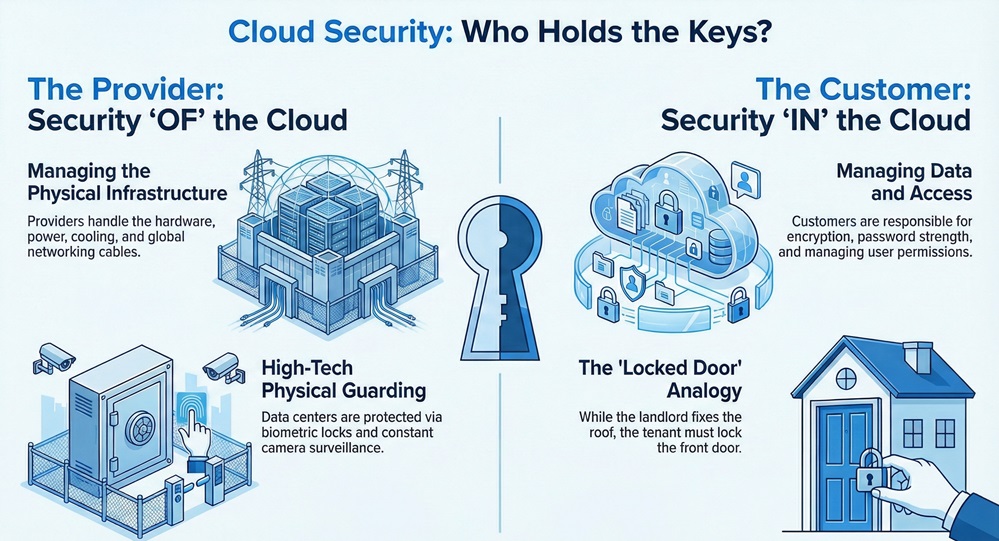
    To be honest, the concept is simpler than most tech blogs make it sound. Every major player, from AWS to Google Cloud, uses a shared responsibility model to keep things organized. They provide the "security OF the cloud," while you handle the "security IN the cloud." That sounds like a catchy slogan, but what does it actually mean for your daily operations?


    Shared Responsibility Model infographic


    The CSP takes care of the physical hardware, the power, the cooling, and the actual cables that run the internet. We've all seen those high-tech data centers in photos. They guard those with biometric locks and cameras. However, they don't look at the data you put on their servers. They don't know if your password is "123456" or if you've given access to a former employee. That part is on you.


    Why is the Shared Responsibility Model Necessary?

    The shared responsibility model exists because cloud providers cannot control how you use their tools. Think of it like a car manufacturer. They build the car with airbags and anti-lock brakes (security OF the car). But if you choose to drive at night without headlights, that’s a user error (security IN the car).


    In the digital world, this means the provider ensures the database software isn't broken, but you ensure the data inside that database is encrypted. We've seen massive data breaches where a company blamed the cloud, only to find out they left a storage bucket public. Don't be that company.


    Secure Your Data Now


    How the Shared Responsibility Model Changes by Service Type

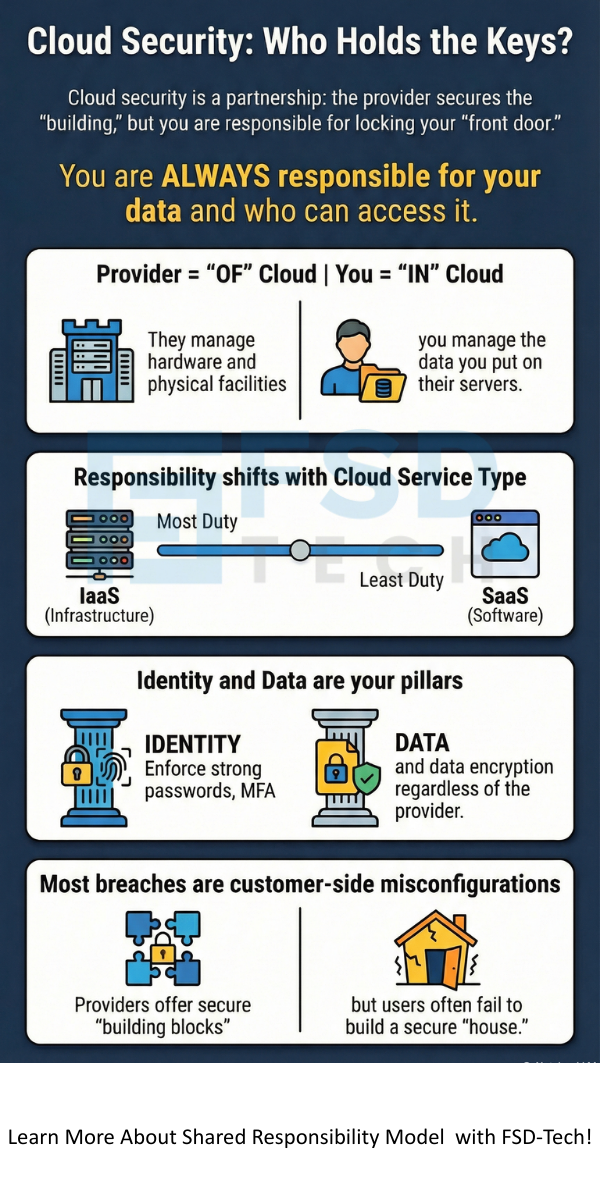
    The line of responsibility moves depending on what kind of cloud service you use. We usually talk about three main types: IaaS, PaaS, and SaaS. It's helpful to picture these as a sliding scale. The more the provider does for you, the less you have to manage—but you never reach 0% responsibility.


    IaaS and the Shared Responsibility Model

    Infrastructure as a Service (IaaS) gives you the most control. Here, the shared responsibility model puts the heavy lifting on your shoulders. The provider manages the physical stuff, like the servers and the hypervisor. You manage everything else.


    • You handle: Operating systems, apps, network firewalls, and data.
    • They handle: Physical security of data centers, hardware, and global infrastructure.


    If you don't patch your virtual machine's OS, it's your fault if it gets hacked. Does that make sense? It's the most flexible option, but it requires the most "security sweat equity."


    PaaS and the Shared Responsibility Model

    Platform as a Service (PaaS) is the middle ground. Developers love it because they don't have to worry about the underlying server. In this version of the shared responsibility model, the provider takes over the operating system and the middleware.


    • You handle: The application code and the data.
    • They handle: The OS, the servers, and the physical network.


    You still have to make sure your code doesn't have bugs that allow SQL injections. The platform is secure, but your specific app might not be.


    SaaS and the Shared Responsibility Model

    Software as a Service (SaaS) is like Microsoft 365 or Salesforce. Here, the provider does almost everything. Many people think the shared responsibility model disappears here, but that is a dangerous myth.


    • You handle: User access (IAM), passwords, and the data itself.
    • They handle: Everything else, including the app and infrastructure.


    Even in SaaS, if your employee's account is compromised because they didn't have Multi-Factor Authentication (MFA) turned on, that's your responsibility. The provider can't stop a user from logging in with a valid (stolen) password.


    Also Read: What is Managed SD-WAN? All You Need to Know


    Critical Areas of the Shared Responsibility Model

    Now, let's look at the specific buckets of tasks. No matter which cloud flavor you pick, these categories always come up.


    Data Governance and Rights

    In every single shared responsibility model, you own the data. This means you are responsible for labeling it, classifying it, and making sure it meets privacy laws like HIPAA or GDPR. The cloud provider is just a vault. They don't decide who gets the key; you do.


    Identity and Access Management (IAM)

    Who can log in? This is the core of cloud security. We've all seen how easy it is to lose a password. Under the shared responsibility model, setting up strong IAM policies is your job. You must enforce the "principle of least privilege." This means only giving people the access they absolutely need to do their jobs.


    Endpoint Security

    Are your employees accessing the cloud from a coffee shop on an unencrypted laptop? The CSP can't see that. Protecting the devices that connect to the cloud is a major part of your side of the shared responsibility model. This includes using VPNs and keeping antivirus software up to date.


    Common Myths About Cloud Security

    I've talked to many business owners who feel overwhelmed by this. Let’s clear up some common misconceptions that lead to "cloud anxiety."


    1. "The cloud is less secure than on-premise." Actually, companies like Amazon and Microsoft spend billions on security. Your local server room probably doesn't have a 24/7 armed guard and world-class encryption experts. The cloud is very secure, provided you do your part.
    2. "Compliance is the provider's job." Just because a provider is "HIPAA compliant" doesn't mean your business is. You have to configure the tools in a compliant way. The shared responsibility model means they provide the compliant "building blocks," but you have to build a compliant "house."
    3. "I don't need backups in the cloud." Wrong! While providers offer high availability, they don't always protect against accidental deletion or ransomware. Maintaining a backup strategy is almost always a customer responsibility.


    Also Read: What is a Secure Web Gateway and How Does It Protect You?


    Steps to Master Your Shared Responsibility Model

    How do you actually implement this without going crazy? Here is a simple plan we often recommend to our partners.


    1. Read Your Contract

    It sounds boring, but your Service Level Agreement (SLA) is where the shared responsibility model is legally defined. Look for the "Security" or "Compliance" sections.


    2. Audit Your Permissions

    Check your IAM settings. Are there "ghost" accounts from people who left the company months ago? Cleaning these up is a quick win for your security posture.


    3. Use Automated Tools

    Many cloud providers offer tools (like AWS Trusted Advisor or Azure Security Center) that tell you if you're failing your side of the shared responsibility model. These tools act like a "security health check."


    4. Train Your Team

    Human error causes most cloud breaches. Make sure your team knows that security isn't "the IT guy's job." It’s everyone’s job to handle data carefully.


    Conclusion

    Understanding the shared responsibility model is the first step toward a secure digital future. It isn't about the provider passing the buck; it's about a partnership where both sides do what they do best. By taking ownership of your data and access points, you can enjoy the speed and scale of the cloud without the constant fear of a breach.


    At FSD-Tech, we believe that security should be accessible to everyone. We're committed to helping you navigate these complex lines so you can focus on growing your business. Your peace of mind is our biggest priority, and we're always here to help you lock that front door.


    Get a Free Cloud Audit


    Key Takeaways on Shared Responsibility Model

    • The line varies: Your duties change based on whether you use IaaS, PaaS, or SaaS.
    • Data is always yours: You are always responsible for the data you put in the cloud.
    • Identity is the new perimeter: Managing who has access is your most important task.
    • Configuration matters: Most breaches happen because of customer misconfigurations, not provider failures.
    • Documentation is key: Always keep a record of how you are meeting your security obligations.


    Frequently Asked Questions on Shared Responsibility Model

    What happens if the provider has a breach?

    If the breach happens in the physical infrastructure or the underlying software they manage, it's on them. They usually have insurance and protocols to handle this. However, if the breach happened because you used a weak password, you are liable.


    Does the shared responsibility model apply to private clouds?

    Yes, but the line shifts even more toward you. In a private cloud, you might even be responsible for the hardware and the cooling systems, depending on the setup.


    How do I know if I'm meeting my responsibilities?

    Use the security frameworks provided by your CSP. They often offer checklists and automated scanners to help you stay on track with the shared responsibility model.

    What is the Shared Responsibility Model and Why Does it Matter?

    About The Author

    Surbhi Suhane

    Surbhi Suhane is an experienced digital marketing and content specialist with deep expertise in Getting Things Done (GTD) methodology and process automation. Adept at optimizing workflows and leveraging automation tools to enhance productivity and deliver impactful results in content creation and SEO optimization.

    TRY OUR PRODUCTS

    Like This Story?

    Share it with friends!

    Subscribe to our newsletter!

    FishOSCato SASEVembuXcitiumZeta HRMSAtera
    Isometric illustration of a centralized performance platform connected to analytics dashboards and team members, representing goal alignment, measurable outcomes, risk visibility, and strategic project tracking within ClickUp.

    How ClickUp Enables Outcome-Based Project Management (Not Just Task Tracking)

    🕓 February 15, 2026
    Isometric illustration of a centralized executive dashboard platform connected to analytics panels, performance charts, security indicators, and strategic milestones, representing real-time business visibility and decision control within ClickUp.

    Executive Visibility in ClickUp – How CXOs Gain Real-Time Control Without Micromanaging

    🕓 February 13, 2026

    Cato SASE Architecture

    Inside Cato’s SASE Architecture: A Blueprint for Modern Security

    🕓 January 26, 2025

    Workflow Automation(8)

    Workforce Automation(1)

    AI Project Management(1)

    HR Data Automation(1)

    RMM(2)

    IT Workflow Automation(1)

    GCC compliance(4)

    IT security(2)

    Payroll Integration(2)

    IT support automation(3)

    procurement automation(1)

    lost device management(1)

    IT Management(5)

    IoT Security(2)

    Cato XOps(1)

    IT compliance(4)

    Workflow Management(1)

    Task Automation(1)

    Kubernetes lifecycle management(2)

    OpenStack automation(1)

    AI-powered cloud ops(1)

    SMB Security(8)

    Data Security(1)

    MDR (Managed Detection & Response)(3)

    Atera Integrations(2)

    MSP Automation(3)

    Threat Detection & Response(1)

    XDR Security(2)

    Ransomware Defense(3)

    SMB Cyber Protection(1)

    HR Tech Solutions(1)

    Zero Trust Network Access(3)

    Post-Quantum Cryptography(1)

    Quantum Security(1)

    Quantum Threat UAE & GCC(1)

    Cloud IDE Security(1)

    Zero Trust Security(2)

    Endpoint Management(1)

    SaaS Security(2)

    Payroll Automation(5)

    IT Monitoring(2)

    Xcitium EDR SOC(15)

    Ransomware Protection GCC(1)

    Network Consolidation UAE(1)

    M&A IT Integration(1)

    MSSP for SMBs(1)

    Managed EDR FSD-Tech(1)

    SMB Cybersecurity GCC(1)

    FSD-Tech MSSP(25)

    Ransomware Protection(3)

    Antivirus vs EDR(1)

    Endpoint Security(1)

    Cybersecurity GCC(13)

    Endpoint Protection(1)

    Data Breach Costs(1)

    Zero Dwell Containment(31)

    Xcitium EDR(30)

    Managed Security Services(2)

    SMB Cybersecurity(8)

    Cloud Backup(1)

    Hybrid Backup(1)

    Backup & Recovery(1)

    pointguard ai(4)

    vembu(9)

    SMB data protection(9)

    backup myths(1)

    disaster recovery myths(1)

    Disaster Recovery(4)

    Vembu BDR Suite(19)

    DataProtection(1)

    GCCBusiness(1)

    Secure Access Service Edge(4)

    Unified Network Management(1)

    GCC IT Solutions(1)

    GCC HR software(20)

    CC compliance(1)

    open banking(1)

    financial cybersecurity(2)

    Miradore EMM(15)

    Government Security(1)

    Cato SASE(9)

    GCC Education(1)

    Hybrid Learning(1)

    Cloud Security(9)

    Talent Development(1)

    AI Governance(4)

    AI Compliance(2)

    AI Cybersecurity(13)

    AI Risk Management(1)

    AI Security(2)

    Secure Remote Access(1)

    GCC business security(1)

    GCC network integration(1)

    compliance automation(5)

    GCC cybersecurity(3)

    education security(1)

    App management UAE(1)

    BYOD security Dubai(8)

    Miradore EMM Premium+(5)

    MiddleEast(1)

    share your thoughts

    Software-Defined Perimeter

    What is Software-Defined Perimeter? The Expert Guide to SDP and Zero Trust

    🕓 March 5, 2026

    Shared Responsibility Model

    What is the Shared Responsibility Model and Why Does it Matter?

    🕓 March 5, 2026

    Perimeter Security

    Perimeter Security: How to Protect Your Property Effectively

    🕓 March 4, 2026

    Decoded(141)

    Cyber Security(125)

    BCP / DR(22)

    Zeta HRMS(78)

    SASE(21)

    Automation(78)

    Next Gen IT-Infra(125)

    Monitoring & Management(77)

    ITSM(22)

    HRMS(21)

    Automation(24)