HomeNext Gen IT-InfraMonitoring & ManagementCyber SecurityBCP / DRAutomationDecoded
Next Gen IT-Infra
Cato’s SASE Supports Cybersecurity Skills Development

How Cato’s SASE Supports Cybersecurity Skills Development

🕓 April 8, 2025

How SASE Supports the Security Needs of SMBs

How SASE Supports the Security Needs of SMBs

🕓 February 9, 2025

Attack Surface Reduction with Cato’s SASE

Attack Surface Reduction with Cato’s SASE

🕓 February 10, 2025

SASE for Digital Transformation in UAE

SASE for Digital Transformation in UAE

🕓 February 8, 2025

Monitoring & Management
Understanding Atera’s SLA Management

Understanding Atera’s SLA Management

🕓 February 7, 2025

Cost-Performance Ratio: Finding the Right Balance in IT Management Networks

Cost-Performance Ratio: Finding the Right Balance in IT Management Networks

🕓 June 16, 2025

Customizing Atera with APIs

Customizing Atera with APIs

🕓 March 3, 2025

Power Up Your IT Team’s Strategy with Atera’s Communication Tools

Power Up Your IT Team’s Strategy with Atera’s Communication Tools

🕓 February 8, 2025

Cyber Security
Illustration of the Cato Cloud architecture showing its role in delivering SASE for secure, optimized global connectivity.

Understanding the Cato Cloud and Its Role in SASE

🕓 January 29, 2025

Isometric illustration of professionals managing network performance, bandwidth analytics, and cloud-based optimization around the Cato Networks platform, symbolizing bandwidth control and QoS visibility.

Mastering Bandwidth Control and QoS in Cato Networks

🕓 July 26, 2025

Global network backbone powering Cato SASE solution for secure, high-performance connectivity across regions.

Global Backbone: The Engine Powering Cato’s SASE Solution

🕓 January 30, 2025

Illustration of team analyzing application traffic and usage insights on a large laptop screen using Cato’s dashboard, surrounded by network and cloud icons.

Cato Networks Application Visibility | Monitoring & Control

🕓 July 27, 2025

BCP / DR
Illustration showing diverse business and IT professionals collaborating with cloud, backup, and security icons, representing Vembu use cases for SMBs, MSPs, and IT teams.

Who Uses Vembu? Real-World Use Cases for SMBs, MSPs & IT Teams

🕓 July 12, 2025

Graphic showcasing Vembu’s all-in-one backup and disaster recovery platform with icons for cloud, data protection, and business continuity for IT teams and SMBs.

What Is Vembu? A Deep Dive Into the All in One Backup & Disaster Recovery Platform

🕓 July 6, 2025

Illustration showing Vembu backup and disaster recovery system with cloud storage, server racks, analytics dashboard, and IT professionals managing data.

The Rising Cost of Data Loss: Why Backup Is No Longer Optional?

🕓 August 14, 2025

3D isometric illustration of cloud backup and data recovery infrastructure with laptop, data center stack, and digital business icons — FSD Tech

RPO & RTO: The Heart of Business Continuity

🕓 August 15, 2025

Automation
Cross-Functional Collaboration with ClickUp

Fostering Cross-Functional Collaboration with ClickUp for Multi-Departmental Projects

🕓 February 11, 2025

ClickUp Project Reporting

Revolutionizing Enterprise Reporting with ClickUp’s Advanced Analytics and Dashboards

🕓 June 16, 2025

ClickUp’s Design Collaboration and Asset Management Tools

Empowering Creative Teams with ClickUp’s Design Collaboration and Asset Management Tools

🕓 February 26, 2025

ClickUp Communication and Collaboration Tools

ClickUp Communication and Collaboration Tools: Empowering Remote Teams

🕓 March 12, 2025

Decoded
Multi-Factor Authentication (MFA)

Multi-Factor Authentication (MFA): All You Need to Know

🕓 December 7, 2025

L3 Switch

What Is an L3 Switch? L2 vs L3 & Why You Need Layer 3?

🕓 December 8, 2025

IPSec

IPSec Explained: Protocols, Modes, IKE & VPN Security

🕓 December 3, 2025

 Datagram Transport Layer Security (DTLS)

What is Datagram Transport Layer Security (DTLS)? How it works?

🕓 December 4, 2025

    Subscribe to our newsletter!

    About Us

    Follow Us

    Copyright © 2024 | Powered by 

    Atera

    (56)

    Cato Networks

    (128)

    ClickUp

    (78)

    FishOS

    (7)

    Miradore

    (21)

    PointGuard AI

    (9)

    Vembu

    (22)

    Xcitium

    (33)

    ZETA HRMS

    (79)

    Table of Contents

    Perimeter Security: How to Protect Your Property Effectively

    Surbhi Suhane
    March 4, 2026
    Comments
    Perimeter Security

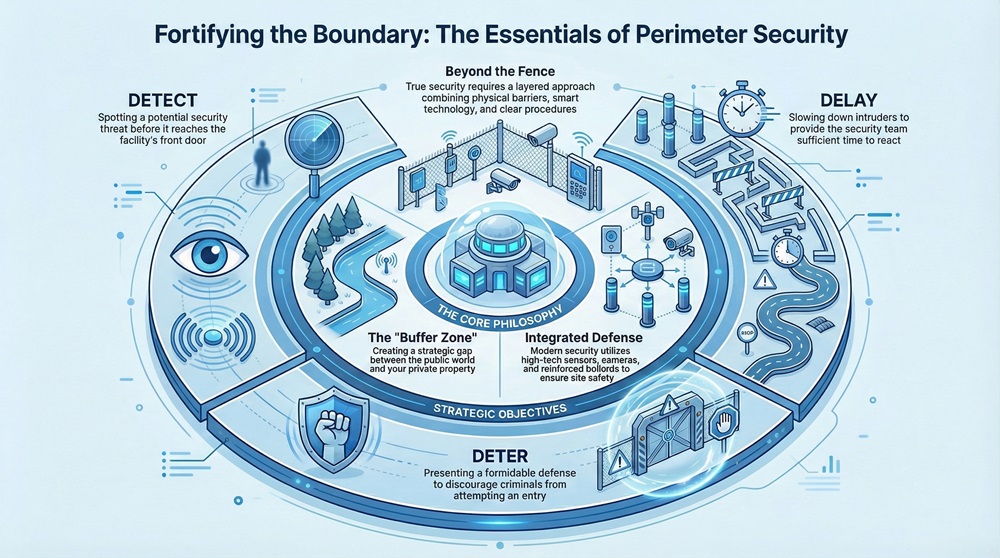
    Perimeter Security refers to the first line of defense used to protect a facility’s boundary from unauthorized access or threats. In my experience working with site managers, many people think a simple fence does the job. To be honest, a fence is just the beginning. True security involves a layered approach that combines physical barriers, smart technology, and clear procedures to keep people and assets safe.


    Have you ever wondered why some buildings feel incredibly secure while others look like an easy target? It usually comes down to how well they've planned their outer defenses. When we talk about protecting a site, we aren't just talking about keeping "bad guys" out. We're also talking about safety, privacy, and peace of mind for everyone inside.


    What is Perimeter Security?

    At its heart, Perimeter Security is about creating a "buffer zone" between the public world and your private property. Think of it like the walls of a castle. In the old days, you had a moat and a stone wall. Today, we use high-tech sensors, cameras, and reinforced bollards.


    Perimeter Security


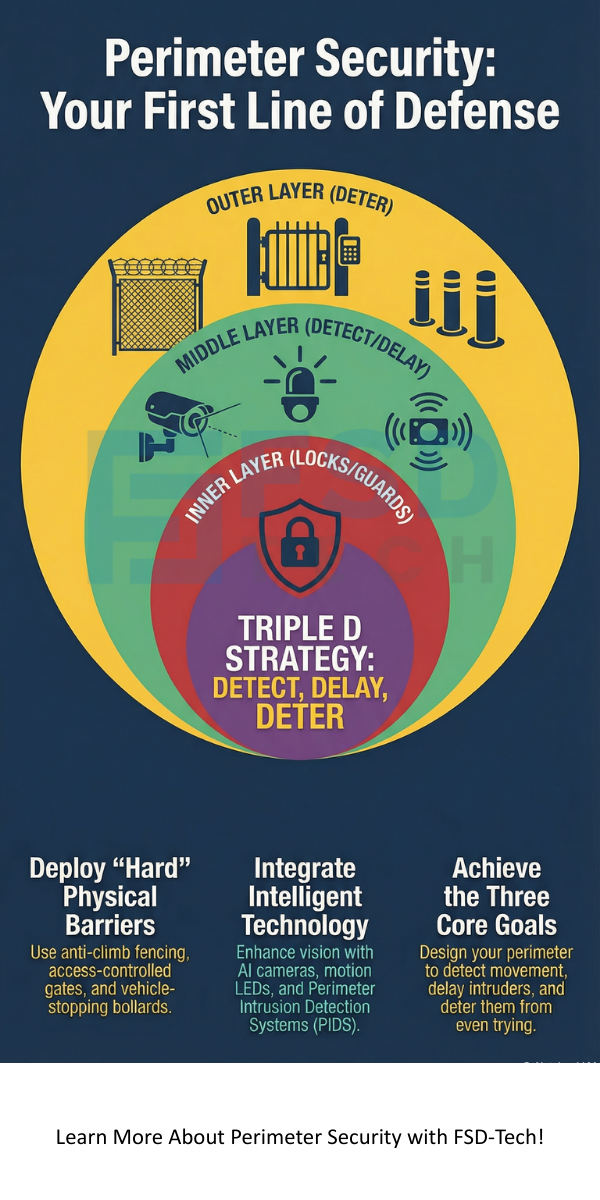
    The main goal of PS is simple: detect, delay, and deter. You want to spot a problem before it reaches your front door. You want to slow down any intruders so your team can react. Most importantly, you want to make your site look so difficult to enter that a criminal doesn't even try.


    Get a Free Security Audit


    Why Should You Care About Your Boundaries?

    Why do we spend so much money on gates and guards? It's because the perimeter is the most vulnerable part of any site. Once someone crosses that line, the risk to your staff and data goes up by 100%.


    In many industries, having a solid security plan is actually a legal requirement. For example, chemical plants or power stations must follow strict rules to prevent sabotage. But even for a standard office building, a breach can lead to stolen equipment or leaked trade secrets. We've all been there—trying to explain to a boss why a laptop went missing over the weekend. A good perimeter plan stops that conversation from ever happening.


    The Key Elements of Physical Barriers in Perimeter Security

    When we look at physical security, we usually start with the things you can touch. These are the "hard" assets that block physical movement.


    Fencing and Walls

    Fences are the most common tool. But not all fences are equal. A chain-link fence might stop a casual wanderer, but a determined intruder will cut right through it. Anti-climb fences with smaller mesh or curved tops are much better.


    Gates and Access Points

    Every hole in your fence is a potential weak spot. This is where you need "Access Control." We use gates that require a badge or a code. Some sites even use biometrics, like thumbprints, to let people in. It's a bit like a VIP club—if your name isn't on the list, you aren't getting past the velvet rope.


    Bollards and Barriers

    Have you seen those thick metal posts outside government buildings? Those are bollards. They are designed to stop a vehicle from driving into a building. If a truck tries to ram the entrance, the bollard takes the hit instead of the glass doors.


    Also Read: Shadow IT & Unmanaged Devices: The Hidden Risks Draining Your SMB’s Security


    The Role of Technology in Modern Defense

    Technology has changed the game for Perimeter Security. We no longer rely on a guy with a flashlight walking in circles. Today, we use "Intelligent Perimeter Defense" to watch the lines 24/7.


    Surveillance Cameras (CCTV)

    Cameras act as your eyes. But modern cameras do more than just record. They use AI to detect movement. They can tell the difference between a stray cat and a person crawling under a fence. This reduces false alarms, which saves everyone a lot of headaches.


    Perimeter Intrusion Detection Systems (PIDS)

    PIDS are sensors that live on or near your fence. Some detect vibrations—if someone tries to climb the fence, the sensor feels it. Others use fiber optics or buried cables to sense pressure on the ground.


    Lighting

    Never underestimate a good light bulb. Criminals love the dark. By using motion-activated LEDs, you take away their cover. It's one of the cheapest and most effective ways to boost your security.


    The Concept of "Layered Defense"

    In the security world, we often talk about "Defense in Depth." This means you don't put all your eggs in one basket. If one layer fails, the next one should catch the threat.


    1. Outer Layer: Signage, lighting, and basic fencing to deter casual intruders.
    2. Middle Layer: High-security fencing, cameras, and PIDS to detect and delay active intruders.
    3. Inner Layer: Building locks, guards, and internal alarms.


    Does your current site have more than one layer? If someone jumps your fence, is there anything else stopping them from reaching your main office?


    Common Challenges in Securing a Perimeter

    Here’s the thing: no system is perfect. One of the biggest issues we face is "False Alarms." If your alarm goes off every time the wind blows, your guards will eventually stop checking it. This is why choosing the right tech for your specific environment is so important.


    Another challenge is the "Human Factor." You can have the best gates in the world, but if an employee props a door open to go have a smoke, your security is gone. Training your team is just as important as buying fancy gear.


    Also Read: The Top 5 Cybersecurity Myths That Are Putting SMBs in Danger


    How to Conduct a Risk Assessment

    Before you buy a single camera, you need to know what you are protecting. Ask yourself these questions:


    • What is the most valuable thing on this site?
    • Where are the easiest places to sneak in?
    • How long would it take for police to arrive if an alarm went off?


    In my view, you should always plan for the "worst-case scenario." Roughly 80% of security is preparation. The other 20% is reacting when things go wrong.


    Conclusion

    Securing your boundaries is about more than just buying gadgets. It’s about creating a smart, layered system that makes it too difficult for anyone to cause trouble. By combining strong physical barriers with modern surveillance technology, you create a safe environment for your business to grow.


    At our company, we believe that every client deserves a tailored solution. We don't believe in "one size fits all" security. Our focus is always on your specific needs and the safety of your people. We've spent years helping sites like yours stay protected, and we're ready to help you too.


    Perimeter Security infographic


    Protect Your Perimeter Now


    Key Takeaways

    • Perimeter Security is your first line of defense and includes fences, tech, and people.
    • The three main goals are to Detect, Delay, and Deter threats.
    • A Layered Approach is the best way to ensure total protection.
    • Physical barriers like Bollards and Anti-climb Fencing are essential for high-risk sites.
    • Technology like AI-powered cameras and PIDS reduces the need for constant manual patrolling.


    Frequently Asked Questions About Perimeter Security

    What is the most effective type of perimeter fence? 

    It depends on your budget, but anti-climb 358 mesh fencing is generally considered the gold standard for high security. It’s hard to cut and nearly impossible to grip for climbing.


    Can lighting really stop intruders?

    Yes. Lighting increases the "risk of detection." Most criminals prefer targets where they can stay hidden. Sudden, bright motion lights are a huge psychological deterrent.


    Is PS only for large businesses?

    Not at all. Small businesses and even residential homes use these principles. A smart doorbell, a locked gate, and good porch lights are all forms of Perimeter Security.


    What is PIDS?

    PIDS stands for Perimeter Intrusion Detection Systems. These are sensors (vibration, infrared, or microwave) that alert security teams the moment someone touches or crosses a boundary.

    Perimeter Security: How to Protect Your Property Effectively

    About The Author

    Surbhi Suhane

    Surbhi Suhane is an experienced digital marketing and content specialist with deep expertise in Getting Things Done (GTD) methodology and process automation. Adept at optimizing workflows and leveraging automation tools to enhance productivity and deliver impactful results in content creation and SEO optimization.

    TRY OUR PRODUCTS

    Like This Story?

    Share it with friends!

    Subscribe to our newsletter!

    FishOSCato SASEVembuXcitiumZeta HRMSAtera
    Isometric illustration of a centralized performance platform connected to analytics dashboards and team members, representing goal alignment, measurable outcomes, risk visibility, and strategic project tracking within ClickUp.

    How ClickUp Enables Outcome-Based Project Management (Not Just Task Tracking)

    🕓 February 15, 2026
    Isometric illustration of a centralized executive dashboard platform connected to analytics panels, performance charts, security indicators, and strategic milestones, representing real-time business visibility and decision control within ClickUp.

    Executive Visibility in ClickUp – How CXOs Gain Real-Time Control Without Micromanaging

    🕓 February 13, 2026

    Cato SASE Architecture

    Inside Cato’s SASE Architecture: A Blueprint for Modern Security

    🕓 January 26, 2025

    Workflow Automation(8)

    Workforce Automation(1)

    AI Project Management(1)

    HR Data Automation(1)

    RMM(2)

    IT Workflow Automation(1)

    GCC compliance(4)

    IT security(2)

    Payroll Integration(2)

    IT support automation(3)

    procurement automation(1)

    lost device management(1)

    IT Management(5)

    IoT Security(2)

    Cato XOps(2)

    IT compliance(4)

    Workflow Management(1)

    Task Automation(1)

    AI-powered cloud ops(1)

    OpenStack automation(1)

    Kubernetes lifecycle management(2)

    SMB Security(8)

    Data Security(1)

    MDR (Managed Detection & Response)(4)

    MSP Automation(3)

    Atera Integrations(2)

    XDR Security(2)

    Threat Detection & Response(1)

    SMB Cyber Protection(1)

    Ransomware Defense(3)

    HR Tech Solutions(1)

    Zero Trust Network Access(3)

    Post-Quantum Cryptography(1)

    Quantum Security(1)

    Quantum Threat UAE & GCC(1)

    Cloud IDE Security(1)

    Zero Trust Security(2)

    Endpoint Management(1)

    SaaS Security(2)

    Payroll Automation(5)

    IT Monitoring(2)

    Xcitium EDR SOC(15)

    Ransomware Protection GCC(1)

    Network Consolidation UAE(1)

    M&A IT Integration(1)

    MSSP for SMBs(1)

    Managed EDR FSD-Tech(1)

    SMB Cybersecurity GCC(1)

    Ransomware Protection(3)

    FSD-Tech MSSP(25)

    Antivirus vs EDR(1)

    Endpoint Security(1)

    Cybersecurity GCC(13)

    Endpoint Protection(1)

    Data Breach Costs(1)

    SMB Cybersecurity(8)

    Xcitium EDR(30)

    Zero Dwell Containment(31)

    Managed Security Services(2)

    Cloud Backup(1)

    Hybrid Backup(1)

    Backup & Recovery(1)

    pointguard ai(4)

    vembu(9)

    backup myths(1)

    disaster recovery myths(1)

    SMB data protection(9)

    Disaster Recovery(4)

    Vembu BDR Suite(19)

    DataProtection(1)

    GCCBusiness(1)

    Secure Access Service Edge(4)

    GCC IT Solutions(1)

    Unified Network Management(1)

    GCC HR software(20)

    open banking(1)

    financial cybersecurity(2)

    CC compliance(1)

    Miradore EMM(15)

    Government Security(1)

    Cato SASE(9)

    GCC Education(1)

    Cloud Security(9)

    Hybrid Learning(1)

    Talent Development(1)

    AI Governance(4)

    AI Compliance(2)

    AI Cybersecurity(13)

    AI Risk Management(1)

    AI Security(2)

    Secure Remote Access(1)

    GCC business security(1)

    GCC network integration(1)

    compliance automation(5)

    GCC cybersecurity(3)

    education security(1)

    App management UAE(1)

    BYOD security Dubai(8)

    Miradore EMM Premium+(5)

    MiddleEast(1)

    share your thoughts

    Perimeter Security

    Perimeter Security: How to Protect Your Property Effectively

    🕓 March 4, 2026

    Unified Endpoint Management

    What is Unified Endpoint Management and Why Does Your Team Need It?

    🕓 March 3, 2026

    Managed SD-WAN

    What is Managed SD-WAN? All You Need to Know

    🕓 March 3, 2026

    Decoded(138)

    Cyber Security(125)

    BCP / DR(22)

    Zeta HRMS(78)

    SASE(21)

    Automation(78)

    Next Gen IT-Infra(125)

    Monitoring & Management(77)

    ITSM(22)

    HRMS(21)

    Automation(24)