HomeNext Gen IT-InfraMonitoring & ManagementCyber SecurityBCP / DRAutomationDecoded
Next Gen IT-Infra
Cato’s SASE Supports Cybersecurity Skills Development

How Cato’s SASE Supports Cybersecurity Skills Development

🕓 April 8, 2025

How SASE Supports the Security Needs of SMBs

How SASE Supports the Security Needs of SMBs

🕓 February 9, 2025

Attack Surface Reduction with Cato’s SASE

Attack Surface Reduction with Cato’s SASE

🕓 February 10, 2025

SASE for Digital Transformation in UAE

SASE for Digital Transformation in UAE

🕓 February 8, 2025

Monitoring & Management
Understanding Atera’s SLA Management

Understanding Atera’s SLA Management

🕓 February 7, 2025

Cost-Performance Ratio: Finding the Right Balance in IT Management Networks

Cost-Performance Ratio: Finding the Right Balance in IT Management Networks

🕓 June 16, 2025

Customizing Atera with APIs

Customizing Atera with APIs

🕓 March 3, 2025

Power Up Your IT Team’s Strategy with Atera’s Communication Tools

Power Up Your IT Team’s Strategy with Atera’s Communication Tools

🕓 February 8, 2025

Cyber Security
Illustration of the Cato Cloud architecture showing its role in delivering SASE for secure, optimized global connectivity.

Understanding the Cato Cloud and Its Role in SASE

🕓 January 29, 2025

Isometric illustration of professionals managing network performance, bandwidth analytics, and cloud-based optimization around the Cato Networks platform, symbolizing bandwidth control and QoS visibility.

Mastering Bandwidth Control and QoS in Cato Networks

🕓 July 26, 2025

Global network backbone powering Cato SASE solution for secure, high-performance connectivity across regions.

Global Backbone: The Engine Powering Cato’s SASE Solution

🕓 January 30, 2025

Illustration of team analyzing application traffic and usage insights on a large laptop screen using Cato’s dashboard, surrounded by network and cloud icons.

Cato Networks Application Visibility | Monitoring & Control

🕓 July 27, 2025

BCP / DR
Illustration showing diverse business and IT professionals collaborating with cloud, backup, and security icons, representing Vembu use cases for SMBs, MSPs, and IT teams.

Who Uses Vembu? Real-World Use Cases for SMBs, MSPs & IT Teams

🕓 July 12, 2025

Graphic showcasing Vembu’s all-in-one backup and disaster recovery platform with icons for cloud, data protection, and business continuity for IT teams and SMBs.

What Is Vembu? A Deep Dive Into the All in One Backup & Disaster Recovery Platform

🕓 July 6, 2025

Illustration showing Vembu backup and disaster recovery system with cloud storage, server racks, analytics dashboard, and IT professionals managing data.

The Rising Cost of Data Loss: Why Backup Is No Longer Optional?

🕓 August 14, 2025

3D isometric illustration of cloud backup and data recovery infrastructure with laptop, data center stack, and digital business icons — FSD Tech

RPO & RTO: The Heart of Business Continuity

🕓 August 15, 2025

Automation
Cross-Functional Collaboration with ClickUp

Fostering Cross-Functional Collaboration with ClickUp for Multi-Departmental Projects

🕓 February 11, 2025

ClickUp Project Reporting

Revolutionizing Enterprise Reporting with ClickUp’s Advanced Analytics and Dashboards

🕓 June 16, 2025

ClickUp’s Design Collaboration and Asset Management Tools

Empowering Creative Teams with ClickUp’s Design Collaboration and Asset Management Tools

🕓 February 26, 2025

ClickUp Communication and Collaboration Tools

ClickUp Communication and Collaboration Tools: Empowering Remote Teams

🕓 March 12, 2025

Decoded
Multi-Factor Authentication (MFA)

Multi-Factor Authentication (MFA): All You Need to Know

🕓 December 7, 2025

L3 Switch

What Is an L3 Switch? L2 vs L3 & Why You Need Layer 3?

🕓 December 8, 2025

IPSec

IPSec Explained: Protocols, Modes, IKE & VPN Security

🕓 December 3, 2025

 Datagram Transport Layer Security (DTLS)

What is Datagram Transport Layer Security (DTLS)? How it works?

🕓 December 4, 2025

    Subscribe to our newsletter!

    About Us

    Follow Us

    Copyright © 2024 | Powered by 

    Atera

    (55)

    Cato Networks

    (121)

    ClickUp

    (76)

    FishOS

    (7)

    Miradore

    (21)

    PointGuard AI

    (9)

    Vembu

    (22)

    Xcitium

    (33)

    ZETA HRMS

    (79)

    Table of Contents

    What is Cloud Identity and Access Management?

    Surbhi Suhane
    February 18, 2026
    Comments
    Cloud Identity and Access Management

    What is Cloud Identity and Access Management?

    Cloud Identity and Access Management is the most vital tool you have to protect your business data in the digital world. Imagine you run a large hotel. You wouldn't give every guest a master key that opens every room, right? You only give them a key to their own door. In the world of computers, Cloud Identity and Access Management (or Cloud IAM) does exactly that. It makes sure the right people can use the right resources for the right reasons.


    To be honest, we’ve all felt that bit of worry when we hear about data breaches. You might wonder, "Is my company's data actually safe?" It's a fair question. As we move more of our work to the cloud, the old way of locking the front door isn't enough. There is no front door anymore! Your employees are working from home, coffee shops, and different countries. This is where Cloud IAM comes in to save the day. It acts as a digital security guard that follows your data wherever it goes.


    But how does it actually work? And why does every tech expert keep talking about it? Let's break it down over this virtual coffee.


    Basics of Cloud IAM

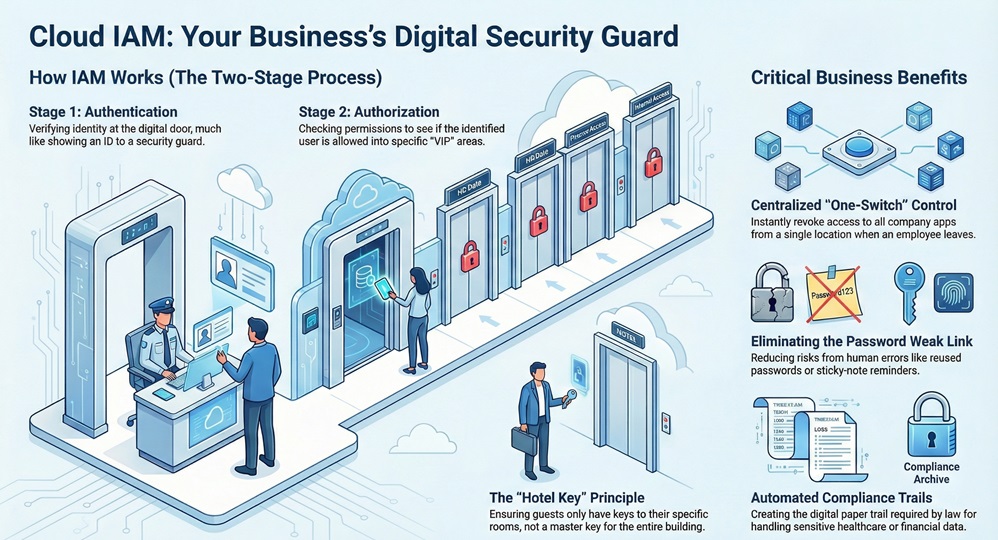
    Before we get into the weeds, let’s define what we are talking about. At its heart, Cloud Identity and Access Management is a framework of policies and technologies. Its goal is to ensure that unauthorized users don't get into your systems. It handles two main jobs: identifying who you are and checking what you are allowed to do.


    Cloud IAM


    Think of it as two stages. First, you show your ID at the door (Authentication). Second, the guard checks the guest list to see if you’re allowed in the VIP lounge (Authorization). In the cloud, this happens in milliseconds. Without a solid Cloud IAM strategy, your data is basically sitting on a park bench.


    Ready to build a Zero Trust foundation? Contact FSD Tech to design your custom IAM roadmap


    Why Do You Need Cloud Identity and Access Management?

    You might ask, "Can't I just use strong passwords?" Well, in my experience, passwords are the weakest link. People reuse them, write them on sticky notes, or pick "Password123."


    Cloud Identity and Access Management helps you move past these human errors. It provides a central place to manage everyone. When an employee leaves the company, you don't want to spend hours logging into fifty different apps to delete their accounts. With IAM, you flip one switch, and they are out. It’s about efficiency just as much as it is about security.


    Furthermore, many industries have strict rules. If you handle healthcare or credit card data, the law says you must control who sees what. Cloud IAM provides the paper trail you need to prove you are following the rules.


    The Core Pillars of Cloud IAM

    When we talk about Cloud Identity and Access Management, we usually look at four main parts. These parts work together like the gears in a watch.


    1. Identity Management

    This is the "Who" part. It involves creating and managing digital identities for users, devices, and even software services. Yes, even your apps need identities! In Cloud IAM, we call these "entities."


    2. Authentication (AuthN)

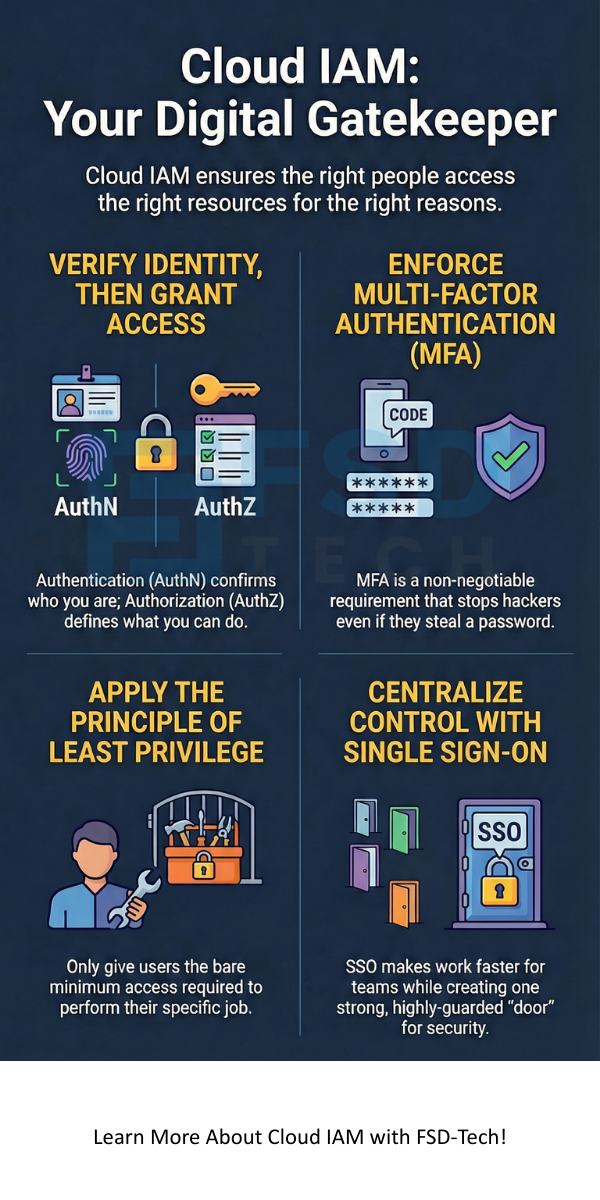
    This is the process of verifying that you are who you say you are. We don’t just trust a username anymore. Most modern systems use Multi-Factor Authentication (MFA). This might be a code sent to your phone or a fingerprint scan. It adds that extra layer of "Are you really sure?"


    3. Authorization (AuthZ)

    Once we know it's you, what can you touch? Authorization uses sets of rules to grant permissions. You don't want the intern to have the power to delete the entire company database by mistake, right?


    4. Auditing and Reporting

    This is the "What happened?" part. Cloud Identity and Access Management keeps a log of every login and every file accessed. If something goes wrong, you can look back and see exactly who was involved. It's like having a security camera for your data.


    Also Read: What is Cloud Access Security Broker (CASB)?


    Role-Based Access Control (RBAC) Explained

    One of the coolest parts of Cloud IAM is something called Role-Based Access Control, or RBAC. Instead of giving permissions to every single person one by one, you create "Roles."

    For example, you might have a "Marketing Role." Anyone in the marketing team gets that role. That role automatically gives them access to Facebook Ads and the email tool. If a new person joins the team, you just give them the role. It's much faster than checking boxes for every single app.


    That said, you should always follow the "Principle of Least Privilege." This is a fancy way of saying: only give people the bare minimum they need to do their job. If they don't need to see the payroll, don't give them access!


    Is Cloud Identity and Access Management Hard to Set Up?

    Here is the thing: it can be as simple or as complex as you make it. Most big cloud providers like Google, Amazon, and Microsoft have built-in IAM tools. They want you to use them!

    The challenge usually isn't the technology; it's the planning. You have to sit down and ask, "Who really needs access to this?" In my view, the best way to start is small. Lock down your most sensitive data first. Then, slowly bring the rest of your apps into the system.


    Do you have a list of all your current users? That’s usually the best place to start. Most companies find "ghost accounts" — accounts for people who left years ago — as soon as they start this process. It’s a real eye-opener!


    The Role of Single Sign-On (SSO)

    We've all been there—trying to remember fifteen different passwords for fifteen different work apps. It’s exhausting. Cloud Identity and Access Management solves this with Single Sign-On, or SSO.


    With SSO, you log in once to a central portal. Then, you can access all your work apps without typing your password again. It makes life easier for your team. But more importantly, it makes things safer. Because there is only one "door" to guard, you can make that door very, very strong with MFA and high-level encryption.


    Also Read: What is Role-Based Access Control (RBAC)?


    Common Threats Cloud IAM Prevents

    Why go through all this trouble? Because the bad guys are getting smarter. Here are a few things Cloud Identity and Access Management helps stop:


    • Phishing: Even if a hacker steals a password, MFA will stop them from getting in.
    • Insider Threats: It prevents employees from snooping in areas they shouldn't be.
    • Privilege Escalation: This is when a user tries to "level up" their permissions to gain control. IAM blocks these unauthorized jumps.
    • Data Exfiltration: By tracking who downloads what, you can catch someone trying to steal company secrets before they leave.


    Best Practices for Managing Cloud Identity

    If you want to do this right, follow these simple steps:


    1. Always use MFA: No exceptions. It's the single best thing you can do.
    2. Clean up regularly: Review who has access every few months. People change jobs and their needs change too.
    3. Use Groups, not Individuals: Always assign permissions to groups or roles. It saves you from a massive headache later.
    4. Watch the Admins: The people with the "Master Keys" need the most monitoring. Their accounts are the biggest targets for hackers.


    The Future of Identity in the Cloud

    We are moving toward something called "Zero Trust." In a Zero Trust world, the system assumes everyone is a threat until proven otherwise. It doesn't matter if you are sitting in the office or at home; the system will check your identity every single time you try to access something. Cloud Identity and Access Management is the engine that makes Zero Trust possible.


    Conclusion

    At the end of the day, Cloud Identity and Access Management is about trust. It’s about making sure your team can work freely without putting the company at risk. We believe that security shouldn't be a hurdle; it should be a quiet partner that helps you grow with confidence. Our focus is always on your peace of mind. By putting people and their identities first, we help you build a digital environment that is both open for business and closed to threats. Let's make your cloud journey a safe one!


    Ready to lock down your cloud environment? We’re here to help you build a security strategy that actually works for your team. Contact us today for a free security consultation and let's protect what matters most to you!


    Cloud Identity and Access Management


    Key Takeaways

    • Cloud Identity and Access Management is the foundation of cloud security.
    • It combines Authentication (who you are) and Authorization (what you can do).
    • Use the Principle of Least Privilege to keep data safe.
    • MFA is a non-negotiable requirement for modern businesses.
    • SSO improves the user experience while centralizing security control.
    • Regular audits help find and remove "ghost accounts" and unnecessary permissions.


    Frequently Asked Questions

    What is the difference between IAM and Cloud IAM? 

    Traditional IAM was built for servers kept inside an office building. Cloud IAM is built for the internet. It handles users coming from anywhere and connects to services hosted by other companies.


    Is Cloud IAM only for big companies? 

    Not at all! In fact, small businesses are often targets because they have weaker security. Even if you only have five employees, using a basic Cloud IAM setup is a smart move.


    Does Cloud IAM slow down my work? 

    Actually, with features like SSO, it usually makes work faster. You spend less time resetting passwords and more time getting things done.


    What happens if the IAM system goes down? 

    Most major cloud providers have very reliable systems with backups. It is much more likely that a user will forget their password than the entire IAM system failing.

    What is Cloud Identity and Access Management?

    About The Author

    Surbhi Suhane

    Surbhi Suhane is an experienced digital marketing and content specialist with deep expertise in Getting Things Done (GTD) methodology and process automation. Adept at optimizing workflows and leveraging automation tools to enhance productivity and deliver impactful results in content creation and SEO optimization.

    Like This Story?

    Share it with friends!

    Subscribe to our newsletter!

    Isometric illustration of a centralized performance platform connected to analytics dashboards and team members, representing goal alignment, measurable outcomes, risk visibility, and strategic project tracking within ClickUp.

    How ClickUp Enables Outcome-Based Project Management (Not Just Task Tracking)

    🕓 February 15, 2026
    Isometric illustration of a centralized executive dashboard platform connected to analytics panels, performance charts, security indicators, and strategic milestones, representing real-time business visibility and decision control within ClickUp.

    Executive Visibility in ClickUp – How CXOs Gain Real-Time Control Without Micromanaging

    🕓 February 13, 2026

    Cato SASE Architecture

    Inside Cato’s SASE Architecture: A Blueprint for Modern Security

    🕓 January 26, 2025

    Workflow Automation(8)

    Workforce Automation(1)

    AI Project Management(1)

    HR Data Automation(1)

    RMM(1)

    IT Workflow Automation(1)

    IT security(2)

    GCC compliance(4)

    Payroll Integration(2)

    IT support automation(3)

    procurement automation(1)

    lost device management(1)

    IT Management(5)

    IoT Security(2)

    Cato XOps(2)

    IT compliance(4)

    Task Automation(1)

    Workflow Management(1)

    Kubernetes lifecycle management(2)

    OpenStack automation(1)

    AI-powered cloud ops(1)

    SMB Security(8)

    Data Security(1)

    MDR (Managed Detection & Response)(4)

    MSP Automation(3)

    Atera Integrations(2)

    XDR Security(2)

    Ransomware Defense(3)

    SMB Cyber Protection(1)

    HR Tech Solutions(1)

    Zero Trust Network Access(3)

    Zero Trust Security(2)

    Endpoint Management(1)

    SaaS Security(1)

    Payroll Automation(5)

    IT Monitoring(2)

    Xcitium EDR SOC(15)

    Ransomware Protection GCC(1)

    Network Consolidation UAE(1)

    M&A IT Integration(1)

    MSSP for SMBs(1)

    SMB Cybersecurity GCC(1)

    FSD-Tech MSSP(25)

    Ransomware Protection(3)

    Managed EDR FSD-Tech(1)

    Antivirus vs EDR(1)

    Cybersecurity GCC(12)

    Endpoint Security(1)

    Data Breach Costs(1)

    Endpoint Protection(1)

    SMB Cybersecurity(8)

    Zero Dwell Containment(31)

    Managed Security Services(2)

    Xcitium EDR(30)

    Cloud Backup(1)

    Hybrid Backup(1)

    Backup & Recovery(1)

    pointguard ai(4)

    vembu(9)

    SMB data protection(9)

    backup myths(1)

    disaster recovery myths(1)

    Disaster Recovery(4)

    Vembu BDR Suite(19)

    DataProtection(1)

    GCCBusiness(1)

    Secure Access Service Edge(4)

    GCC IT Solutions(1)

    Unified Network Management(1)

    GCC HR software(20)

    open banking(1)

    financial cybersecurity(2)

    CC compliance(1)

    Miradore EMM(15)

    Government Security(1)

    Cato SASE(8)

    Hybrid Learning(1)

    Cloud Security(9)

    GCC Education(1)

    Talent Development(1)

    AI Risk Management(1)

    AI Compliance(2)

    AI Governance(4)

    AI Cybersecurity(12)

    AI Security(2)

    Secure Remote Access(1)

    GCC business security(1)

    GCC network integration(1)

    compliance automation(5)

    GCC cybersecurity(3)

    education security(1)

    BYOD security Dubai(8)

    Miradore EMM Premium+(5)

    App management UAE(1)

    MiddleEast(1)

    HealthcareSecurity(1)

    Team Collaboration(1)

    IT automation(12)

    Zscaler(1)

    SD-WAN(7)

    share your thoughts

    https://link.maDigital Risk Monitoringrk1.ai/widget/booking/7kogp1x6hfZEXPlpGBay

    What is Digital Risk Monitoring? Protecting Your Assets

    🕓 February 18, 2026

    Cloud Identity and Access Management

    What is Cloud Identity and Access Management?

    🕓 February 18, 2026

    Breach and Attack Simulation

    7 Ways Breach and Attack Simulation Secures Your Data

    🕓 February 17, 2026

    Decoded(117)

    Cyber Security(118)

    BCP / DR(22)

    Zeta HRMS(78)

    SASE(21)

    Automation(76)

    Next Gen IT-Infra(118)

    Monitoring & Management(76)

    ITSM(22)

    HRMS(21)

    Automation(24)