.webp&w=3840&q=75)
How ClickUp Enables Outcome-Based Project Management (Not Just Task Tracking)
🕓 February 15, 2026
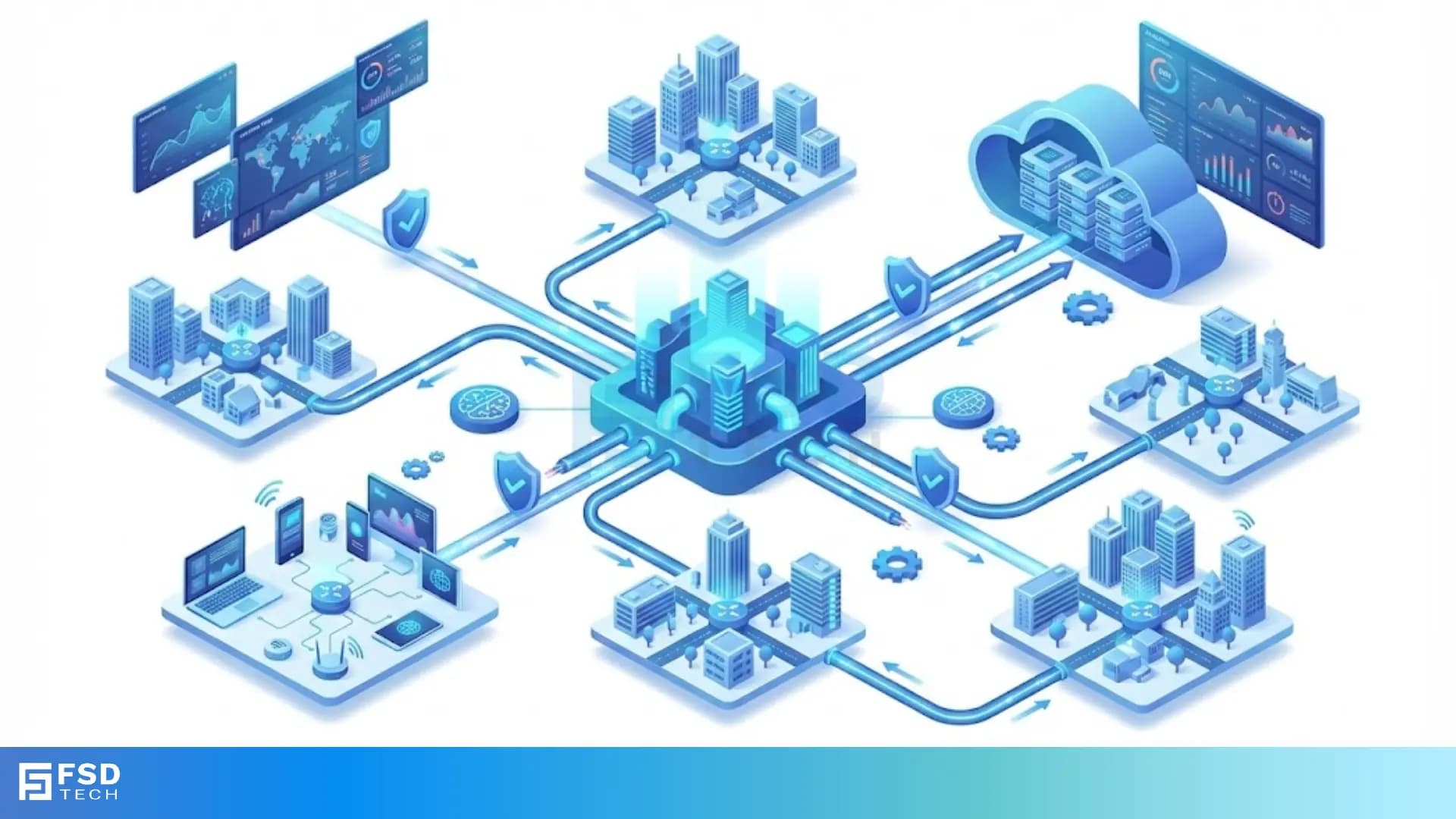
Have you ever wondered how a large city stays connected? Different offices, schools, and government buildings need to share data fast. A small home network cannot cover a whole city. On the other hand, the global internet is too vast for private city needs. This is where a Metropolitan Area Network comes into play. It fills the gap perfectly. But what makes it so special for urban areas?
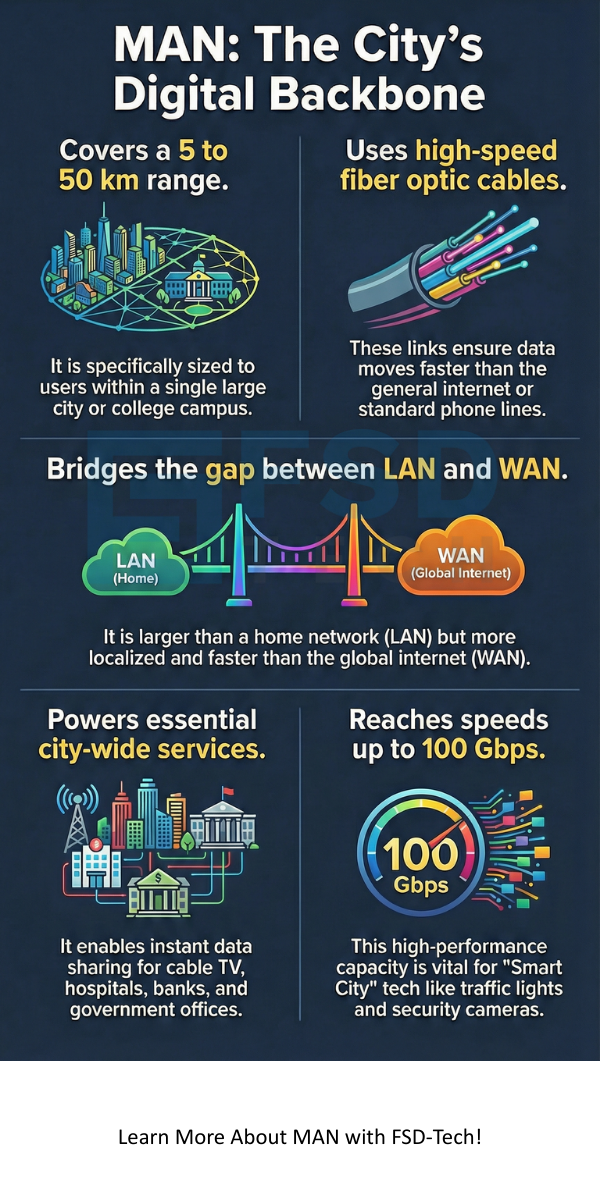
A Metropolitan Area Network refers to a computer network that connects users within a geographic area. This area is usually larger than a local network but smaller than a wide area network. Think of a single large city or a college campus. Metropolitan area network means a system that links several local area networks (LANs) together. It uses high-speed links like fiber optic cables to ensure data moves quickly.
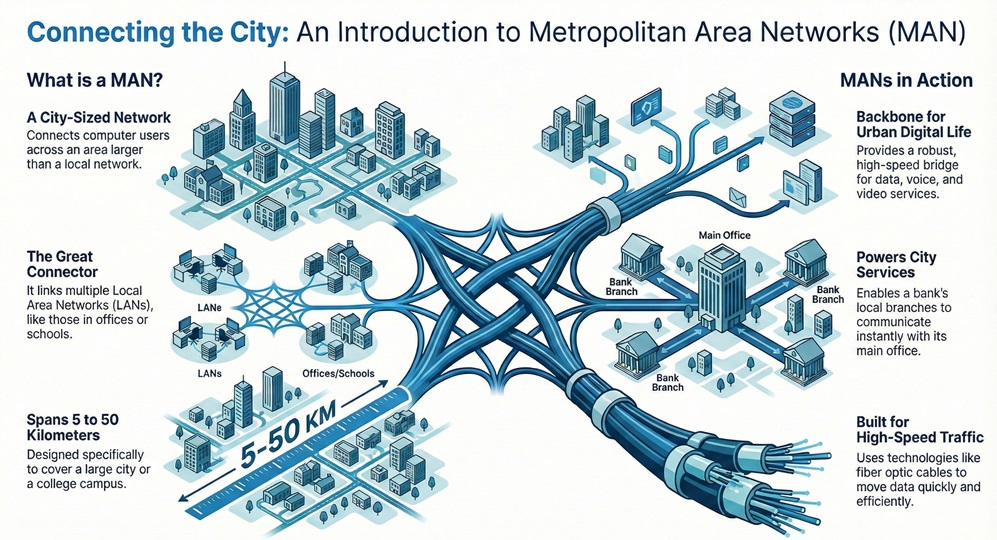
Metropolitan area network systems often serve as a bridge. They connect smaller office networks to the wider internet. By doing this, they allow for efficient resource sharing across a city. Does your local bank branch talk to the main office instantly? They likely use a man metropolitan area network to do it.
A metropolitan area network provides the backbone for urban digital life. It handles high-speed data, voice, and video. Because it covers a city, it must be robust. Metropolitan area network meaning relates to the scale of the connection. It usually spans between 5 to 50 kilometers.
Metropolitan area network setups use various technologies. Many use Distributed Queue Dual Bus (DQDB) standards. This allows the network to handle two directions of data flow at once. It prevents traffic jams in the digital world. This keeps city services running without delays.
When we look at networking, size matters. A metropolitan area network sits right in the middle. Let us look at how it compares to its "siblings" in the networking family.
| Feature | Local Area Network (LAN) | Metropolitan Area Network (MAN) | Wide Area Network (WAN) |
|---|---|---|---|
| Geographic Range | Small (Home, Office) | Medium (City, Campus) | Large (Country, World) |
| Data Speed | Very High | High | Low to Medium |
| Ownership | Private | Private or Public | Private or Public |
| Main Technology | Ethernet, Wi-Fi | Fiber Optics, DQDB | Satellites, Leased Lines |
| Maintenance | Easy | Moderate | Difficult |
Also Read: What is Network Access Control (NAC)? with Process
An example of metropolitan area network usage is easy to find if you look around. Many organizations need more than just one building's worth of space.
We see them in places where high-speed communication is a daily need. Public service providers rely on them heavily.
Metropolitan area network technology is vital for "Smart Cities." It connects traffic lights, public Wi-Fi, and security cameras. This allows a city to "breathe" and react to data in real time. Without a metropolitan area network, the data would move too slowly to be useful.
Knowing how to draw metropolitan area network layouts helps in understanding the flow. Usually, you start with several LAN icons. These represent individual buildings. You then connect these LANs to a central hub or a "ring" of fiber optic cable.
A metropolitan area network often uses a ring or star topology. In a ring, if one path breaks, the data can travel the other way. This makes the man metropolitan area network very reliable. If you are designing one, focus on the central backbone that carries the most traffic.
Also Read: What is Network Traffic Analysis (NTA) in Cybersecurity?
The metropolitan area network has specific traits that define it. These features help it stand out from smaller or larger setups.
Why do cities choose a metropolitan area network? The benefits are quite clear for large groups.
While powerful, the metropolitan area network does have some hurdles. It is not always the best choice for every situation.
Also Read: What is SD-WAN Architecture? Benefits and Working
The metropolitan area network is evolving. We are moving toward Wireless MAN (WMAN). This uses technologies like WiMAX. This means cities can stay connected without digging up streets to lay wires. A metropolitan area network will soon be mostly invisible and wireless.
As we move toward 5G and 6G, the metropolitan area network will become even faster. It will support more devices. Your car, your phone, and even city trash cans will talk to each other through this network.
Understanding what is metropolitan area network helps us see how our modern world stays linked. These networks are the silent workers of the city. They ensure that hospitals, schools, and offices can talk to each other instantly.
At FSD-Tech company, we believe in the power of connection. We value providing clear, reliable information to help you navigate the tech world. Our goal is to make sure your business has the right tools to grow.
Contact our network experts today
The main goal of a metropolitan area network is to connect multiple LANs within a city. This allows for high-speed data exchange and resource sharing across a wide urban area.
A man metropolitan area network can be owned by a private company or a public entity. For example, a city government might own one, or a large ISP might provide it as a service.
No, the internet is a Wide Area Network (WAN). A metropolitan area network is much smaller and usually stays within the limits of one city or region.
Most metropolitan area network setups use fiber optics. This allows them to reach speeds of 1 Gbps to 100 Gbps. It is much faster than the typical home internet.
A LAN covers one building. A metropolitan area network covers many buildings throughout a whole city.

Surbhi Suhane is an experienced digital marketing and content specialist with deep expertise in Getting Things Done (GTD) methodology and process automation. Adept at optimizing workflows and leveraging automation tools to enhance productivity and deliver impactful results in content creation and SEO optimization.
Share it with friends!


.webp&w=3840&q=75)





share your thoughts