HomeNext Gen IT-InfraMonitoring & ManagementCyber SecurityBCP / DRAutomationDecoded
Next Gen IT-Infra
Cato’s SASE Supports Cybersecurity Skills Development

How Cato’s SASE Supports Cybersecurity Skills Development

🕓 April 8, 2025

How SASE Supports the Security Needs of SMBs

How SASE Supports the Security Needs of SMBs

🕓 February 9, 2025

Attack Surface Reduction with Cato’s SASE

Attack Surface Reduction with Cato’s SASE

🕓 February 10, 2025

SASE for Digital Transformation in UAE

SASE for Digital Transformation in UAE

🕓 February 8, 2025

Monitoring & Management
Understanding Atera’s SLA Management

Understanding Atera’s SLA Management

🕓 February 7, 2025

Cost-Performance Ratio: Finding the Right Balance in IT Management Networks

Cost-Performance Ratio: Finding the Right Balance in IT Management Networks

🕓 June 16, 2025

Customizing Atera with APIs

Customizing Atera with APIs

🕓 March 3, 2025

Power Up Your IT Team’s Strategy with Atera’s Communication Tools

Power Up Your IT Team’s Strategy with Atera’s Communication Tools

🕓 February 8, 2025

Cyber Security
Illustration of the Cato Cloud architecture showing its role in delivering SASE for secure, optimized global connectivity.

Understanding the Cato Cloud and Its Role in SASE

🕓 January 29, 2025

Isometric illustration of professionals managing network performance, bandwidth analytics, and cloud-based optimization around the Cato Networks platform, symbolizing bandwidth control and QoS visibility.

Mastering Bandwidth Control and QoS in Cato Networks

🕓 July 26, 2025

Global network backbone powering Cato SASE solution for secure, high-performance connectivity across regions.

Global Backbone: The Engine Powering Cato’s SASE Solution

🕓 January 30, 2025

Illustration of IT team managing user roles and permissions on the Cato CMA dashboard via laptops and cloud interfaces.

Setting Up Role-Based Access Control (RBAC) in Cato

🕓 July 28, 2025

BCP / DR
Illustration showing diverse business and IT professionals collaborating with cloud, backup, and security icons, representing Vembu use cases for SMBs, MSPs, and IT teams.

Who Uses Vembu? Real-World Use Cases for SMBs, MSPs & IT Teams

🕓 July 12, 2025

Graphic showcasing Vembu’s all-in-one backup and disaster recovery platform with icons for cloud, data protection, and business continuity for IT teams and SMBs.

What Is Vembu? A Deep Dive Into the All in One Backup & Disaster Recovery Platform

🕓 July 6, 2025

Illustration showing Vembu backup and disaster recovery system with cloud storage, server racks, analytics dashboard, and IT professionals managing data.

The Rising Cost of Data Loss: Why Backup Is No Longer Optional?

🕓 August 14, 2025

3D isometric illustration of cloud backup and data recovery infrastructure with laptop, data center stack, and digital business icons — FSD Tech

RPO & RTO: The Heart of Business Continuity

🕓 August 15, 2025

Automation
Cross-Functional Collaboration with ClickUp

Fostering Cross-Functional Collaboration with ClickUp for Multi-Departmental Projects

🕓 February 11, 2025

ClickUp Project Reporting

Revolutionizing Enterprise Reporting with ClickUp’s Advanced Analytics and Dashboards

🕓 June 16, 2025

ClickUp’s Design Collaboration and Asset Management Tools

Empowering Creative Teams with ClickUp’s Design Collaboration and Asset Management Tools

🕓 February 26, 2025

ClickUp Communication and Collaboration Tools

ClickUp Communication and Collaboration Tools: Empowering Remote Teams

🕓 March 12, 2025

Decoded
Multi-Factor Authentication (MFA)

Multi-Factor Authentication (MFA): All You Need to Know

🕓 December 7, 2025

L3 Switch

What Is an L3 Switch? L2 vs L3 & Why You Need Layer 3?

🕓 December 8, 2025

IPSec

IPSec Explained: Protocols, Modes, IKE & VPN Security

🕓 December 3, 2025

 Datagram Transport Layer Security (DTLS)

What is Datagram Transport Layer Security (DTLS)? How it works?

🕓 December 4, 2025

    Subscribe to our newsletter!

    About Us

    Follow Us

    Copyright © 2024 | Powered by 

    Cato SASE Architecture

    Inside Cato’s SASE Architecture: A Blueprint for Modern Security

    🕓 January 26, 2025

    Enterprise Data Security and Privacy with ClickUp

    Ensuring Enterprise Data Security and Privacy with ClickUp

    🕓 February 9, 2025

    DDoS protection SASE

    DDoS Protection and Cato’s Defence Mechanisms

    🕓 February 11, 2025

    Table of Contents

    Tags and Custom Fields – Organizing Devices with Precision in Miradore EMM

    Anas Abdu Rauf
    October 26, 2025
    Comments
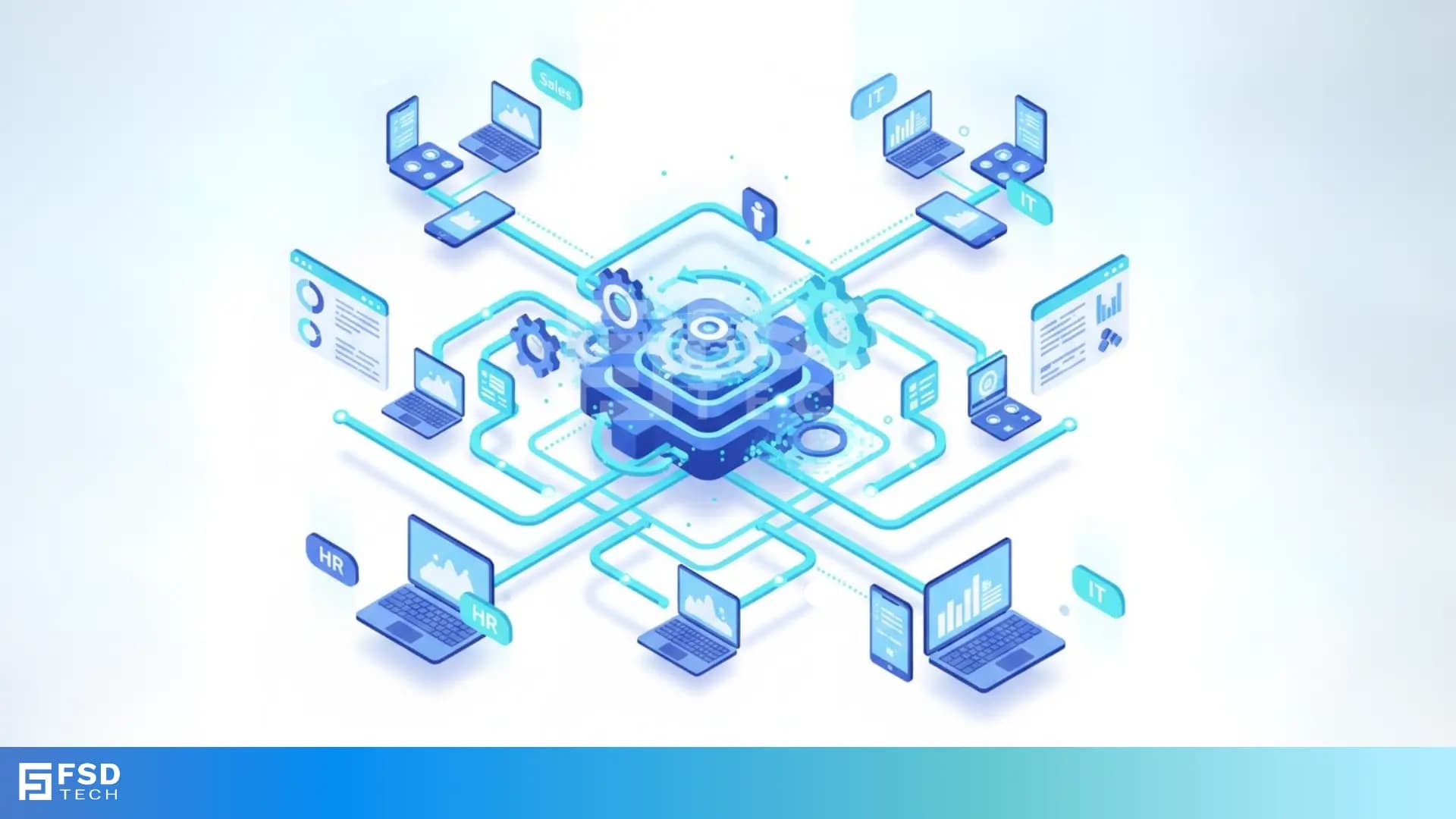
    Isometric illustration of Miradore’s centralized management system connecting multiple laptops from HR, IT, and Sales departments through data pipelines and gears. Each device screen displays analytics dashboards and compliance charts, symbolizing automation, tagging, and structured asset data management. Designed in FSD Tech’s blue gradient theme to represent efficient and compliant multi-department device control.

    Introduction

    Managing hundreds or thousands of devices can quickly become overwhelming without proper organization and categorization. IT teams need tools to segment devices by department, role, location, compliance status, or other custom parameters to maintain control, enforce policies effectively, and generate meaningful reports.


    Miradore EMM provides robust tags and custom fields capabilities, allowing administrators to categorize devices with precision. This improves visibility, simplifies policy assignment, and enhances reporting for compliance and operational efficiency.


    Key Takeaways

    • Tags and custom fields allow granular device classification
    • Simplify policy enforcement by grouping devices logically
    • Enhance reporting and audit readiness with structured metadata
    • Support dynamic device grouping and automated workflows
    • Useful for multi-site, multi-department, and BYOD environments


    Why Tags and Custom Fields Matter

    Large-scale device management requires more than simple device lists. Tags and custom fields help IT teams:

    • Identify device characteristics: OS version, ownership type, or hardware specifications
    • Segment by department or function: Sales, finance, field operations, or IT
    • Track lifecycle status: Active, inactive, retired, or pending enrollment
    • Streamline compliance management: Group devices by audit requirements or regulatory standards

    This granular categorization enables automated policy application, targeted notifications, and accurate reporting, reducing manual intervention and operational errors.


    Creating and Using Tags in Miradore

    Tags are flexible labels that can be applied to devices manually or automatically based on predefined rules. Examples include:

    • Department tags: “HR”, “Engineering”, “Sales”
    • Device type tags: “MacBook Pro”, “Windows Laptop”, “Android Tablet”
    • Location tags: “Head Office”, “Branch A”, “Remote Site”
    • Compliance status tags: “Encrypted”, “Non-Compliant”, “Pending Update”

    Benefits of Tags

    • Dynamic Policy Application: Assign security or app policies based on tags to enforce compliance automatically
    • Simplified Reporting: Generate reports filtered by tags to focus on specific groups
    • Efficient Troubleshooting: Quickly identify devices with shared characteristics or issues


    Custom Fields: Add Context Beyond Defaults

    While tags provide labels, custom fields allow IT teams to capture unique device attributes or organizational information. Examples include:

    • Asset ID or serial number
    • Employee ID or user role
    • Warranty expiry date
    • Custom compliance notes

    Custom fields can be text, numeric, or date types, providing structured data for reporting, automation, and analytics. They are particularly useful in large enterprises with complex device environments or regulatory obligations.


    Dynamic Device Grouping Using Tags and Custom Fields

    Miradore enables dynamic grouping, where devices automatically join groups based on tags, custom fields, or other attributes. This allows:

    • Policies to be applied automatically to relevant devices
    • Targeted notifications for specific groups, such as devices pending updates
    • Simplified onboarding of new devices into the correct operational and compliance workflows

    For example:

    • All Windows laptops in “Sales” with “Pending Update” tag can automatically receive patch reminders
    • Android devices tagged “Field Operations” automatically get VPN and security policies applied


    Reporting and Compliance

    Tags and custom fields enhance reporting by:

    • Allowing IT teams to filter devices based on any attribute
    • Generating role-specific or department-specific reports for management
    • Tracking compliance trends and highlighting gaps efficiently

    This structured metadata ensures that enterprises remain audit-ready and simplifies demonstrating regulatory compliance, such as GDPR or ISO 27001 standards.


    Real-World Use Case: Large Enterprise with Multi-Department Device Fleet

    A multinational firm manages over 2,500 devices across multiple departments and sites. Using Miradore’s tags and custom fields, the IT team was able to:

    • Tag devices by department, ownership, and device type
    • Use custom fields to track warranty and employee assignment
    • Automate policy deployment for encryption, VPN, and app installation based on tags
    • Generate detailed compliance reports for executive management and auditors

    This reduced manual work, improved operational visibility, and strengthened security and compliance enforcement across the organization.


    Benefits Summary

    • Improved Organization: Categorize devices logically across platforms
    • Automated Policy Enforcement: Apply rules dynamically based on device attributes
    • Enhanced Reporting: Filter, export, and visualize data using tags and custom fields
    • Scalable Management: Ideal for growing fleets with mixed OS devices and BYOD policies
    • Audit Readiness: Structured data supports compliance reporting and investigations


    Next Steps

    Tags and custom fields are not just labels—they are powerful organizational tools that enhance security, compliance, and operational efficiency. Miradore EMM provides everything IT teams need to categorize devices accurately and enforce policies consistently across Android, iOS, macOS, and Windows.


    If You Need Further Details On Any Specific Feature Or On Using Miradore EMM In Your Organization, Please Feel Free To Schedule a No-Obligation Requirement Gathering Virtual Meeting With Our Endpoint Management Experts. Schedule Now
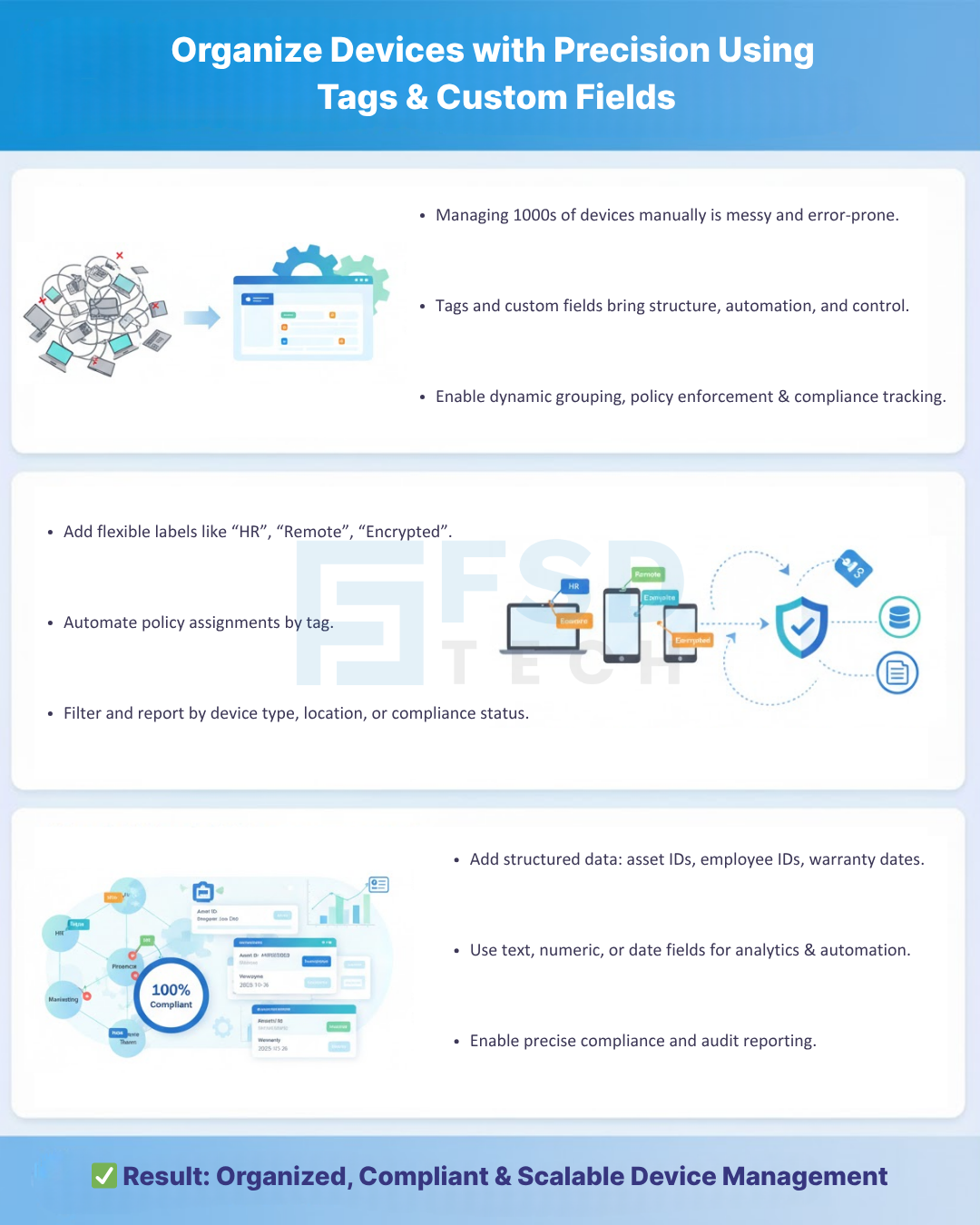
     

    Miradore infographic by FSD Tech explaining how to organize devices using tags and custom fields for scalable IT management. It highlights automation of device grouping, policy enforcement, and compliance tracking through structured labels like “HR,” “Remote,” and “Encrypted.” The design shows workflows with gears, dashboards, and charts in blue-white tones, ending with the result “Organized, Compliant & Scalable Device Management.


     FAQs 

    What are tags in Miradore EMM?

    In Miradore EMM, tags are customizable labels applied to devices to logically group them by department, device type, location, compliance status, or any other attribute. Tags simplify device management and policy enforcement.
     

    How do custom fields differ from tags in Miradore EMM?

    Miradore EMM custom fields allow IT teams to capture structured metadata about devices, such as asset IDs, employee IDs, warranty dates, or other organizational information, providing context beyond simple tags.


    Can policies be assigned based on tags or custom fields in Miradore EMM?

    Yes. Miradore EMM supports dynamic policy assignment using tags and custom fields, automatically applying security, app, and compliance rules to relevant devices without manual intervention.


    Is dynamic device grouping possible with tags and custom fields in Miradore EMM?

    Absolutely. Miradore EMM allows devices to automatically join groups based on tags, custom field values, OS type, or other attributes, streamlining policy enforcement, reporting, and compliance management.


    Do tags and custom fields help with compliance reporting in Miradore EMM?

    Yes. Miradore EMM provides structured metadata through tags and custom fields, enabling filtered, exportable, and auditable reports for regulatory compliance and internal audits.


    Can tags and custom fields be applied to BYOD devices in Miradore EMM?

    Yes. Miradore EMM supports tagging and custom fields for BYOD devices, allowing IT teams to enforce corporate policies while maintaining user privacy.


    Are tags and custom fields useful for multi-site organizations in Miradore EMM?

    Definitely. Miradore EMM tags and custom fields allow IT teams to organize devices across multiple sites, departments, and roles, enabling consistent device management, visibility, and reporting.

    Tags and Custom Fields – Organizing Devices with Precision in Miradore EMM

    About The Author

    Anas Abdu Rauf

    Anas is an Expert in Network and Security Infrastructure, With over seven years of industry experience, holding certifications Including CCIE- Enterprise, PCNSE, Cato SASE Expert, and Atera Certified Master. Anas provides his valuable insights and expertise to readers.

    Like This Story?

    Share it with friends!

    Subscribe to our newsletter!

    Atera

    (48)

    Cato Networks

    (118)

    ClickUp

    (70)

    FishOS

    (7)

    Miradore

    (21)

    PointGuard AI

    (9)

    Vembu

    (22)

    Xcitium

    (33)

    ZETA HRMS

    (76)

    Workflow Automation(8)

    Workforce Automation(1)

    AI Project Management(1)

    HR Data Automation(1)

    RMM(1)

    IT Workflow Automation(1)

    IT security(2)

    GCC compliance(4)

    Payroll Integration(2)

    IT support automation(3)

    procurement automation(1)

    lost device management(1)

    IT Management(5)

    IoT Security(2)

    Cato XOps(2)

    IT compliance(4)

    Workflow Management(1)

    Task Automation(1)

    OpenStack automation(1)

    Kubernetes lifecycle management(2)

    AI-powered cloud ops(1)

    SMB Security(8)

    Data Security(1)

    MDR (Managed Detection & Response)(4)

    Atera Integrations(2)

    MSP Automation(3)

    XDR Security(2)

    SMB Cyber Protection(1)

    Ransomware Defense(3)

    HR Tech Solutions(1)

    Zero Trust Network Access(3)

    Zero Trust Security(2)

    Endpoint Management(1)

    SaaS Security(1)

    Payroll Automation(5)

    IT Monitoring(2)

    Xcitium EDR SOC(15)

    Ransomware Protection GCC(1)

    M&A IT Integration(1)

    Network Consolidation UAE(1)

    MSSP for SMBs(1)

    Managed EDR FSD-Tech(1)

    Ransomware Protection(3)

    SMB Cybersecurity GCC(1)

    FSD-Tech MSSP(25)

    Antivirus vs EDR(1)

    Endpoint Security(1)

    Cybersecurity GCC(12)

    Data Breach Costs(1)

    Endpoint Protection(1)

    SMB Cybersecurity(8)

    Zero Dwell Containment(31)

    Managed Security Services(2)

    Xcitium EDR(30)

    Cloud Backup(1)

    Hybrid Backup(1)

    Backup & Recovery(1)

    pointguard ai(4)

    backup myths(1)

    vembu(9)

    SMB data protection(9)

    disaster recovery myths(1)

    Disaster Recovery(4)

    Vembu BDR Suite(19)

    GCCBusiness(1)

    DataProtection(1)

    Secure Access Service Edge(4)

    GCC HR software(18)

    Miradore EMM(15)

    Cato SASE(7)

    Cloud Security(8)

    Talent Development(1)

    AI Cybersecurity(12)

    AI Governance(4)

    AI Security(2)

    AI Compliance(2)

    AI Risk Management(1)

    GCC business security(1)

    GCC network integration(1)

    compliance automation(5)

    education security(1)

    GCC cybersecurity(2)

    BYOD security Dubai(8)

    App management UAE(1)

    Miradore EMM Premium+(5)

    MiddleEast(1)

    HealthcareSecurity(1)

    Team Collaboration(1)

    IT automation(12)

    Zscaler(1)

    SD-WAN(6)

    HR Integration(4)

    Cloud Networking(3)

    device management(9)

    VPN(1)

    RemoteWork(1)

    ZeroTrust(2)

    MPLS(1)

    Project Management(9)

    HR automation(16)

    share your thoughts

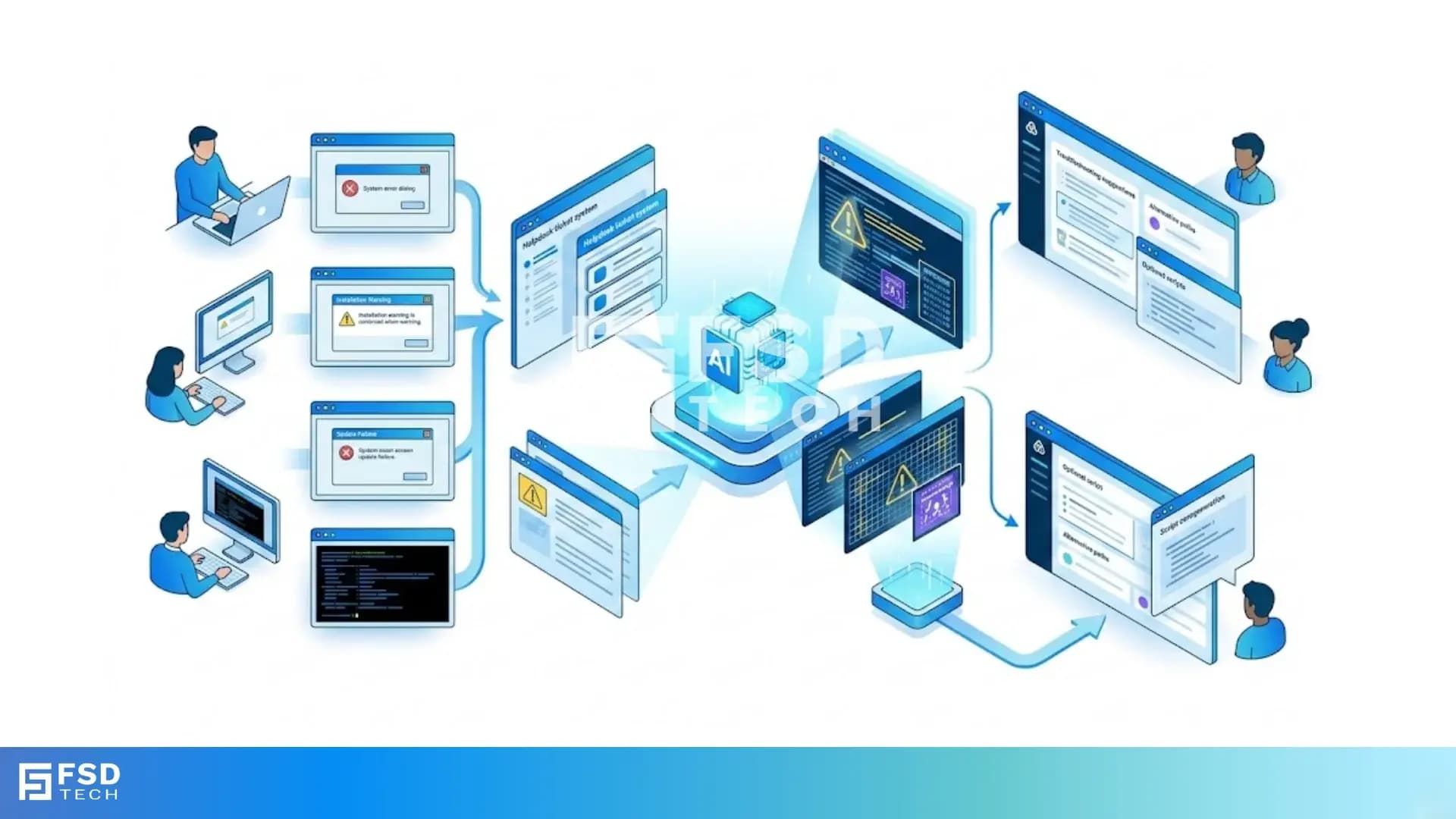
    Isometric illustration showing Atera Copilot generating AI-powered remote session summaries, connecting multiple devices, dashboards, and IT teams to automate documentation, improve visibility, and support MSP operations.

    AI-Driven Remote Session Summaries in Atera: Turning Hands-On Support Into Instant Documentation

    🕓 January 1, 2026

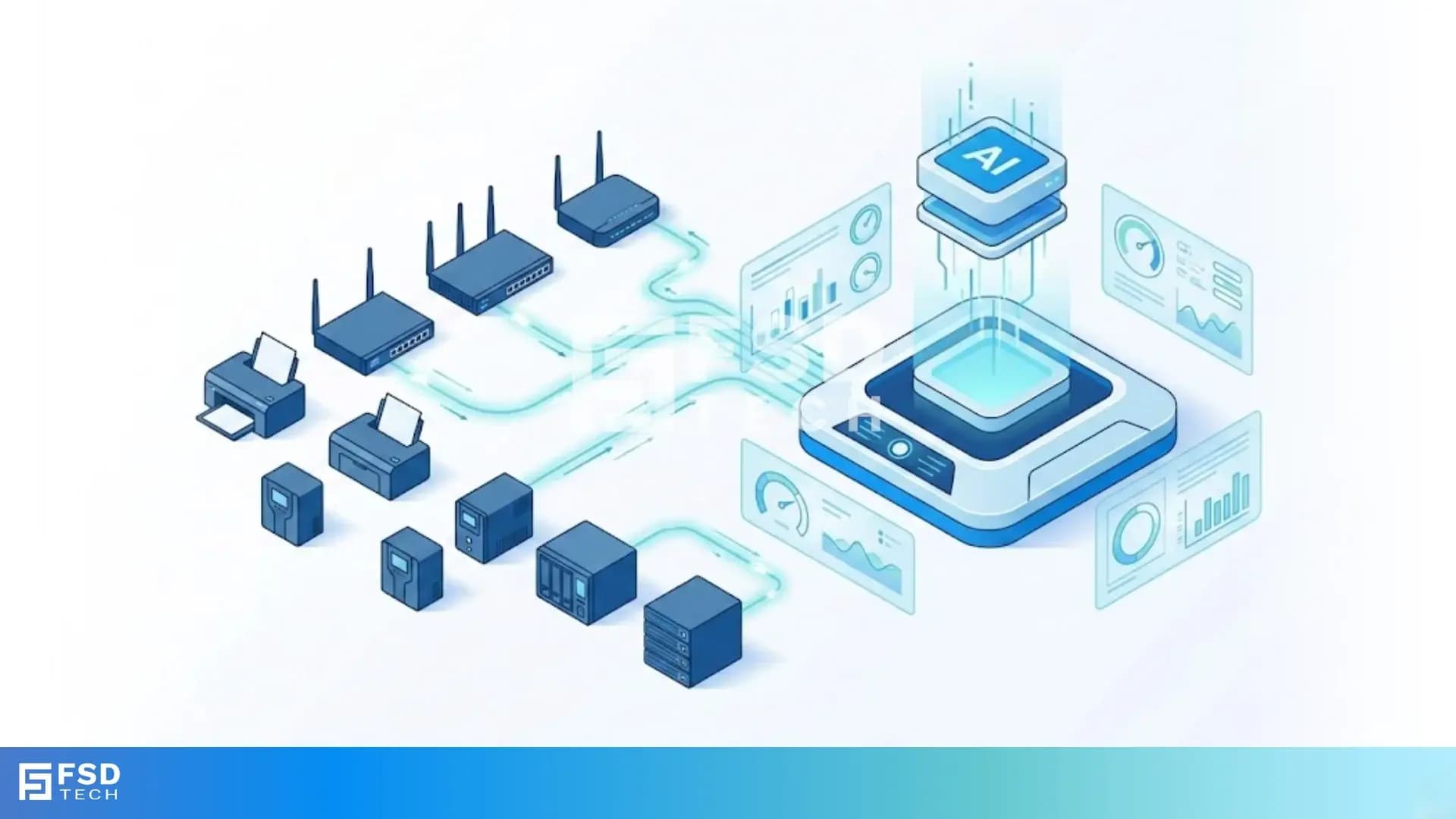
    Illustration showing Atera’s AI Diagnostic Core performing automated health checks, root-cause analysis, and device actions across multiple endpoints for IT teams and MSP environments.

    Health Checks & Device Actions in Atera: From Detection to Autonomous Remediation

    🕓 December 15, 2025

    Illustration showing Atera’s AI automation hub with a glowing blue sphere connected to multiple screens displaying tickets, device data, scripts, instant response times, and technician dashboards. Two IT technicians sit at workstations monitoring hours saved and ticket analytics.

    AI Copilot 3.0 and Action Mode: From Recommendations to Fully Autonomous IT

    🕓 December 12, 2025

    Decoded(87)

    Cyber Security(118)

    BCP / DR(22)

    Zeta HRMS(75)

    SASE(21)

    Automation(70)

    Next Gen IT-Infra(118)

    Monitoring & Management(69)

    ITSM(22)

    HRMS(21)

    Automation(24)