.webp&w=3840&q=75)
How ClickUp Enables Outcome-Based Project Management (Not Just Task Tracking)
🕓 February 15, 2026
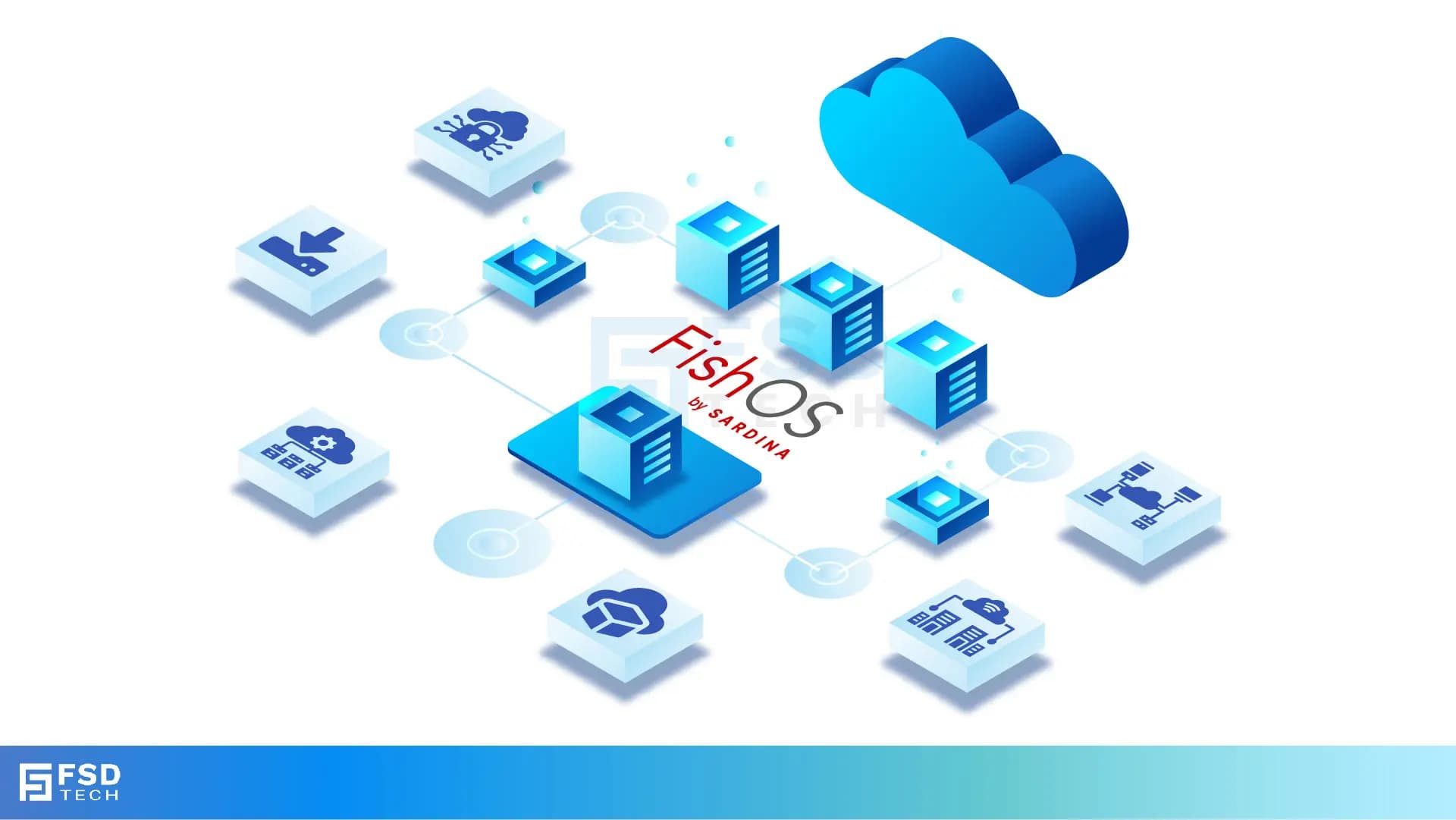
Ask any platform engineer or IT operations leader managing a private cloud: maintaining uptime, patching critical systems, and juggling workloads across multiple layers (OpenStack, Kubernetes, Ceph) is hard work. The problem isn’t just the tools — it’s the operational complexity they introduce.
From manual upgrades to configuration drift, from fragmented monitoring to multi-vendor support contracts, traditional OpenStack and Kubernetes environments force teams into firefighting mode. Instead of building value, they’re constantly managing risk and reacting to alerts.
FishOS, by Sardina Systems was built to fix this. By combining OpenStack, Kubernetes, and Ceph into one self-operating cloud platform with AI-based tools, FishOS drastically reduces day-to-day complexity. It turns what used to be brittle, manual infrastructure into a self-regulating ecosystem — freeing your team to focus on innovation, not incident response.
Managing cloud infrastructure often feels like juggling multiple spinning plates. You’re expected to:
This model not only wastes time but introduces risk — especially in multi-tenant, feature rich or regulated environments.
FishOS directly addresses these pain points with built-in automation, orchestration, and intelligence.
FishOS doesn’t just stitch together OpenStack and Kubernetes — it rearchitects the entire operational lifecycle around automation, telemetry, and resilience. Here’s how:
FishOS automates key lifecycle operations such as:
Upgrades happen without downtime, and without needing hands-on intervention — even across large clusters.
TheFishOS Health Monitoring Services goes beyond basic alerts:
Think of it as an embedded Site Reliability Engineer (SRE) that never sleeps.
Health Engine (based on Prometheus and Sensu plugins), Grafana Loki (for log aggregation) and Pipeline & Conditional Engine (for intelligent alerting)
Instead of manual cobbling together Prometheus, Grafana, Nagios, and Zabbix, FishOS provides a built-in telemetry stack:
Imagine a cloud operations lead at a healthcare tech firm responsible for:
With a traditional OpenStack-K8s setup, this would require:
With FishOS, this cloud lead can:
Before FishOS, many enterprise environments looked like this:
| Layer | Tools Used | Problems Introduced |
|---|---|---|
| Compute (VMs) | Nova CLI, Ansible, shell scripts | Manual intervention, error-prone upgrades |
| Kubernetes | Kubectl, Helm, Prometheus | Separate lifecycle, lack of alignment |
| Storage | Ceph CLI, custom tuning | Requires storage specialists, no automation |
| Monitoring | Sensu + Grafana | Alert overload, no root cause tracing |
| Support | 2–3 different vendors | Finger-pointing and slow resolution |
With FishOS, it’s all under one roof:
Sardina Systems customers across telecom, financial, and research sectors have reported:
In highly regulated industries (banking, government, telco), reliability and compliance are non-negotiable. But with great complexity often comes fragility.
FishOS solves for both:
Whether you're managing 3 nodes or 300, FishOS ensures you don’t need an army of specialists to keep the lights on.
Tired of cloud ops complexity and costly downtime?
Get a live walkthrough of how FishOS eliminates toil and helps your cloud team run faster, leaner, and more confidently. Schedule Now
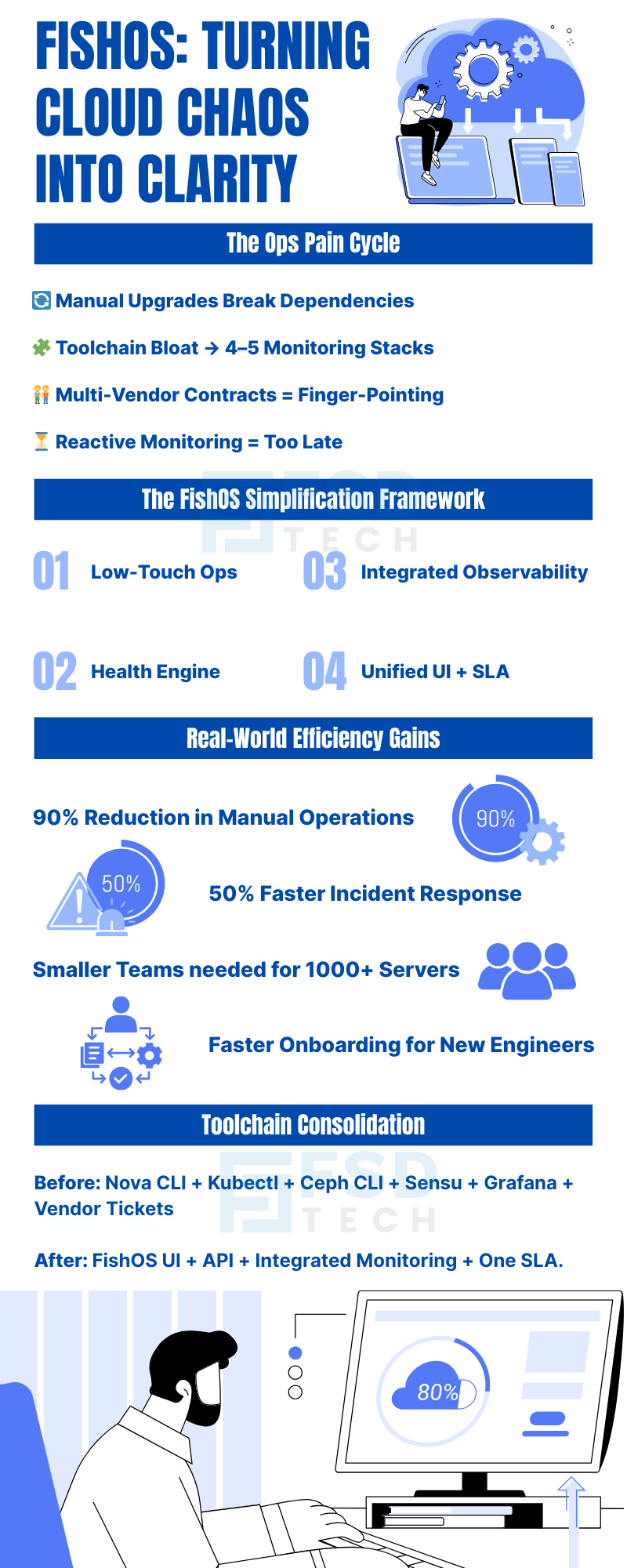
By automating provisioning, patching, monitoring, and remediation using AI-powered orchestration across all layers of the infrastructure stack.
Yes. While FishOS includes built-in telemetry, it also supports integration with SIEM systems, third-party alert managers, and enterprise NOC platforms.
Yes. Users can define policies for maintenance windows, patching frequency, health thresholds, and automated remediation actions.
No. FishOS includes full-stack support under a single SLA—covering OpenStack, Kubernetes, Ceph, and platform automation.
The FishOs Health Engine detects anomalies in real time and can be configured to automatical triggering self-healing tasks like restarting services, isolating faulty nodes, or live-migrating workloads.
Yes. FishOS supports geographically distributed clusters and centralizes operations via its control plane, making it suitable for multi-region or cloud environments.
Minimal to none. Upgrades of OpenStack components to a new release does not need in manual intervention, is supported by automatic zero-downtime upgrading and audit-ready logs.

Anas is an Expert in Network and Security Infrastructure, With over seven years of industry experience, holding certifications Including CCIE- Enterprise, PCNSE, Cato SASE Expert, and Atera Certified Master. Anas provides his valuable insights and expertise to readers.
Share it with friends!
.webp&w=3840&q=75)
.webp&w=3840&q=75)
share your thoughts