HomeNext Gen IT-InfraMonitoring & ManagementCyber SecurityBCP / DRAutomationDecoded
Next Gen IT-Infra
Cato’s SASE Supports Cybersecurity Skills Development

How Cato’s SASE Supports Cybersecurity Skills Development

🕓 April 8, 2025

How SASE Supports the Security Needs of SMBs

How SASE Supports the Security Needs of SMBs

🕓 February 9, 2025

Attack Surface Reduction with Cato’s SASE

Attack Surface Reduction with Cato’s SASE

🕓 February 10, 2025

SASE for Digital Transformation in UAE

SASE for Digital Transformation in UAE

🕓 February 8, 2025

Monitoring & Management
Understanding Atera’s SLA Management

Understanding Atera’s SLA Management

🕓 February 7, 2025

Cost-Performance Ratio: Finding the Right Balance in IT Management Networks

Cost-Performance Ratio: Finding the Right Balance in IT Management Networks

🕓 June 16, 2025

Customizing Atera with APIs

Customizing Atera with APIs

🕓 March 3, 2025

Power Up Your IT Team’s Strategy with Atera’s Communication Tools

Power Up Your IT Team’s Strategy with Atera’s Communication Tools

🕓 February 8, 2025

Cyber Security
Visual guide showing Cato CMA interface for configuring Internet and WAN firewall rules, enabling threat protection, and monitoring security events in real time for UAE IT teams.

Enforcing Firewall and Threat Protection Policies in Cato

🕓 July 25, 2025

Isometric illustration of professionals managing network performance, bandwidth analytics, and cloud-based optimization around the Cato Networks platform, symbolizing bandwidth control and QoS visibility.

Mastering Bandwidth Control and QoS in Cato Networks

🕓 July 26, 2025

Illustration of the Cato Cloud architecture showing its role in delivering SASE for secure, optimized global connectivity.

Understanding the Cato Cloud and Its Role in SASE

🕓 January 29, 2025

Global network backbone powering Cato SASE solution for secure, high-performance connectivity across regions.

Global Backbone: The Engine Powering Cato’s SASE Solution

🕓 January 30, 2025

BCP / DR
Illustration showing diverse business and IT professionals collaborating with cloud, backup, and security icons, representing Vembu use cases for SMBs, MSPs, and IT teams.

Who Uses Vembu? Real-World Use Cases for SMBs, MSPs & IT Teams

🕓 July 12, 2025

Graphic showcasing Vembu’s all-in-one backup and disaster recovery platform with icons for cloud, data protection, and business continuity for IT teams and SMBs.

What Is Vembu? A Deep Dive Into the All in One Backup & Disaster Recovery Platform

🕓 July 6, 2025

Illustration showing Vembu backup and disaster recovery system with cloud storage, server racks, analytics dashboard, and IT professionals managing data.

The Rising Cost of Data Loss: Why Backup Is No Longer Optional?

🕓 August 14, 2025

3D isometric illustration of cloud backup and data recovery infrastructure with laptop, data center stack, and digital business icons — FSD Tech

RPO & RTO: The Heart of Business Continuity

🕓 August 15, 2025

Automation
Cross-Functional Collaboration with ClickUp

Fostering Cross-Functional Collaboration with ClickUp for Multi-Departmental Projects

🕓 February 11, 2025

ClickUp Project Reporting

Revolutionizing Enterprise Reporting with ClickUp’s Advanced Analytics and Dashboards

🕓 June 16, 2025

ClickUp’s Design Collaboration and Asset Management Tools

Empowering Creative Teams with ClickUp’s Design Collaboration and Asset Management Tools

🕓 February 26, 2025

ClickUp Communication and Collaboration Tools

ClickUp Communication and Collaboration Tools: Empowering Remote Teams

🕓 March 12, 2025

Decoded
Multi-Factor Authentication (MFA)

Multi-Factor Authentication (MFA): All You Need to Know

🕓 December 7, 2025

L3 Switch

What Is an L3 Switch? L2 vs L3 & Why You Need Layer 3?

🕓 December 8, 2025

IPSec

IPSec Explained: Protocols, Modes, IKE & VPN Security

🕓 December 3, 2025

 Datagram Transport Layer Security (DTLS)

What is Datagram Transport Layer Security (DTLS)? How it works?

🕓 December 4, 2025

    Subscribe to our newsletter!

    About Us

    Follow Us

    Copyright © 2024 | Powered by 

    Cato SASE Architecture

    Inside Cato’s SASE Architecture: A Blueprint for Modern Security

    🕓 January 26, 2025

    Enterprise Data Security and Privacy with ClickUp

    Ensuring Enterprise Data Security and Privacy with ClickUp

    🕓 February 9, 2025

    DDoS protection SASE

    DDoS Protection and Cato’s Defence Mechanisms

    🕓 February 11, 2025

    Table of Contents

    Platforms, Countries, and Origin of Connection: Advanced Device Criteria in Cato Firewall

    Anas Abdu Rauf
    January 24, 2026
    Comments
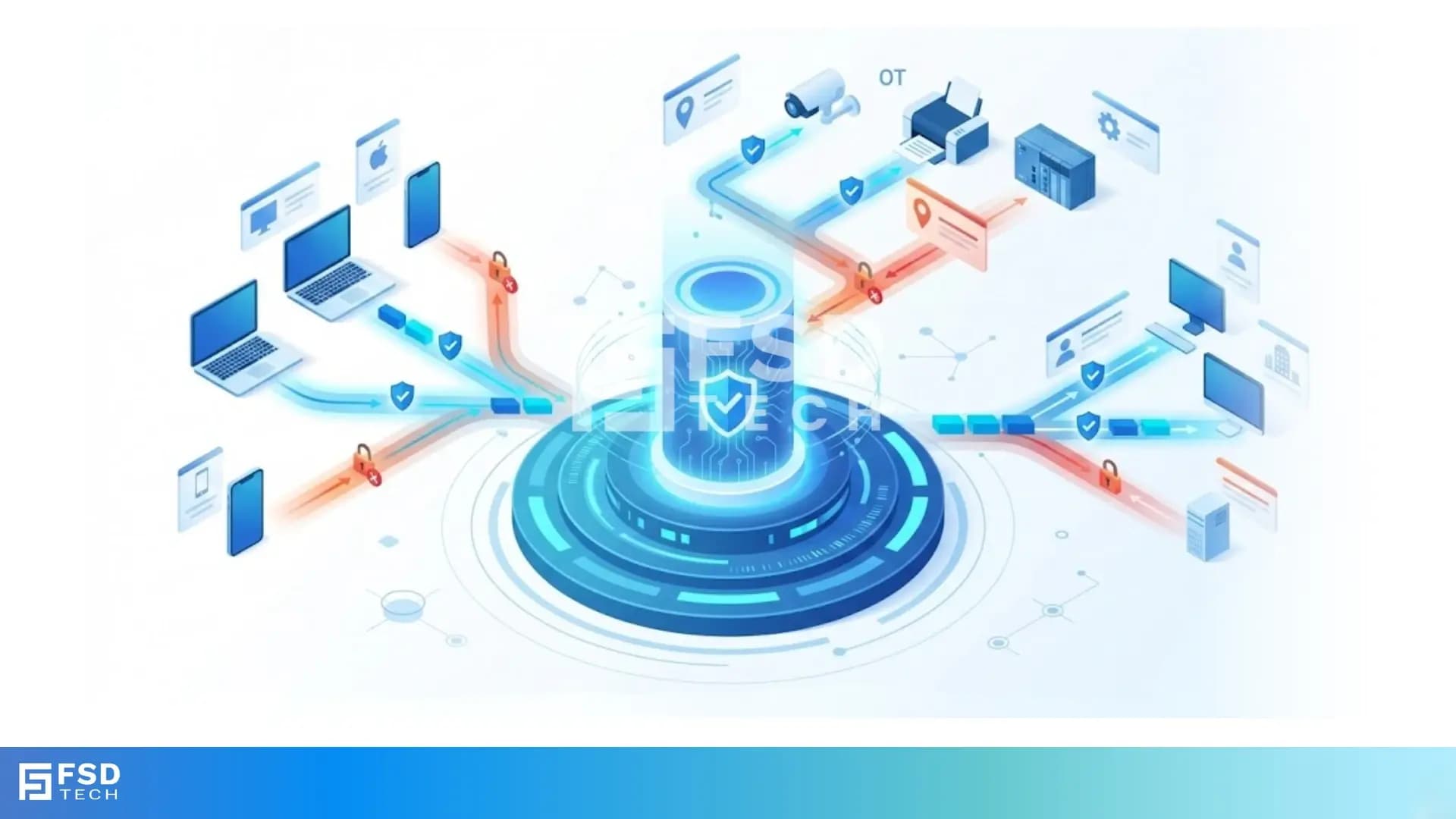
    Context-aware firewall enforcement in Cato SASE illustrating how device platform, country, and origin of connection enhance Zero Trust security beyond basic device context.

    As enterprises move toward Zero Trust architectures, enforcing security based only on IP addresses or network locations is no longer sufficient. Modern access decisions must consider who is connecting, from where, using what device, and under which conditions.
     

    In Cato Networks SASE, firewall enforcement extends beyond traditional device attributes. The platform allows administrators to apply advanced device criteria - including Platform, Country, and Origin of Connection - to both WAN and Internet firewall policies.
     

    These criteria enable organizations to build context-aware access controls that adapt to user mobility, hybrid work, and global operations—without fragmenting policy design.

    This blog explains how these advanced criteria work, how they differ from device attributes and posture, and how they strengthen policy enforcement across the Cato SASE fabric.


    Why Advanced Device Criteria Matter in Modern Firewall Policies

    Enterprise traffic today originates from multiple contexts:

    • Users working remotely or behind sites
    • Devices moving between corporate and external networks
    • Applications accessed from different geographic regions
    • Mixed environments of managed and unmanaged endpoints

    Firewall policies that rely only on device type or IP range cannot reliably handle this complexity.

    Cato addresses this gap by allowing firewall rules to evaluate how and from where a connection originates—adding a critical layer of context to access decisions.


    Understanding Platform-Based Enforcement in Cato Firewall

    The Platform criterion allows firewall rules to evaluate traffic based on the operating system of the connecting device.

    Supported platforms include:

    • Windows
    • macOS
    • Linux
    • iOS
    • Android

    How Platform Criteria Are Used

    Platform conditions can be applied to:

    • WAN firewall rules (internal traffic)
    • Internet firewall rules (outbound access)

    Typical use cases include:

    • Allowing administrative access only from desktop operating systems
    • Restricting sensitive applications from mobile platforms
    • Applying different controls to BYOD vs corporate endpoints

    Platform-based rules help organizations align access with device capability and risk profile, without relying on static network segmentation.


    Country-Based Enforcement for Geographic Control

    The Country criterion enables firewall rules to evaluate the geographic location of the device at the time of connection.

    This is particularly relevant for:

    • Remote users connecting from outside corporate regions
    • Organizations with region-specific access requirements
    • Reducing exposure from high-risk or unexpected locations

    Documented Country Enforcement Behavior

    • Country conditions can be combined with other device criteria
    • Multiple countries within a rule follow OR logic
    • Country criteria apply consistently across WAN and Internet firewall policies

    This allows enterprises to:

    • Restrict access to internal resources based on user location
    • Apply tighter controls for connections originating outside approved regions


    Origin of Connection: Remote vs Behind-Site Context

    One of the most powerful and often misunderstood criteria in Cato firewall policies is Origin of Connection.

    This condition distinguishes how traffic enters the Cato fabric, not just where it comes from.

    Supported Origins

    • Behind Site – Traffic originating from devices behind a Cato Socket
    • Remote User – Traffic originating from a device using the Cato Client

    This distinction allows organizations to apply different security policies depending on whether a device is:

    • On a corporate network
    • Accessing resources remotely
    • Moving between office and remote contexts


    How These Criteria Differ from Device Attributes and Posture

    To design effective policies, it’s important to understand the roles of each control type:

    Device Attributes

    • Describe what the device is
    • Derived from Device Inventory
    • Used heavily for segmentation and classification

    Device Posture Profiles

    • Validate device compliance
    • Enforced through the Cato Client
    • Focus on security state (encryption, malware, processes)

    Platform, Country, Origin

    • Describe connection context
    • Independent of inventory classification
    • Evaluate environment, location, and access path

    These controls are complementary not interchangeable and together enable layered Zero Trust enforcement.


    Logical Evaluation in Firewall Rules

    Cato applies consistent logic when evaluating firewall rules:

    • AND logic between different criteria
      • Platform + Country + Origin + Device Attributes
    • OR logic within a single criterion
      • Multiple platforms
      • Multiple countries

    This ensures predictable, auditable enforcement across complex policies.


    Practical Policy Design Examples

    Example 1: Remote Access Control

    Allow access to internal systems only if:

    • Platform = Windows or macOS
    • Origin = Remote User
    • Country = Approved regions

    Example 2: Office-Only Application Access

    Allow application access only if:

    • Origin = Behind Site
    • Platform = Desktop OS

    Example 3: Reduced Risk Exposure

    Block internet access if:

    • Origin = Remote User
    • Country = Unapproved regions

    Each of these examples relies on documented, supported Cato firewall behavior.
     

    Operational Benefits for Security Teams

    Using advanced device criteria provides:

    • Clear separation between remote and on-site access
    • Reduced policy sprawl through reusable conditions
    • Improved audit readiness with explicit contextual rules
    • Consistent enforcement across WAN and Internet traffic

    Because all rules are enforced centrally, teams gain global visibility and control without managing multiple firewall layers.


    Strategic Value: Context-Aware Security Without Complexity

    By incorporating Platform, Country, and Origin of Connection into firewall policies, Cato SASE enables enterprises to:

    • Enforce Zero Trust consistently across all access paths
    • Adapt security to user mobility and global operations
    • Reduce reliance on brittle network-based controls

    This approach allows security teams to focus on policy intent, not infrastructure constraints.


    Secure remote and on-site access with smarter firewall criteria → Schedule a free 30-minute Cato Firewall strategy session.
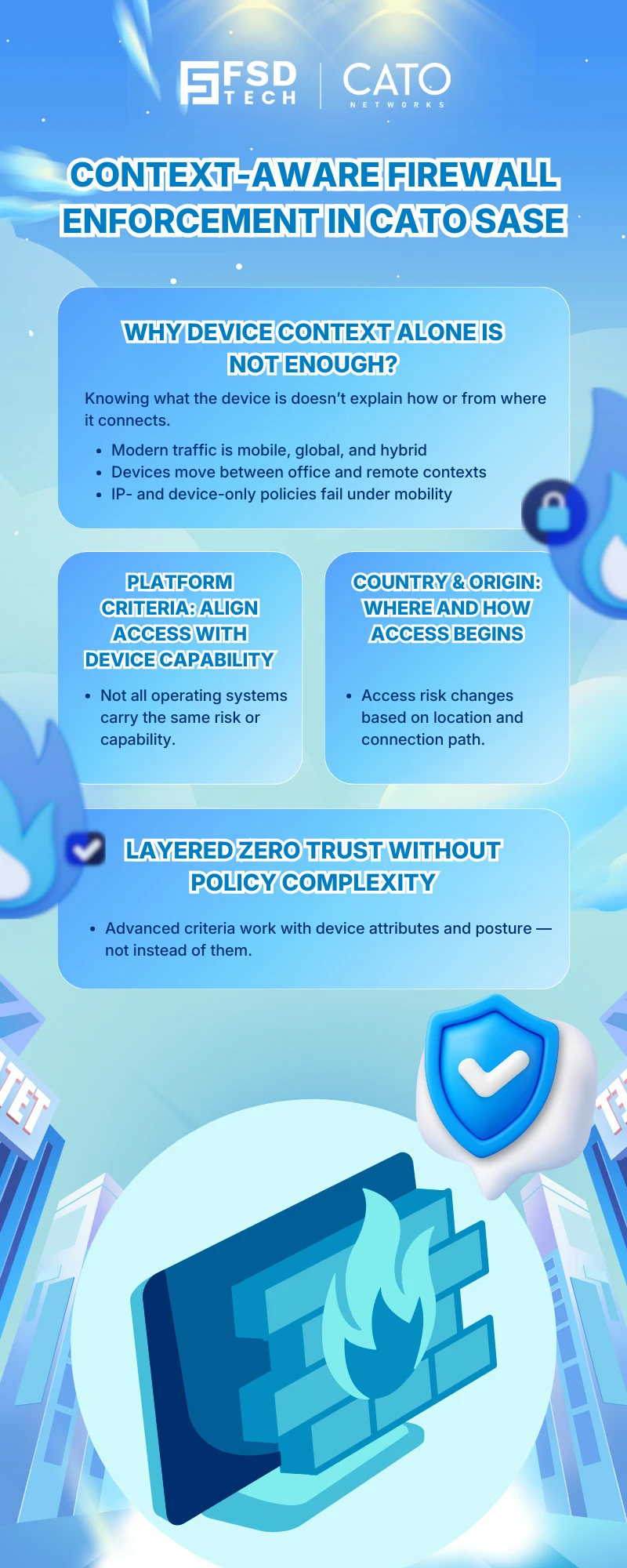
     

    Diagram showing context-aware firewall policies in Cato SASE, where devices, users, and OT systems are evaluated based on platform, location, and connection origin for adaptive Zero Trust enforcement.


    FAQs


    How does Cato SASE use Platform criteria in firewall rules?

    Cato SASE firewall rules can evaluate the operating system of a device (Platform) to apply access controls based on device capability and risk profile.


    Can Cato firewall policies restrict access based on country?

    Yes. Cato firewall rules support Country conditions, allowing enforcement based on the geographic location of the connecting device.


    What does Origin of Connection mean in Cato firewall rules?

    Origin of Connection identifies whether traffic originates from behind a Cato site or from a remote user using the Cato Client.


    How is Origin of Connection different from Platform in Cato SASE?

    Platform describes the device’s operating system, while Origin of Connection describes how the device connects to the Cato fabric (remote vs behind site).


    Can Platform, Country, and Origin be combined in Cato firewall rules?

    Yes. Cato firewall rules evaluate these criteria together using AND logic across conditions and OR logic within each condition.


    Do these criteria apply to both WAN and Internet firewall policies in Cato?

    Yes. Platform, Country, and Origin of Connection are supported in both WAN and Internet firewall policies.


    How do these advanced criteria support Zero Trust in Cato SASE?

    They enable context-aware access decisions that consider device environment, location, and connection path—key pillars of Zero Trust enforcement.

    Platforms, Countries, and Origin of Connection: Advanced Device Criteria in Cato Firewall

    About The Author

    Anas Abdu Rauf

    Anas is an Expert in Network and Security Infrastructure, With over seven years of industry experience, holding certifications Including CCIE- Enterprise, PCNSE, Cato SASE Expert, and Atera Certified Master. Anas provides his valuable insights and expertise to readers.

    Like This Story?

    Share it with friends!

    Subscribe to our newsletter!

    Atera

    (48)

    Cato Networks

    (116)

    ClickUp

    (70)

    FishOS

    (7)

    Miradore

    (21)

    PointGuard AI

    (9)

    Vembu

    (22)

    Xcitium

    (33)

    ZETA HRMS

    (73)

    Workflow Automation(8)

    Workforce Automation(1)

    AI Project Management(1)

    HR Data Automation(1)

    RMM(1)

    IT Workflow Automation(1)

    IT security(2)

    GCC compliance(4)

    Payroll Integration(2)

    IT support automation(3)

    procurement automation(1)

    lost device management(1)

    IT Management(5)

    IoT Security(2)

    Cato XOps(2)

    IT compliance(4)

    Task Automation(1)

    Workflow Management(1)

    AI-powered cloud ops(1)

    Kubernetes lifecycle management(2)

    OpenStack automation(1)

    SMB Security(8)

    Data Security(1)

    MDR (Managed Detection & Response)(4)

    Atera Integrations(2)

    MSP Automation(3)

    XDR Security(2)

    SMB Cyber Protection(1)

    Ransomware Defense(3)

    HR Tech Solutions(1)

    Zero Trust Network Access(3)

    Zero Trust Security(2)

    Endpoint Management(1)

    SaaS Security(1)

    Payroll Automation(5)

    IT Monitoring(2)

    Xcitium EDR SOC(15)

    Ransomware Protection GCC(1)

    Network Consolidation UAE(1)

    M&A IT Integration(1)

    MSSP for SMBs(1)

    Antivirus vs EDR(1)

    FSD-Tech MSSP(25)

    Ransomware Protection(3)

    Managed EDR FSD-Tech(1)

    SMB Cybersecurity GCC(1)

    Cybersecurity GCC(12)

    Endpoint Security(1)

    Endpoint Protection(1)

    Data Breach Costs(1)

    Xcitium EDR(30)

    Zero Dwell Containment(31)

    SMB Cybersecurity(8)

    Managed Security Services(2)

    Hybrid Backup(1)

    Cloud Backup(1)

    Backup & Recovery(1)

    pointguard ai(4)

    backup myths(1)

    vembu(9)

    SMB data protection(9)

    disaster recovery myths(1)

    Disaster Recovery(4)

    Vembu BDR Suite(19)

    GCCBusiness(1)

    DataProtection(1)

    Secure Access Service Edge(4)

    GCC HR software(17)

    Miradore EMM(15)

    Cato SASE(7)

    Cloud Security(8)

    Talent Development(1)

    AI Governance(4)

    AI Risk Management(1)

    AI Security(2)

    AI Cybersecurity(12)

    AI Compliance(2)

    GCC business security(1)

    GCC network integration(1)

    compliance automation(5)

    education security(1)

    GCC cybersecurity(2)

    BYOD security Dubai(8)

    App management UAE(1)

    Miradore EMM Premium+(5)

    MiddleEast(1)

    HealthcareSecurity(1)

    Team Collaboration(1)

    IT automation(12)

    Zscaler(1)

    SD-WAN(6)

    HR Integration(4)

    Cloud Networking(3)

    device management(9)

    VPN(1)

    RemoteWork(1)

    ZeroTrust(2)

    MPLS(1)

    Project Management(9)

    HR automation(16)

    share your thoughts

    Illustration showing identity-centric Zero Trust security with the Cato Client acting as a continuous identity signal, connecting users, devices, cloud resources, and OT systems through unified policy enforcement.”

    How the Cato Client Becomes the Identity Anchor for Zero Trust Access

    🕓 January 25, 2026

    Context-aware firewall enforcement in Cato SASE illustrating how device platform, country, and origin of connection enhance Zero Trust security beyond basic device context.

    Platforms, Countries, and Origin of Connection: Advanced Device Criteria in Cato Firewall

    🕓 January 24, 2026

    Cato SASE platform visual showing device-aware WAN firewall enforcement with centralized security controls, analytics dashboards, IPS, and Zero Trust policy monitoring across enterprise infrastructure.

    Device-Aware WAN Firewall Policies in Cato SASE

    🕓 January 23, 2026

    Decoded(81)

    Cyber Security(116)

    BCP / DR(22)

    Zeta HRMS(72)

    SASE(21)

    Automation(70)

    Next Gen IT-Infra(116)

    Monitoring & Management(69)

    ITSM(22)

    HRMS(21)

    Automation(24)