.webp&w=3840&q=75)
How ClickUp Enables Outcome-Based Project Management (Not Just Task Tracking)
🕓 February 15, 2026
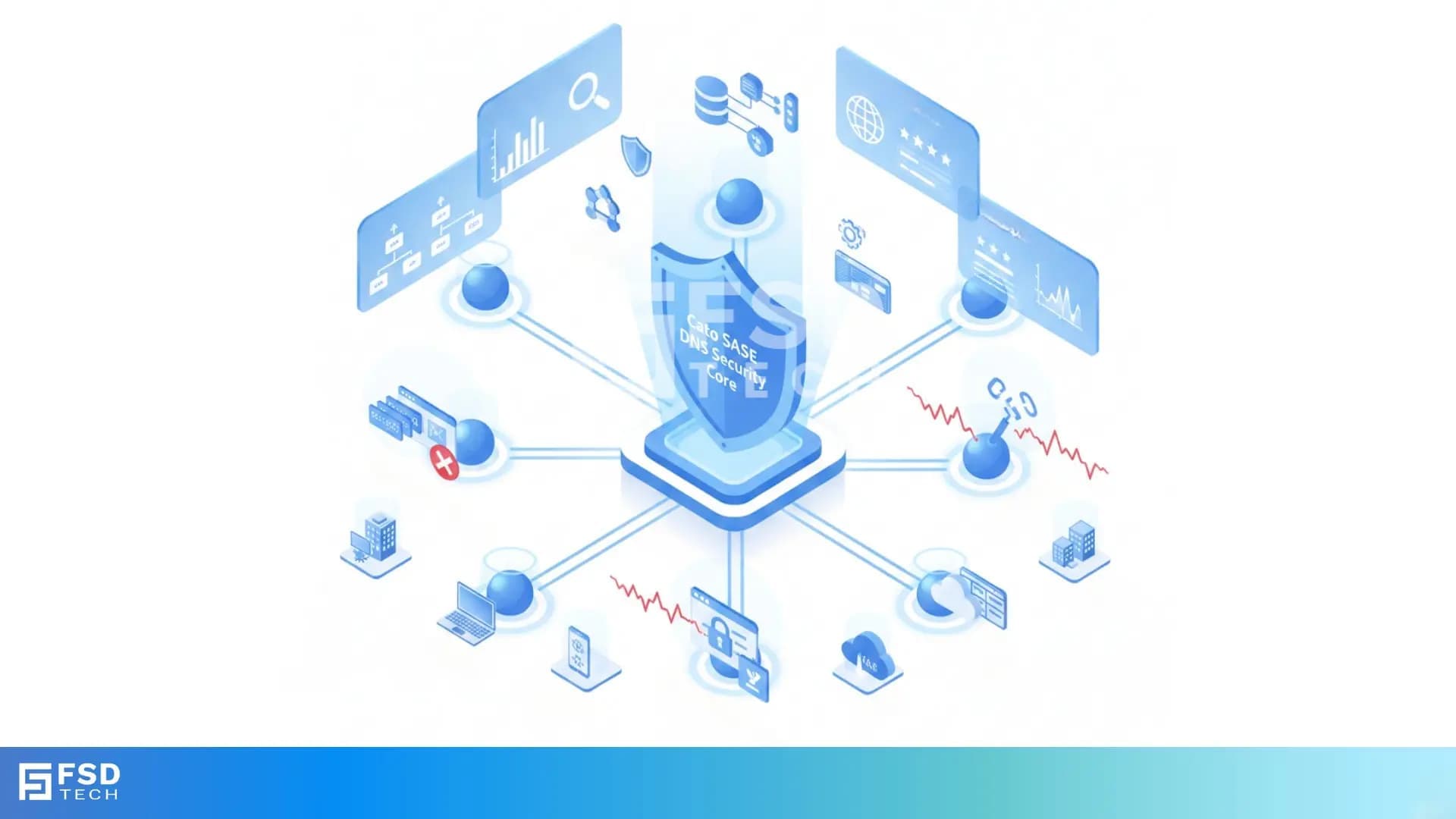
DNS is more than just the internet’s “phonebook”—it is a pivotal layer in enterprise security. As organizations in the GCC and beyond embrace cloud-first and hybrid architectures, DNS becomes a critical control point for threat detection and policy enforcement. Attackers increasingly exploit DNS for data exfiltration, phishing, and command-and-control (C&C) communications, often bypassing traditional security measures.
This guide examines how Cato SASE, enabled by FSD Tech, delivers advanced DNS security as part of a unified SASE platform. We analyze attack techniques, modern defense frameworks, and practical strategies for network administrators and security teams to prevent and mitigate DNS-based threats.
DNS underpins nearly every digital interaction—web browsing, SaaS access, email, and more. Its ubiquity and trust make it both a rich source of security telemetry and a frequent target for attackers.
An attacker compromises an endpoint in a UAE-based enterprise and uses DNS tunneling to exfiltrate confidential data. The data is split into small chunks and sent via seemingly innocuous DNS queries to an attacker-controlled domain. Without DNS-layer inspection, the attack persists undetected.
A user in a GCC financial institution clicks a link in a phishing email. The DNS request for a lookalike domain is intercepted by Cato SASE, which blocks the request based on threat intelligence, preventing the user from reaching the malicious site.
DNS-based attacks are challenging to detect and mitigate due to the protocol’s essential role and the sophistication of modern threat actors.
Attackers often leverage DNS tunneling tools to encode and transmit sensitive information out of the network. These tools mimic legitimate DNS traffic, making detection difficult for traditional security appliances that focus on HTTP/S or other protocols.
Phishing campaigns increasingly use DNS manipulation—either by registering deceptive domains or poisoning DNS caches—to redirect users to malicious sites. These attacks can bypass endpoint defenses if DNS queries are not inspected and filtered in real time.
Malware families frequently use DNS as a resilient channel for C&C, issuing queries to dynamically generated domains or leveraging fast-flux techniques to evade static blocklists.
Effective DNS security requires a multi-layered approach that combines real-time inspection, threat intelligence, behavioral analytics, and flexible policy enforcement.
Modern DNS security leverages global threat intelligence feeds and domain reputation databases. Queries to known malicious or suspicious domains are blocked in real time, preventing access to phishing sites and C&C infrastructure.
Advanced solutions analyze DNS query patterns for anomalies—such as unusual query rates, rare TLDs, or atypical domain structures—that may indicate tunneling or exfiltration attempts. Machine learning and heuristics help identify novel threats that evade static blocklists.
Protocols like DNS over HTTPS (DoH) and DNS over TLS (DoT) encrypt DNS traffic, enhancing privacy but complicating security inspection. While these protocols can protect against eavesdropping, they may also limit the visibility needed for threat detection unless integrated with the security platform.
The most effective DNS security frameworks enforce policies before connections are established, reducing the window of opportunity for attackers and minimizing the risk of lateral movement or data loss.
Cato SASE delivers DNS-layer protection as a core capability of its cloud-native SASE platform, ensuring that DNS security is unified, scalable, and always up to date.
Hybrid and multi-cloud environments require nuanced DNS handling to balance performance and security.
A multinational company with offices in Dubai and Riyadh uses DNS split tunneling to resolve internal resources locally, while all public DNS queries are inspected by Cato SASE. This approach ensures both high performance for local applications and robust protection against external threats.
Independent testing by SafeBreach and Frost & Sullivan demonstrates that Cato SASE blocks 99–100% of advanced threats, including DNS-based data exfiltration, C&C communications, and phishing attempts. These results highlight the efficacy of unified, cloud-native DNS security over fragmented or legacy solutions.
| Threat Type | Cato SASE Block Rate |
|---|---|
| Malware Transfer | 100% |
| C&C Communication | 100% |
| Data Exfiltration | 100% |
Such comprehensive protection is only possible when DNS security is integrated at the platform level, with real-time threat intelligence and behavioral analytics.
FSD Tech is the GCC’s regional enabler for Cato SASE, providing local expertise, deployment, and ongoing support. This partnership ensures that organizations in the UAE, Saudi Arabia, and across the region benefit from:
By bridging global innovation with regional execution, FSD Tech empowers GCC organizations to achieve world-class DNS security.
To maximize DNS security with Cato SASE, network administrators and security teams should:
Protect your network from DNS-based attacks—end to end → Schedule a strategy call with our Cato SASE experts.
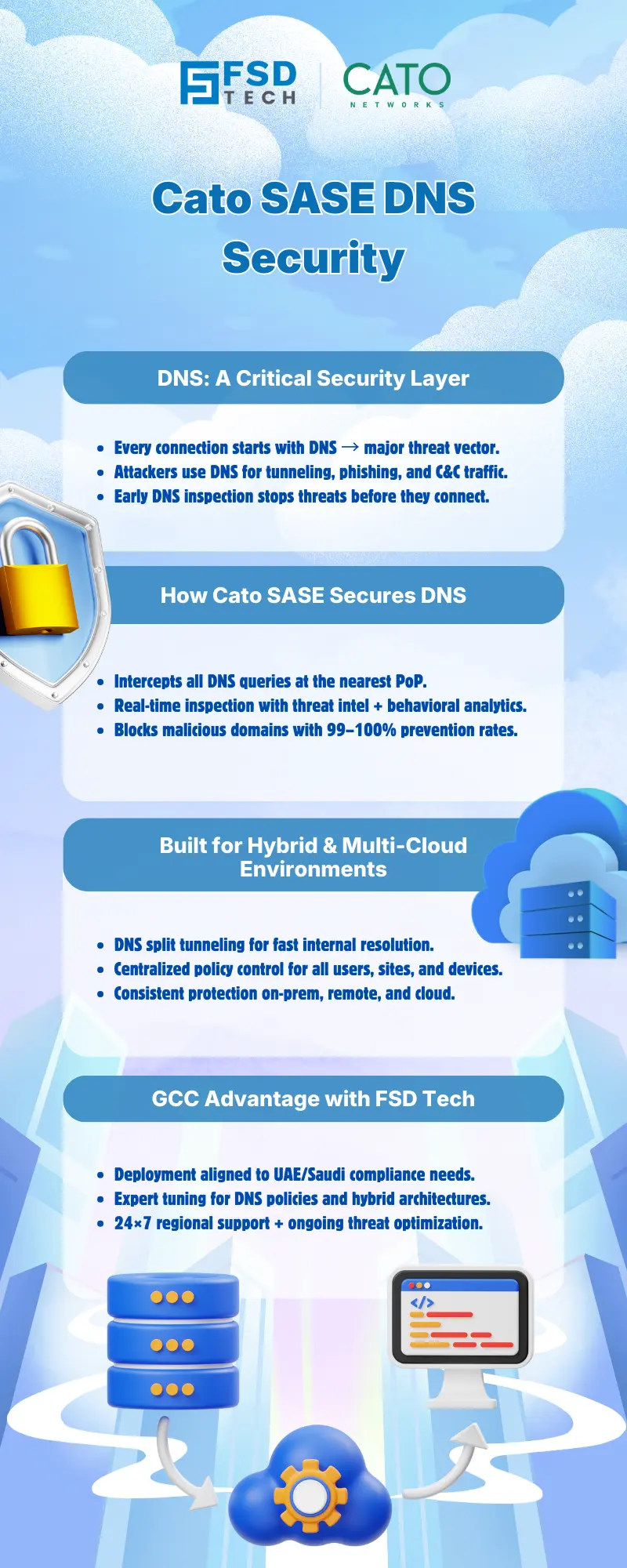
DNS-layer security refers to the inspection and filtering of DNS queries to detect and block malicious domains, phishing attempts, and data exfiltration before a connection is established. It is important because DNS is a foundational protocol used by nearly all network communications, making it a prime target for attackers seeking to bypass traditional security controls.
Cato SASE intercepts all DNS queries at the nearest Point of Presence (PoP), inspects them in real time using threat intelligence, behavioral analytics, and heuristics, and enforces security policies before any connection is made. This approach ensures consistent protection across all users and locations, whether on-premises or remote.
Yes. Cato SASE’s DNS-layer inspection identifies suspicious query patterns and behaviors associated with DNS tunneling, blocking attempts to exfiltrate data through covert DNS channels. This is validated by independent testing showing 100% prevention of DNS-based data exfiltration.
DNS split tunneling allows internal DNS queries (for local resources) to be resolved on-premises for speed and compatibility, while public DNS queries are routed through Cato SASE for inspection and threat prevention. This balances performance and security, especially in distributed or multi-cloud environments.
FSD Tech acts as the regional enabler for Cato SASE in the GCC, providing local deployment, compliance alignment, and ongoing support. Their expertise ensures that organizations in the UAE, Saudi Arabia, and neighboring countries benefit from globally proven DNS security tailored to regional needs.
Unlike traditional or bolt-on DNS security tools, Cato SASE delivers DNS protection as a native, unified cloud service. This ensures real-time enforcement, seamless scalability, and consistent policy application across all users and locations, outperforming fragmented solutions in both efficacy and simplicity.
Cato SASE blocks a wide range of DNS-based attacks, including data exfiltration via DNS tunneling, phishing redirection, command-and-control (C&C) communications, and access to known malicious domains. Its integrated threat intelligence and behavioral analytics enable detection of both known and novel threats.
Cato SASE provides centralized policy management, allowing administrators to define and enforce DNS security policies at the user, group, site, or account level. Policies are instantly applied and auditable, ensuring consistent protection regardless of user location.
While DNS over HTTPS (DoH) and DNS over TLS (DoT) enhance privacy by encrypting DNS queries, they can also limit the visibility needed for threat detection. Cato SASE currently focuses on comprehensive inspection of standard DNS traffic to maintain security efficacy.
Cato SASE integrates global threat intelligence feeds and domain reputation databases to block queries to known malicious or suspicious domains in real time. This proactive approach prevents access to phishing sites and C&C infrastructure before connections are established.
Policy changes in Cato SASE are applied instantly across the entire platform, ensuring rapid response to emerging threats or operational needs. This agility streamlines troubleshooting and compliance reporting for security teams.
local presence ensures rapid support and alignment with regional business practices.
Cato SASE provides detailed DNS logs and alerting capabilities, enabling security teams to monitor for anomalous activity, investigate incidents, and refine policies based on real-world threat patterns.
Best practices include enabling DNS-layer inspection for all users, defining granular policies, leveraging split tunneling for hybrid environments, regularly reviewing logs and alerts, and collaborating with regional partners like FSD Tech for deployment and ongoing optimization.
By intercepting DNS queries at the nearest PoP and enforcing policies centrally, Cato SASE provides uniform DNS security regardless of user location or device, ensuring that remote and mobile users are protected to the same standard as on-premises staff.

Anas is an Expert in Network and Security Infrastructure, With over seven years of industry experience, holding certifications Including CCIE- Enterprise, PCNSE, Cato SASE Expert, and Atera Certified Master. Anas provides his valuable insights and expertise to readers.
Share it with friends!


.webp&w=3840&q=75)


.webp&w=3840&q=75)
share your thoughts