HomeNext Gen IT-InfraMonitoring & ManagementCyber SecurityBCP / DRAutomationDecoded
Next Gen IT-Infra
Cato’s SASE Supports Cybersecurity Skills Development

How Cato’s SASE Supports Cybersecurity Skills Development

🕓 April 8, 2025

How SASE Supports the Security Needs of SMBs

How SASE Supports the Security Needs of SMBs

🕓 February 9, 2025

Attack Surface Reduction with Cato’s SASE

Attack Surface Reduction with Cato’s SASE

🕓 February 10, 2025

SASE for Digital Transformation in UAE

SASE for Digital Transformation in UAE

🕓 February 8, 2025

Monitoring & Management
Understanding Atera’s SLA Management

Understanding Atera’s SLA Management

🕓 February 7, 2025

Cost-Performance Ratio: Finding the Right Balance in IT Management Networks

Cost-Performance Ratio: Finding the Right Balance in IT Management Networks

🕓 June 16, 2025

Customizing Atera with APIs

Customizing Atera with APIs

🕓 March 3, 2025

Power Up Your IT Team’s Strategy with Atera’s Communication Tools

Power Up Your IT Team’s Strategy with Atera’s Communication Tools

🕓 February 8, 2025

Cyber Security
Visual guide showing Cato CMA interface for configuring Internet and WAN firewall rules, enabling threat protection, and monitoring security events in real time for UAE IT teams.

Enforcing Firewall and Threat Protection Policies in Cato

🕓 July 25, 2025

Isometric illustration of professionals managing network performance, bandwidth analytics, and cloud-based optimization around the Cato Networks platform, symbolizing bandwidth control and QoS visibility.

Mastering Bandwidth Control and QoS in Cato Networks

🕓 July 26, 2025

Illustration of the Cato Cloud architecture showing its role in delivering SASE for secure, optimized global connectivity.

Understanding the Cato Cloud and Its Role in SASE

🕓 January 29, 2025

Global network backbone powering Cato SASE solution for secure, high-performance connectivity across regions.

Global Backbone: The Engine Powering Cato’s SASE Solution

🕓 January 30, 2025

BCP / DR
Illustration showing diverse business and IT professionals collaborating with cloud, backup, and security icons, representing Vembu use cases for SMBs, MSPs, and IT teams.

Who Uses Vembu? Real-World Use Cases for SMBs, MSPs & IT Teams

🕓 July 12, 2025

Graphic showcasing Vembu’s all-in-one backup and disaster recovery platform with icons for cloud, data protection, and business continuity for IT teams and SMBs.

What Is Vembu? A Deep Dive Into the All in One Backup & Disaster Recovery Platform

🕓 July 6, 2025

Illustration showing Vembu backup and disaster recovery system with cloud storage, server racks, analytics dashboard, and IT professionals managing data.

The Rising Cost of Data Loss: Why Backup Is No Longer Optional?

🕓 August 14, 2025

3D isometric illustration of cloud backup and data recovery infrastructure with laptop, data center stack, and digital business icons — FSD Tech

RPO & RTO: The Heart of Business Continuity

🕓 August 15, 2025

Automation
Cross-Functional Collaboration with ClickUp

Fostering Cross-Functional Collaboration with ClickUp for Multi-Departmental Projects

🕓 February 11, 2025

ClickUp Project Reporting

Revolutionizing Enterprise Reporting with ClickUp’s Advanced Analytics and Dashboards

🕓 June 16, 2025

ClickUp’s Design Collaboration and Asset Management Tools

Empowering Creative Teams with ClickUp’s Design Collaboration and Asset Management Tools

🕓 February 26, 2025

ClickUp Communication and Collaboration Tools

ClickUp Communication and Collaboration Tools: Empowering Remote Teams

🕓 March 12, 2025

Decoded
Multi-Factor Authentication (MFA)

Multi-Factor Authentication (MFA): All You Need to Know

🕓 December 7, 2025

L3 Switch

What Is an L3 Switch? L2 vs L3 & Why You Need Layer 3?

🕓 December 8, 2025

IPSec

IPSec Explained: Protocols, Modes, IKE & VPN Security

🕓 December 3, 2025

 Datagram Transport Layer Security (DTLS)

What is Datagram Transport Layer Security (DTLS)? How it works?

🕓 December 4, 2025

    Subscribe to our newsletter!

    About Us

    Follow Us

    Copyright © 2024 | Powered by 

    Cato SASE Architecture

    Inside Cato’s SASE Architecture: A Blueprint for Modern Security

    🕓 January 26, 2025

    Enterprise Data Security and Privacy with ClickUp

    Ensuring Enterprise Data Security and Privacy with ClickUp

    🕓 February 9, 2025

    DDoS protection SASE

    DDoS Protection and Cato’s Defence Mechanisms

    🕓 February 11, 2025

    Table of Contents

    Immutable Backups: What They Are and Why You Need Them

    Nasmal
    August 20, 2025
    Comments
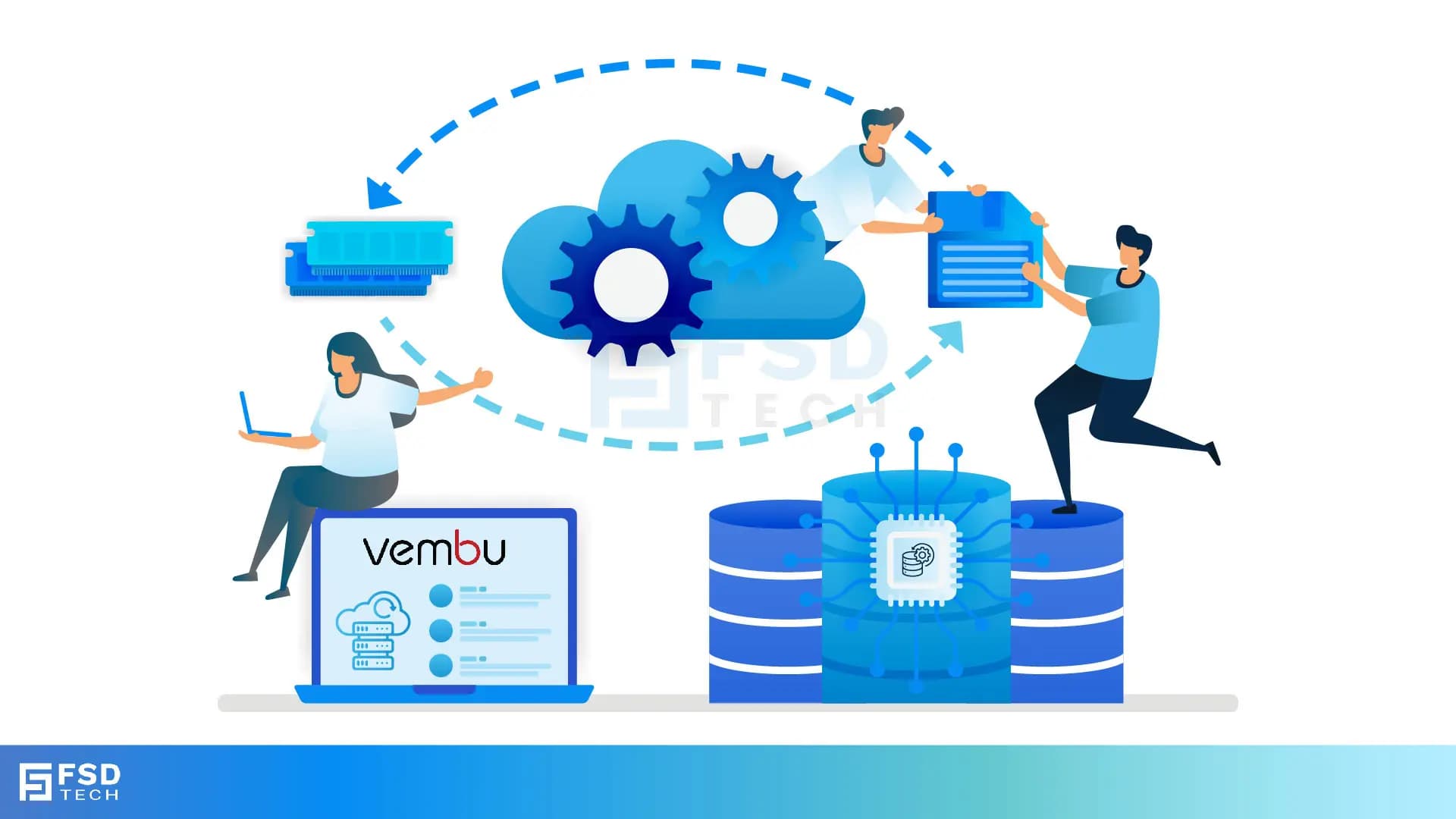
    Illustration showing Vembu cloud backup automation with people managing files, cloud storage gears, servers, and data protection icons for immutable and ransomware-proof backups.

    A Story About the Backup That Saved a Company

    In early 2024, a medium-sized manufacturing company in Riyadh faced a crisis.

    On a Monday morning, their computer systems suddenly froze.


    A message popped up on every employee’s screen:

    “Your files have been encrypted. Pay $150,000 in cryptocurrency within 72 hours, or your data will be deleted forever.”


    The hackers had done their homework. Before locking the files, they searched the company’s network and deleted every backup they could find.


    But the attackers missed one thing: The company had a set of immutable backups stored in the cloud. These backups were locked in such a way that no one — not even the company’s own IT administrator — could delete or change them until the time period expired.


    Within hours, the IT team restored every system from these untouchable backups. No ransom was paid.

    Operations were back to normal by the next day.


    This wasn’t luck — it was planning. And it’s why immutable backups are now considered one of the most important tools for data protection in 2025.


    Don’t wait for ransomware to teach you a costly lesson. Secure your business with immutable backup protection today. Book Your Free Consultation
     

    What Is an Immutable Backup?

    An immutable backup is a locked copy of your data that cannot be changed, overwritten, or deleted for a certain amount of time — not by hackers, not by employees, and not even by your IT team.

    Think of it like keeping your most valuable documents in a vault with a timer. Once you close the vault and set the timer for, say, 30 days, no one can open it until that time is up — no matter how hard they try.


    Why Are Immutable Backups So Important in 2025?

    1. They Stop Ransomware in Its Tracks
      Hackers often target backups first so you can’t recover without paying them. Immutable backups mean the attackers can’t erase or encrypt your safe copies.
       
    2. They Protect Against Accidental Deletion
      We’ve all been there — an important file gets deleted or replaced by mistake. With immutable backups, you can recover the original, untouched version.
       
    3. They Guard Against Insider Threats
      Not all risks come from outside. Sometimes, a disgruntled employee or contractor might try to damage your data. Immutability ensures they can’t touch the locked backups.
       
    4. They Help With Compliance
      In some industries — like healthcare, finance, and legal — you’re legally required to keep records unchanged for a certain number of years. Immutable backups make it easy to prove your data hasn’t been tampered with.


    How Do Immutable Backups Actually Work?

    Immutable backups use a technology often called Write Once, Read Many (WORM).

    This means:

    • You can write data once (save it).
    • You can read it many times (restore it whenever needed).
    •  You cannot change or delete it until the time lock expires.

    Once the “lock period” you’ve chosen is over, you can delete or replace the backup if you wish — but until then, it’s completely safe.


    Your data deserves a shield hackers can’t break. Get started with Vembu Immutable Backup now. Claim Free Data Protection Health Check
     

    Common Myths About Immutable Backups

    Myth 1: They’re too expensive for small businesses.

    Reality: Cloud-based immutable storage is now affordable, with plans designed for SMB budgets.

    Myth 2: They’re complicated to set up.

    Reality: With solutions like Vembu BDR Suite, immutability can be turned on with just a few clicks.

    Myth 3: I already have regular backups, so I don’t need immutability.

    Reality: Regular backups can still be changed or deleted by ransomware or human error. Without immutability, your “safe copy” might not be so safe.


    How Vembu BDR Suite Does Immutable Backups

    Vembu BDR Suite makes immutability simple and practical for all business sizes:

    • Choose Your Lock Period: Set how long your backups should be untouchable (e.g., 7 days, 30 days, 1 year).
    • Hybrid Protection: Keep immutable backups locally (on your premises) and/or in the cloud.
    • Ransomware-Resistant: Locked backups cannot be deleted or changed — even by an administrator.
    • Easy to Use: Activate immutability with a simple configuration setting — no special hardware needed.


    Real-World Example

    A medical clinic in Nairobi stored all patient records on a central server.

    When ransomware hit, it destroyed all the local backups.

    But their immutable backups stored in Vembu’s cloud were untouched.

    They restored the entire system in under 3 hours, avoided paying the ransom, and prevented a legal disaster under healthcare privacy laws.


    The Key Takeaway

    Immutable backups are like an insurance policy that can’t be canceled.

    In today’s world of ransomware, human mistakes, and insider risks, they’re no longer a “nice-to-have” — they’re a must-have for business survival.


    Tomorrow’s Topic – We’ll explore “The 3-2-1 Backup Strategy: Still Relevant in 2025?” and how to adapt it to modern threats.


    If your backups can be deleted or changed, you’re one step away from disaster.


    Ready to lock down your backups and stay ransomware-proof? Schedule a Free Strategy Call with Our Experts
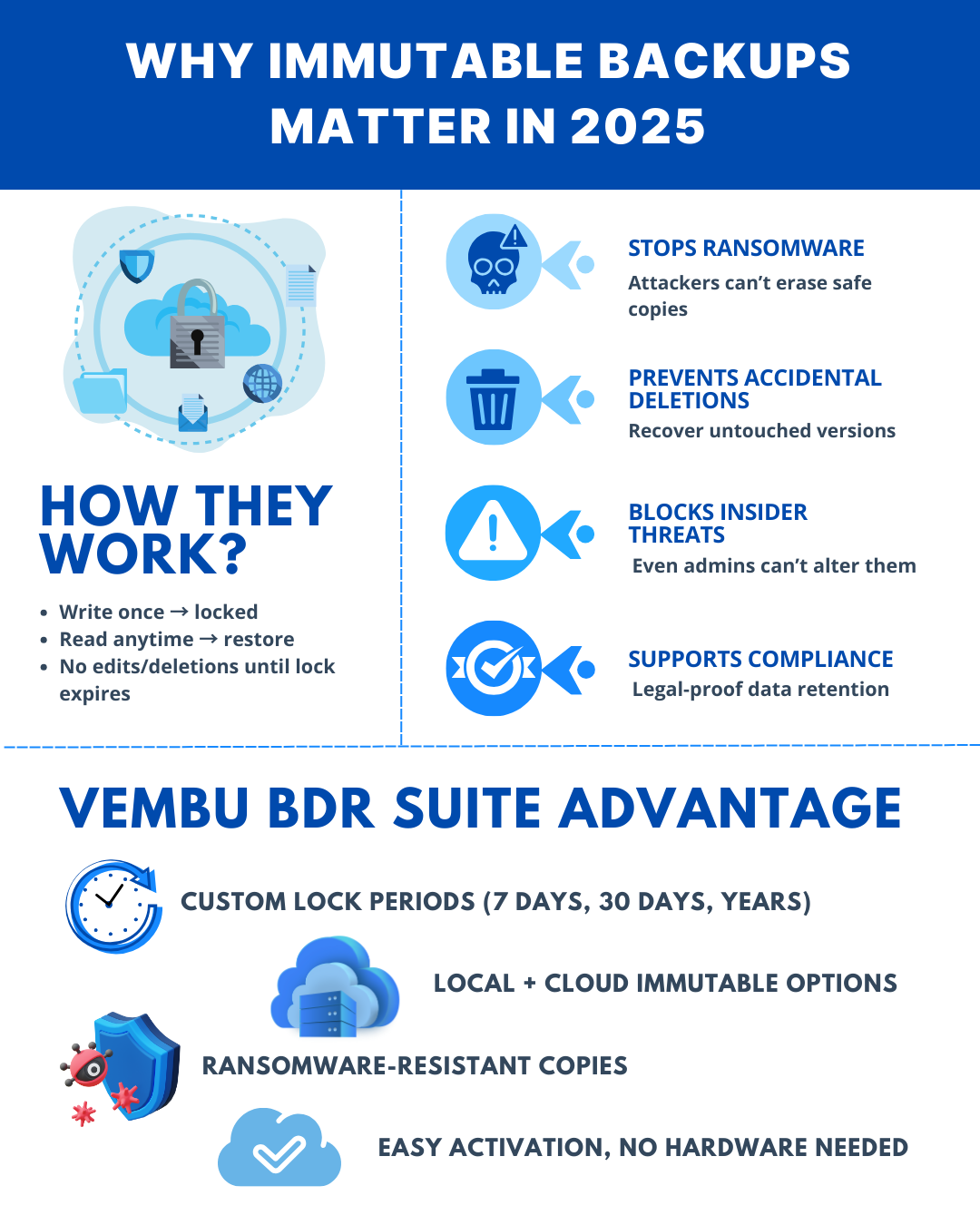
     

    Infographic explaining why immutable backups matter in 2025, highlighting ransomware protection, prevention of accidental deletions, blocking insider threats, compliance support, and Vembu BDR Suite advantages with ransomware-resistant copies and cloud options.

    FAQ

    1. What exactly is an immutable backup?

    An immutable backup is a special kind of backup that is completely locked for a certain period of time.

    Once the backup is created, no one — not even the system administrator or the person who set it up — can delete, edit, or change it until the lock time runs out.

    Think of it as putting your most important files in a safe with a timer. You can open the safe to read the files whenever you want, but you can’t remove or change them until the timer finishes.


    2. How is this different from a regular backup?

    A regular backup is like a regular filing cabinet — you can open it any time and add, change, or remove files. That means if something goes wrong — like a hacker attack or a mistaken deletion — the backup can also be destroyed or altered.

    An immutable backup is like a filing cabinet that locks itself and refuses to open for editing until a set date. It’s much harder (often impossible) for hackers, viruses, or even accidental clicks to damage it.


    3. Why are immutable backups so important now?

    In the past, backups were enough to recover from most problems. But now, cybercriminals have gotten smarter.

    Modern ransomware often attacks backups first so that you can’t restore your data without paying them.

    Immutable backups make that impossible — even if hackers get into your systems, they can’t touch these protected copies.


    4. How do immutable backups protect me from ransomware?

    Let’s say ransomware attacks your main computer systems and also tries to delete your backups. If your backups are immutable, the ransomware will fail because the system simply will not allow changes or deletion until the lock period is over.

    You can then restore your files from these untouched backups without paying the ransom.


    5. Do immutable backups help if someone makes a mistake?

    Yes. Sometimes people delete the wrong folder or overwrite an important document by accident. If your backup is immutable, you can go back to the original, unchanged version and recover it easily — even if the mistake was made weeks ago.


    6. Can immutable backups stop insider threats?

    Yes. Unfortunately, not all risks come from outsiders. If a disgruntled employee or contractor tries to damage your data, immutable backups will still be safe because they cannot be deleted or changed until the lock period ends.


    7. How do immutable backups actually work?

    They use something called Write Once, Read Many (WORM) technology:

    • Write Once: Once the data is saved, it’s locked in place.
    • Read Many: You can look at it or restore it anytime you want.
    • No Changes: You cannot edit, delete, or overwrite it until the set lock time is over.


    8. What is a “lock period” and how long should it be?

    The lock period is the time during which your backup is completely unchangeable.

    This could be 7 days, 30 days, 6 months, or even years — depending on your needs.

    For example:

    • A retail business might set a 30-day lock to protect monthly sales records.
    • A hospital might set a multi-year lock to meet legal patient data requirements.


    9. Is this only for big companies?

    No. In fact, small businesses benefit a lot from immutable backups because they often have fewer resources to recover from disasters. Cloud-based immutable backup solutions have made this technology affordable for everyone.


    10. Are immutable backups expensive?

    Not anymore. Modern solutions, especially cloud-based ones, cost far less than paying a ransom or losing your data forever. For most businesses, the cost is tiny compared to the risk they remove.


    11. Do I still need regular backups if I have immutable backups?

    Yes. Immutability is not a replacement for a good backup plan — it’s an extra layer of protection. You still need to:

    • Back up regularly.
    • Keep copies in more than one location (e.g., local + cloud).
    • Test your backups to make sure they work.


    12. How does Vembu BDR Suite provide immutable backups?

    Vembu’s system makes it simple:

    • You set a lock time for each backup.
    • It works for both your local backups and cloud backups.
    • It uses WORM technology so your data can’t be changed or deleted until the lock ends.
    • It combines immutability with automated verification so you know every backup is valid.


    13. How do immutable backups help with compliance and legal requirements?

    In industries like healthcare, finance, and law, you often must keep certain records in their original form for years. Immutable backups guarantee the data hasn’t been altered, which makes audits and legal checks much easier.


    14. Are they hard to set up?

    Not at all. With solutions like Vembu, immutability can be enabled with just a few clicks — no special equipment, extra staff, or complex training needed.


    15. What’s the first step to get immutable backups?

    Start by reviewing your current backup process:

    • Where are your backups stored?
    • Could they be deleted if someone got access?
    • Do you have copies in different locations?

    Then, work with a trusted provider like Vembu to:

    • Identify which data should be immutable.
    • Decide how long each set of backups should be locked.
    • Enable immutability on both local and cloud backups.
    Immutable Backups: What They Are and Why You Need Them

    About The Author

    Nasmal

    Nasmal is a Solution Architect & Business Analyst focused on AI, Data, Automation, BCP, and Process Optimization. He helps businesses evolve from reactive to proactive, data-driven, and resilient operations. With hands-on expertise, he simplifies complex tech into clear, easy-to-understand blogs.

    Like This Story?

    Share it with friends!

    Subscribe to our newsletter!

    Atera

    (48)

    Cato Networks

    (111)

    ClickUp

    (68)

    FishOS

    (7)

    Miradore

    (21)

    PointGuard AI

    (9)

    Vembu

    (22)

    Xcitium

    (33)

    ZETA HRMS

    (69)

    Workflow Automation(5)

    Workforce Automation(1)

    AI Project Management(1)

    HR Data Automation(1)

    RMM(1)

    IT Workflow Automation(1)

    IT security(2)

    GCC compliance(4)

    Payroll Integration(2)

    IT support automation(3)

    procurement automation(1)

    lost device management(1)

    IT Management(5)

    IoT Security(2)

    Cato XOps(2)

    IT compliance(4)

    Task Automation(1)

    Workflow Management(1)

    OpenStack automation(1)

    Kubernetes lifecycle management(2)

    AI-powered cloud ops(1)

    SMB Security(8)

    Data Security(1)

    MDR (Managed Detection & Response)(4)

    Atera Integrations(2)

    MSP Automation(3)

    XDR Security(2)

    SMB Cyber Protection(1)

    Ransomware Defense(3)

    HR Tech Solutions(1)

    Zero Trust Network Access(3)

    Zero Trust Security(2)

    Endpoint Management(1)

    SaaS Security(1)

    Payroll Automation(5)

    IT Monitoring(2)

    Xcitium EDR SOC(15)

    Ransomware Protection GCC(1)

    M&A IT Integration(1)

    Network Consolidation UAE(1)

    MSSP for SMBs(1)

    FSD-Tech MSSP(25)

    SMB Cybersecurity GCC(1)

    Managed EDR FSD-Tech(1)

    Ransomware Protection(3)

    Antivirus vs EDR(1)

    Cybersecurity GCC(12)

    Endpoint Security(1)

    Endpoint Protection(1)

    Data Breach Costs(1)

    Managed Security Services(2)

    SMB Cybersecurity(8)

    Zero Dwell Containment(31)

    Xcitium EDR(30)

    Cloud Backup(1)

    Hybrid Backup(1)

    Backup & Recovery(1)

    pointguard ai(4)

    disaster recovery myths(1)

    backup myths(1)

    vembu(9)

    SMB data protection(9)

    Vembu BDR Suite(19)

    Disaster Recovery(4)

    DataProtection(1)

    GCCBusiness(1)

    Secure Access Service Edge(4)

    GCC HR software(15)

    Miradore EMM(15)

    Cato SASE(7)

    Cloud Security(8)

    Talent Development(1)

    AI Cybersecurity(12)

    AI Risk Management(1)

    AI Governance(4)

    AI Security(2)

    AI Compliance(2)

    GCC business security(1)

    GCC network integration(1)

    compliance automation(4)

    GCC cybersecurity(2)

    education security(1)

    App management UAE(1)

    BYOD security Dubai(8)

    Miradore EMM Premium+(5)

    HealthcareSecurity(1)

    MiddleEast(1)

    Team Collaboration(1)

    IT automation(10)

    Zscaler(1)

    SD-WAN(6)

    HR Integration(4)

    Cloud Networking(3)

    device management(9)

    RemoteWork(1)

    ZeroTrust(2)

    VPN(1)

    MPLS(1)

    Project Management(9)

    HR automation(16)

    share your thoughts

    Why Is Data Backup Crucial for Cybersecurity

    Why Is Data Backup Crucial for Cybersecurity? Protect Your Business from Ransomware & Data Loss

    🕓 November 24, 2025

    Vector illustration showcasing Vembu cloud backup solutions. A central laptop screen displays the Vembu logo, surrounded by connected cloud storage icons, files, and mobile devices representing seamless data synchronization. Additional graphics include a store with "3-2-1" backup signage, servers, and secure connections, symbolizing hybrid cloud storage and reliable data protection for SMBs.

    SMB Backup Starter Pack: What to Back Up, Where to Store It & How Often (3-2-1 Checklist)

    🕓 September 16, 2025

    Illustration showing data being backed up from two on-premise servers to the Vembu cloud, with two people sitting on the servers and looking at laptops. The image visually represents the concept of offsite data backup to a remote cloud location.

    The Importance of Offsite Backups in Disaster Recovery Planning

    🕓 September 5, 2025

    Decoded(52)

    Cyber Security(112)

    BCP / DR(22)

    Zeta HRMS(68)

    SASE(21)

    Automation(68)

    Next Gen IT-Infra(111)

    Monitoring & Management(69)

    ITSM(22)

    HRMS(21)

    Automation(24)