HomeNext Gen IT-InfraMonitoring & ManagementCyber SecurityBCP / DRAutomationDecoded
Next Gen IT-Infra
Cato’s SASE Supports Cybersecurity Skills Development

How Cato’s SASE Supports Cybersecurity Skills Development

🕓 April 8, 2025

How SASE Supports the Security Needs of SMBs

How SASE Supports the Security Needs of SMBs

🕓 February 9, 2025

Attack Surface Reduction with Cato’s SASE

Attack Surface Reduction with Cato’s SASE

🕓 February 10, 2025

SASE for Digital Transformation in UAE

SASE for Digital Transformation in UAE

🕓 February 8, 2025

Monitoring & Management
Understanding Atera’s SLA Management

Understanding Atera’s SLA Management

🕓 February 7, 2025

Cost-Performance Ratio: Finding the Right Balance in IT Management Networks

Cost-Performance Ratio: Finding the Right Balance in IT Management Networks

🕓 June 16, 2025

Customizing Atera with APIs

Customizing Atera with APIs

🕓 March 3, 2025

Power Up Your IT Team’s Strategy with Atera’s Communication Tools

Power Up Your IT Team’s Strategy with Atera’s Communication Tools

🕓 February 8, 2025

Cyber Security
Illustration of the Cato Cloud architecture showing its role in delivering SASE for secure, optimized global connectivity.

Understanding the Cato Cloud and Its Role in SASE

🕓 January 29, 2025

Isometric illustration of professionals managing network performance, bandwidth analytics, and cloud-based optimization around the Cato Networks platform, symbolizing bandwidth control and QoS visibility.

Mastering Bandwidth Control and QoS in Cato Networks

🕓 July 26, 2025

Global network backbone powering Cato SASE solution for secure, high-performance connectivity across regions.

Global Backbone: The Engine Powering Cato’s SASE Solution

🕓 January 30, 2025

Illustration of IT team managing user roles and permissions on the Cato CMA dashboard via laptops and cloud interfaces.

Setting Up Role-Based Access Control (RBAC) in Cato

🕓 July 28, 2025

BCP / DR
Illustration showing diverse business and IT professionals collaborating with cloud, backup, and security icons, representing Vembu use cases for SMBs, MSPs, and IT teams.

Who Uses Vembu? Real-World Use Cases for SMBs, MSPs & IT Teams

🕓 July 12, 2025

Graphic showcasing Vembu’s all-in-one backup and disaster recovery platform with icons for cloud, data protection, and business continuity for IT teams and SMBs.

What Is Vembu? A Deep Dive Into the All in One Backup & Disaster Recovery Platform

🕓 July 6, 2025

Illustration showing Vembu backup and disaster recovery system with cloud storage, server racks, analytics dashboard, and IT professionals managing data.

The Rising Cost of Data Loss: Why Backup Is No Longer Optional?

🕓 August 14, 2025

3D isometric illustration of cloud backup and data recovery infrastructure with laptop, data center stack, and digital business icons — FSD Tech

RPO & RTO: The Heart of Business Continuity

🕓 August 15, 2025

Automation
Cross-Functional Collaboration with ClickUp

Fostering Cross-Functional Collaboration with ClickUp for Multi-Departmental Projects

🕓 February 11, 2025

ClickUp Project Reporting

Revolutionizing Enterprise Reporting with ClickUp’s Advanced Analytics and Dashboards

🕓 June 16, 2025

ClickUp’s Design Collaboration and Asset Management Tools

Empowering Creative Teams with ClickUp’s Design Collaboration and Asset Management Tools

🕓 February 26, 2025

ClickUp Communication and Collaboration Tools

ClickUp Communication and Collaboration Tools: Empowering Remote Teams

🕓 March 12, 2025

Decoded
Multi-Factor Authentication (MFA)

Multi-Factor Authentication (MFA): All You Need to Know

🕓 December 7, 2025

L3 Switch

What Is an L3 Switch? L2 vs L3 & Why You Need Layer 3?

🕓 December 8, 2025

IPSec

IPSec Explained: Protocols, Modes, IKE & VPN Security

🕓 December 3, 2025

 Datagram Transport Layer Security (DTLS)

What is Datagram Transport Layer Security (DTLS)? How it works?

🕓 December 4, 2025

    Subscribe to our newsletter!

    About Us

    Follow Us

    Copyright © 2024 | Powered by 

    Cato SASE Architecture

    Inside Cato’s SASE Architecture: A Blueprint for Modern Security

    🕓 January 26, 2025

    Enterprise Data Security and Privacy with ClickUp

    Ensuring Enterprise Data Security and Privacy with ClickUp

    🕓 February 9, 2025

    DDoS protection SASE

    DDoS Protection and Cato’s Defence Mechanisms

    🕓 February 11, 2025

    Table of Contents

    Cybersecurity ROI – Why Investing in Protection Saves SMBs More Than It Costs

    Anas Abdu Rauf
    September 10, 2025
    Comments
    Illustration explaining Business Email Compromise (BEC) risks. Shows how a perfect-looking invoice can be used by cybercriminals to steal money without malware, highlighting the dangers of phishing and financial fraud for SMBs.

    Introduction – The Business Owner’s Dilemma

    Let’s imagine Ahmed, a mid-sized retail business owner in Dubai.

    He runs three shops, employs 45 people, and serves thousands of customers every month.

    Ahmed’s biggest worries? Rent, salaries, and competition.
     

    When his accountant suggests a cybersecurity investment, his first reaction is:

    “Another expense? I’d rather spend that money on marketing to bring in more customers.”

    This is the mindset of many small and mid-sized business (SMB) owners across GCC & Africa.

    They think cybersecurity is a cost… something optional.
     

    But what Ahmed – and thousands of other SMB owners – don’t see is this:

    The cost of not investing in cybersecurity is far higher than the cost of prevention.

    In fact, a single cyberattack can destroy years of hard work.

    This is not theory. It’s reality.


    The Hidden Price of a Cyberattack

    Let’s continue Ahmed’s story.

    One day, Ahmed arrives at his store to find his point-of-sale system frozen.

    A message flashes on the screen:

    “Your files are encrypted. Pay $20,000 in Bitcoin to unlock them.”

    This is ransomware – one of the most common attacks hitting SMBs.


    What happens next?

    1. Downtime: His shops cannot process sales. Every hour costs him money.
    2. Employee Panic: Staff don’t know what to do. Productivity drops.
    3. Customer Anger: Regular customers leave frustrated. Some never return.
    4. Financial Loss: Even if Ahmed pays the ransom, there’s no guarantee hackers will release his data.
    5. Reputation Damage: News spreads fast. Customers wonder if their card details were stolen.


    By the end of the week, Ahmed has already lost:

    • $35,000 in sales due to downtime
    • $20,000 in ransom (with no guarantee of recovery)
    • $10,000 in IT and legal fees

    That’s $65,000 gone in less than 7 days.


    Now, compare this to what cybersecurity would have cost Ahmed → around $1,200 per month for full protection through FSD-Tech’s MSSP model (EDR + MDR + SOC monitoring + Zero Dwell).

    In other words: Ahmed lost the equivalent of 4 years of cybersecurity investment in just one week.


    Cybersecurity is Not a Cost – It’s ROI

    Here’s the biggest misconception:

    Many SMB owners think of cybersecurity as buying insurance against an event that “might not happen.”

    But in reality:

    • The question is not if SMBs will be attacked.
    • The question is when.

    And because hackers actively target SMBs (who they see as “easy prey”), attacks are almost certain.


    This means cybersecurity is not an optional expense.

    It is an investment that delivers ROI in multiple ways:

    1. Prevents Breaches: Avoiding downtime and lost sales.
    2. Protects Reputation: Customers trust secure businesses.
    3. Reduces Costs: Lowers insurance premiums and fines.
    4. Enables Growth: Compliance opens doors to bigger contracts.


    The ROI Math – Prevention vs Recovery

    Let’s break down the numbers in simple terms.

    • Average cost of an SMB cyberattack in GCC & Africa: $50,000 – $200,000 (depending on industry).
    • Average cost of FSD-Tech’s MSSP protection (EDR + MDR + SOC + Zero Dwell): $1,000 – $2,000 per month.


    That means:

    For every $1 spent on cybersecurity, SMBs save $4–8 in potential losses.

    This is not just saving money. This is profit protection.


    Why SMBs Delay Cybersecurity Investment

    If the math is so clear, why do many SMBs still delay?

    1. “We’re Too Small – Hackers Won’t Target Us.”

    Reality: Hackers prefer small businesses because they know SMBs lack security.

    In fact, 43% of cyberattacks globally hit SMBs.

    2. “It’s Too Expensive.”

    Reality: Hiring full-time cybersecurity staff is expensive.

    But outsourcing to an MSSP like FSD-Tech makes it affordable, with monthly packages tailored to SMB budgets.

    3. “We Already Have Antivirus.”

    Reality: Antivirus is outdated.

    Modern attacks bypass antivirus easily.

    What SMBs need is EDR (endpoint protection), MDR (24/7 monitoring), and Zero Dwell containment.


    Want to know how much ROI cybersecurity can deliver for your business? Fill out the form to get your personalized Cybersecurity ROI Snapshot.
     

    The Story of a Retail SMB in Lagos

    Let’s look at another real-world story.

    Fatima runs a mid-sized e-commerce business in Lagos. She thought her business was safe because she used antivirus software.

    One day, hackers injected malware into her website checkout page. For two weeks, customer credit card details  Owners can focus on growth, not worrying about hackers.

    1. Investor Confidence
       Investors prefer businesses that have risk management in place.


    How FSD-Tech Helps SMBs Achieve Cybersecurity ROI

    FSD-Tech’s role is to make enterprise-level protection affordable for SMBs.

    Here’s how we do it:

    • MSSP Model (Managed Security Services Provider): Instead of hiring staff, SMBs pay a fixed monthly fee.
    • EDR: Protects every laptop, desktop, and device.
    • MDR: 24/7 expert monitoring, so threats are detected in real time.
    • SOC: Provides compliance-ready reports for regulators and insurers.
    • Zero Dwell Containment: Blocks threats instantly before they spread.
    • Scalable Packages: Pay only for what you need.

    In short: SMBs get enterprise-grade security at SMB pricing.
     

    were silently stolen.

    By the time she found out:

    • Over 500 customers’ data was exposed.
    • She faced legal complaints and fines.
    • Her reputation was shattered.
       

    Fatima nearly shut down her business.

    When she turned to FSD-Tech, here’s what changed:

    ✔ EDR was deployed across all endpoints.

    ✔ MDR began 24/7 monitoring of her systems.

    ✔ Zero Dwell containment blocked malicious files instantly.

    ✔ SOC reports gave her compliance documentation to rebuild customer trust.

    Today, Fatima’s business not only recovered but is thriving.

    She calls cybersecurity her “best investment of the year.”


    The Hidden ROI Benefits of Cybersecurity

    Cybersecurity ROI goes beyond preventing losses. It creates positive business outcomes too:

    1. Customer Trust = Repeat Sales
       Customers are more loyal when they know their data is safe.
       
    2. Compliance = Bigger Contracts
       SMBs with ISO, GDPR, or PCI DSS compliance win more government and corporate contracts.
       
    3. Lower Cyber Insurance Premiums
       Insurers reward SMBs with strong security by lowering premiums.
       
    4. Peace of Mind = Business Focus
       

    Key Takeaways for SMB Leaders in GCC & Africa

    • Cybersecurity is not a cost — it’s an ROI engine.
    • Every $1 invested saves SMBs $4–8 in breach costs.
    • Modern security (EDR, MDR, SOC, Zero Dwell) is now affordable through FSD-Tech.
    • Cybersecurity brings hidden ROI benefits: compliance, trust, growth, and peace of mind.
    • SMBs that invest early are safer, stronger, and more competitive.


    Conclusion – The ROI That Pays for Itself

    Ahmed in Dubai and Fatima in Lagos both learned the hard way:

    Cybersecurity is cheaper than a cyberattack.

    The ROI is clear:

    ✔ Protection from losses

    ✔ Stronger reputation

    ✔ Compliance advantages

    ✔ Lower insurance premiums

    ✔ Business growth

    SMBs in GCC & Africa can no longer afford to delay.


    Book your SMB Cybersecurity ROI Assessment with FSD-Tech today and discover how much your business can save. Book Now
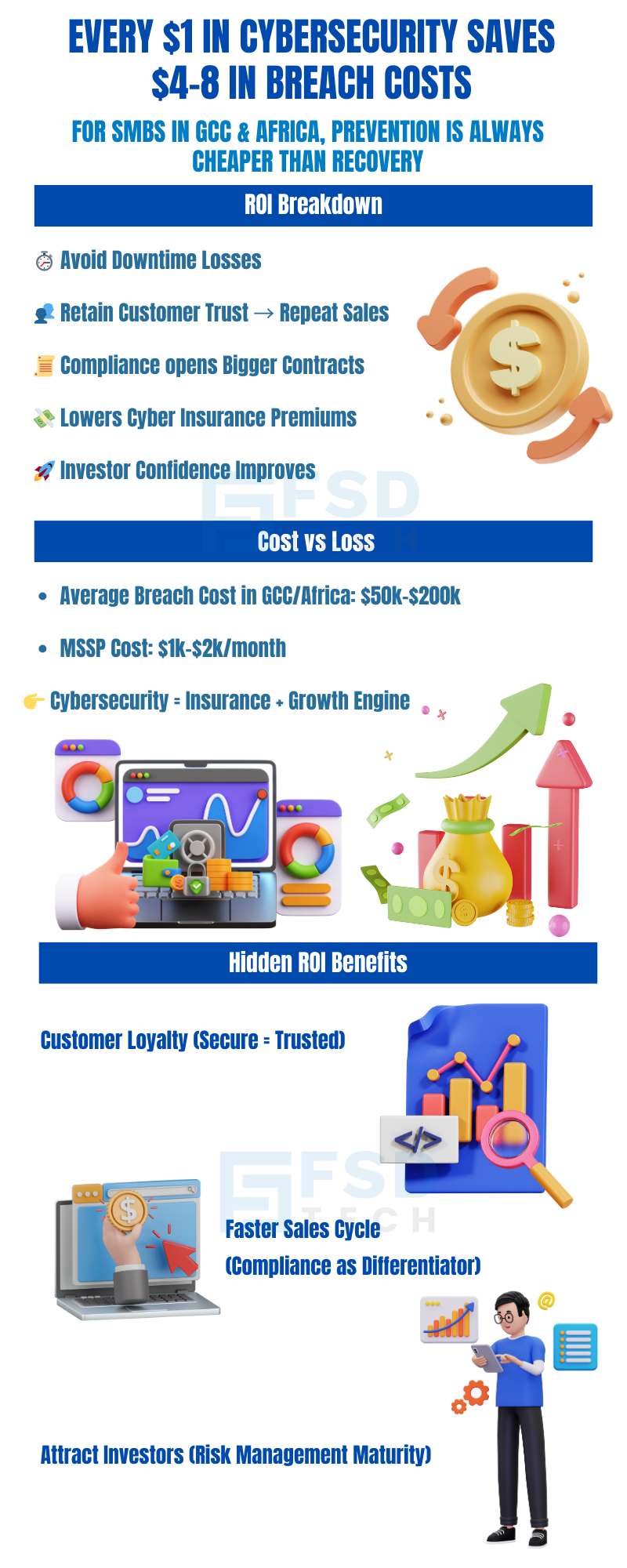
     

    Infographic showing how every $1 invested in cybersecurity saves $4–8 in breach costs for SMBs in GCC & Africa. Highlights ROI benefits such as avoiding downtime losses, retaining customer trust, lowering insurance premiums, improving investor confidence, and compliance advantages. Includes cost vs loss breakdown, hidden ROI benefits like customer loyalty, faster sales cycles, and attracting investors.

    FAQ 

    1. What does ROI mean in cybersecurity?

    ROI (Return on Investment) in cybersecurity means the money saved by preventing cyberattacks compared to the money spent on security solutions. For example, if a cyberattack could cost your SMB $100,000, but cybersecurity protection costs only $15,000 a year, your ROI is very high.


    2. Why should SMBs in GCC & Africa care about cybersecurity ROI?

    SMBs are often seen as “easy targets” by hackers. The cost of a breach (downtime, fines, lost customers) is usually 10x higher than the cost of cybersecurity tools and services. For SMBs in GCC & Africa, cybersecurity ROI is about protecting profits and business continuity.


    3. How much does a cyberattack cost an SMB on average?

    Research shows SMB cyberattacks cost between $50,000 and $200,000 in GCC & Africa, depending on the size and industry. This includes ransom payments, downtime, legal costs, and lost sales. For many SMBs, that’s enough to shut down the business permanently.


    4. How much does cybersecurity investment usually cost SMBs?

    With FSD-Tech’s MSSP (Managed Security Services) model, SMBs pay a fixed monthly fee instead of hiring expensive in-house staff. Packages start from affordable rates per endpoint, making cybersecurity accessible to retail, healthcare, finance, logistics, and other SMBs.


    5. Is cybersecurity really cheaper than recovery from a cyberattack?

    Yes. Prevention is always cheaper. The cost of MSSP services (EDR, MDR, SOC, Zero Dwell) is usually less than 5–10% of the cost of one major breach. Cybersecurity protects against losses that can destroy SMB budgets.


    6. How does cybersecurity create ROI beyond cost savings?

    Cybersecurity also helps SMBs:

    ✔ Win contracts (by meeting compliance standards)

    ✔ Reduce insurance premiums

    ✔ Build customer trust (leading to more sales)

    ✔ Attract investors and partners

    This means ROI is not just saving money, but also growing revenue.


    7. What tools give SMBs the best ROI in cybersecurity?

    The highest ROI comes from:

    • EDR (Endpoint Detection & Response) → stops malware on devices
    • MDR (Managed Detection & Response) → 24/7 human monitoring
    • SOC (Security Operations Center) → provides compliance reports
    • Zero Dwell Containment → blocks threats instantly


    8. Can SMBs measure cybersecurity ROI in real numbers?

    Yes. SMBs can calculate:

    • Expected Losses from cyberattacks (downtime, ransom, fines).
    • Cybersecurity Costs (monthly MSSP fees).
       Subtracting these shows ROI. Example: If an SMB avoids a $100,000 breach with $20,000 cybersecurity investment, ROI = $80,000 saved.


    9. What industries in GCC & Africa see the highest ROI from cybersecurity?

    Industries that handle sensitive customer data or rely on continuous uptime see the highest ROI:

    • Retail & E-commerce
    • Healthcare
    • Finance & Fintech
    • Logistics & Transport


    10. How does FSD-Tech’s MSSP model maximize ROI for SMBs?

    FSD-Tech provides enterprise-grade security at SMB pricing. Instead of hiring IT staff, SMBs pay a monthly fee for:

    • EDR, MDR, SOC monitoring
    • Zero Dwell containment
    • Compliance-ready reporting
    • 24/7 protection

    This reduces risks, saves money, and improves ROI.


    11. Does cybersecurity also help lower insurance premiums?

    Yes. Insurers look at SMBs with strong cybersecurity as “low risk.” This means lower premiums and better claim approval rates. Without cybersecurity, insurers often reject claims after breaches.


    12. Why is ROI higher for SMBs compared to large enterprises?

    Large enterprises often have bigger reserves to survive attacks. But for SMBs, even a single breach can be fatal. This means every dollar spent on cybersecurity delivers much higher ROI because it can literally save the entire business.


    13. Is antivirus software enough to deliver cybersecurity ROI?

    No. Antivirus is outdated. Modern threats bypass it easily. SMBs need advanced tools like EDR, MDR, and Zero Dwell containment to protect against ransomware, phishing, and insider threats.


    14. Can SMBs achieve cybersecurity ROI without a big upfront investment?

    Yes. With FSD-Tech’s MSSP services, SMBs pay monthly packages instead of big upfront costs. This makes ROI achievable immediately because protection begins from day one.


    15. What is the first step for SMBs to calculate their cybersecurity ROI?

    The first step is a Cybersecurity ROI Assessment. FSD-Tech helps SMBs:

    1. Calculate their potential cyber risk losses.
    2. Compare those costs with affordable security investments.
    3. Show exactly how much SMBs can save with EDR, MDR, SOC, and Zero Dwell.


    Cybersecurity ROI – Why Investing in Protection Saves SMBs More Than It Costs

    About The Author

    Anas Abdu Rauf

    Anas is an Expert in Network and Security Infrastructure, With over seven years of industry experience, holding certifications Including CCIE- Enterprise, PCNSE, Cato SASE Expert, and Atera Certified Master. Anas provides his valuable insights and expertise to readers.

    Like This Story?

    Share it with friends!

    Subscribe to our newsletter!

    Atera

    (48)

    Cato Networks

    (118)

    ClickUp

    (70)

    FishOS

    (7)

    Miradore

    (21)

    PointGuard AI

    (9)

    Vembu

    (22)

    Xcitium

    (33)

    ZETA HRMS

    (76)

    Workflow Automation(8)

    Workforce Automation(1)

    AI Project Management(1)

    HR Data Automation(1)

    RMM(1)

    IT Workflow Automation(1)

    IT security(2)

    GCC compliance(4)

    Payroll Integration(2)

    IT support automation(3)

    procurement automation(1)

    lost device management(1)

    IT Management(5)

    IoT Security(2)

    Cato XOps(2)

    IT compliance(4)

    Workflow Management(1)

    Task Automation(1)

    OpenStack automation(1)

    Kubernetes lifecycle management(2)

    AI-powered cloud ops(1)

    SMB Security(8)

    Data Security(1)

    MDR (Managed Detection & Response)(4)

    Atera Integrations(2)

    MSP Automation(3)

    XDR Security(2)

    SMB Cyber Protection(1)

    Ransomware Defense(3)

    HR Tech Solutions(1)

    Zero Trust Network Access(3)

    Zero Trust Security(2)

    Endpoint Management(1)

    SaaS Security(1)

    Payroll Automation(5)

    IT Monitoring(2)

    Xcitium EDR SOC(15)

    Ransomware Protection GCC(1)

    M&A IT Integration(1)

    Network Consolidation UAE(1)

    MSSP for SMBs(1)

    Managed EDR FSD-Tech(1)

    Ransomware Protection(3)

    SMB Cybersecurity GCC(1)

    FSD-Tech MSSP(25)

    Antivirus vs EDR(1)

    Endpoint Security(1)

    Cybersecurity GCC(12)

    Data Breach Costs(1)

    Endpoint Protection(1)

    SMB Cybersecurity(8)

    Zero Dwell Containment(31)

    Managed Security Services(2)

    Xcitium EDR(30)

    Cloud Backup(1)

    Hybrid Backup(1)

    Backup & Recovery(1)

    pointguard ai(4)

    backup myths(1)

    vembu(9)

    SMB data protection(9)

    disaster recovery myths(1)

    Disaster Recovery(4)

    Vembu BDR Suite(19)

    GCCBusiness(1)

    DataProtection(1)

    Secure Access Service Edge(4)

    GCC HR software(18)

    Miradore EMM(15)

    Cato SASE(7)

    Cloud Security(8)

    Talent Development(1)

    AI Cybersecurity(12)

    AI Governance(4)

    AI Security(2)

    AI Compliance(2)

    AI Risk Management(1)

    GCC business security(1)

    GCC network integration(1)

    compliance automation(5)

    education security(1)

    GCC cybersecurity(2)

    BYOD security Dubai(8)

    App management UAE(1)

    Miradore EMM Premium+(5)

    MiddleEast(1)

    HealthcareSecurity(1)

    Team Collaboration(1)

    IT automation(12)

    Zscaler(1)

    SD-WAN(6)

    HR Integration(4)

    Cloud Networking(3)

    device management(9)

    VPN(1)

    RemoteWork(1)

    ZeroTrust(2)

    MPLS(1)

    Project Management(9)

    HR automation(16)

    share your thoughts

    Illustration showing identity-centric Zero Trust security with the Cato Client acting as a continuous identity signal, connecting users, devices, cloud resources, and OT systems through unified policy enforcement.”

    How the Cato Client Becomes the Identity Anchor for Zero Trust Access

    🕓 January 25, 2026

    Context-aware firewall enforcement in Cato SASE illustrating how device platform, country, and origin of connection enhance Zero Trust security beyond basic device context.

    Platforms, Countries, and Origin of Connection: Advanced Device Criteria in Cato Firewall

    🕓 January 24, 2026

    Cato SASE platform visual showing device-aware WAN firewall enforcement with centralized security controls, analytics dashboards, IPS, and Zero Trust policy monitoring across enterprise infrastructure.

    Device-Aware WAN Firewall Policies in Cato SASE

    🕓 January 23, 2026

    Decoded(85)

    Cyber Security(118)

    BCP / DR(22)

    Zeta HRMS(75)

    SASE(21)

    Automation(70)

    Next Gen IT-Infra(118)

    Monitoring & Management(69)

    ITSM(22)

    HRMS(21)

    Automation(24)