HomeNext Gen IT-InfraMonitoring & ManagementCyber SecurityBCP / DRAutomationDecoded
Next Gen IT-Infra
Cato’s SASE Supports Cybersecurity Skills Development

How Cato’s SASE Supports Cybersecurity Skills Development

🕓 April 8, 2025

How SASE Supports the Security Needs of SMBs

How SASE Supports the Security Needs of SMBs

🕓 February 9, 2025

Attack Surface Reduction with Cato’s SASE

Attack Surface Reduction with Cato’s SASE

🕓 February 10, 2025

SASE for Digital Transformation in UAE

SASE for Digital Transformation in UAE

🕓 February 8, 2025

Monitoring & Management
Understanding Atera’s SLA Management

Understanding Atera’s SLA Management

🕓 February 7, 2025

Cost-Performance Ratio: Finding the Right Balance in IT Management Networks

Cost-Performance Ratio: Finding the Right Balance in IT Management Networks

🕓 June 16, 2025

Customizing Atera with APIs

Customizing Atera with APIs

🕓 March 3, 2025

Power Up Your IT Team’s Strategy with Atera’s Communication Tools

Power Up Your IT Team’s Strategy with Atera’s Communication Tools

🕓 February 8, 2025

Cyber Security
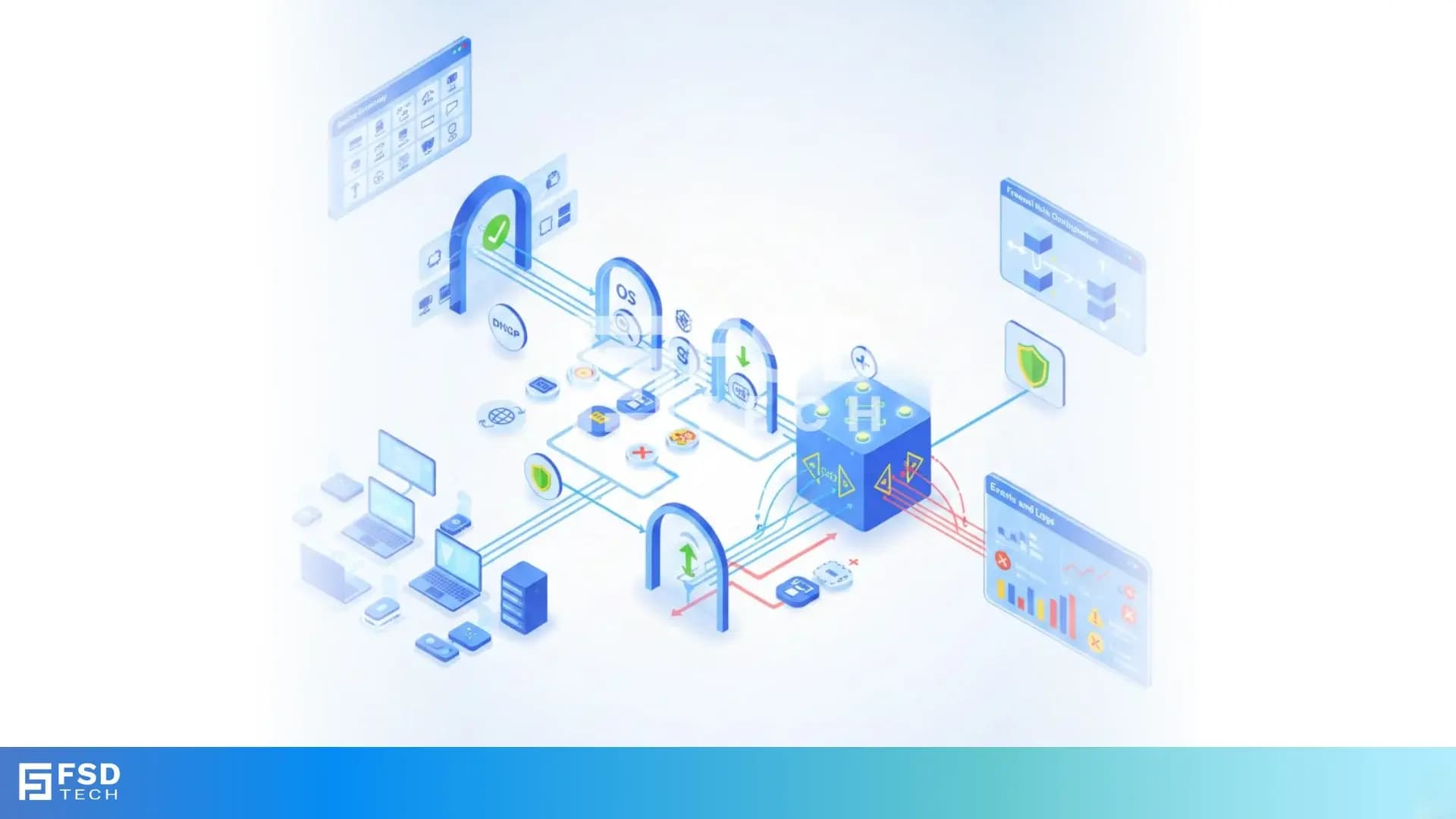
Visual guide showing Cato CMA interface for configuring Internet and WAN firewall rules, enabling threat protection, and monitoring security events in real time for UAE IT teams.

Enforcing Firewall and Threat Protection Policies in Cato

🕓 July 25, 2025

Isometric illustration of professionals managing network performance, bandwidth analytics, and cloud-based optimization around the Cato Networks platform, symbolizing bandwidth control and QoS visibility.

Mastering Bandwidth Control and QoS in Cato Networks

🕓 July 26, 2025

Illustration of the Cato Cloud architecture showing its role in delivering SASE for secure, optimized global connectivity.

Understanding the Cato Cloud and Its Role in SASE

🕓 January 29, 2025

Global network backbone powering Cato SASE solution for secure, high-performance connectivity across regions.

Global Backbone: The Engine Powering Cato’s SASE Solution

🕓 January 30, 2025

BCP / DR
Illustration showing diverse business and IT professionals collaborating with cloud, backup, and security icons, representing Vembu use cases for SMBs, MSPs, and IT teams.

Who Uses Vembu? Real-World Use Cases for SMBs, MSPs & IT Teams

🕓 July 12, 2025

Graphic showcasing Vembu’s all-in-one backup and disaster recovery platform with icons for cloud, data protection, and business continuity for IT teams and SMBs.

What Is Vembu? A Deep Dive Into the All in One Backup & Disaster Recovery Platform

🕓 July 6, 2025

Illustration showing Vembu backup and disaster recovery system with cloud storage, server racks, analytics dashboard, and IT professionals managing data.

The Rising Cost of Data Loss: Why Backup Is No Longer Optional?

🕓 August 14, 2025

3D isometric illustration of cloud backup and data recovery infrastructure with laptop, data center stack, and digital business icons — FSD Tech

RPO & RTO: The Heart of Business Continuity

🕓 August 15, 2025

Automation
Cross-Functional Collaboration with ClickUp

Fostering Cross-Functional Collaboration with ClickUp for Multi-Departmental Projects

🕓 February 11, 2025

ClickUp Project Reporting

Revolutionizing Enterprise Reporting with ClickUp’s Advanced Analytics and Dashboards

🕓 June 16, 2025

ClickUp’s Design Collaboration and Asset Management Tools

Empowering Creative Teams with ClickUp’s Design Collaboration and Asset Management Tools

🕓 February 26, 2025

ClickUp Communication and Collaboration Tools

ClickUp Communication and Collaboration Tools: Empowering Remote Teams

🕓 March 12, 2025

Decoded
Multi-Factor Authentication (MFA)

Multi-Factor Authentication (MFA): All You Need to Know

🕓 December 7, 2025

L3 Switch

What Is an L3 Switch? L2 vs L3 & Why You Need Layer 3?

🕓 December 8, 2025

IPSec

IPSec Explained: Protocols, Modes, IKE & VPN Security

🕓 December 3, 2025

 Datagram Transport Layer Security (DTLS)

What is Datagram Transport Layer Security (DTLS)? How it works?

🕓 December 4, 2025

    Subscribe to our newsletter!

    About Us

    Follow Us

    Copyright © 2024 | Powered by 

    Cato SASE Architecture

    Inside Cato’s SASE Architecture: A Blueprint for Modern Security

    🕓 January 26, 2025

    Enterprise Data Security and Privacy with ClickUp

    Ensuring Enterprise Data Security and Privacy with ClickUp

    🕓 February 9, 2025

    DDoS protection SASE

    DDoS Protection and Cato’s Defence Mechanisms

    🕓 February 11, 2025

    Table of Contents

    Cato SASE Implementation Roadmap 2025: A Step-by-Step Guide

    Anas Abdu Rauf
    December 23, 2025
    Comments
    Illustration showing the transition from manual spreadsheets and paper-based HR processes to the Zeta HRMS digital platform. Depicts HR teams moving data into a centralized, automated HR system with modules for payroll, attendance, compliance, and employee management, highlighting improved efficiency and collaboration. FSD Tech branding visible at the bottom.

    Key Takeaways

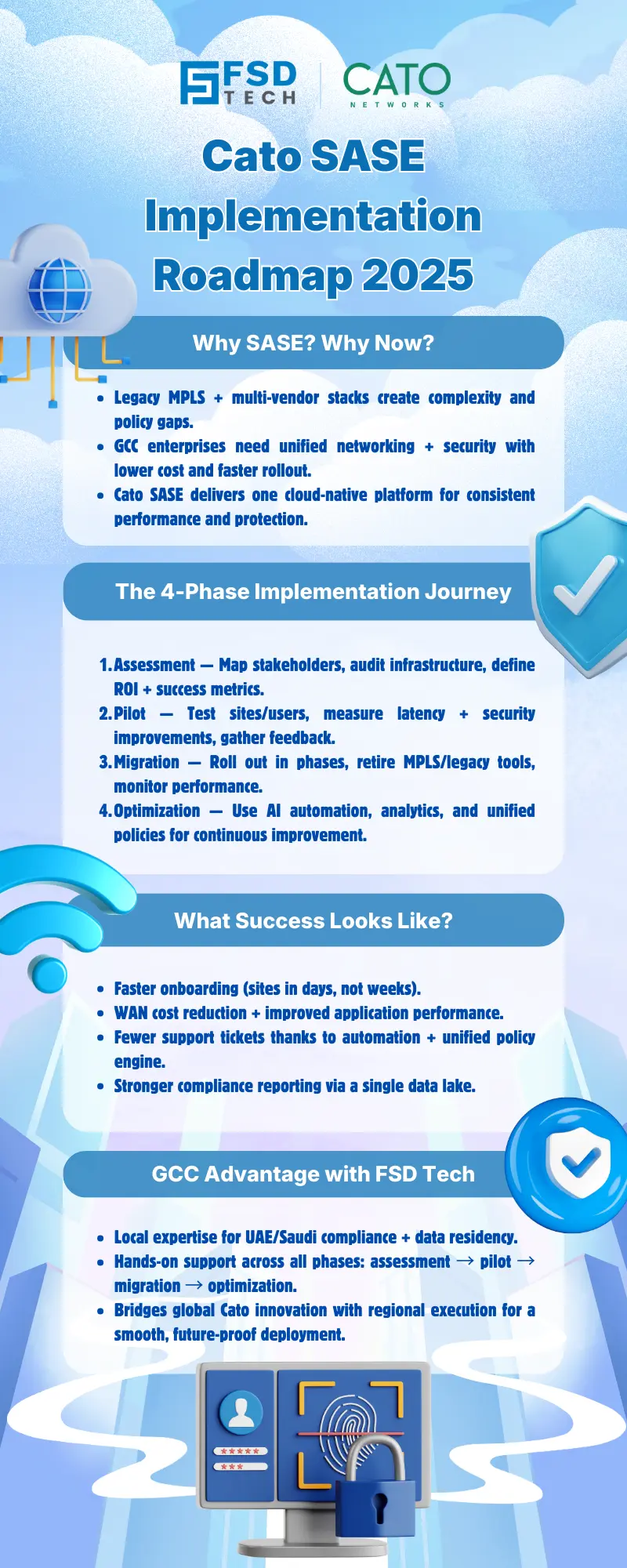
    • Unified SASE for GCC enterprises:  Cato SASE’s cloud-native platform integrates networking and security, eliminating complexity and policy gaps common in multi-vendor environments—ideal for UAE-based and regional operations.
    • Phased, business-aligned rollout:  Align SASE deployment with business priorities and technical readiness, enabling gradual migration from legacy MPLS and hardware for maximum ROI and minimal disruption.
    • Regional enablement by FSD Tech:  FSD Tech bridges global Cato SASE innovation with hands-on GCC expertise, ensuring compliance, local adaptation, and rapid support for Middle East deployments.
    • Operational efficiency through automation:  AI-driven automation streamlines updates, threat detection, and policy management, reducing support tickets and freeing IT teams for strategic initiatives.
    • Measurable success metrics:  Track WAN cost reductions, onboarding speed, application performance, and compliance improvements to demonstrate SASE project value.
    • Stakeholder collaboration is critical:  Cross-team alignment between IT, networking, security, and regional partners ensures smooth implementation and ongoing optimization.
       

    Introduction

    As digital transformation accelerates across the GCC and globally, organizations face mounting pressure to unify networking and security without adding complexity or risk. Secure Access Service Edge (SASE) has emerged as the architectural answer, but not all platforms deliver true convergence or regional adaptability.

    This guide provides a practical, step-by-step Cato SASE implementation roadmap for 2025, tailored for IT project leads, network managers, and consultants. It details each phase of the SASE lifecycle, highlights stakeholder roles,checklist—enabling you to streamline deployment, maximize ROI, and ensure compliance with the support of FSD Tech, the GCC’s regional SASE enabler.


    Understanding the SASE Lifecycle

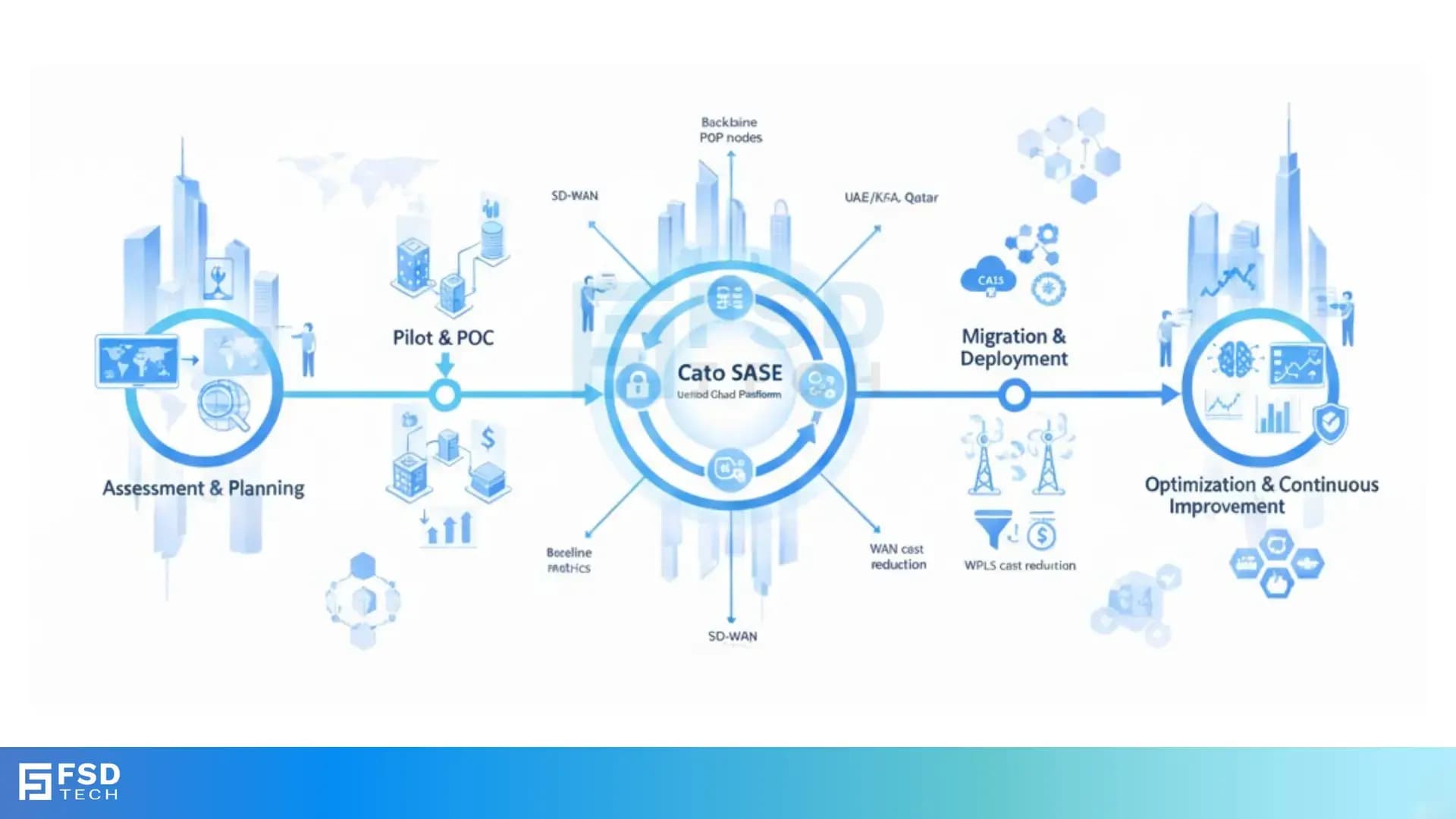
    A successful SASE deployment follows a structured, business-aligned lifecycle. Each phase is designed to minimize risk, maximize value, and ensure stakeholder buy-in.

    Assessment & Planning

    Begin by defining your business objectives and building a clear case for SASE adoption. Typical drivers include eliminating legacy appliances, reducing WAN costs, enabling secure remote access, and improving policy consistency.

     Key Actions: 

    • Map stakeholders across IT, security, and business units.
    • Inventory current infrastructure and identify pain points.
    • Conduct a gap analysis between legacy capabilities and SASE requirements.
    • Set measurable success criteria (e.g., cost savings, onboarding speed, compliance targets).

     Example: 

    A UAE-based financial group identified inconsistent security enforcement and rising WAN costs across regional offices. By mapping these issues, they set clear objectives for their SASE migration.

    Pilot & Proof of Concept

    A focused pilot reduces risk and validates assumptions. Select pilot sites or user groups that represent your broader environment. Define clear success metrics such as latency, security event correlation, and user experience.

     Checklist: 

    • Select pilot locations or user segments.
    • Establish baseline performance and security metrics.
    • Solicit feedback from pilot participants.
    • Document lessons learned for broader rollout.

     Example: 

    A global financial services firm piloted Cato SASE with 75+ remote employees across three continents. The pilot delivered consistent security and low-latency access, outperforming their previous multi-vendor solution, which suffered from latency spikes in APAC.

    Migration & Deployment

    With pilot success, scale up in planned phases. Cato SASE’s unified architecture enables rapid onboarding—some organizations have deployed 50+ sites in under two years with minimal downtime. FSD Tech provides local support, ensuring GCC compliance and smooth execution.

     Key Steps: 

    • Develop a phased migration schedule (by region, site, or business function).
    • Plan for the gradual retirement of legacy systems and MPLS circuits.
    • Implement real-time monitoring and troubleshooting.
    • Communicate progress and gather feedback at each stage.

     Example: 

    A retail chain migrated 30+ branches from MPLS to Cato’s private backbone, reducing WAN costs by 40% and onboarding new locations in days instead of weeks.

    Optimization & Continuous Improvement

    SASE is an ongoing journey. Cato’s AI-driven platform automates routine tasks—such as updates, threat-hunting, and policy deployment—freeing IT teams for strategic work. Use the unified management console and data lake to monitor, report, and optimize performance.

     Metrics to Track: 

    • WAN cost reduction
    • Application performance (latency, uptime)
    • Security event resolution speed
    • User satisfaction and support ticket volume

     Example: 

    A SaaS provider leveraged Cato’s automation to enforce DLP and ZTNA policies globally, reducing manual intervention and compliance risks.


    Stakeholder Roles and Collaboration

    SASE projects succeed when all relevant stakeholders are engaged and aligned from the outset.

    IT Leadership

    • Owns the business case and sets strategic priorities.
    • Ensures cross-team alignment and resource allocation.
    • Champions the value of unified SASE for business agility.

    Network & Security Teams

    • Collaborate to define technical requirements and evaluation criteria.
    • Manage deployment, policy configuration, and ongoing monitoring.
    • Benefit from Cato’s unified platform, which bridges networking and security silos.

    Regional Partners (FSD Tech)

    • Deliver local expertise and compliance guidance for GCC-specific needs.
    • Provide hands-on support during assessment, migration, and optimization.
    • Act as a bridge between global SASE innovation and regional execution.


    Milestones and Success Metrics

    A structured migration plan with clear milestones and metrics ensures transparency and accountability.

    PhaseKey MilestonesSuccess Metrics
    AssessmentStakeholder alignment, gap analysisBusiness case approval, baseline metrics
    PilotPilot launch, feedback collectionLatency, security event correlation, NPS
    MigrationPhased rollout, legacy retirementSites onboarded/month, downtime incidents
    OptimizationOngoing tuning, automation adoptionWAN cost reduction, support ticket volume


     Checklist for Each Phase: 

    • Assessment: Stakeholder map, infrastructure inventory, ROI targets
    • Pilot: Site/user selection, baseline measurement, feedback loop
    • Migration: Phased schedule, monitoring, communication plan
    • Optimization: Metric tracking, AI/automation review, continuous improvement

    .

    Why Cato SASE Stands Apart

    Cato SASE is engineered for true convergence: a single, cloud-native platform delivering integrated networking (SD-WAN, private backbone) and security (ZTNA, SWG, DLP, FWaaS). This unified approach eliminates the complexity, policy gaps, and performance issues common with multi-vendor or stitched-together solutions.

     Key Differentiators: 

    •  Simplicity: One platform, one management console, one policy engine.
    •  Performance: Global private backbone ensures low-latency, secure access—even in distributed GCC environments.
    •  Operational Efficiency:  AI-driven automation reduces manual tasks, accelerates onboarding, and minimizes downtime.
    •  Peer Validation:  Organizations report rapid site onboarding, fewer support tickets, and measurable cost savings.

     Peer Review Highlight: 

    “Great product, simple design: Very responsive and easy to understand. We rolled out 52 sites in a year and a half with no customer downtime.” — IT Director, Manufacturing


    Planning your Cato SASE rollout for 2026? → Book a 30-minute implementation strategy call with our GCC SASE experts.
     

    Infographic titled ‘From Spreadsheets to Zeta HRMS – A Smarter Way to Run HR’ explaining the limitations of manual HR workflows and the benefits of Zeta HRMS. Highlights automated payroll, attendance, compliance reporting, self-service access, scalable workflows, real-time dashboards, and structured HRMS implementation for UAE organizations.


    FAQ

    How long does a typical Cato SASE rollout take?

    Timelines depend on organization size and complexity, but Cato’s unified platform enables rapid onboarding. Many enterprises have rolled out 50+ sites in under two years, with minimal downtime and disruption. FSD Tech’s regional support further accelerates deployment for GCC-based organizations.


    What are the main success metrics for SASE deployment?

    Key metrics include WAN cost reduction, improved application performance (latency, uptime), faster onboarding, fewer support tickets, and enhanced compliance reporting. Tracking these metrics helps demonstrate the value of your SASE migration plan.


    How does FSD Tech support regional deployments in the GCC?

    FSD Tech provides local expertise, compliance guidance, and hands-on support throughout the SASE lifecycle. Their knowledge of GCC regulations and business practices ensures that Cato SASE deployments are tailored for regional requirements and achieve rapid, compliant outcomes.


    Can we migrate to Cato SASE in phases?

    Yes. Cato SASE supports phased migration, allowing organizations to retire legacy hardware and MPLS circuits at their own pace. This approach minimizes disruption and aligns with business priorities, making it ideal for complex or distributed environments.


    How does Cato SASE compare to other SASE solutions?

    Cato’s single-platform architecture delivers true convergence, operational simplicity, and consistent performance. Unlike multi-vendor or stitched-together solutions, Cato eliminates policy gaps and reduces operational overhead, as validated by peer reviews and industry recognition.


    What role does automation play in Cato SASE deployments?

    Cato’s AI-driven platform automates routine tasks such as updates, threat detection, and policy deployment. This reduces manual workload, accelerates onboarding, and allows IT teams to focus on strategic initiatives. Automation also improves consistency and reduces the risk of human error.


    How does Cato SASE ensure compliance for GCC enterprises?

    Cato SASE’s unified policy engine and data lake support granular compliance reporting and enforcement. FSD Tech’s regional expertise ensures that deployments meet local regulatory requirements, providing peace of mind for organizations operating in the GCC.


    What is the typical onboarding process for new sites or users?

    Onboarding with Cato SASE is streamlined through a centralized management console and automated workflows. New sites or users can be added rapidly—often in days rather than weeks—without complex manual configuration. FSD Tech assists with regional adaptation and troubleshooting.


    How does Cato SASE handle remote and hybrid workforces?

    Cato SASE provides secure, low-latency access for remote and hybrid users through integrated ZTNA and SWG capabilities. The platform ensures consistent security policies and user experience, regardless of location, making it ideal for distributed GCC operations.


    What are the main challenges during SASE migration, and how are they addressed?

    Common challenges include stakeholder alignment, legacy system integration, and policy consistency. Cato SASE’s unified architecture and FSD Tech’s consultative approach help overcome these hurdles by providing clear migration plans, cross-team collaboration, and hands-on support.


    How does Cato SASE improve application performance?

    Cato’s global private backbone and intelligent routing minimize latency and packet loss, ensuring optimal application performance. This is particularly beneficial for organizations with distributed sites or cloud workloads in the Middle East.


    Can Cato SASE integrate with existing security tools?

    While Cato SASE is designed as a unified platform, it can coexist with certain legacy tools during phased migration. Over time, organizations typically consolidate onto Cato to reduce complexity and improve policy consistency.


    What ongoing support is available after deployment?

    FSD Tech provides ongoing regional support, including monitoring, troubleshooting, and optimization services. Cato’s platform also offers continuous updates and AI-driven insights to ensure your deployment remains secure and efficient.


    How does Cato SASE support digital transformation initiatives?

    By unifying networking and security in a cloud-native platform, Cato SASE accelerates digital transformation. It enables secure cloud adoption, supports hybrid work, and reduces reliance on legacy infrastructure—empowering GCC organizations to innovate with confidence.


    What are the licensing and cost considerations for Cato SASE?

    Cato SASE offers a predictable, subscription-based model that consolidates networking and security costs. Organizations often realize significant savings by retiring legacy appliances and MPLS circuits. FSD Tech can provide detailed cost analyses tailored to your regional needs.


    How do we get started with a Cato SASE implementation in the GCC?

    Begin with an assessment of your current environment and business objectives. Engage FSD Tech for a consultative workshop, pilot planning, and access to the downloadable implementation roadmap. Their regional expertise ensures a smooth, compliant, and future-ready deployment.

    Cato SASE Implementation Roadmap 2025: A Step-by-Step Guide

    About The Author

    Anas Abdu Rauf

    Anas is an Expert in Network and Security Infrastructure, With over seven years of industry experience, holding certifications Including CCIE- Enterprise, PCNSE, Cato SASE Expert, and Atera Certified Master. Anas provides his valuable insights and expertise to readers.

    Like This Story?

    Share it with friends!

    Subscribe to our newsletter!

    Atera

    (48)

    Cato Networks

    (111)

    ClickUp

    (63)

    FishOS

    (7)

    Miradore

    (21)

    PointGuard AI

    (9)

    Vembu

    (22)

    Xcitium

    (33)

    ZETA HRMS

    (66)

    Workflow Automation(4)

    Workforce Automation(1)

    AI Project Management(1)

    HR Data Automation(1)

    RMM(1)

    IT Workflow Automation(1)

    GCC compliance(4)

    IT security(2)

    Payroll Integration(2)

    IT support automation(2)

    procurement automation(1)

    lost device management(1)

    IT Management(5)

    IoT Security(2)

    Cato XOps(2)

    IT compliance(4)

    Task Automation(1)

    Workflow Management(1)

    OpenStack automation(1)

    AI-powered cloud ops(1)

    Kubernetes lifecycle management(2)

    SMB Security(8)

    Data Security(1)

    MDR (Managed Detection & Response)(4)

    MSP Automation(2)

    Atera Integrations(2)

    XDR Security(2)

    SMB Cyber Protection(1)

    Ransomware Defense(3)

    HR Tech Solutions(1)

    Zero Trust Network Access(3)

    Zero Trust Security(2)

    Endpoint Management(1)

    SaaS Security(1)

    Payroll Automation(5)

    IT Monitoring(2)

    Xcitium EDR SOC(15)

    Ransomware Protection GCC(1)

    M&A IT Integration(1)

    Network Consolidation UAE(1)

    MSSP for SMBs(1)

    Antivirus vs EDR(1)

    Managed EDR FSD-Tech(1)

    SMB Cybersecurity GCC(1)

    FSD-Tech MSSP(25)

    Ransomware Protection(3)

    Cybersecurity GCC(12)

    Endpoint Security(1)

    Data Breach Costs(1)

    Endpoint Protection(1)

    Managed Security Services(2)

    Xcitium EDR(30)

    SMB Cybersecurity(8)

    Zero Dwell Containment(31)

    Cloud Backup(1)

    Hybrid Backup(1)

    Backup & Recovery(1)

    pointguard ai(4)

    backup myths(1)

    vembu(9)

    disaster recovery myths(1)

    SMB data protection(9)

    Disaster Recovery(4)

    Vembu BDR Suite(19)

    GCCBusiness(1)

    DataProtection(1)

    Secure Access Service Edge(4)

    GCC HR software(14)

    Miradore EMM(15)

    Cato SASE(7)

    Cloud Security(8)

    Talent Development(1)

    AI Cybersecurity(12)

    AI Security(2)

    AI Risk Management(1)

    AI Governance(4)

    AI Compliance(2)

    GCC business security(1)

    GCC network integration(1)

    compliance automation(4)

    GCC cybersecurity(2)

    education security(1)

    App management UAE(1)

    Miradore EMM Premium+(5)

    BYOD security Dubai(8)

    HealthcareSecurity(1)

    MiddleEast(1)

    Team Collaboration(1)

    IT automation(9)

    Zscaler(1)

    SD-WAN(6)

    HR Integration(4)

    Cloud Networking(3)

    device management(9)

    RemoteWork(1)

    ZeroTrust(2)

    VPN(1)

    MPLS(1)

    Project Management(9)

    HR automation(16)

    share your thoughts

    Illustration showing the transition from manual spreadsheets and paper-based HR processes to the Zeta HRMS digital platform. Depicts HR teams moving data into a centralized, automated HR system with modules for payroll, attendance, compliance, and employee management, highlighting improved efficiency and collaboration. FSD Tech branding visible at the bottom.

    Cato SASE Implementation Roadmap 2025: A Step-by-Step Guide

    🕓 December 23, 2025

    Illustration showing Cato SASE’s global private backbone across the GCC region, with network nodes in Dubai, Riyadh, Jeddah, Kuwait, Muscat, and Bahrain. Depicts secure connectivity to cloud platforms such as AWS, Azure, and Google, with intelligent traffic routing, analytics, and high availability. FSD Tech branding visible at the bottom

    Strategies to Eliminate Network Downtime with Cato SASE’s Reliable Global Backbone

    🕓 December 19, 2025

    Illustration showing a transition from old, wired on-premise servers to a modern Cato SASE cloud network. The left side depicts multiple physical servers with tangled cables, while the right side shows a global cloud platform delivering secure connectivity, analytics, and networking across regions, with users connected worldwide. FSD Tech branding visible at the bottom.

    Beyond VPN Limitations: Why Cato SASE Is the Better Choice for Remote Workforces

    🕓 December 16, 2025

    Decoded(35)

    Cyber Security(112)

    BCP / DR(22)

    Zeta HRMS(65)

    SASE(21)

    Automation(63)

    Next Gen IT-Infra(111)

    Monitoring & Management(69)

    ITSM(22)

    HRMS(21)

    Automation(24)