HomeNext Gen IT-InfraMonitoring & ManagementCyber SecurityBCP / DRAutomationDecoded
Next Gen IT-Infra
Cato’s SASE Supports Cybersecurity Skills Development

How Cato’s SASE Supports Cybersecurity Skills Development

🕓 April 8, 2025

How SASE Supports the Security Needs of SMBs

How SASE Supports the Security Needs of SMBs

🕓 February 9, 2025

Attack Surface Reduction with Cato’s SASE

Attack Surface Reduction with Cato’s SASE

🕓 February 10, 2025

SASE for Digital Transformation in UAE

SASE for Digital Transformation in UAE

🕓 February 8, 2025

Monitoring & Management
Understanding Atera’s SLA Management

Understanding Atera’s SLA Management

🕓 February 7, 2025

Cost-Performance Ratio: Finding the Right Balance in IT Management Networks

Cost-Performance Ratio: Finding the Right Balance in IT Management Networks

🕓 June 16, 2025

Customizing Atera with APIs

Customizing Atera with APIs

🕓 March 3, 2025

Power Up Your IT Team’s Strategy with Atera’s Communication Tools

Power Up Your IT Team’s Strategy with Atera’s Communication Tools

🕓 February 8, 2025

Cyber Security
Illustration of the Cato Cloud architecture showing its role in delivering SASE for secure, optimized global connectivity.

Understanding the Cato Cloud and Its Role in SASE

🕓 January 29, 2025

Isometric illustration of professionals managing network performance, bandwidth analytics, and cloud-based optimization around the Cato Networks platform, symbolizing bandwidth control and QoS visibility.

Mastering Bandwidth Control and QoS in Cato Networks

🕓 July 26, 2025

Global network backbone powering Cato SASE solution for secure, high-performance connectivity across regions.

Global Backbone: The Engine Powering Cato’s SASE Solution

🕓 January 30, 2025

Illustration of team analyzing application traffic and usage insights on a large laptop screen using Cato’s dashboard, surrounded by network and cloud icons.

Cato Networks Application Visibility | Monitoring & Control

🕓 July 27, 2025

BCP / DR
Illustration showing diverse business and IT professionals collaborating with cloud, backup, and security icons, representing Vembu use cases for SMBs, MSPs, and IT teams.

Who Uses Vembu? Real-World Use Cases for SMBs, MSPs & IT Teams

🕓 July 12, 2025

Graphic showcasing Vembu’s all-in-one backup and disaster recovery platform with icons for cloud, data protection, and business continuity for IT teams and SMBs.

What Is Vembu? A Deep Dive Into the All in One Backup & Disaster Recovery Platform

🕓 July 6, 2025

Illustration showing Vembu backup and disaster recovery system with cloud storage, server racks, analytics dashboard, and IT professionals managing data.

The Rising Cost of Data Loss: Why Backup Is No Longer Optional?

🕓 August 14, 2025

3D isometric illustration of cloud backup and data recovery infrastructure with laptop, data center stack, and digital business icons — FSD Tech

RPO & RTO: The Heart of Business Continuity

🕓 August 15, 2025

Automation
Cross-Functional Collaboration with ClickUp

Fostering Cross-Functional Collaboration with ClickUp for Multi-Departmental Projects

🕓 February 11, 2025

ClickUp Project Reporting

Revolutionizing Enterprise Reporting with ClickUp’s Advanced Analytics and Dashboards

🕓 June 16, 2025

ClickUp’s Design Collaboration and Asset Management Tools

Empowering Creative Teams with ClickUp’s Design Collaboration and Asset Management Tools

🕓 February 26, 2025

ClickUp Communication and Collaboration Tools

ClickUp Communication and Collaboration Tools: Empowering Remote Teams

🕓 March 12, 2025

Decoded
Multi-Factor Authentication (MFA)

Multi-Factor Authentication (MFA): All You Need to Know

🕓 December 7, 2025

L3 Switch

What Is an L3 Switch? L2 vs L3 & Why You Need Layer 3?

🕓 December 8, 2025

IPSec

IPSec Explained: Protocols, Modes, IKE & VPN Security

🕓 December 3, 2025

 Datagram Transport Layer Security (DTLS)

What is Datagram Transport Layer Security (DTLS)? How it works?

🕓 December 4, 2025

    Subscribe to our newsletter!

    About Us

    Follow Us

    Copyright © 2024 | Powered by 

    Atera

    (56)

    Cato Networks

    (128)

    ClickUp

    (78)

    FishOS

    (7)

    Miradore

    (21)

    PointGuard AI

    (9)

    Vembu

    (22)

    Xcitium

    (33)

    ZETA HRMS

    (79)

    Table of Contents

    Reducing IoT Attack Surface with Cato Internet Firewall Policies

    Anas Abdu Rauf
    March 2, 2026
    Comments
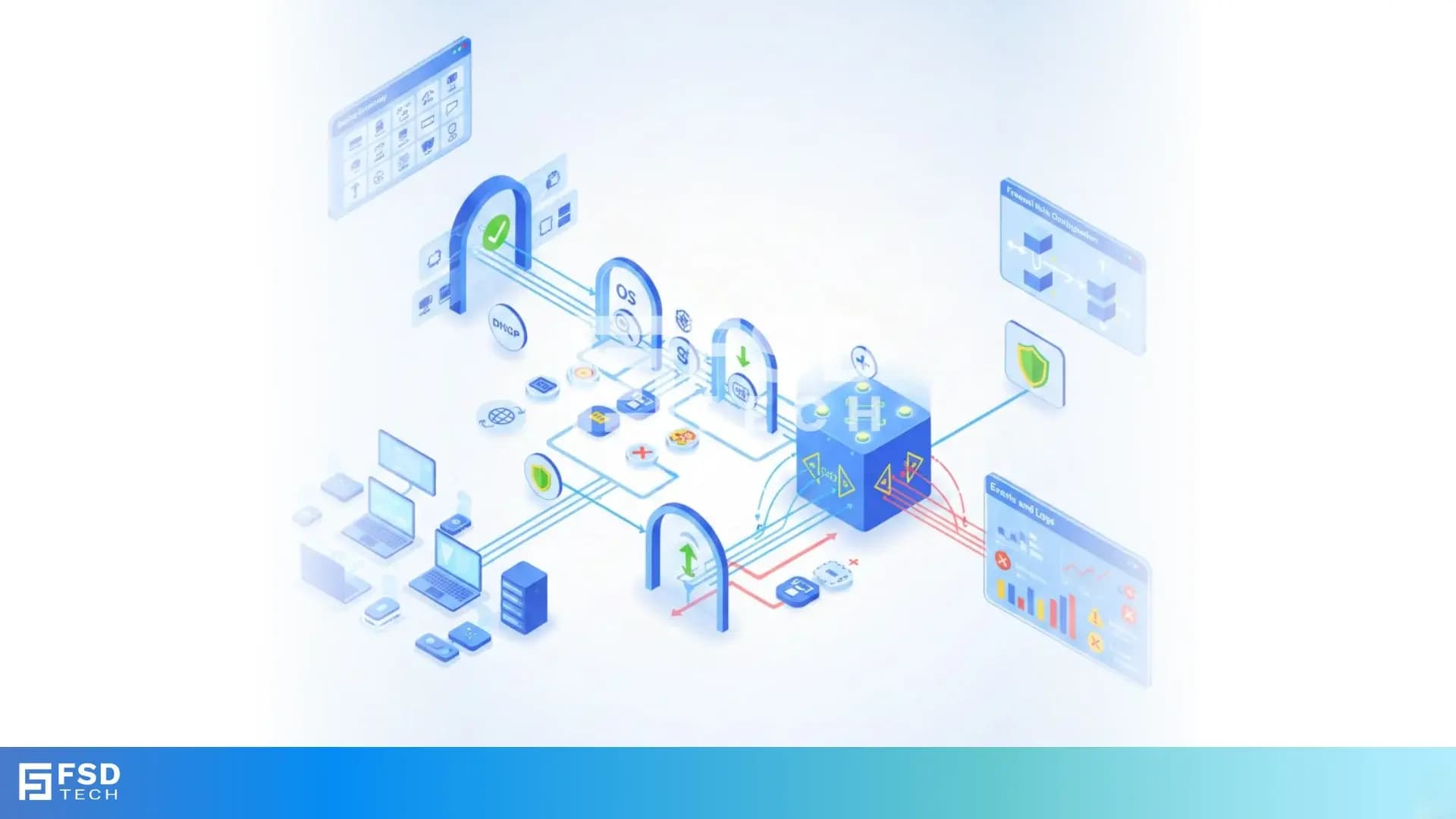
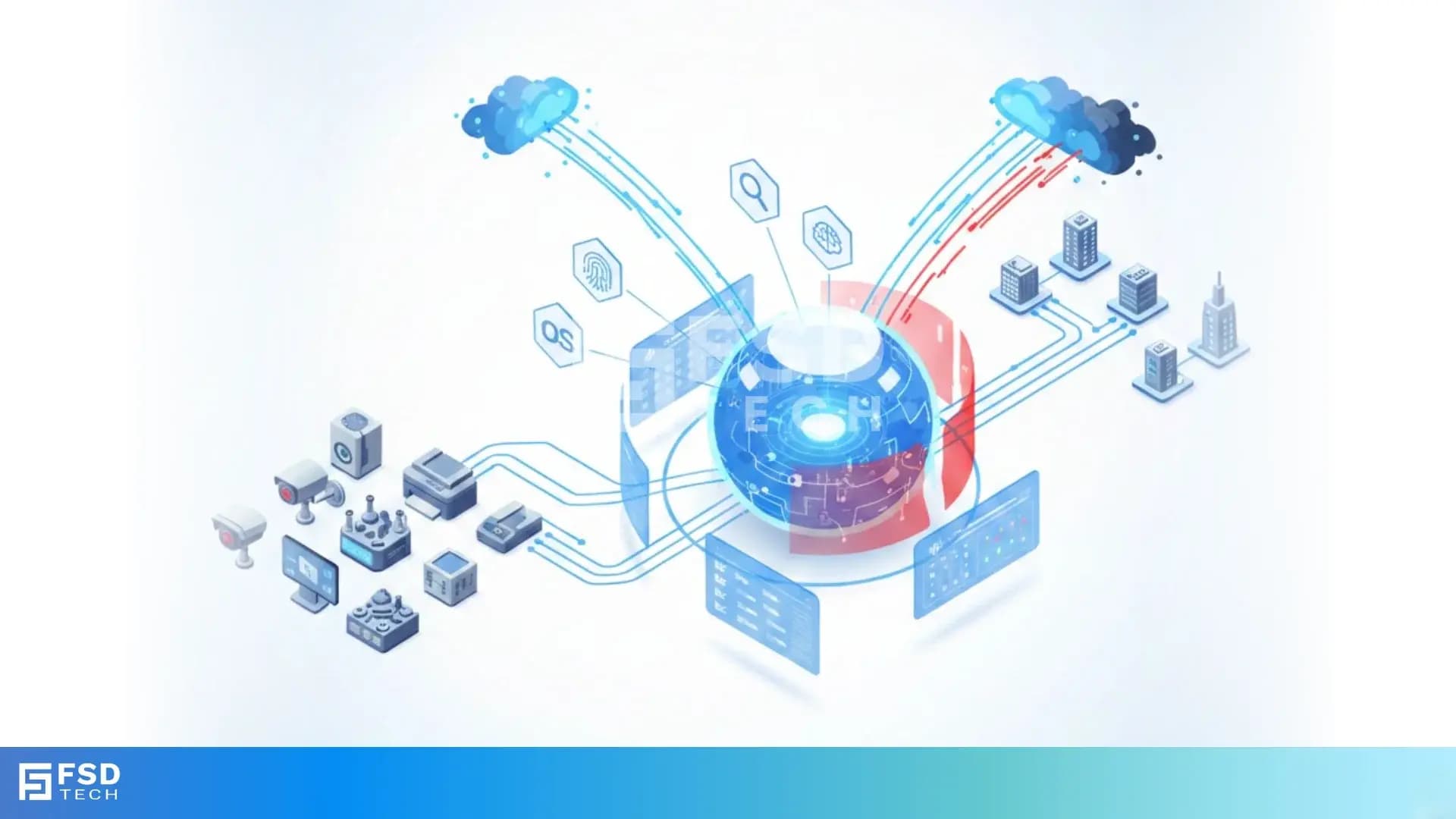
    Isometric illustration showing IoT devices routed through Cato Internet Firewall with device-aware policies blocking unauthorized external traffic, preventing botnet communication, malware callbacks, and data exfiltration in a unified SASE architecture.

    Why IoT Internet Exposure Is One of the Largest Enterprise Risks Today

    IoT devices were never designed with modern security architectures in mind. Cameras, sensors, smart controllers, building management systems, and industrial gateways often require limited connectivity to function - yet in many networks, they end up with far broader internet access than necessary.

    This overexposure dramatically increases the enterprise attack surface.


    Traditional firewalls struggle to address this problem because they rely on static IP addresses, VLANs, and network zones - all of which break down quickly in environments where IoT devices are numerous, distributed, and difficult to manage.


    Cato SASE approaches IoT internet security differently.
    Instead of protecting networks, Cato protects devices and their behavior, enforcing internet access policies through the Cato Internet Firewall using device identity and context rather than fragile network constructs.


    What “Reducing IoT Attack Surface” Really Means in Practice

    Reducing attack surface is not about blocking everything blindly. In real environments, IoT devices may need:

    • Limited outbound access to vendor update servers
    • Connectivity to specific cloud services
    • Restricted communication for telemetry or management

    The risk emerges when devices are allowed to:

    • Reach unrestricted internet destinations
    • Communicate with unnecessary SaaS categories
    • Download updates or firmware from unverified sources
    • Become entry points for malware, botnets, or lateral attacks
       

    Cato Internet Firewall policies allow organizations to explicitly define what IoT devices are allowed to access - and just as importantly, what they are not.


    How the Cato Internet Firewall Applies Device-Aware Control to IoT Traffic

    The Cato Internet Firewall enforces north–south traffic control—traffic flowing between devices and the internet.

    Unlike legacy firewalls, Cato policies can reference device identity, powered by the Device Inventory engine, rather than IP-based segmentation.

    Using officially documented capabilities, organizations can build policies based on:

    • Device category (e.g., IoT, OT, IT)
    • Device type (e.g., camera, printer, sensor)
    • Manufacturer or model (when identified)
    • Device operating system (when available)

    These attributes allow security teams to apply internet access rules directly to devices, regardless of where they are deployed.


    Common IoT Internet Exposure Patterns and How Cato Addresses Them

    Blocking Unnecessary Internet Access for OT Systems

    Many OT devices do not require any direct internet connectivity. With Cato Internet Firewall policies, organizations can:

    • Explicitly deny all internet traffic for OT device categories
    • Prevent accidental exposure caused by misconfigurations
    • Ensure OT systems communicate only internally through controlled WAN paths

    This significantly reduces the risk of external exploitation or command-and-control communication.


    Restricting IoT Devices to Approved Internet Destinations

    Some IoT devices legitimately require internet access - but only to specific destinations.

    Cato Internet Firewall rules allow enterprises to:

    • Permit access only to specific application categories
    • Restrict traffic to approved cloud services
    • Block high-risk categories such as anonymizers, file-sharing, or unknown destinations

    By enforcing least-privilege internet access, Cato ensures IoT devices cannot be abused beyond their operational purpose.


    Preventing IoT Devices from Becoming Malware Launch Points

    IoT botnets often rely on outbound internet connectivity to:

    • Receive commands
    • Exfiltrate data
    • Participate in distributed attacks

    Cato Internet Firewall enforcement blocks these behaviors by default when devices attempt to reach disallowed destinations - effectively neutralizing compromised devices without requiring endpoint agents.


    Why Device-Aware Internet Firewalling Is Superior to Network-Based Controls

    Traditional firewall models assume:

    • Devices stay in fixed locations
    • IP addressing is predictable
    • Segmentation can be maintained indefinitely

    IoT environments break all three assumptions.

    Cato SASE eliminates this fragility by:

    • Identifying devices dynamically
    • Applying policies based on device identity
    • Enforcing rules globally across all sites

    Once an IoT internet policy is defined, it applies everywhere - without redesigning networks or maintaining complex rule sprawl.


    Operational Visibility and Enforcement Confidence

    Reduccing attack surface is only effective if security teams can verify enforcement.

    Cato provides visibility through:

    • Internet Firewall event logs
    • Device Inventory views showing affected devices
    • Security dashboards highlighting blocked activity

    This allows teams to:

    • Confirm policies are working as intended
    • Identify misclassified or newly discovered devices
    • Adjust policies safely without disrupting operations


    Strategic Value: Why This Matters Beyond Security

    Reducing IoT attack surface with Cato Internet Firewall policies delivers benefits beyond risk reduction:

    • Lower incident response costs by preventing attacks before they start
    • Simplified compliance narratives through consistent, auditable controls
    • Operational stability by preventing unauthorized updates or connections
    • Scalability as IoT deployments grow across sites and regions

    Most importantly, it allows organizations to secure IoT environments without slowing down business operations.


    Need help designing device-aware Internet Firewall policies for IoT environments?
     

    Schedule your 30-minute Zero Trust consultation today.


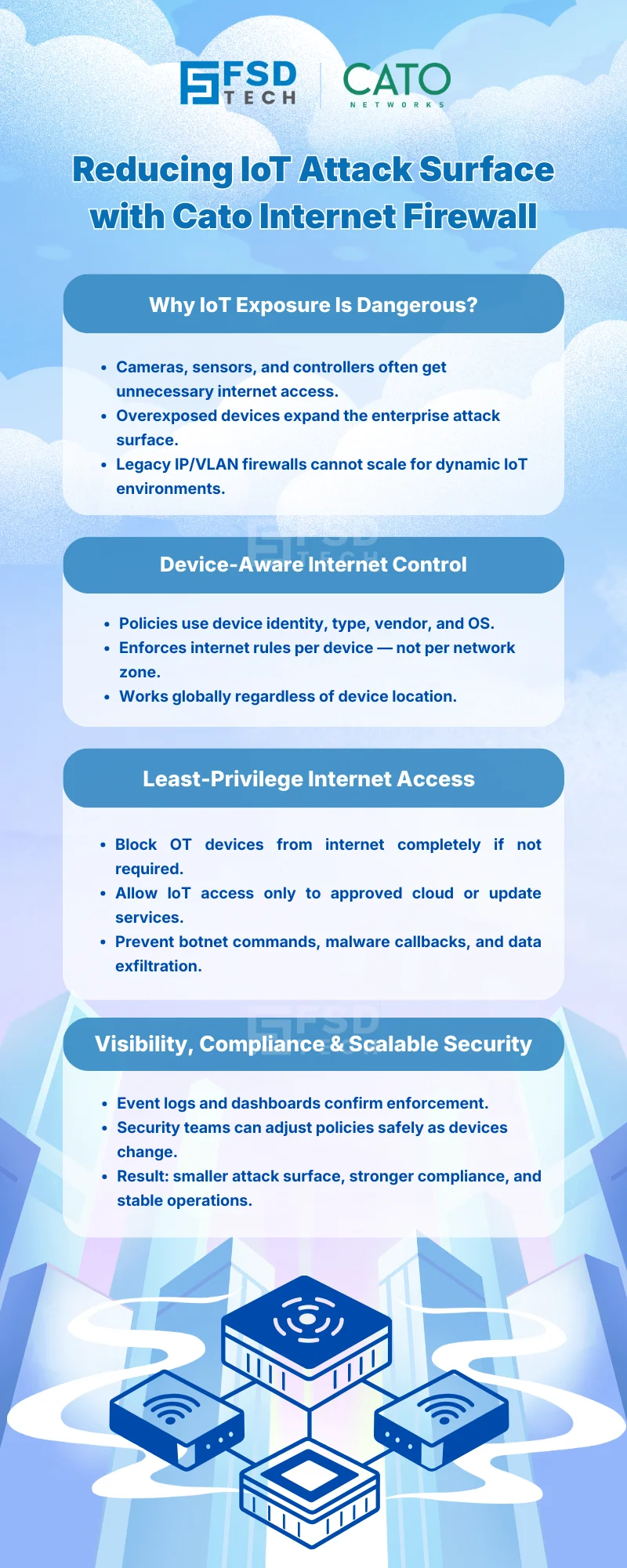
    Infographic titled “Reducing IoT Attack Surface with Cato Internet Firewall,” explaining how device-aware internet policies enforce least-privilege access, restrict unnecessary IoT exposure, and reduce enterprise attack surface through centralized Cato SASE enforcement.


    FAQs: Reducing IoT Attack Surface with Cato Internet Firewall Policies


    How does Cato SASE reduce IoT attack surface using the Internet Firewall?

    Cato SASE reduces IoT attack surface by enforcing device-aware Internet Firewall policies that limit outbound internet access based on device identity. Instead of relying on IP-based rules, Cato applies policies using Device Inventory attributes to restrict unnecessary or risky internet communication from IoT devices.


    Can Cato Internet Firewall completely block internet access for OT devices?

    Yes. Cato Internet Firewall policies can explicitly deny all internet traffic for OT device categories. This ensures OT systems remain isolated from external networks while still allowing controlled internal communication through WAN Firewall rules.


    How does Cato SASE identify IoT devices for internet access control?

    Cato SASE identifies IoT devices using its Device Inventory engine, which analyzes network traffic patterns, MAC address data, and protocol behavior. Identified devices are categorized and can be referenced directly in Internet Firewall rules.


    Does Cato Internet Firewall prevent IoT malware from communicating externally?

    Yes. By blocking unauthorized outbound destinations and application categories, Cato Internet Firewall policies prevent compromised IoT devices from reaching command-and-control servers or participating in external attacks.


    Are IoT internet access policies enforced consistently across all sites in Cato SASE?

    Absolutely. Cato SASE enforces Internet Firewall policies globally. Once defined, IoT internet access rules apply uniformly across all sites, eliminating inconsistencies caused by local firewall configurations.


    What visibility does Cato provide into blocked IoT internet traffic?

    Cato provides visibility through firewall event logs, security dashboards, and Device Inventory views. Security teams can see which IoT devices attempted internet access, which policies were triggered, and how traffic was handled.


    Why is Cato Internet Firewall better than traditional firewalls for IoT security?

    Traditional firewalls rely on static network constructs that don’t scale well for IoT. Cato Internet Firewall uses identity- and device-aware enforcement, making it far more effective for dynamic, distributed IoT environments.


    Closing Perspective

    IoT security fails when devices are treated as anonymous network endpoints.

    Cato SASE changes the equation by treating every device as a policy object, enforcing precise internet access controls through the Cato Internet Firewall. By reducing unnecessary exposure, organizations dramatically shrink their attack surface without agents, without complex redesigns, and without operational friction.

    This is how modern enterprises secure IoT environments at scale.


    Reducing IoT Attack Surface with Cato Internet Firewall Policies

    About The Author

    Anas Abdu Rauf

    Anas is an Expert in Network and Security Infrastructure, With over seven years of industry experience, holding certifications Including CCIE- Enterprise, PCNSE, Cato SASE Expert, and Atera Certified Master. Anas provides his valuable insights and expertise to readers.

    TRY OUR PRODUCTS

    Like This Story?

    Share it with friends!

    Subscribe to our newsletter!

    FishOSCato SASEVembuXcitiumZeta HRMSAtera
    Isometric illustration of a centralized performance platform connected to analytics dashboards and team members, representing goal alignment, measurable outcomes, risk visibility, and strategic project tracking within ClickUp.

    How ClickUp Enables Outcome-Based Project Management (Not Just Task Tracking)

    🕓 February 15, 2026
    Isometric illustration of a centralized executive dashboard platform connected to analytics panels, performance charts, security indicators, and strategic milestones, representing real-time business visibility and decision control within ClickUp.

    Executive Visibility in ClickUp – How CXOs Gain Real-Time Control Without Micromanaging

    🕓 February 13, 2026

    Cato SASE Architecture

    Inside Cato’s SASE Architecture: A Blueprint for Modern Security

    🕓 January 26, 2025

    Workflow Automation(8)

    Workforce Automation(1)

    AI Project Management(1)

    HR Data Automation(1)

    RMM(2)

    IT Workflow Automation(1)

    GCC compliance(4)

    IT security(2)

    Payroll Integration(2)

    IT support automation(3)

    procurement automation(1)

    lost device management(1)

    IT Management(5)

    IoT Security(2)

    Cato XOps(2)

    IT compliance(4)

    Workflow Management(1)

    Task Automation(1)

    AI-powered cloud ops(1)

    OpenStack automation(1)

    Kubernetes lifecycle management(2)

    SMB Security(8)

    Data Security(1)

    MDR (Managed Detection & Response)(4)

    Atera Integrations(2)

    MSP Automation(3)

    XDR Security(2)

    Threat Detection & Response(1)

    Ransomware Defense(3)

    SMB Cyber Protection(1)

    HR Tech Solutions(1)

    Zero Trust Network Access(3)

    Zero Trust Security(2)

    Endpoint Management(1)

    SaaS Security(1)

    Payroll Automation(5)

    IT Monitoring(2)

    Xcitium EDR SOC(15)

    Ransomware Protection GCC(1)

    M&A IT Integration(1)

    Network Consolidation UAE(1)

    MSSP for SMBs(1)

    Managed EDR FSD-Tech(1)

    SMB Cybersecurity GCC(1)

    Ransomware Protection(3)

    Antivirus vs EDR(1)

    FSD-Tech MSSP(25)

    Cybersecurity GCC(13)

    Endpoint Security(1)

    Data Breach Costs(1)

    Endpoint Protection(1)

    SMB Cybersecurity(8)

    Managed Security Services(2)

    Xcitium EDR(30)

    Zero Dwell Containment(31)

    Cloud Backup(1)

    Hybrid Backup(1)

    Backup & Recovery(1)

    pointguard ai(4)

    vembu(9)

    SMB data protection(9)

    backup myths(1)

    disaster recovery myths(1)

    Disaster Recovery(4)

    Vembu BDR Suite(19)

    DataProtection(1)

    GCCBusiness(1)

    Secure Access Service Edge(4)

    Unified Network Management(1)

    GCC IT Solutions(1)

    GCC HR software(20)

    CC compliance(1)

    open banking(1)

    financial cybersecurity(2)

    Miradore EMM(15)

    Government Security(1)

    Cato SASE(9)

    Hybrid Learning(1)

    Cloud Security(9)

    GCC Education(1)

    Talent Development(1)

    AI Governance(4)

    AI Compliance(2)

    AI Cybersecurity(13)

    AI Risk Management(1)

    AI Security(2)

    Secure Remote Access(1)

    GCC business security(1)

    GCC network integration(1)

    compliance automation(5)

    GCC cybersecurity(3)

    education security(1)

    App management UAE(1)

    BYOD security Dubai(8)

    Miradore EMM Premium+(5)

    MiddleEast(1)

    HealthcareSecurity(1)

    Team Collaboration(1)

    IT automation(13)

    Zscaler(1)

    share your thoughts

    Isometric illustration showing IoT devices routed through Cato Internet Firewall with device-aware policies blocking unauthorized external traffic, preventing botnet communication, malware callbacks, and data exfiltration in a unified SASE architecture.

    Reducing IoT Attack Surface with Cato Internet Firewall Policies

    🕓 March 2, 2026

    Isometric illustration showing IoT and OT devices segmented through Cato WAN and Internet Firewalls, with centralized policy enforcement preventing lateral movement and controlling external traffic exposure in a unified SASE architecture.

    Segmenting IoT and OT Devices Using Cato WAN and Internet Firewalls

    🕓 March 1, 2026

    Isometric illustration showing a centralized security platform automatically discovering and classifying IoT and OT devices into a unified inventory, representing agentless device visibility and network-based discovery in Cato SASE.

    Cato IoT/OT Device Discovery: Securing What You Can’t Install Agents On

    🕓 February 26, 2026

    Decoded(136)

    Cyber Security(125)

    BCP / DR(22)

    Zeta HRMS(78)

    SASE(21)

    Automation(78)

    Next Gen IT-Infra(125)

    Monitoring & Management(77)

    ITSM(22)

    HRMS(21)

    Automation(24)