HomeNext Gen IT-InfraMonitoring & ManagementCyber SecurityBCP / DRAutomationDecoded
Next Gen IT-Infra
Cato’s SASE Supports Cybersecurity Skills Development

How Cato’s SASE Supports Cybersecurity Skills Development

🕓 April 8, 2025

How SASE Supports the Security Needs of SMBs

How SASE Supports the Security Needs of SMBs

🕓 February 9, 2025

Attack Surface Reduction with Cato’s SASE

Attack Surface Reduction with Cato’s SASE

🕓 February 10, 2025

SASE for Digital Transformation in UAE

SASE for Digital Transformation in UAE

🕓 February 8, 2025

Monitoring & Management
Understanding Atera’s SLA Management

Understanding Atera’s SLA Management

🕓 February 7, 2025

Cost-Performance Ratio: Finding the Right Balance in IT Management Networks

Cost-Performance Ratio: Finding the Right Balance in IT Management Networks

🕓 June 16, 2025

Customizing Atera with APIs

Customizing Atera with APIs

🕓 March 3, 2025

Power Up Your IT Team’s Strategy with Atera’s Communication Tools

Power Up Your IT Team’s Strategy with Atera’s Communication Tools

🕓 February 8, 2025

Cyber Security
Illustration of the Cato Cloud architecture showing its role in delivering SASE for secure, optimized global connectivity.

Understanding the Cato Cloud and Its Role in SASE

🕓 January 29, 2025

Isometric illustration of professionals managing network performance, bandwidth analytics, and cloud-based optimization around the Cato Networks platform, symbolizing bandwidth control and QoS visibility.

Mastering Bandwidth Control and QoS in Cato Networks

🕓 July 26, 2025

Global network backbone powering Cato SASE solution for secure, high-performance connectivity across regions.

Global Backbone: The Engine Powering Cato’s SASE Solution

🕓 January 30, 2025

Illustration of team analyzing application traffic and usage insights on a large laptop screen using Cato’s dashboard, surrounded by network and cloud icons.

Cato Networks Application Visibility | Monitoring & Control

🕓 July 27, 2025

BCP / DR
Illustration showing diverse business and IT professionals collaborating with cloud, backup, and security icons, representing Vembu use cases for SMBs, MSPs, and IT teams.

Who Uses Vembu? Real-World Use Cases for SMBs, MSPs & IT Teams

🕓 July 12, 2025

Graphic showcasing Vembu’s all-in-one backup and disaster recovery platform with icons for cloud, data protection, and business continuity for IT teams and SMBs.

What Is Vembu? A Deep Dive Into the All in One Backup & Disaster Recovery Platform

🕓 July 6, 2025

Illustration showing Vembu backup and disaster recovery system with cloud storage, server racks, analytics dashboard, and IT professionals managing data.

The Rising Cost of Data Loss: Why Backup Is No Longer Optional?

🕓 August 14, 2025

3D isometric illustration of cloud backup and data recovery infrastructure with laptop, data center stack, and digital business icons — FSD Tech

RPO & RTO: The Heart of Business Continuity

🕓 August 15, 2025

Automation
Cross-Functional Collaboration with ClickUp

Fostering Cross-Functional Collaboration with ClickUp for Multi-Departmental Projects

🕓 February 11, 2025

ClickUp Project Reporting

Revolutionizing Enterprise Reporting with ClickUp’s Advanced Analytics and Dashboards

🕓 June 16, 2025

ClickUp’s Design Collaboration and Asset Management Tools

Empowering Creative Teams with ClickUp’s Design Collaboration and Asset Management Tools

🕓 February 26, 2025

ClickUp Communication and Collaboration Tools

ClickUp Communication and Collaboration Tools: Empowering Remote Teams

🕓 March 12, 2025

Decoded
Multi-Factor Authentication (MFA)

Multi-Factor Authentication (MFA): All You Need to Know

🕓 December 7, 2025

L3 Switch

What Is an L3 Switch? L2 vs L3 & Why You Need Layer 3?

🕓 December 8, 2025

IPSec

IPSec Explained: Protocols, Modes, IKE & VPN Security

🕓 December 3, 2025

 Datagram Transport Layer Security (DTLS)

What is Datagram Transport Layer Security (DTLS)? How it works?

🕓 December 4, 2025

    Subscribe to our newsletter!

    About Us

    Follow Us

    Copyright © 2024 | Powered by 

    Atera

    (59)

    Cato Networks

    (131)

    ClickUp

    (78)

    FishOS

    (7)

    Miradore

    (21)

    PointGuard AI

    (9)

    Vembu

    (22)

    Xcitium

    (33)

    ZETA HRMS

    (79)

    Table of Contents

    Moving Beyond the Single Enterprise Perimeter Paradigm in 2026

    Surbhi Suhane
    March 31, 2026
    Comments
    Single Enterprise Perimeter Paradigm

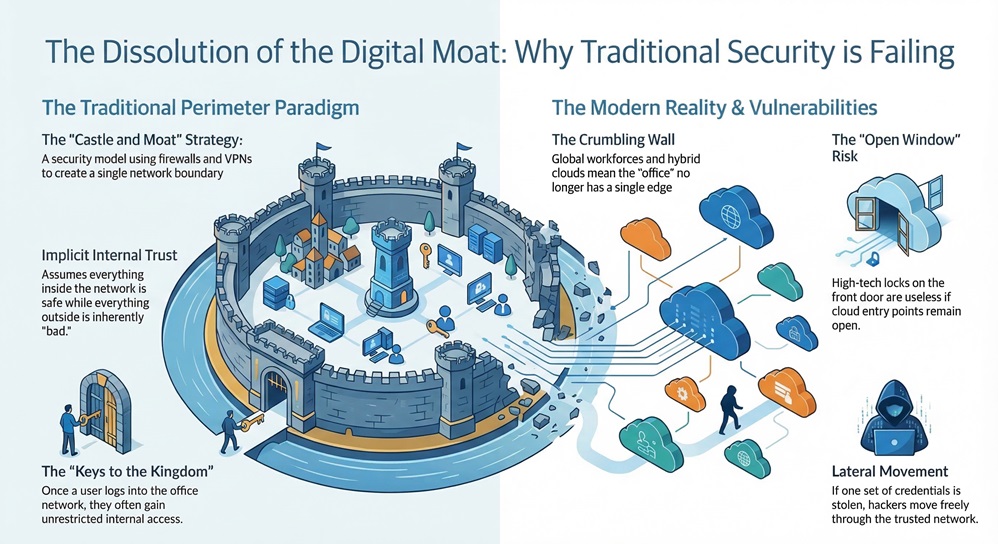
    In 2026, the way we protect our digital assets has shifted from building walls to verifying every single movement. The Single Enterprise Perimeter Paradigm refers to the traditional "castle and moat" strategy where we focused all our energy on securing the network edge. We've all been there: you log into the office network, and suddenly, you have the keys to the kingdom. But as our work moves to the cloud and our teams go remote, that old-school wall is crumbling.


    Here’s the thing—the world doesn't look like a single office anymore. We’re dealing with hybrid clouds, AI agents, and a workforce spread across the globe. To be honest, relying on one big perimeter in this day and age is a bit like putting a high-tech lock on your front door but leaving all the windows wide open.


    What Is the Single Enterprise Perimeter Paradigm?

    This security model assumes that everything inside your company network is "safe" and everything outside is "bad." It uses tools like firewalls and VPNs to create a boundary. If you are inside the perimeter, the system trusts you.


    Single Enterprise Perimeter Paradigm


    But wait, why is this a problem now? In my experience, the moment a hacker steals just one set of credentials, they can move through your entire system. This is called lateral movement. Since the paradigm assumes internal trust, there are very few checks once someone gets past the front gate.


    Upgrade Your Security


    The Shift From Perimeters to Zero Trust

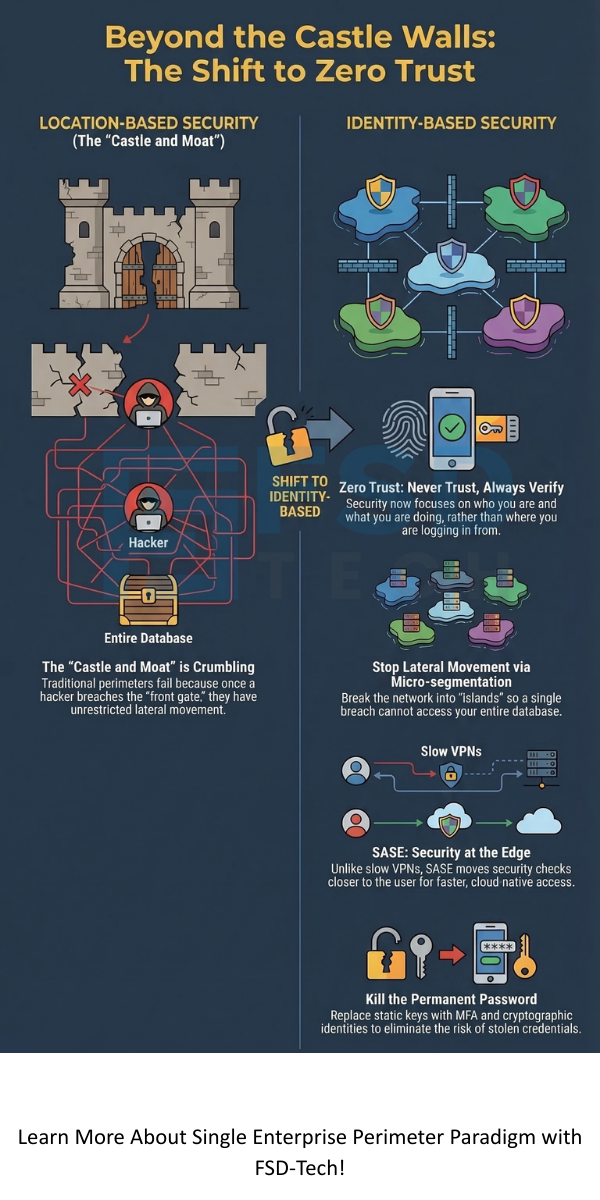
    The Single Enterprise Perimeter Paradigm is slowly being replaced by Zero Trust Architecture (ZTA). While the old way focused on where you were connecting from, the new way focuses on who you are and what you are doing.


    • Continuous Verification: We don't just check your ID once. We check it every time you try to access a new file.
    • Least Privilege: You only get access to what you absolutely need for your job.
    • Micro-segmentation: We break the network into tiny islands. Even if one island is taken, the rest stay safe.


    Picture this: in the old model, if a pirate boards your ship, they take the whole boat. In the new model, every room on the ship has its own biometric lock. One leak won't sink the whole vessel.


    Why the "Castle and Moat" Is Failing in 2026

    1. The Cloud Explosion: Most of your data isn't even in your office anymore. It's on AWS, Azure, or Google Cloud. You can't build a wall around something you don't physically own.
    2. Remote and Hybrid Work: We’re logging in from coffee shops and home Wi-Fi. The "perimeter" now exists wherever the employee is sitting.
    3. The Rise of AI Threats: Machine-speed attacks can bypass static firewalls in milliseconds. We need security that moves as fast as the code itself.


    Also Read: Advanced Posture in Cato Client: Continuous Compliance Without User Friction


    Comparing Modern Security Frameworks

    When we talk about moving away from a Single Enterprise Perimeter Paradigm, two names always come up: ZT and SASE.


    FeatureSingle Perimeter ParadigmZero Trust (ZT)SASE (Secure Access Service Edge)
    Trust ModelImplicit (Trust if inside)None (Never trust, always verify)Identity-centric & Context-aware
    Main ToolsFirewalls, VPNsMFA, Micro-segmentationSD-WAN, CASB, ZTNA
    LocationOn-premise / Data CenterDecoupled from locationCloud-native / At the edge
    Primary GoalKeep outsiders outStop lateral movementSecure access for the "everywhere" enterprise


    Have you ever wondered why your VPN feels so slow? That’s because the old paradigm often "backhauls" your traffic to a central data center before letting you go to the internet. It’s a massive bottleneck. Modern solutions like SASE fix this by moving the security check to the "edge"—closer to you.


    Get Your Zero Trust Roadmap


    How to Modernize Your Security Posture

    Moving away from the Single Enterprise Perimeter Paradigm isn't a "flip the switch" situation. It’s a journey. In our view, it starts with identity.


    1. Kill the Permanent Password

    Stop relying on static keys. Use Multi-Factor Authentication (MFA) as your baseline. In 2026, we're even seeing a shift toward "passwordless" cryptographic identities. It's much harder for a hacker to spoof a hardware key than to guess "Password123."


    2. Implement Micro-segmentation

    Don't let your guest Wi-Fi talk to your financial server. By creating small, isolated zones, you reduce the "blast radius" of any potential breach. If a developer's laptop gets hit with malware, the malware shouldn't be able to "see" the HR database.


    3. Focus on "Protect Surfaces"

    The old paradigm tried to defend the "Attack Surface," which is huge and always changing. Instead, identify your "Crown Jewels"—your most sensitive data and apps. Build your strongest defenses around them first.


    Also Read: Handling Unsupported or Legacy Clients in Cato Device Security Policies


    Conclusion

    At the end of the day, the Single Enterprise Perimeter Paradigm belonged to a simpler time. We've moved past the era of "set it and forget it" security. Today, your defense needs to be as dynamic as your business. We believe in building resilience that empowers your team to work from anywhere without fear.


    Our goal is to help you bridge the gap between legacy systems and the secure, cloud-first future. We don't just protect data; we protect the people and the innovation that drive your company forward.

    Single Enterprise Perimeter Paradigm


    Secure Your Perimeter Today


    Key Takeaways on Single Enterprise Perimeter Paradigm

    • The Single Enterprise Perimeter Paradigm is outdated because it assumes internal users are inherently safe.
    • Modern threats like credential theft and AI-driven attacks easily bypass traditional firewalls.
    • Zero Trust and SASE are the modern standards, focusing on identity and continuous verification rather than network location.
    • Micro-segmentation is the best way to stop "lateral movement" during a breach.
    • Security must now be cloud-native to support remote work and distributed data.


    Frequently Asked Questions about Single Enterprise Perimeter Paradigm

    Does Zero Trust replace the Single Enterprise Perimeter Paradigm entirely?

    Not exactly. You still need firewalls, but they are no longer your only line of defense. Think of it as adding internal security guards to a building that already has a front door lock.


    What is the biggest risk of staying with the old model?

    Lateral movement. If a hacker gets past the perimeter, they can roam free. Most major data breaches happen because the internal network was too "flat" and trusting.


    Is SASE just a fancy name for a VPN?

    Definitely not. While a VPN creates a tunnel to a network, SASE provides a whole suite of security (like ZTNA and Web Gateways) directly in the cloud. It’s faster and much more secure


    Moving Beyond the Single Enterprise Perimeter Paradigm in 2026

    About The Author

    Surbhi Suhane

    Surbhi Suhane is an experienced digital marketing and content specialist with deep expertise in Getting Things Done (GTD) methodology and process automation. Adept at optimizing workflows and leveraging automation tools to enhance productivity and deliver impactful results in content creation and SEO optimization.

    TRY OUR PRODUCTS

    Like This Story?

    Share it with friends!

    Subscribe to our newsletter!

    FishOSCato SASEVembuXcitiumZeta HRMSAtera
    Isometric illustration of a centralized performance platform connected to analytics dashboards and team members, representing goal alignment, measurable outcomes, risk visibility, and strategic project tracking within ClickUp.

    How ClickUp Enables Outcome-Based Project Management (Not Just Task Tracking)

    🕓 February 15, 2026
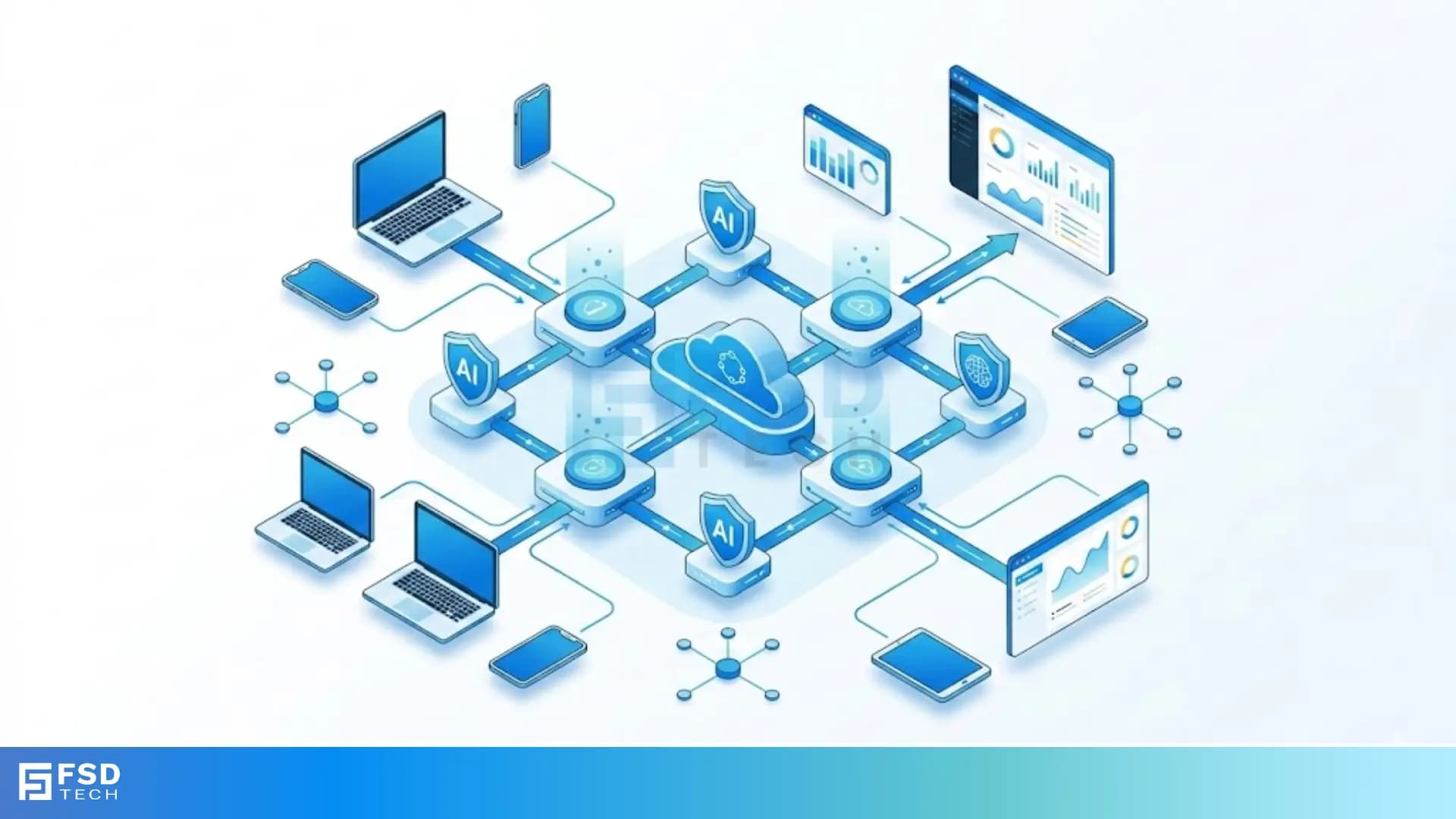
    Isometric illustration of a centralized executive dashboard platform connected to analytics panels, performance charts, security indicators, and strategic milestones, representing real-time business visibility and decision control within ClickUp.

    Executive Visibility in ClickUp – How CXOs Gain Real-Time Control Without Micromanaging

    🕓 February 13, 2026

    Cato SASE Architecture

    Inside Cato’s SASE Architecture: A Blueprint for Modern Security

    🕓 January 26, 2025

    Workflow Automation(8)

    Workforce Automation(1)

    AI Project Management(1)

    HR Data Automation(1)

    RMM(2)

    IT Workflow Automation(1)

    IT security(2)

    GCC compliance(4)

    Payroll Integration(2)

    IT support automation(3)

    procurement automation(1)

    lost device management(1)

    IT Management(5)

    IoT Security(3)

    Cato XOps(1)

    IT compliance(5)

    Task Automation(1)

    Workflow Management(1)

    Kubernetes lifecycle management(2)

    OpenStack automation(1)

    AI-powered cloud ops(1)

    SMB Security(8)

    Data Security(1)

    MDR (Managed Detection & Response)(3)

    MSP Automation(3)

    Atera Integrations(2)

    XDR Security(2)

    Threat Detection & Response(1)

    Ransomware Defense(3)

    SMB Cyber Protection(1)

    HR Tech Solutions(1)

    Zero Trust Network Access(3)

    Quantum Threat UAE & GCC(1)

    Post-Quantum Cryptography(1)

    Quantum Security(1)

    Zero Trust Security(2)

    Cloud IDE Security(1)

    Endpoint Management(1)

    SaaS Security(2)

    Payroll Automation(5)

    IT Monitoring(2)

    Xcitium EDR SOC(15)

    Ransomware Protection GCC(1)

    Network Consolidation UAE(1)

    M&A IT Integration(1)

    MSSP for SMBs(1)

    Antivirus vs EDR(1)

    Managed EDR FSD-Tech(1)

    FSD-Tech MSSP(25)

    Ransomware Protection(3)

    SMB Cybersecurity GCC(1)

    Endpoint Security(1)

    Cybersecurity GCC(15)

    Data Breach Costs(1)

    Endpoint Protection(1)

    SMB Cybersecurity(8)

    Managed Security Services(2)

    Xcitium EDR(30)

    Zero Dwell Containment(31)

    Hybrid Backup(1)

    Cloud Backup(1)

    Backup & Recovery(1)

    pointguard ai(4)

    vembu(9)

    SMB data protection(9)

    disaster recovery myths(1)

    backup myths(1)

    Disaster Recovery(4)

    Vembu BDR Suite(19)

    DataProtection(1)

    GCCBusiness(1)

    Secure Access Service Edge(4)

    Unified Network Management(1)

    GCC IT Solutions(1)

    GCC HR software(20)

    financial cybersecurity(2)

    open banking(1)

    CC compliance(1)

    Miradore EMM(15)

    Cato SASE(9)

    Government Security(1)

    GCC Education(1)

    Hybrid Learning(1)

    Cloud Security(9)

    Talent Development(1)

    AI Governance(4)

    AI Compliance(2)

    AI Security(2)

    AI Cybersecurity(13)

    AI Risk Management(1)

    Secure Remote Access(1)

    GCC business security(1)

    GCC network integration(1)

    compliance automation(5)

    education security(1)

    GCC cybersecurity(3)

    BYOD security Dubai(8)

    App management UAE(1)

    Miradore EMM Premium+(5)

    MiddleEast(1)

    share your thoughts

    Defense in Depth

    Defense in Depth: How to Layer Your Security Like a Pro

    🕓 March 31, 2026

    Single Enterprise Perimeter Paradigm

    Moving Beyond the Single Enterprise Perimeter Paradigm in 2026

    🕓 March 31, 2026

    Perimeter-less Securit

    What is Perimeter-less Security? SASE and Modern Networking

    🕓 March 30, 2026

    Decoded(181)

    Cyber Security(128)

    BCP / DR(22)

    Zeta HRMS(78)

    SASE(21)

    Automation(78)

    Next Gen IT-Infra(128)

    Monitoring & Management(80)

    ITSM(22)

    HRMS(21)

    Automation(24)