.webp&w=3840&q=75)
How ClickUp Enables Outcome-Based Project Management (Not Just Task Tracking)
🕓 February 15, 2026
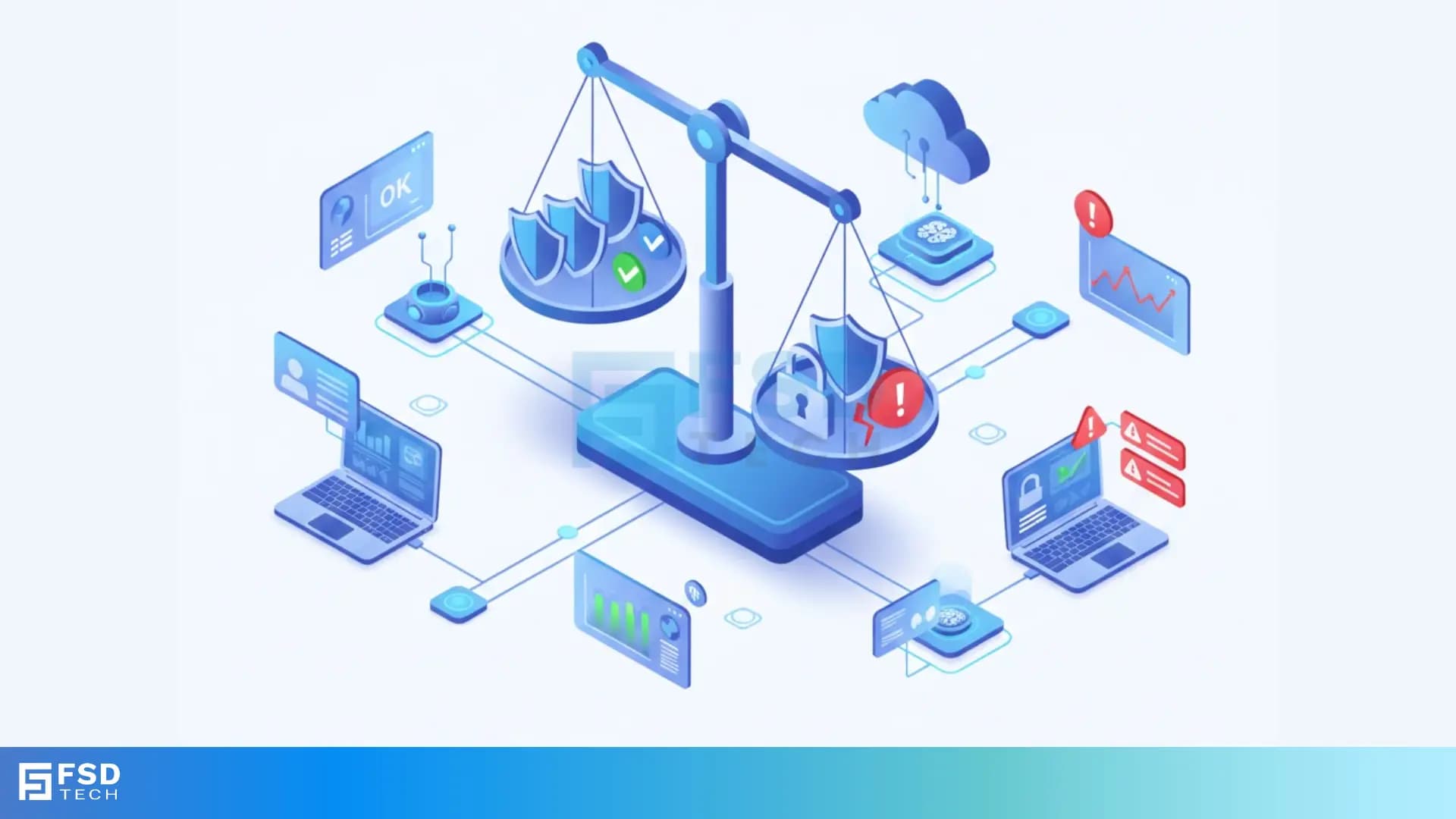
Security posture refers to the collective strength of your organization’s entire cybersecurity defense system at any given moment. Think of it like a professional athlete’s physical condition. It isn’t just about having strong muscles; it’s about how well those muscles, your reflexes, and your strategy work together to win the game. In the digital world, your "muscles" are your firewalls and encryption, while your "strategy" includes your policies and how your team reacts to a breach.
Have you ever wondered if your company is actually safe, or if you’ve just been lucky so far? Many leaders feel like they're playing a high-stakes game of whack-a-mole with new threats. We've all seen the headlines about data leaks. It’s scary because even big companies with massive budgets get hit. But here is the secret: a great security posture isn't about being unhackable—because no one is. It is about how hard you are to hit and how fast you get back up.
Your security posture acts as the foundation for everything your business does online. If the foundation is shaky, your apps, customer data, and reputation are all at risk. In my experience, most companies wait for a "close call" before they take this seriously. Don't be that person.
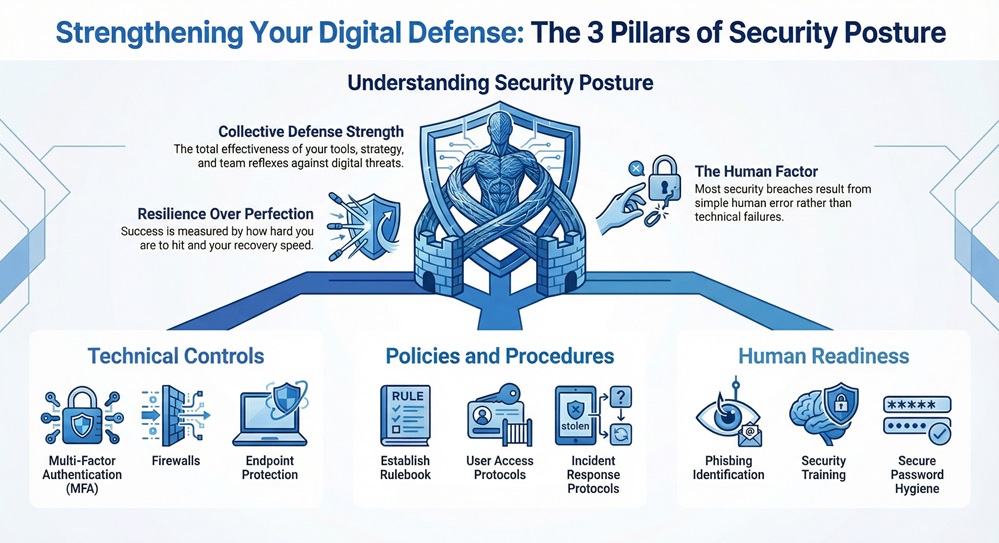
Today, hackers use AI to find tiny cracks in your system. If you aren't watching your security posture, you're basically leaving your front door unlocked in a bad neighborhood. It's not just about the technical stuff, either. It’s about people. Did you know that most breaches happen because of a simple human error? That is why a holistic approach is so vital.
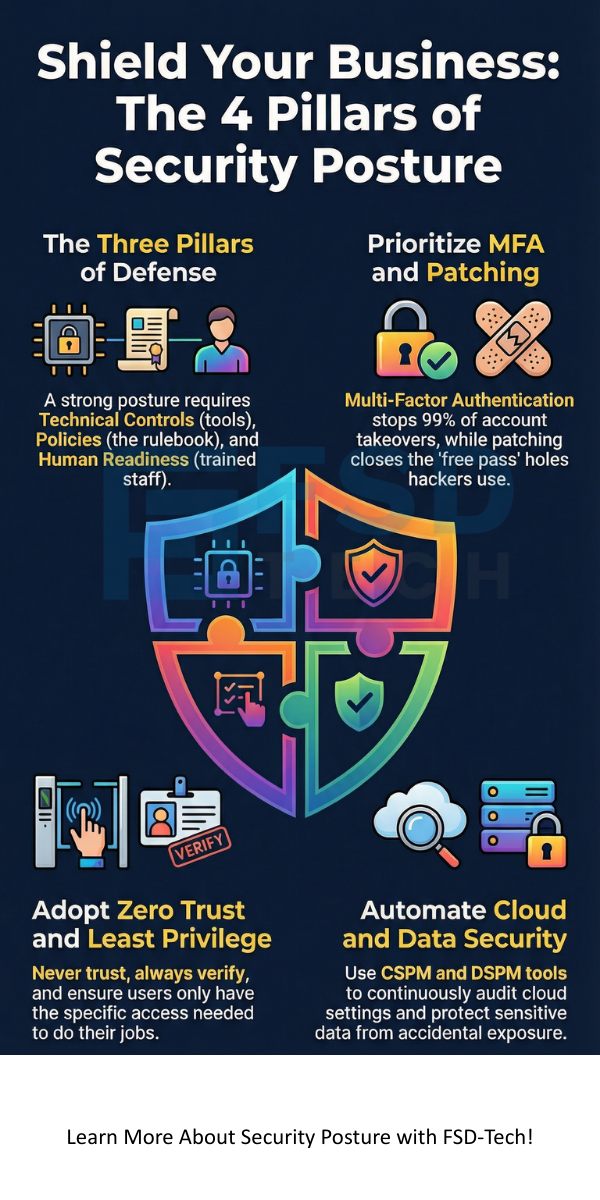
To build a better security posture, you need to look at three main areas. We call these the pillars of defense. If one is weak, the whole structure can fall.
You can't fix what you don't measure. Assessing your security posture is like getting a full medical check-up. It might be a bit uncomfortable to see the results, but it’s better than a heart attack later.
First, look at your inventory. Do you know every device connected to your network? Most IT managers I talk to are surprised to find "ghost" devices they forgot existed. Next, run a vulnerability scan. This tool looks for known weaknesses in your software.
Also Read: How Remote Browser Isolation Protects Your Team from Web Threats?
In many cases, the biggest gap is "Configuration Drift." This happens when you set up a server perfectly, but over time, people change settings to make things "easier." Suddenly, you have a gaping hole in your security posture.
Another big one is over-privileged users. Does the intern really need access to the financial records? Probably not. We use the "Principle of Least Privilege" (PoLP) to solve this. It means people only get the access they need to do their job—nothing more.
Improving your security posture doesn't have to happen overnight. In fact, it shouldn't. If you change everything at once, your team will revolt because they can't get their work done.
Step 1: Patch Management
It sounds boring, but keeping software updated is the easiest way to boost your security posture. Most attacks target old bugs that companies already released fixes for. If you don't patch, you're giving hackers a free pass.
Step 2: Implement Zero Trust
The old way was "trust but verify." The new way is "never trust, always verify." A Zero Trust Architecture (ZTA) assumes the threat is already inside. It requires every user and device to prove who they are every time they want access. This is a game-changer for your security posture.
Step 3: Monitor Everything
You need eyes on your network 24/7. This is where Security Operations Centers (SOC) come in. They use tools to watch for weird behavior, like someone logging in from a different country at 3 AM.
As we move more stuff to the cloud, Data Security Posture Management (DSPM) has become a hot topic. It's not enough to secure the network; you have to secure the data itself.
Think about where your sensitive data lives. Is it in a spreadsheet on a salesperson's desktop? Is it in an unencrypted S3 bucket? Data Security Posture Management helps you find that data, classify it, and make sure it's wrapped in the right protection. We've seen cases where companies didn't even know they were storing old credit card info until a DSPM tool flagged it.
If you use AWS, Azure, or Google Cloud, you need Cloud Security Posture Management (CSPM). The cloud is great, but it's easy to misconfigure. One wrong click can make your private database public.
CSPM tools act like a continuous auditor. They check your cloud settings against best practices and alert you the second something looks wrong. This automation is essential because the cloud moves too fast for humans to check manually.
Also Read: What is Managed Detection and Response (MDR)?
What does a "good" security posture actually look like in practice? To be honest, it looks like a culture of safety.
You can track your progress using a "Security Rating." Several companies provide a score, much like a credit score, for your security posture. While not perfect, it gives you a benchmark to show your board of directors that the investment is working.
At the end of the day, your security posture tells the world how much you value your customers' trust. We've all been there—staring at a complex report and wondering where to start. The trick is to just start. Pick one thing, like enabling MFA, and do it today.
At our core, we believe that security should empower your business, not slow it down. We're dedicated to helping our clients build a future where they can innovate without fear. Your safety is our mission, and we're here to help you every step of the way.
Ready to see where you stand?
What is the difference between security posture and security strategy?
Strategy is your long-term plan (the "where we want to go"), while security posture is your current state (the "where we are now"). You need the strategy to improve the posture.
How often should we assess our security posture?
Ideally, it should be continuous. However, a deep-dive assessment should happen at least once a quarter or after any major change to your network.
Is security posture only for large enterprises?
Absolutely not. Small businesses are often preferred targets because they usually have a weaker security posture. It’s much easier for a hacker to rob ten small stores with no alarms than one big bank with guards.
Does insurance cover a poor security posture?
Cyber insurance providers now look at your security posture before they even give you a quote. If your posture is bad, they might deny you coverage or charge a massive premium.

Surbhi Suhane is an experienced digital marketing and content specialist with deep expertise in Getting Things Done (GTD) methodology and process automation. Adept at optimizing workflows and leveraging automation tools to enhance productivity and deliver impactful results in content creation and SEO optimization.
Share it with friends!




.webp&w=3840&q=75)


share your thoughts